

Can THC Drinks Help You Do Dry January? What the 2026 Survey Shows
A 2026 survey found THC drink users reported 3.35 weekly drinks, down from 7.02. Here is why that self-report cannot prove a Dry January swap works.

Professor High
Written by Professor High, our AI guide. See how we research and correct articles.
THC drinks are not a proven way to do Dry January: the main study is a 2026 survey in which cannabis users who started THC drinks reported 3.35 alcoholic drinks a week, down from 7.02, with no control group. That is a real and interesting signal. It is also one self-reported snapshot, and better-controlled studies of cannabis and drinking point in both directions. PubMed abstract
Here is the number worth sending to the friend who swears a seltzer swap “basically halves your drinking.” The drop from 7.02 to 3.35 is 3.67 drinks, or about 52% of the starting figure. But both numbers came from the same people filling out the same survey, remembering “before” and reporting “now.” Nobody was assigned to a THC drink, and nobody was followed as a comparison group. So the survey can show who reports drinking less. It cannot show the drink did the work.
Dry January 2027 starts in about nine weeks, and the swap pitch is already everywhere. Here in High School, we read the study behind the pitch. If you need the basics first, start with how THC drinks work.
Sources checked October 29, 2026.
Can THC drinks replace alcohol during Dry January?
Some people report that they do, but no trial has tested it. We found no randomized trial of THC drinks against placebo drinks on alcohol use, and no peer-reviewed study of cannabis use during an actual Dry January month. Not finding them is not proof they do not exist, but it means every claim you read rests on surveys, lab sessions with smoked cannabis, or daily-diary studies.
A survey tells you what people say happened. A lab trial tells you what happens in a two-hour session. A daily diary tells you what tends to happen on the same day. None of them alone answers “Will swapping to THC drinks help me drink less in January?”
What did the 2026 THC drink survey find?
The study is Kruger, Felicione and Kruger, “The Exploration of Cannabis Beverage Substitution for Alcohol: A Novel Harm Reduction Strategy,” in the Journal of Psychoactive Drugs (2026). It was an anonymous survey of 438 adults who had used cannabis in the past year. PubMed record The full paper sits behind a paywall, so the figures below come from the abstract and the University at Buffalo press release. ScienceDaily release
| What was measured | Result reported | Source |
|---|---|---|
| Respondents who used cannabis beverages | 33.6%, typically one per session | Abstract |
| Weekly alcoholic drinks, before vs. after starting THC drinks | 7.02 before, 3.35 after (self-reported) | Abstract |
| Binge drinking less than monthly or never | 47.2% before, 80.7% after | Abstract |
| Said they substitute cannabis for alcohol | 58.6% of beverage users vs. 47.2% of non-users | Abstract |
| Said they reduced or stopped drinking after starting THC drinks | 62.6% (61.5% reduced, 1.1% stopped) | Press release |
| Said they drank more | 3.3% | Press release |
| Respondents who drank alcohol at all | Nearly 56% | Press release |
| Beverage users who did not know the drink’s CBD content | 48% | Press release |
The authors wrote that the findings “suggest” support for substitution, and the press release called it a “small study.” Its headline, “cut their alcohol use nearly in half,” travels faster than the table.
One detail matters for reading every row: the abstract does not say how many people the before-and-after comparison covers. Only about 56% of the 438 drank alcohol, and only about a third used beverages. So “438 people cut their drinking” is not what the study says.
Why does 7.02 to 3.35 not prove THC drinks caused the drop?
Because the design cannot separate the drink from everything else that changed.
- No control group. People who did not start THC drinks were not tracked over the same period. Drinking often changes for reasons that have nothing to do with cannabis: a new job, a health scare, a resolution.
- One sitting, two memories. “Before” was recalled, not measured at the time. Recall of past drinking can drift, especially when a person now sees themselves as someone who cut back.
- Who answered. The press release says two licensed dispensaries in the Buffalo area helped distribute the survey. People reached through a dispensary are not a random slice of drinkers. That is our reading of the recruitment, not a limit the abstract states.
- Who joins Dry January. A 2020 cohort study found Dry January participants had higher alcohol-use scores and felt less control over their drinking than other adult drinkers. Benefits seen in people who completed the month were not seen in drinkers who did not take part. de Visser and Piper, 2020 People motivated enough to try a swap are already different from people who are not.
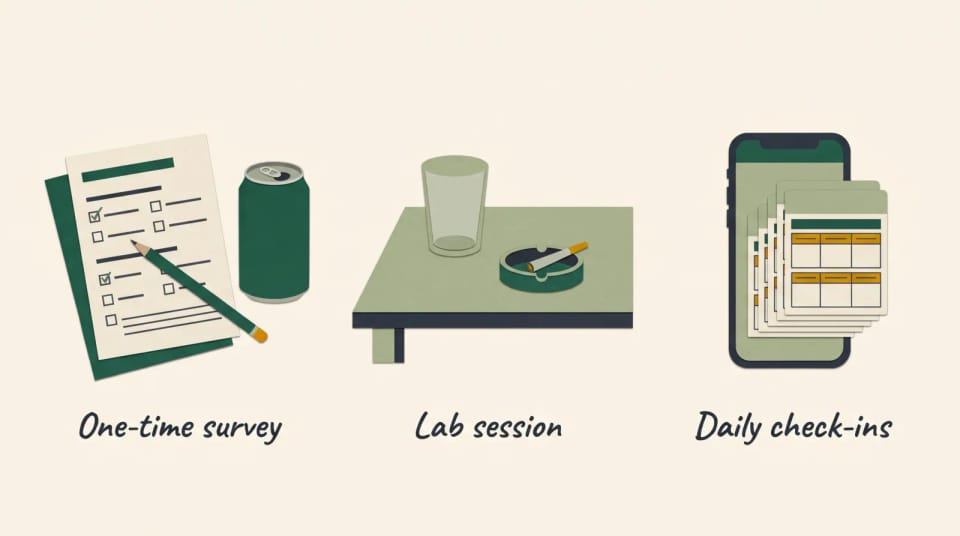
A survey, a lab session and a daily diary each measure something different. In current research they do not all point the same way.
What do lab and daily-life studies say about cannabis and drinking?
They point both ways, depending on who is studied and how.
The strongest design so far is a double-blind crossover trial with heavy drinkers who already used cannabis at least twice a week. After overnight abstinence, they smoked cannabis with 7.2%, 3.1% or 0.03% THC, then had two hours to choose alcohol. They drank 27% less after the 7.2% joint and 19% less after the 3.1% joint than after placebo. The main craving measure did not change significantly. Metrik et al., 2026 We walk through that design in the lab trial behind the 19% and 27% figures. It used smoked cannabis, not drinks, in short sessions, in people already using cannabis, so it says nothing direct about a month of THC seltzers.
A smaller lab study of 61 people who use both substances found fewer drinks after cannabis overall. But only a subgroup of 23 “substituters” showed lower craving; others drank about the same. Pince et al., 2025
Daily-life studies are less encouraging. In a 2026 study of 58 adults who used cannabis at least three times a week and were trying to quit or cut back on drinking, using cannabis in the moment came with higher odds of drinking at the same time (odds ratio 2.39). The authors concluded that cannabis “appears to be an obstacle” to reducing drinking. Wycoff et al., 2026 A Washington State panel study found recreational users drank more on cannabis days, while people with a medical recommendation may have substituted. Zhu et al., 2025
The reviews say the same thing at a larger scale. A systematic review of 65 articles found 30 supporting substitution, 17 supporting complementary use, 14 neither and 4 both, and called the evidence “mixed.” Risso et al., 2020 A 2022 review of 95 studies found “compelling evidence for both,” shaped by population, timing, formulation and context. Gunn et al., 2022
| Study type | Who | Cannabis form | What it found |
|---|---|---|---|
| One-time survey (Kruger 2026) | 438 past-year cannabis users | THC drinks | Beverage users reported drinking less after starting |
| Randomized lab trial (Metrik 2026) | Heavy drinkers who use cannabis | Smoked | Less alcohol chosen in a two-hour session |
| Daily diary (Wycoff 2026) | 58 adults trying to cut back | Any | Cannabis moments came with more drinking |
| Daily panel (Zhu 2025) | 259 Washington adults | Any | Recreational users drank more on cannabis days |
Does a THC drink count as Dry January?
That is your call, not a rule. Alcohol Change UK, the charity that runs Dry January, defines it as “one month alcohol-free.” Alcohol Change UK Its FAQ says nothing about cannabis or other substances. Dry January FAQ So no official source says a THC drink does or does not “count.”
A more useful question is what you want from the month. If the goal is a break from intoxication, a THC drink defeats it. If the goal is fewer alcoholic drinks, we do not yet know whether a swap helps most people.
What Dry January itself is associated with is better documented. In a French cohort of 1,886 participants, alcohol-use scores fell at three months and stayed lower at nine months, with only a modest rebound. Rolland et al., 2026 A 2025 scoping review found sustained reductions among people who abstained, but noted that nearly all the research comes from the UK and that more rigorous studies are needed. Strowger et al., 2025 Those studies are observational too, and they are about stopping alcohol, not replacing it.
What are the risks of swapping alcohol for THC drinks?
A THC drink is an intoxicant, not a mocktail. A review of cannabis-infused beverage research found reports of unpleasant acute effects in healthy, infrequent users, and labels that did not always match what was in the drink. Froude et al., 2024 Some drinks use emulsions that can change how fast THC arrives; see why nano-emulsified drinks can hit faster than gummies and how long the effects can last.
Driving. The Colorado Department of Transportation notes that trading cannabis for alcohol during Dry January is common, and warns that cannabis impairment “can last up to eight hours.” CDOT Treat that as a caution, not a clearance time. Our guide on how long to wait before driving explains why no single number works.
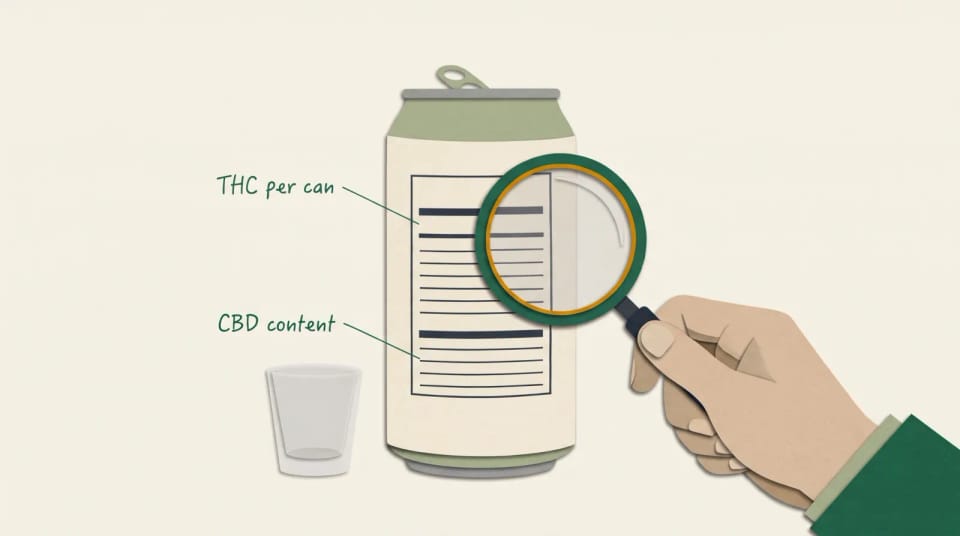
Nearly half of beverage users in the 2026 survey did not know their drink’s CBD content, and a review found labels do not always match contents. Read the panel, then treat it as a claim.
Mixing. A swap that turns into “a seltzer plus a couple of beers” is crossfading. Here is what happens when you mix them.
Trading one habit for another. Daily use of any intoxicant can become its own problem. Our explainer on dependence and where to get help covers the signs.
If you do try THC drinks in January, the High IQ app can log what you had and how it felt. That is a personal record, not proof the swap works.
When to talk to a clinician
Talk to a doctor before Dry January if you drink heavily most days, get shaky, sweaty or anxious when you skip a drink, or have ever had withdrawal symptoms. Alcohol Change UK warns that people who are clinically dependent on alcohol can be in danger if they suddenly stop drinking completely, and advises seeing a GP first. Alcohol Change UK THC drinks are not a treatment for alcohol dependence, and this article is not medical advice.
Will hemp THC drinks still be on shelves in January?
Possibly not where you buy them now. Under the new federal hemp definition, final hemp-derived cannabinoid products with more than 0.4 mg of total THC per container are excluded from “hemp,” and the effective date for most of that change is December 11, 2026, according to the Congressional Research Service. CRS IF13136 Further bills are pending, so that date can still move. Our guide to the 0.4 mg cap tracks the details. Drinks sold in state-licensed dispensaries follow your state’s cannabis law instead.
Sources
- Kruger JS, Felicione N, Kruger DJ. The Exploration of Cannabis Beverage Substitution for Alcohol. Journal of Psychoactive Drugs, 2026. Abstract only; full text paywalled.
- University at Buffalo. People who switched to cannabis drinks cut their alcohol use nearly in half. ScienceDaily, 2026.
- Metrik J et al. Acute Effects of Cannabis on Alcohol Craving and Consumption. American Journal of Psychiatry, 2026.
- Pince CL et al. Cannabis administration is associated with reduced alcohol consumption. Drug and Alcohol Dependence, 2025.
- Wycoff AM et al. Momentary cannabis effects on alcohol use among adults trying to quit or cut back. Psychology of Addictive Behaviors, 2026.
- Zhu Y et al. Does cannabis substitute or complement alcohol after legalization in Washington State? Addictive Behaviors, 2025.
- Risso C et al. Does cannabis complement or substitute alcohol consumption? Journal of Psychopharmacology, 2020.
- Gunn RL et al. Patterns of Cannabis and Alcohol Co-Use. Alcohol Research: Current Reviews, 2022.
- de Visser RO, Piper R. Benefits of Dry January are not also observed among other drinkers. Alcohol and Alcoholism, 2020.
- Rolland B et al. Change in alcohol consumption among French adults participating in Dry January. International Journal of Drug Policy, 2026.
- Strowger M et al. A scoping review of Dry January. Alcohol and Alcoholism, 2025.
- Froude AM et al. Potential Risks from Cannabis-Infused Beverages. Cannabis, 2024.
- Colorado Department of Transportation. Dry January: A sobering perspective on safe choices.
- Alcohol Change UK. The Dry January challenge and its FAQ.
- Congressional Research Service. Changes to the Statutory Definition of Hemp. IF13136, 2026.
Key takeaways
- The main THC-drink study is a one-time survey: beverage users reported 3.35 weekly drinks, down from 7.02, with no control group.
- That drop is about 52%, but it is self-reported and cannot show the drink caused it.
- Lab trials with smoked cannabis found less drinking in short sessions; daily-life studies of people trying to cut back found cannabis moments came with more drinking.
- No official Dry January rule covers cannabis. Whether a THC drink “counts” depends on your goal.
- THC drinks impair driving, and anyone who drinks heavily needs a clinician before stopping alcohol.
FAQ
Does Dry January include marijuana?
The official challenge is defined as one month alcohol-free, and the organizer’s FAQ says nothing about cannabis. Whether you include marijuana is your own rule. If your goal is a full break from intoxication, a THC drink works against it.
Can THC drinks help you drink less?
Some cannabis users report drinking less after starting THC drinks, but that comes from one self-reported survey with no control group. Other studies of people trying to cut back found cannabis use went with more drinking, not less. The evidence does not yet show that a swap helps most people.
Is a THC seltzer safer than a beer?
They carry different risks, so “safer” depends on the person and the amount. THC drinks are intoxicating, can impair driving for hours, and do not always match their labels. Neither is risk-free, and combining them adds the risks of both.
Can I use cannabis daily during Dry January?
You can, but daily use of any intoxicant can build tolerance and dependence, and research on people trying to cut back found cannabis days came with more drinking for some. If you drink heavily now, talk to a clinician before changing anything, because stopping alcohol suddenly can be dangerous.



