Are Hemp THC Drinks Being Banned? The 0.4 mg Cap Explained
The hemp THC drink ban sets a 0.4 mg total-THC cap per container on December 11, 2026. A labeled 10 mg seltzer is 25 times that line.

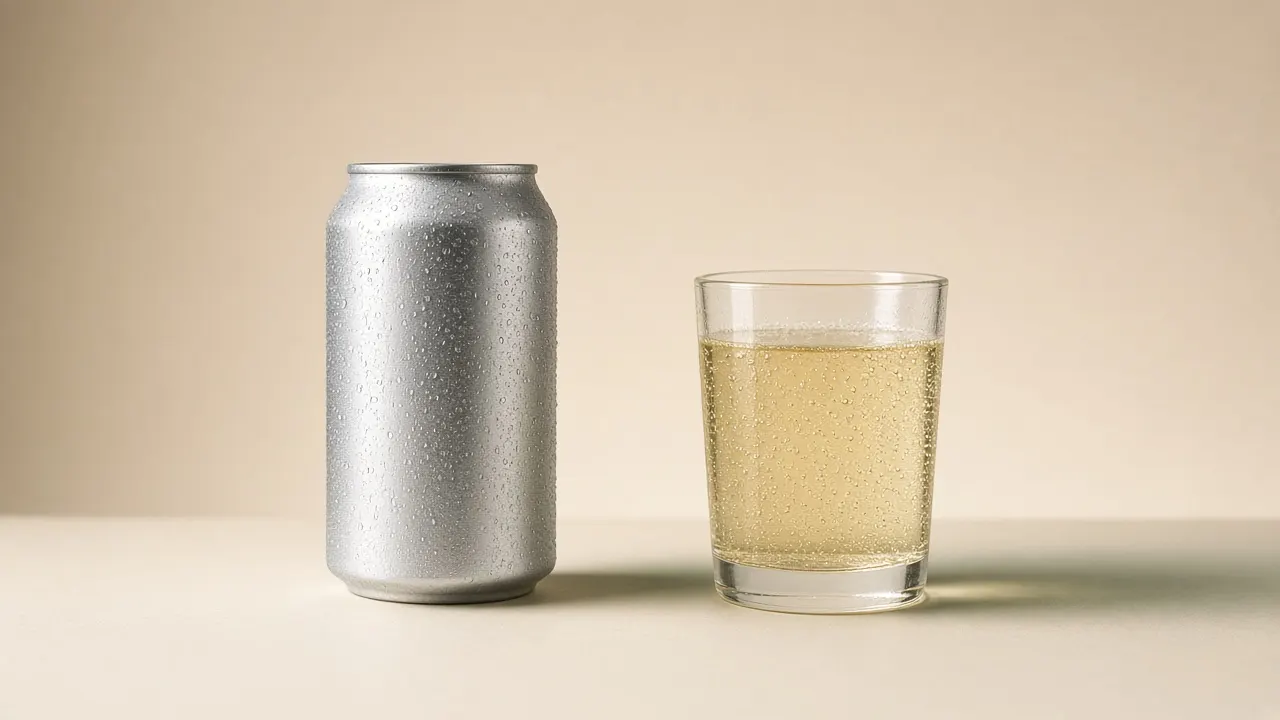
Most hemp THC drinks on sale today are scheduled to fall outside the federal definition of hemp on December 11, 2026, because a 10 mg can holds 25 times the new 0.4 mg per-container cap.
A standard 10 mg hemp THC seltzer holds 25 times the new federal 0.4 mg per-container limit. Minnesota law is the reason that 10 mg figure is a real legal ceiling, and the arithmetic is simple: 10 divided by 0.4 is 25. [Congress, 2025]
Last checked: October 8, 2026. This page is education. It is not legal advice. A lawyer in your state can tell you how the rule meets your shop, your license, or your cupboard. Bill status can move after this check.
The wider statute, including flower and synthesized cannabinoids, is in what the 2026 hemp law changes for consumers. This article stays on drinks, gummies, and the container math.
Will hemp THC drinks disappear on December 11, 2026?
Two dates are in the law. They do different jobs.
Public Law 119-37 was enacted on November 12, 2025. Section 781 rewrites the federal definition of hemp in the Agricultural Marketing Act. Its own text says the rewrite is effective 365 days after enactment. That calendar day is November 12, 2026. [Congress, 2025]
Public Law 119-103 was signed on September 2, 2026. Section 2019 then limits which pieces of that rewrite apply before December 11, 2026. Until that later date, the amendments apply only to products described in two clauses: intermediate products, and final products, that contain a cannabinoid “not capable of being naturally produced” by a Cannabis sativa L. plant. [Congress, 2026]
The 0.4 milligram cap lives in a different clause. It is paragraph (1)(C)(iv)(III). Section 2019 does not put that clause on the early list.
So a drink made with cannabinoids the plant can produce, such as delta-9 THC or CBD, meets the container cap on December 11, 2026. A product that contains a cannabinoid the plant cannot naturally produce is on the November 12, 2026 track. Congressional Research Service In Focus IF13136, updated September 28, 2026, says those excluded products are to be classified as marijuana under the Controlled Substances Act starting November 12, 2026. The other portions of the new definition, including the container cap, wait until December 11, 2026.
Which molecule sits in which bucket is partly what an FDA list was supposed to settle. Section 781 told FDA to publish, within 90 days of enactment, lists of cannabinoids known to be naturally produced, THC-class cannabinoids known to occur in the plant, and other cannabinoids with similar effects. It also asked for more specificity about the word “container.” CRS reported on September 28, 2026 that those lists had not been published. On October 8, 2026, the FDA page “FDA Regulation of Cannabis and Cannabis-Derived Products, Including Cannabidiol (CBD)” still described the 2018 Farm Bill definition. It did not post the section 781 lists.
A shopper cannot treat every can as a December 11 product, and cannot treat every can as a November 12 product. The ingredient decides the date. The milligrams decide whether the December rule reaches it.
Minnesota’s Office of Cannabis Management told licensees on September 3, 2026 that the federal change “effectively bans hemp products containing more than 0.4 milligrams (mg) of THC per package” and “will now take effect on Dec. 11, 2026, unless other federal action occurs.” That is a regulator’s summary. The statute’s own words are narrower and more exact: a final hemp-derived cannabinoid product is excluded when it contains “greater than 0.4 milligrams combined total per container.”
Why is the limit 0.4 mg per container?
The old federal hemp test was a percentage. Hemp could contain not more than 0.3 percent delta-9 THC on a dry-weight basis. A heavy edible can hold many milligrams and still look small as a percent of its weight.
A 2026 study checked whether labeled delta-9 THC edibles marketed as hemp could even be made from material that stayed under that 0.3 percent line. Rossheim and colleagues looked at online products from October 2025 through February 2026. They used labels and lab reports. They did not run a new chemical assay. On their main test, 80 percent of products would have needed more cannabis than the edible’s non-sugar mass (95 percent confidence interval 72 to 88 percent; n = 297). The median product needed cannabis equal to 160 percent of that available mass. On a stricter test that used the whole product mass, 2 percent still failed (95 percent confidence interval 0 to 4 percent; n = 380). Rossheim et al., 2026
That paper is about the old percent rule. It is also why a milligram cap changes the drink aisle. A can of water is heavy. A few milligrams of THC are a tiny percent of that weight. The percent test let the category grow. The container test counts the milligrams you buy. The Research Hub page on hemp-labeled THC edibles and the marijuana line walks through the same study.
Section 781 sets the new finished-product line at greater than 0.4 milligrams combined total per container. The combined total has two parts. One part is total tetrahydrocannabinols, including THCA. The other part is any other cannabinoid that has similar effects, or is marketed as having similar effects, as determined by the Secretary of Health and Human Services. [Congress, 2025]
The word “greater than” matters. A product at exactly 0.4 milligrams is not over that clause. A product at 0.41 milligrams is.
“Per container” is doing as much work as the number. The statute defines container in paragraph (3)(C). It means “the innermost wrapping, packaging, or vessel in direct contact with a final hemp-derived cannabinoid product” enclosed for retail sale. The examples include a jar, bottle, bag, box, packet, can, carton, or cartridge.
Paragraph (3)(D) then excludes bulk shipping containers and outer wrappings that are not essential for the final retail sale to a person for personal or household use.
The law is measuring the vessel that touches the product. A sip is a different unit. A serving size on a label is a different unit too. How total THC differs from delta-9 is the companion explainer for the molecule side of that math.
How far over the cap is a 2, 5, 10, or 50 mg product?
Divide the labeled amount in one container by 0.4. The table uses the federal combined total, as if the whole labeled amount were the amount the statute counts. A real can can count higher than its delta-9 line, because the federal total includes THCA and similar-effect cannabinoids. Why a printed milligram can miss the batch is the reason to read the label as a claim, not as the lab’s last word.
| Amount in one container | Divided by 0.4 mg | Times the cap | Over the line? |
|---|---|---|---|
| 0.4 mg | 0.4 / 0.4 | 1 | No. The statute uses “greater than.” |
| 2 mg | 2 / 0.4 | 5 | Yes |
| 5 mg | 5 / 0.4 | 12.5 | Yes |
| 10 mg | 10 / 0.4 | 25 | Yes |
| 50 mg | 50 / 0.4 | 125 | Yes |
A standard 10 mg hemp THC seltzer holds 25 times the new federal 0.4 mg per-container limit. The 10 mg example comes from Minnesota, where a single beverage container of a lower-potency hemp edible must not contain more than ten milligrams of delta-9 THC. That is the text the Revisor of Statutes still displayed on October 8, 2026, in Minnesota Statutes section 342.62, subdivision 2. The same page carried a banner: subdivision 2 was amended by 2026 Minnesota Laws chapter 123, section 107. The session law changes “single” to “single-serving” and keeps the ten-milligram delta-9 ceiling for that single-serving can.
Minnesota is measuring delta-9. The federal cap is the broader combined total. A can labeled 10 mg delta-9 can sit even farther over the federal line once THCA and similar-effect cannabinoids are added in.
The same arithmetic covers the other rows. A 2 mg container is 5 times the cap. A 5 mg container is 12.5 times the cap. A 50 mg container is 125 times the cap. Each of those amounts is greater than 0.4 mg, so each one fails the finished-product clause on its own.
Does a four-pack count as one container?
The can is the usual answer. Liquid sits against the inside of the can. That can is the innermost vessel in direct contact with the product. An outer carton that holds four of those cans is an outer wrapping under paragraph (3)(D), unless the carton itself is the innermost vessel touching the drink.
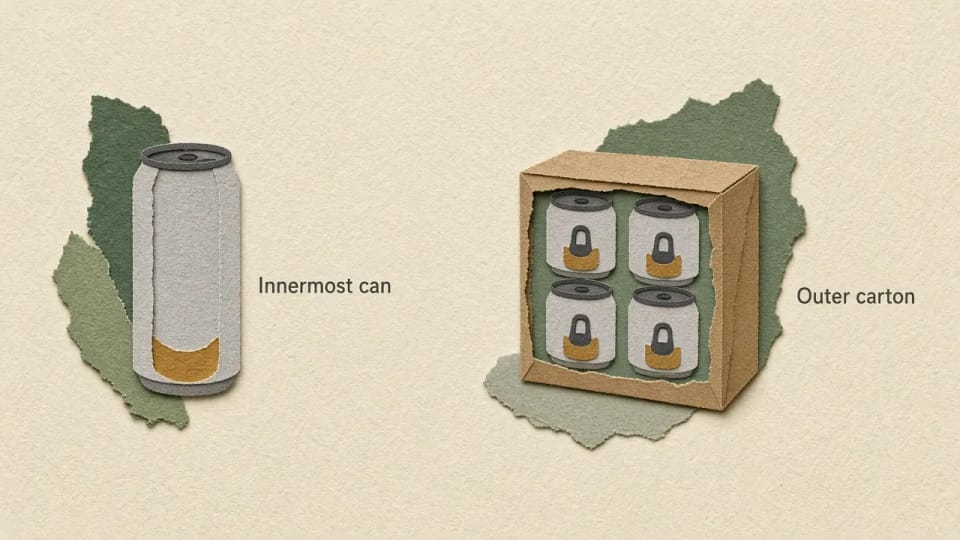
The statute measures the innermost vessel that touches the product. An outer carton counts as the container only when that carton is itself the vessel in direct contact. FDA was told to add more specificity about “container,” and that guidance was not on the FDA cannabis page when this article was checked.
A four-pack of 5 mg cans is four containers of 5 mg if each can touches its own liquid. It is not one container of 20 mg. Each can is still 12.5 times the cap.
A bag of gummies works the other way. The gummies share one bag. The bag is the innermost wrapping. The milligrams add up. Ten gummies at 5 mg each put 50 mg in that bag. The bag is 125 times the 0.4 mg line.
A multi-serve bottle is one container too. Minnesota’s 2026 session law shows how large that bottle can be under state rules. Chapter 123, section 107, says a multi-serving lower-potency hemp beverage in a resealable child-resistant container must hold at least 750 milliliters, must stay at or under five milligrams of delta-9 THC per serving, and must stay at or under 17 servings. A bottle that used both ceilings would hold 85 mg of delta-9 THC. That is 5 times 17. It is 212.5 times the federal 0.4 mg cap, before any THCA or similar-effect cannabinoid is counted.
FDA was directed to publish extra detail about “container.” That detail was still missing from the public FDA cannabis page on October 8, 2026. Until it exists, the statute’s own sentences are the ones a reader can quote: innermost vessel in direct contact, and outer wrappings that are not essential for the retail sale.
What about gummies and full-spectrum CBD?
Gummies follow the bag, the jar, or the packet that touches them. A single gummy in its own packet is its own container. A jar of many gummies is one container. The cap does not reset at each piece.
Full-spectrum CBD is the same test with a different label. Full-spectrum products keep a range of plant compounds, including some THC. The federal cap does not ask whether the front of the bottle says CBD. It asks what the combined total is inside the whole container.
A multi-serve bottle of full-spectrum oil is one vessel. Trace THC across every serving is one number. That is a hard fit for a bottle that was built to supply many days of use. Full-spectrum, broad-spectrum, and isolate CBD explains those three labels in plain language.
An isolate, or a broad-spectrum product that truly stays at or under 0.4 mg combined total per container, can still meet this clause. It still has to clear the other clauses. A cannabinoid the plant cannot naturally produce is a separate exclusion. A cannabinoid the plant can make, but that was synthesized or manufactured outside the plant, is a separate exclusion too. That second exclusion is among the portions CRS says wait until December 11, 2026.
CBD itself is not named as banned. The container total is the hurdle.
What can you still buy after the cap?
Several categories stay where the enacted text leaves them.
A final product at or under 0.4 mg combined total per container can still fit the milligram clause. “Greater than 0.4” is the cutoff.
Industrial hemp grown for stalk, fiber, grain, seed oil, and other non-cannabinoid uses remains inside the industrial-hemp definition in the same section. [Congress, 2025]
A drug approved under section 505(c) or 505(j) of the Federal Food, Drug, and Cosmetic Act is carved out of the term “hemp-derived cannabinoid product.” That carve-out is about approved drugs. It does not bless a gas-station seltzer.
State-licensed adult-use cannabis drinks were never federal hemp. The new cap rewrites the hemp definition. It does not rewrite a state cannabis statute into a hemp statute. A dispensary beverage in an adult-use state stays in that state’s cannabis system. Under federal law it remains marijuana, the category the Controlled Substances Act already used for cannabis outside the hemp definition. How cannabis drinks became their own aisle covers that aisle, including the dispensary side.
A drink you make at home from cannabis you already obtained under your state system was never a hemp product either. The kitchen method is a separate guide: how to make a cannabis-infused drink at home. This article does not add a recipe, and it does not suggest carrying cannabis across a state line.
Minnesota’s own lower-potency hemp rules are still on the books. The Office of Cannabis Management’s September 3, 2026 bulletin says the federal definition change does not itself rewrite Minnesota’s lower-potency hemp law, and it points businesses to counsel. The same bulletin lists practical pressure points: banking, payment systems, federal tax deductions, and interstate commerce. Interstate limits are the regulator’s warning. They are not an invitation to move products yourself.
Minnesota’s THC drink and hemp edible license rules stay useful for the state side of that picture. What the sales data shows about hemp THC and minors is the reason age gates and packaging were already under strain before this milligram cap.
Is Congress about to change the drink rule?
A bill can propose a different drink rule. A bill is not the rule until it becomes law.
H.R. 10079 is the Beverage Regulatory Parity Act. Ms. Van Duyne introduced it in the House on August 10, 2026, for herself and Mr. Landsman. The introduced text was referred to the Committee on Energy and Commerce and the Committee on Ways and Means.
Section 2(a) of that introduced text says that, notwithstanding the hemp amendments, the per-container limit shall not apply to a hemp-derived beverage made, shipped, labeled, advertised, or sold in line with the serving rules in the bill. Those proposed serving rules include a ceiling of 5 milligrams of total intoxicating tetrahydrocannabinol per serving, and a separate ceiling of 5 milligrams of non-THC naturally occurring cannabinoids. A single-use serving would be 12 fluid ounces. A multiple-serving container whose total volume equals 750 milliliters would count a serving as 1.5 fluid ounces. The bill would also impose a tax of 8 cents per milligram of intoxicating THC.
That is a proposal. It would replace the 0.4 mg container cap for drinks that met its own conditions. It has not done that.
Minnesota’s Office of Cannabis Management said on September 3, 2026 that the Beverage Regulatory Parity Act had not received a vote in either chamber. Congress.gov did not load during this check on October 8, 2026, so this article does not claim a newer floor action. It also does not predict whether the bill will pass.
Other bills can appear. A prediction about Congress is not a source. The enacted dates a reader can hold are November 12, 2026 for the “not capable of being naturally produced” exclusions, and December 11, 2026 for the rest of the new definition, including the 0.4 mg container cap. [Congress, 2026]
Key takeaways
- A hemp drink whose cannabinoids the plant can produce faces the 0.4 mg combined-total cap on December 11, 2026.
- A product with a cannabinoid the plant cannot naturally produce is on the November 12, 2026 track, and CRS says that product is to be treated as marijuana under the Controlled Substances Act.
- The statute excludes amounts greater than 0.4 mg per container. A product at exactly 0.4 mg is still inside that clause.
- A 2 mg container is 5 times the cap. A 5 mg container is 12.5 times. A 10 mg container is 25 times. A 50 mg container is 125 times.
- The container is the innermost vessel that touches the product. Each can in a four-pack is its own container. A shared bag or a multi-serve bottle is one container, so the milligrams add.
- THC-free products that stay at or under 0.4 mg combined total can still fit the milligram clause. Full-spectrum bottles are measured as one vessel.
- H.R. 10079 would set a different drink rule, including 5 mg of intoxicating THC per serving. It is an introduced bill, not enacted law.
- FDA’s cannabinoid lists and extra container guidance were still unpublished on the public FDA cannabis page as of October 8, 2026.
FAQ
Are THC seltzers banned in every state on December 11?
The federal hemp definition is national. On December 11, 2026, a finished hemp product over 0.4 mg combined total per container falls outside that definition, for cannabinoids the plant can produce. State cannabis stores are a different category. A state can also enforce its own hemp rules on an earlier day. Minnesota’s regulator is already telling licensees to plan for December 11 unless another federal law intervenes.
Does 0.4 mg mean per sip or per can?
It means per container. For a seltzer, the can is the usual container, because the can is the innermost vessel touching the liquid. The sip, and the serving size printed on a label, are different units.
Can a dispensary THC drink stay on the shelf?
A drink sold under a state adult-use cannabis license was not a federal hemp product. This cap rewrites hemp. It leaves that dispensary category in state cannabis law. Federal law still classifies cannabis outside the hemp definition as marijuana. Shelf rules inside a licensed dispensary come from the state that issued the license.
Will THC-free CBD drinks be banned?
A drink that stays at or under 0.4 mg combined total per container can still meet the milligram clause. The test includes total THC, THCA, and similar-effect cannabinoids in the whole container. A CBD drink that is over that combined total is over the line, even when the front label leads with CBD.
What is H.R. 10079?
It is the Beverage Regulatory Parity Act, introduced in the House on August 10, 2026. The introduced text would lift the per-container hemp cap for hemp drinks that follow the bill’s serving rules, including no more than 5 mg of intoxicating THC per serving. As of the September 3, 2026 Minnesota regulator bulletin, it had not received a vote. It is not the law that takes effect in December.
Sources
- Public Law 119-37, section 781, enacted 12 November 2025. Official HTML, 139 Stat. 558–561. The finished-product exclusion is “greater than 0.4 milligrams combined total per container.” The container is the innermost wrapping, packaging, or vessel in direct contact with the product. Cited in the body as [Congress, 2025].
- Public Law 119-103, section 2019, 140 Stat. 1003, enacted 2 September 2026. Official text. Until 11 December 2026, the section 781 amendments apply only to products in paragraphs (1)(C)(ii)(I) and (1)(C)(iv)(I). Cited in the body as [Congress, 2026].
- Congressional Research Service, In Focus IF13136, “Changes to the Statutory Definition of Hemp,” updated 28 September 2026. EveryCRSReport copy. Reports the December 11 delay, the November 12 track for cannabinoids the plant cannot naturally produce, marijuana classification under the Controlled Substances Act for that early exclusion, and unpublished FDA lists as of 28 September 2026.
- Rossheim, M. E., Voleti, S., LoParco, C. R., Mehmood, A., Ghevariya, V., Tillett, K. K., and Moore, R. M. (2026). “Most Delta-9-THC Edibles Marketed as Hemp Appear to Require THC Ingredients Classified as Marijuana Under Federal Law.” Journal of Studies on Alcohol and Drugs. doi:10.15288/jsad.26-00120. PubMed 42554669. Online products, October 2025 to February 2026. Labels and certificates, not a new assay. Edibles, not a drink-only sample.
- Minnesota Statutes section 342.62, subdivision 2, as displayed 8 October 2026. Revisor page. A single beverage container must not contain more than ten milligrams of delta-9 THC. Banner: amended by 2026 Laws chapter 123, section 107.
- 2026 Minnesota Laws chapter 123, section 107. Session law. Single-serving beverage ceiling remains ten milligrams of delta-9 THC. Multi-serving resealable child-resistant beverage: at least 750 milliliters, no more than five milligrams of delta-9 THC per serving, and no more than 17 servings.
- Minnesota Office of Cannabis Management, bulletin sent 3 September 2026, “Preparing for upcoming federal hemp changes.” Bulletin. States a December 11, 2026 effective date and says the Beverage Regulatory Parity Act had not received a vote.
- H.R. 10079, Beverage Regulatory Parity Act, introduced in the House 10 August 2026. Introduced text. Proposal only. Congress.gov did not load on 8 October 2026, so later floor action was not re-checked.
- U.S. Food and Drug Administration, “FDA Regulation of Cannabis and Cannabis-Derived Products, Including Cannabidiol (CBD),” checked 8 October 2026. FDA page. The page still described the 2018 definition. The section 781 lists were not posted there.


