

Failed, Retested, Passed: What Does a Cannabis Retest Prove?
A cannabis retest can follow a lab investigation, authorized resampling, or remediation. Learn what a later pass proves under California rules.

A later cannabis test can show that a sample passed. It cannot, by itself, explain why an earlier test failed. Ask what happened between the two results. Was the original analysis checked, a new sample collected, or the material treated?
Those are different events. Calling all three a “retest” hides the part you need to understand.
Here in High School, we will use California’s licensed cannabis system as the worked example. These are state rules. Other states can have different rules. The DCC regulations page separates current rules from proposed updates; this lesson uses the current text reviewed October 10, 2026.
What are the different kinds of cannabis retest?
Start with three questions: What was tested? What changed? Who authorized the next step?
| Event | What happens | What the next result cannot explain alone |
|---|---|---|
| Reanalysis | The lab examines material from the original submitted sample again | Why the earlier measurement differed |
| Resampling | A new representative sample is collected from the batch | Whether the first sample or analysis was wrong |
| Remediation followed by testing | An allowed corrective process occurs before further compliance testing | Whether the untreated material would have passed |
This table describes what happens to the material. It does not mean a company has a right to take any of these steps. California sets the limits below.
A certificate of analysis, or COA, belongs to a particular sample and batch. If that connection is unfamiliar, start with how to read cannabis lab results and matching a COA to the package batch number.
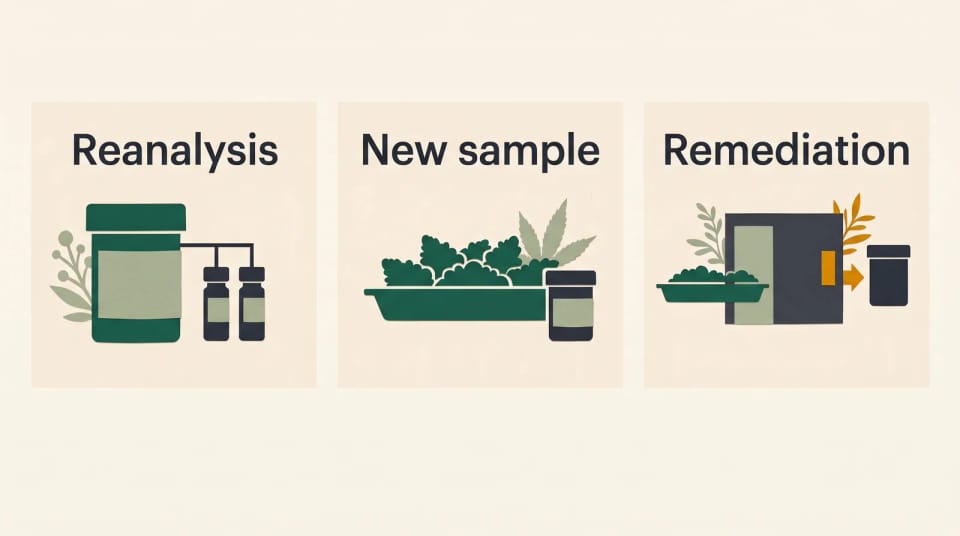
A repeat measurement, a new sample, and a treated batch answer different questions. None explains the whole history on its own.
Does reanalysis mean the first test was wrong?
No. A lab may repeat an analysis as part of its required checks. That can happen before it issues the final report.
An action level is a test limit. Under California’s §15730, a result above that limit triggers more lab work. The lab must prepare the sample again and test it twice in a different analytical batch. It must also address failed quality-control checks. This checks the measurement process. It does not treat the product batch. California §15730
If the lab finds a false positive or false negative, DCC may ask it to take a new sample or retest. That is one route allowed by the rule. A producer cannot just declare that a result was a false positive.
The useful follow-up is: “What documented analytical problem was found?” A second number is an observation. An investigation is the explanation. Our guide to measurement uncertainty explains why a difference between measurements is not automatically misconduct or proof of error.
Can a company send a failed batch to another lab?
A California distributor cannot simply take another sample and shop for a result it prefers.
Section 15705(g) sets one narrow route. The original lab must be unable to competently finish the tests before it issues a COA. The distributor can then ask DCC to let another lab take a new sample and test it. DCC must approve the request in writing before that happens. This is not a general appeal after a failed COA. California §15705
The current §15305.1 links the limits on new samples to that route. DCC’s representative sampling checklist also tells distributors to obtain written approval before another lab samples the same batch.
A new sample comes from the batch. It is different from testing the first sample again. This is why representative sampling and chain of custody matter together.
What must happen after remediation?
In California, a batch processed again after a failed test must pass all required analyses. Passing only the failed panel is not enough. Section 15727 also limits remediation to two attempts. If the batch fails after the second attempt and retest, the whole batch must be destroyed. California §15727
That is the detail to save when someone says, “They fixed the mold test.” Ask for the complete later compliance report, not an isolated result for one organism.
Remediation does not mean every failure can be treated. Section 17305 sets strict limits for edibles. The allowed routes are new labels or specified changes to packaging. The rule also allows a label to be corrected when its cannabinoid or terpene content is wrong, under stated conditions. So “remediated” can mean a label changed. It does not always mean a contaminant was removed. California §17305
The type of correction matters. For a separate lesson on a physical treatment, read irradiated cannabis and its evidence limits.
What should I ask when I see “retested and passed”?
Ask for the connection between the reports:
- The initial issue: Which test requirement was not met? Was there a final failed COA or a problem found during laboratory quality control?
- The intervening event: Was the sample reanalyzed, the batch resampled, or the product corrected? What record explains that event?
- The identity: Do the later report and package identify the relevant batch and product?
- The scope: Does the later report contain the required analyses, rather than one selected passing panel?
Ask the retailer or producer for that history. Some internal records may not be public. DCC says a lab needs its permission to change an issued COA. Ask for a clear reason when a report changes. DCC laboratory guidance
If you cannot link the reports, a question remains. A missing explanation alone does not prove fraud. It also does not show that the first failure “never mattered.” Check batch-specific recalls separately when a safety notice is involved.
FAQ
Does passing a retest erase the first failure?
No. Ask what happened between the reports. Did the lab find an error? Did DCC allow a new sample? Was the material processed or its label changed?
Does California allow two retests for any reason?
No. The two-attempt rule in §15727 is about remediation and the tests that follow. It does not allow a failed batch to keep moving between labs until one gives it a pass.
Does remediation always mean mold removal?
No. California’s rules also describe corrections involving product labels and packaging. Ask which failure occurred and which corrective route applied.
Is a passing result a guarantee that every package is risk-free?
No. The report covers its sample and the tests it lists. It cannot tell you what happened during later storage or how you will respond to the product.
Key takeaways
- A later pass needs a documented explanation of the earlier failure.
- Reanalysis, resampling and remediation describe different events.
- California requires additionally processed failed batches to pass all required analyses.
- The two remediation attempts and edible-product restrictions are California rules, not national standards.
Sources
- California DCC: current regulations and separate proposed rulemaking.
- California DCC: searchable current regulatory text, including §15305.1.
- California §15730: laboratory quality-control procedures.
- California §15705: general sampling requirements and authorized replacement laboratory.
- California §15727: remediation and retesting.
- California §17305: failed product batches and corrective routes.
- California DCC: representative sampling checklist.
- California DCC: testing laboratory overview.


