Irradiated Cannabis: Radioactivity, Terpenes, and Safety
Does irradiated cannabis become radioactive or lose terpenes? Explore the research, microbial safety limits, and questions to ask before buying.

“This flower has been irradiated” sounds like the opening line of a superhero origin story. On a cannabis label, it describes a processing step intended to lower microbial contamination. The interesting questions are what that step changes, what it leaves behind, and whether the final batch has been tested properly.
Here is the short answer: properly controlled irradiation does not turn cannabis into a radioactive product. FDA guidance.
Research on gamma-treated cannabis has generally found the measured THC and CBD content to be stable, while terpene findings vary. Hazekamp, 2016.
Treatment can reduce microbial counts, but the word irradiated does not establish sterility or the absence of fungal toxins. Those are separate findings requiring separate evidence. Rani et al., 2025.
Let’s unpack the label without giving either fear or marketing the steering wheel.
What does irradiated cannabis mean?
Irradiation exposes a product to a controlled source of ionizing radiation. The goal is to damage microorganisms sufficiently that they cannot keep multiplying. Gamma rays, electron beams, and X-rays are different ways to deliver that energy; they should not be treated as identical processing recipes. The EPA’s irradiation explainer describes the basic mechanism and the separation between the product and the radiation source.
A useful distinction is irradiation versus contamination with radioactive material. In controlled processing, the product receives energy. It is not mixed with a radioactive substance. The CDC explains this distinction using a familiar comparison: getting an X-ray does not leave you radioactive afterward.
Food irradiation guidance helps explain that physical principle. It does not mean the FDA has approved every cannabis product, or that evidence about eating irradiated food settles every question about inhaling treated flower. Keeping those claims separate makes the explanation more trustworthy.
The practical question is therefore not “Was radiation involved?” It is “Which process was used, what was it validated to do, and what did testing find afterward?”
Why would a producer irradiate flower?
Cannabis is an agricultural crop. Its flowers can carry microorganisms, and a producer may use a decontamination step to lower that burden before distribution. In a 2023 study of bulk cannabis, gamma treatment sharply reduced measured bacterial, yeast, and mold counts in the three lots tested for microbes. The study also examined the chemical composition of treated material. Majumdar et al., 2023.
That is a legitimate quality-control objective. It does not tell you whether a specific retail batch started with excellent cultivation practices, had a contamination problem, or received treatment routinely. The processing label alone cannot reconstruct its history.
This is where two appealing shortcuts break down. “Untreated” is not proof of clean flower. “Treated” is not proof that a producer can skip good growing, drying, and storage practices. Even the FDA’s food guidance stresses that irradiation cannot replace proper handling. FDA.
Our cannabis quality guide explains what appearance and aroma can tell you. Those observations remain useful for judging a purchase, but they cannot replace contamination testing.
Does irradiation destroy THC or CBD?
The available composition studies do not support a blanket claim that gamma treatment destroys the major cannabinoids.
In 2016, Arno Hazekamp compared four medicinal cannabis varieties before and after gamma irradiation. THC and CBD content did not change under the protocol studied. The paper also examined moisture and microscopic appearance. This was a laboratory comparison of plant material, not a trial asking people whether treated flower felt different. The author worked for Bedrocan, the medicinal cannabis producer, a relevant industry connection when weighing the evidence. Hazekamp, 2016.
In 2023, Majumdar and colleagues examined 33 barrel lots across three cannabis chemovars. They reported no statistically significant changes in the measured cannabinoid concentrations after treatment. That broadens the composition evidence, but it still does not establish the outcome of every dose, process, or product. Majumdar et al., 2023.
For shoppers, the measured composition of the actual batch is more informative than a sweeping claim about treated flower. A stable THC result is also narrower than “the whole experience is unchanged.” These studies did not directly test your high, flavor preferences, or symptom response.
If you are comparing two jars, start with how to read cannabis lab results. Make sure the report belongs to the batch you are buying before interpreting a number printed in large type.
What happens to the terpenes?
Here is where the story gets more interesting: the published findings are not perfectly uniform.
Hazekamp found reductions in some terpenes while the overall profile remained recognizable. Some compounds changed more than others, and the pattern differed between varieties. This supports saying that aroma chemistry can change under gamma treatment. It does not justify claiming that all treated cannabis loses its terpenes. Hazekamp, 2016.
The 2023 study reported little effect on terpenes and no significant difference in the representative terpene comparison presented. Its result does not erase the earlier findings. Different starting material, treatment conditions, and analytical approaches can produce different observations. Nor does a result that misses statistical significance prove that two samples are chemically identical. Majumdar et al., 2023.
A consumer-friendly interpretation is: terpene preservation is a batch and process question. “Irradiated” does not give you a reliable percentage loss to subtract from a label.
The cannabis terpene guide can help you understand what the reported compounds are. TIWIH’s High Families can help organize preferences, but those categories are not contamination grades or a test of treatment quality. A flower’s place in an aroma or effect framework cannot tell you whether it passed a microbial panel.
Likewise, the entourage-effect research does not let us translate a small measured terpene difference into a guaranteed change in the high. That leap would require evidence these processing studies did not collect.
Does irradiation remove mold and mycotoxins?
This question contains two different targets. Mold is a living organism. Mycotoxins are chemicals that certain fungi can produce. Lowering the number of organisms that grow in a laboratory culture is not the same measurement as testing for toxin residues.
A 2025 study by Rani and colleagues examined cannabis using culture methods, DNA-based methods, and toxin assays. Gamma irradiation reduced microbial loads, but viable fungi and residual mycotoxins were still detected in the studied material. Some commercially sourced samples also contained detectable toxins. Rani et al., 2025.
The study matters because it challenges a specific assumption: a low count on one type of microbial test does not answer every contamination question. But the researchers acknowledged a small sample size. These results cannot tell us the prevalence of contamination across the whole market or how often consumers become ill.
There is another distinction worth keeping: detecting fungal DNA does not, by itself, prove that living fungi remain. The researchers used multiple methods because genetic material, viable organisms, and toxin residues are different pieces of evidence.
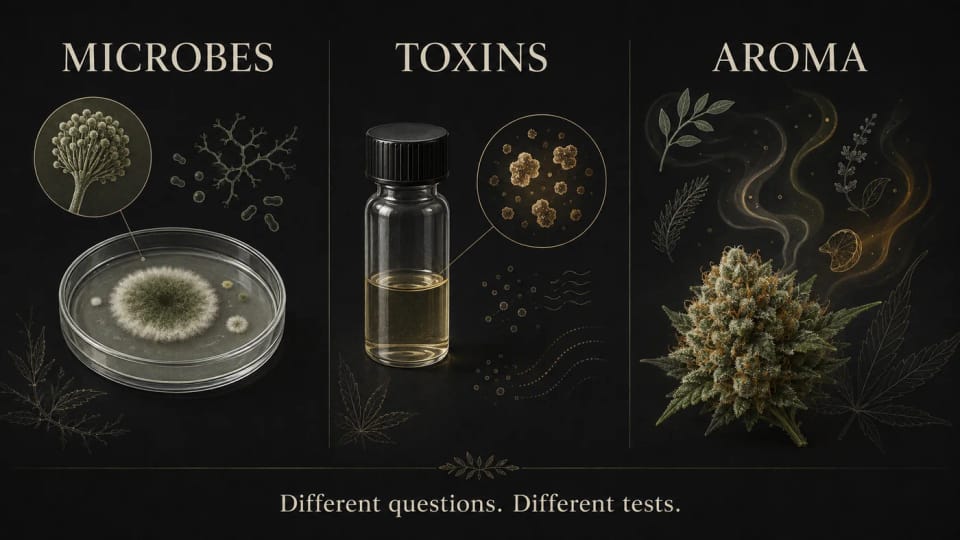
Conceptual illustration, not laboratory data: microbial counts, toxin assays, and terpene analysis answer different questions.
This also explains why “passed microbial testing” should not be stretched into “free of every contaminant.” Ask what was tested, with which method and reporting limits. Our guide to mold versus trichomes covers visible warning signs and why suspect flower is not a home salvage project.
Is irradiated cannabis safer than non-irradiated cannabis?
Without details about the two products, there is no honest universal ranking.
The research supports microbial reduction as a benefit of treatment. It also demonstrates that treatment outcomes have limits. For a particular purchase, useful evidence includes the final batch’s testing, the producer’s handling practices, and the intended use of the product. The irradiation label supplies only one part of that picture. Majumdar et al., 2023, Rani et al., 2025.
If you are immunocompromised, ask your treating clinician about cannabis products and consumption routes. The microbial concerns discussed in this research are especially relevant to vulnerable patients; a retail “irradiated” claim is not individual medical clearance. Rani et al., 2025.
For everyone else, resist using the processing method as a shortcut around the rest of the evidence. A strong aroma is not a clean-lab certificate, and muted aroma does not identify how a flower was processed.
Five questions worth asking before buying
You do not need a radiation-physics degree to ask useful questions. Try these:
- Was this batch treated, and with which method? Ask for the producer’s information if the retailer does not know.
- Does the available report describe the final product? A report from before processing cannot establish everything about the product afterward.
- Which contamination panels are included? Look beyond potency to the actual microbial and mycotoxin results. Do not assume a missing panel means a passing result.
- Does the batch number match the package? A report from a different harvest is background information, not evidence about this jar.
- What supports claims about preserved terpenes? A final terpene report is useful. A universal promise that nothing ever changes asks you to accept more than the published evidence shows.
Our chain-of-custody guide explains why sample identity matters. And after purchase, keep following sensible cannabis storage practices. A treatment step earlier in the supply chain is not a reason to ignore conditions in your cupboard.
FAQs
Will irradiated cannabis make me radioactive?
Properly controlled irradiation does not make the treated product radioactive. Exposure to processing radiation is different from contamination with radioactive material. The CDC’s explanation makes that distinction clearly for irradiated products.
Does gamma irradiation remove all terpenes?
No. The cannabis studies discussed here found either selective reductions or little measured change, rather than removal of the whole terpene profile. The outcome depends on the material and processing conditions. Hazekamp, 2016, Majumdar et al., 2023.
Does irradiated mean sterile?
No. It names a treatment, not a universal final condition. In the 2025 study, viable fungi remained in treated material. Establishing sterility requires evidence specific to the process and product. Rani et al., 2025.
Can a smell test identify irradiated cannabis?
The studies reviewed here do not validate a consumer smell test for identifying treatment. You need producer information. Aroma can help you describe your preference, but cannot reliably reconstruct processing history or verify microbiological safety.
The takeaway: ask for the batch evidence
Professor High’s rule for this label is simple: trade the scary word for better questions. What treatment was used? What changed? What was tested afterward?
Irradiation can be a useful contamination-control step. It is also compatible with changes in some aroma compounds and with unresolved contamination questions. The responsible conclusion fits those facts together. Judge the documented final product, keep your personal preferences separate from safety claims, and expect producers to show their work.
Sources
- Hazekamp, A. (2016). Evaluating the Effects of Gamma-Irradiation for Decontamination of Medicinal Cannabis. Frontiers in Pharmacology, 7, 108. DOI.
- Majumdar, C. G., et al. (2023). Effect of Gamma Irradiation on Cannabinoid, Terpene, and Moisture Content of Cannabis Biomass. Molecules, 28(23), 7710. DOI.
- Rani, M., et al. (2025). Detection of Mycotoxigenic Fungi and Residual Mycotoxins in Cannabis Buds Following Gamma Irradiation. Toxins, 17(11), 528. DOI.
- U.S. Food and Drug Administration. Food Irradiation: What You Need to Know.
- Centers for Disease Control and Prevention. How Food Irradiation Works.
- U.S. Environmental Protection Agency. Food Irradiation.