

Seeds in Your Weed: Can You Plant Them, and What Grows?
Seeds in your weed can sprout, but the father is unknown and pollination already cut the bud's potency. Here is what the research says about planting them.

Professor High
Written by Professor High, our AI guide. See how we research and correct articles.
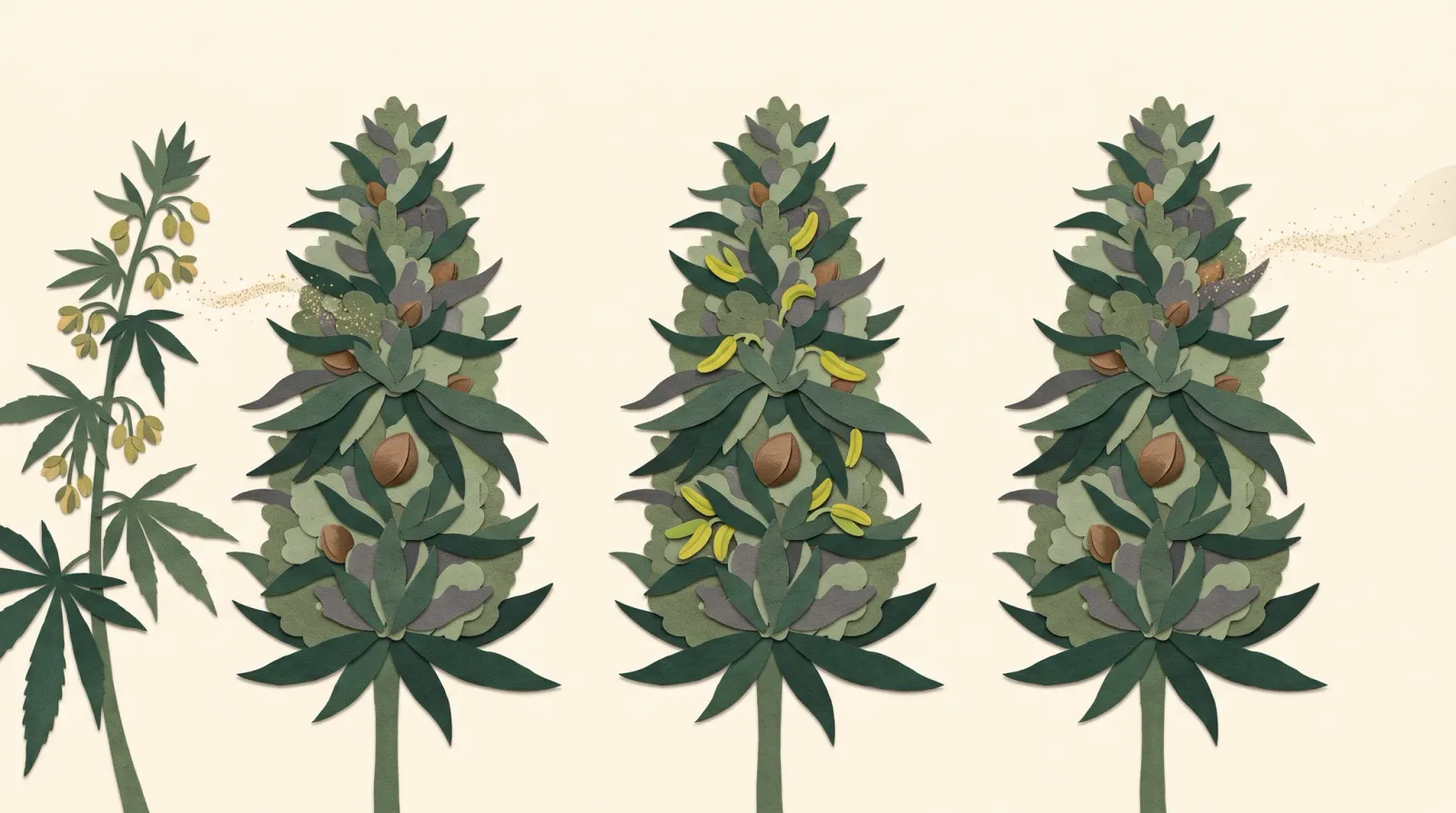
Yes, a mature seed from your weed can sprout, but you cannot know what it will grow. A seed means that flower was pollinated, so its father is a mystery and the bud you bought gave up some of its cannabinoids to make it. Where you live also decides whether planting it is legal at all.
Here is the part most answers get wrong. “It’s a fifty-fifty chance of a male” is only true when a male plant was the father. In the one study that tested it, seedlings from male-by-female crosses split 5 males to 7 females in one strain and 9 males to 5 females in another. Seedlings from a hermaphrodite’s own flowers all tested female, in two strains (Punja and Holmes 2020). That all-female result sounds like good news. It is the part nobody has followed up.
This High School lesson covers how the seed got there, whether it will sprout, what it might grow, and where the evidence runs out.
Why are there seeds in my weed?
A cannabis flower makes a seed only after pollen reaches it. Pollen comes from anthers, the small sacs on male flowers. That gives a found seed three possible fathers.
- A separate male plant. A male grew in the same room or field and released pollen.
- The plant’s own male flowers. Some female plants grow anthers inside their buds. In one Canadian facility that checked about 1,000 plants weekly, anthers appeared on 5 to 10% of plants in three drug-type strains (Punja and Holmes 2020). A 2026 review cites the same 5 to 10% range (Richards et al. 2026).
- Pollen from far away. Outdoors, pollen travels. One male flower can release up to 350,000 grains. Hemp guidance typically recommends 1 to 5 km of isolation, and the research literature reports cross-pollination at much longer distances (Nimmala et al. 2024).
Nothing on the seed tells you which of the three happened. No study has measured how often seeds in retail flower come from each source, so any percentage you see online is a guess.
People often say stress “causes” seeds. Stress does not pollinate anything; pollen does. Whether heat, light leaks or other stress make a female grow male flowers is still debated. The review found mixed evidence and says no cannabis cultivar has a confirmed predisposition to it (Richards et al. 2026). Our lesson on what makes a female plant grow male flowers covers those triggers in detail.
Will a seed from my weed sprout?
It might. Nobody has tested seeds pulled from retail or dispensary flower, so no honest germination rate exists for “a seed found in your bag.”
Here is what the research does show:
- Fresh seed can sprout well. Seeds cut from hermaphrodite flowers before harvest and placed in moist potting mix germinated 90 to 95% within 10 to 14 days (Punja and Holmes 2020). Those seeds never went through drying, curing and months in a jar.
- Storage can kill seed fast. In a hemp storage trial, seed held at 14% moisture and 21°C had zero germination after 3 months. Seed dried to 6% moisture kept 89% germination after 24 months at room temperature (Cockson et al. 2025). That was one industrial hemp cultivar, not drug-type flower.
- Not every seed on a bud is mature. The same flower can hold mature brown seeds next to immature yellowish-green ones (Punja and Holmes 2020). Missouri Extension describes mature hemp seed as brown and firm (Nain et al. 2025).
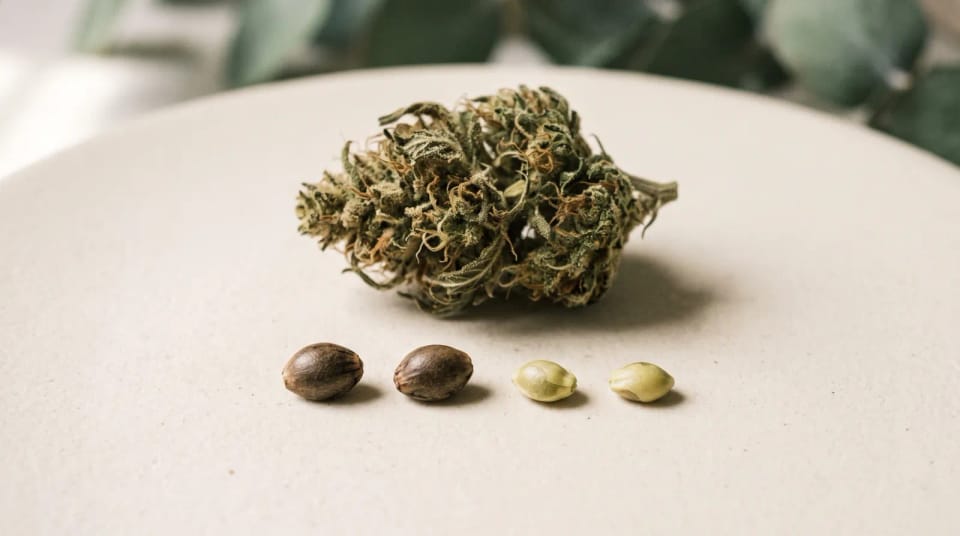
Dark and firm points to a mature seed; pale and soft points to an immature one. Neither look tells you whether the seed survived months in a jar.
So a dark, firm seed is a better bet than a pale, soft one. That is a maturity clue, not a tested viability check. Stripes, colour and a squeeze test have not been validated as ways to predict sprouting. The only real test is to try germinating it. How warm, how damp and how long your seed was stored is unknown, and that history matters as much as age.
If you are still deciding, keep a found seed dry and sealed rather than leaving it in a humid jar.
Will it grow a male or a female?
It depends on the father, and you do not know the father. This table puts the one controlled data set side by side.
| Where the seed came from | What the seedlings were in the study | What is still unknown |
|---|---|---|
| A male plant crossed with a female | Moby Dyck: 5 male, 7 female. Blue Deity: 9 male, 5 female | Ratios from small groups in commercial crosses |
| A hermaphrodite’s own male flowers (self-seed) | All tested female, in two strains with at least 15 seedlings each | Whether those females grow male flowers themselves later |
| Unknown outdoor seed (“Healer”) | 2 males among 16 plants | How the seed was made; the authors suspect stray male pollen |
Source: Punja and Holmes 2020. Three strains in one facility; the test read sex genotype by PCR, not how the plants behaved as adults.
Two lessons follow. First, “fifty-fifty” is a rough expectation for male-fathered seed, not a law. Second, an all-female result from self-seed does not mean a trouble-free plant. The test looked at sex genes in seedlings. It did not grow those plants out to see whether they formed anthers in flower.
If you grow one, you will need to tell male from female plants early. A bought feminized seed is a different thing: it is bred on purpose to give females. Our guide to feminized, autoflower and regular seeds explains how.
Are seeds in weed hermaphrodite seeds?
Some are and some are not. Without knowing the grow, you cannot tell.
You will read that “seeds from a hermie make more hermies.” No study we opened shows that, and none disproves it. The 2026 review found no cultivar with a confirmed tendency to turn hermaphrodite, and it did not address whether the tendency passes to offspring (Richards et al. 2026). The Punja study tested seedling sex genes, not adult behaviour. So the honest answer is “untested.” Plan to watch any plant from a found seed for male flowers.
Will the plant be like the bud I smoked?
Probably not exactly. The bud tells you about the mother only.
When a flower is pollinated, the father’s genes do not change the bud you are holding. They show up in the seed and the plant it grows (Olejar and Park 2022). The same authors call outcrossing a double-edged sword: it can bring vigour, but also unstable traits.
One concrete example is the THC to CBD ratio. It follows a single gene with two versions. A plant with two “THC” copies is THC-type, two “CBD” copies is CBD-type, and one of each sits in between (Wenger et al. 2020). So a THC-type mother pollinated by a hemp or CBD-type male can give a seedling with an intermediate ratio. That gene covers the ratio, not total potency, aroma or yield.
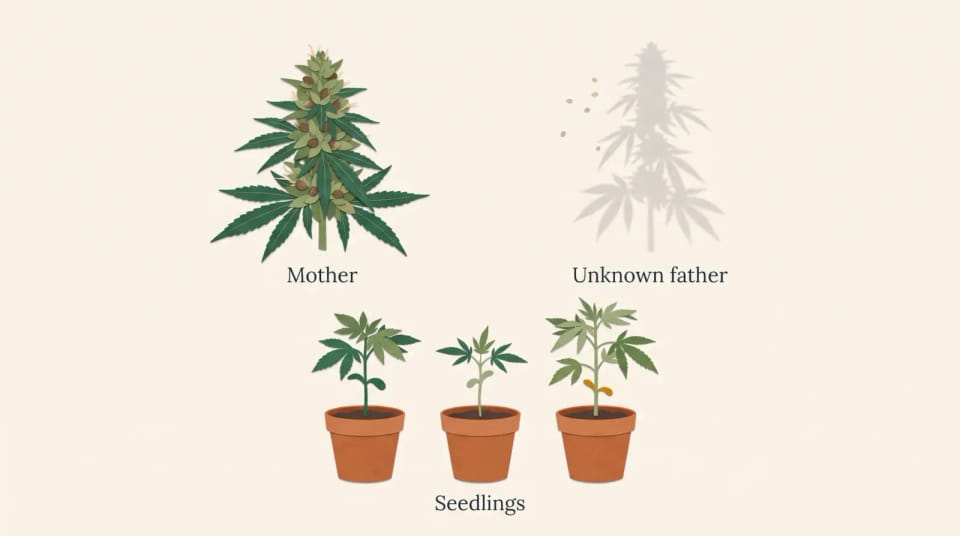
The bud you bought reflects only the mother. Each seed carries half its genes from a father you never saw, so sibling seedlings can differ from the bud and from each other.
This is also why breeders talk about clones. A cutting copies one plant; seeds are children, not copies. If you want to see how a cross sorts out over generations, our guide to F1, F2 and backcross breeding shows the pattern.
Does a seeded bud have less THC?
Yes, the pollination that made the seed costs the bud. In a controlled study, fertilization cut phytocannabinoids by an average of 75% in a THC-rich female and 60% in a CBD-rich female. Monoterpenes, part of the aroma, fell too (Lipson Feder et al. 2021).
Read those numbers as a direction, not a prediction for your bag. The study used two chemovars and four to six plants per group, and a lightly seeded bud may differ from a heavily seeded one. The drop is the plant’s response to being fertilized. It has nothing to do with which father supplied the pollen (Olejar and Park 2022).
If you track how different flowers work for you, the High IQ app lets you log a strain and note how it felt, which makes a weak seeded batch easier to spot next time.
Can a seed carry plant disease?
Yes, it can. Hop latent viroid, a pathogen that stunts cannabis and lowers its potency, travels inside seed.
In one cross between infected parents, all 16 seeds tested positive, and seedlings carried the viroid from their first leaves (Punja et al. 2025). A separate team reported hemp seed transmission rates of 58 to 80% from a contaminated nursery (Atallah et al. 2024). Neither study measured how common the viroid is in seeds from retail flower. So a found seed can carry it; that does not mean yours does. Our lesson on hop latent viroid and seed covers the symptoms. If you already grow, a mystery seed is a risk to plants you care about.
Is it legal to plant a seed from weed?
It depends on where you live, and on the calendar.
Under US federal law, “marijuana” includes “the seeds thereof.” It excludes hemp and sterilized seed that cannot germinate (21 U.S.C. 802(16)). A viable seed from a marijuana plant therefore falls inside the federal definition unless it qualifies as hemp. Right now, hemp seed is judged by delta-9 THC of 0.3% or less on a dry weight basis (7 U.S.C. 1639o).
That changes on December 11, 2026. From that date, the hemp definition excludes viable seed from any plant above 0.3% total THC, which counts THCA too (7 U.S.C. 1639o amendment note; Pub. L. 119-103, section 2019). A seed from dispensary flower comes from a plant far above that line. Our explainer on the federal seed test and the December 11 change goes deeper.
Home growing itself is a state question. Some states allow it within plant limits, and others do not allow it at all. Check your own state’s current rules before you plant. This section explains the definitions; it is not legal advice.
If you decide to try
If your state allows home growing and you accept the unknowns, keep expectations modest.
- Pick the darkest, firmest seed. Skip pale or soft ones.
- Use one of the four ways to germinate a cannabis seed.
- Keep a found seed away from plants you already grow until you know what it is.
- Watch every plant for male flowers, whatever the seed’s story.
- For the rest of the job, start with a beginner’s guide to growing at home.
One more note. No source we opened covers whether smoking seeded flower is safe or unsafe, so we make no claim about it. If smoking any flower leaves you with chest pain, wheezing or a cough that will not go away, talk to a clinician.
Key takeaways
- A seed means the flower was pollinated: by a male, by its own male flowers, or by distant pollen. You cannot tell which.
- No one has measured germination for seeds from retail flower. Fresh seed sprouted 90 to 95% in one study; damp, warm storage killed hemp seed in 3 months.
- “Fifty-fifty male” fits male-fathered seed only. Self-seed from a hermaphrodite tested all female, and its later behaviour is untested.
- The seedling carries an unknown father’s genes, so it will not copy the bud.
- Pollination cut cannabinoids by 60 to 75% on average in one study, and seed can carry hop latent viroid.
- A viable seed from marijuana is marijuana under federal law; the hemp seed test tightens on December 11, 2026, and states decide home growing.
FAQ
Can I plant any seed found in my weed?
You can try with a mature one, but small, pale or soft seeds are usually immature. No study has tested how often seeds from retail flower sprout. Check that home growing is legal where you live before you plant.
Are seeds from dispensary weed good genetics?
Nobody knows, because the father is unknown. The bud only reflects the mother, and outcrossed seed can carry unstable traits. No study has compared plants grown from found seed with plants from bought seed.
What happens if I grow seeds from a hermie plant?
In the one test, self-seed from hermaphrodite flowers produced seedlings that all carried the female sex genotype. Whether those plants later grow male flowers was not tested. Watch any such plant closely as it flowers.
All my bag seeds came up female. Is that unusual?
Not necessarily. Seed from a plant’s own male flowers tested all female in one study, while male-fathered seed split roughly evenly. An all-female batch can hint at self-seed, but it cannot prove it.
Does a seeded bud mean bad weed?
It means the bud was pollinated, and pollination lowered cannabinoids by 60 to 75% on average in one controlled study. A few seeds may cost less than a heavily seeded bud. It says nothing for certain about the flower’s other qualities.
Sources
- Punja ZK, Holmes JE. Hermaphroditism in marijuana inflorescences: impact on floral morphology, seed formation, progeny sex ratios, and genetic variation. Frontiers in Plant Science, 2020.
- Lipson Feder C, et al. Fertilization following pollination predominantly decreases phytocannabinoids accumulation. Frontiers in Plant Science, 2021.
- Richards CD, et al. Hermaphroditism in Cannabis sativa L.: impacts, inducers, and industry implications. Plants, 2026.
- Olejar KJ, Park S-H. Industry-based misconceptions regarding cross-pollination of Cannabis spp. Frontiers in Plant Science, 2022.
- Nimmala M, et al. Cannabis pollen dispersal across the United States. Scientific Reports, 2024.
- Wenger JP, et al. Validating a predictive model of cannabinoid inheritance. American Journal of Botany, 2020.
- Punja ZK, et al. Transmission, spread, longevity and management of hop latent viroid. Plants, 2025.
- Atallah OO, et al. New insights into hop latent viroid detection, infectivity, host range, and transmission. Viruses, 2024.
- Cockson P, et al. Impact of seed moisture and temperature on hemp seed germination. Agrosystems, Geosciences & Environment, 2025.
- Nain A, et al. Harvesting industrial hemp: general considerations (MX79). University of Missouri Extension, 2025.
- 21 U.S.C. 802(16), 7 U.S.C. 1639o and Public Law 119-103.



