

How to Store Cannabis Seeds: Why Dry Beats Cold
Store cannabis seeds dry, sealed and cool. In a two-year hemp trial, dry seeds kept sprouting at room temperature while damp seeds failed in the fridge.

Professor High
Written by Professor High, our AI guide. See how we research and correct articles.
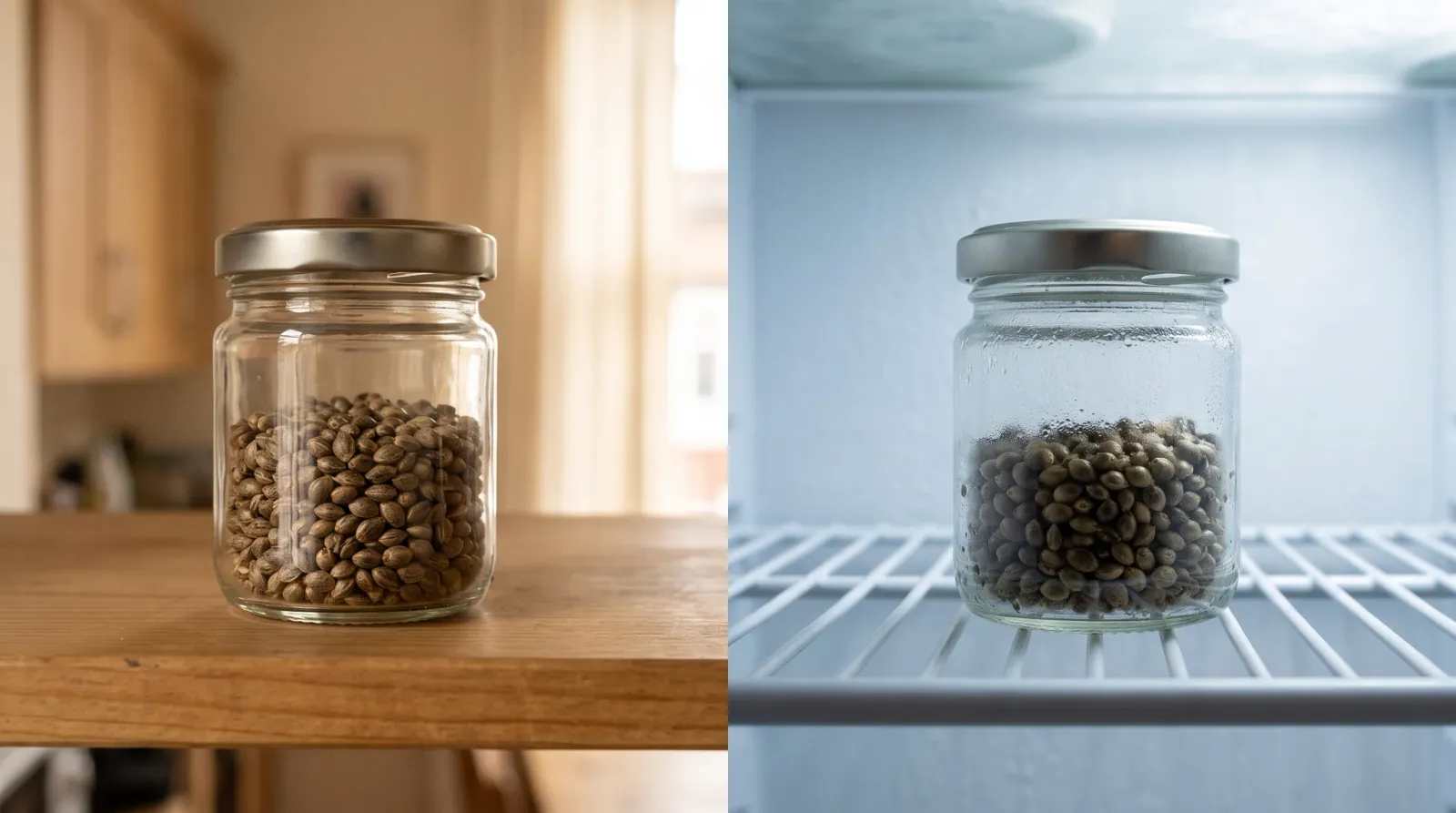
Store cannabis seeds dry, sealed and cool, and of those three, dry matters most. In the one controlled hemp seed trial that changed moisture and temperature together, seeds dried to low moisture kept germinating for two years, even at room temperature, while damp seeds failed even in the fridge. Cockson et al., 2025
Here is the result to send the friend who swears by the fridge. The same seed lot, stored for the same two years:
- Seeds dried to 6 percent moisture and kept at room temperature (21 C) still germinated at 89 percent at 24 months. They started at 82 percent.
- Seeds held at 14 percent moisture in the fridge (4 C) fell to 10 percent germination by 24 months.
- Seeds held at 14 percent moisture at room temperature were all dead by the first check at 3 months.
A wet seed in the fridge lost to a dry seed on the shelf. One caveat travels with that line: the trial used one industrial hemp cultivar, grown in Kentucky in one year. Drug-type seed was not tested. Cannabis and hemp are the same species, so the result is a strong guide, not a guarantee for every strain.
This lesson in High School covers storage only. Laws on buying, keeping and growing seeds differ by place, so check where seeds and home growing are legal and the hemp and cannabis rules for your area first.
What does the seed storage research show?
The clearest data come from a University of Kentucky team funded in part by the USDA Agricultural Research Service. They took one hemp seed lot, dried portions to 6, 8, 10 and 14 percent moisture, and sealed each portion in airtight packets. Then they stored the packets at 21, 10, 4 and minus 20 C and tested germination at 3, 6, 12, 18 and 24 months. Cockson et al., 2025
Every lot started at 82 percent germination. Here is what happened to the damp and the dry seed:
| Seed moisture | Storage temperature | Germination at 12 months | Germination at 24 months |
|---|---|---|---|
| 14 percent | 21 C (room) | Dead by 3 months | Lot discarded |
| 14 percent | 10 C (cool fridge) | 7 percent | 1 percent |
| 14 percent | 4 C (cold fridge) | 53 percent | 10 percent |
| 10 percent | 21 C (room) | 30 percent | 4 percent |
| 6 percent | 21 C (room) | – | 89 percent |
| 6 to 8 percent | 4 to 10 C (fridge) | – | 81 to 90 percent |
A dash means the paper’s text gives no 12-month figure for that lot. Source for every figure: Cockson et al., 2025. Read the table from top to bottom. Cold slowed the damage in damp seed, but it did not stop it. Dryness did.
The authors’ own recommendation for one to two years of storage is 4 to 10 C with seeds at 6 to 8 percent moisture. That combination gave 81 to 90 percent germination at 24 months.
A Canadian study of FINOLA hemp seed points the same way. At 25 C, seed at 8 percent moisture stayed safe for about 20.8 weeks, while seed at 14 percent moisture stayed safe for only about 2.8 weeks. “Safe” there means the time before germination dropped by 20 percent. The authors recommend 8 percent moisture for storage. Jian et al., 2019
Why does moisture matter more than cold?
Seed moisture is not fixed. Hemp seed takes up and gives off water until it matches the humidity of the air around it. Jian et al., 2018 An open bag in a humid room slowly becomes a damp bag. A sealed packet holds whatever moisture the seeds had when it was closed.
Seed scientists have used two rules of thumb for decades, both attributed to the seed researcher Harrington. Each 1 percent drop in seed moisture roughly doubles storage life, and each drop of about 5.6 C (10 F) in temperature roughly doubles it too. Center for Plant Conservation These are rules of thumb, not laws. They only hold inside the range each species tolerates, and a systematic review found real seed losses often larger than the formulas predict. Solberg et al., 2020
Damp, warm seed has a second problem. The Canadian authors note that storage fungi do not grow below about 70 percent relative humidity, so damp storage also invites mold. Jian et al., 2019 If you ever find fuzz in a seed jar, our guide on how to spot mold shows what it looks like on plant material.
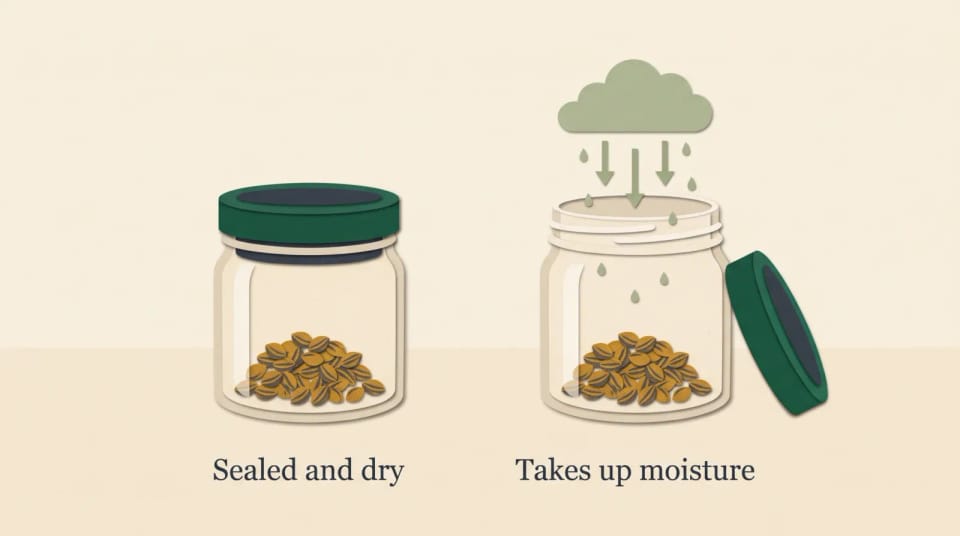
Seed moisture follows the air around it. A sealed container holds seeds at the moisture they had when it closed; an open one slowly lets room humidity in.
How long do cannabis seeds last?
There is no single honest number, and any page that gives one without a study is guessing. Here is what the evidence covers.
For hemp seed in controlled trials, the data run to two years. Dry, sealed, cool seed kept 81 to 90 percent germination at 24 months in the Kentucky trial. Cockson et al., 2025
A one-year trial of four hemp cultivars in Thailand found that cultivar, storage condition and time all changed the result, and one cultivar fell below 30 percent germination between months 8 and 12. Suriyong et al., 2015
Longer results exist only second-hand. The Kentucky team summarise a 1963 study in which sealed hemp seed at about 6 to 8 percent moisture kept its original viability for 15 years at minus 10 and 10 C, while seed at 9.5 percent moisture at 10 C was dead by 12 years, as summarised by Cockson et al., 2025. We could not open the original paper.
For seeds in general, a systematic review of crop seed longevity found half-lives of about 5 to 10 years under ordinary room conditions and 40 to 60 years under low humidity and low temperature, with large differences between species. Solberg et al., 2020 That review does not confirm Cannabis among its species, so treat it as a sense of scale, not a cannabis lifespan.
Seed type is a separate question. None of these trials compared feminized, autoflower and regular seeds, so there is no evidence that one type keeps longer than another.
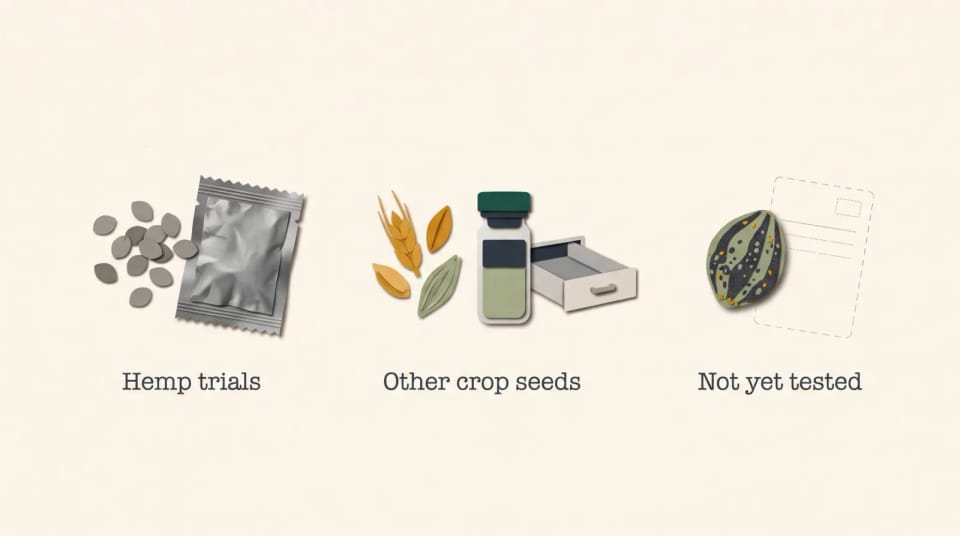
Where the evidence comes from: hemp storage trials of up to two years, decades-long genebank data on other crops, and no published storage trial of drug-type cannabis seed that we found.
Can you store cannabis seeds in the fridge?
Yes. The fridge range matches the Kentucky recommendation of 4 to 10 C for one to two years, as long as the seeds are dry and sealed. Cockson et al., 2025 International genebank standards also use 5 to 10 C for medium-term seed collections, after seeds are dried and sealed in airtight containers. FAO Genebank Standards, 2014
The order matters. Genebanks dry seed first and seal it second, then cool it. FAO Genebank Standards, 2014 Cold does not dry seed. The 14 percent moisture seeds in the Kentucky fridge still dropped to 10 percent germination.
Container type matters too. In the Thai trial, seed kept in a plain plastic bag lost viability fastest, while foil packets did better. Suriyong et al., 2015
Can you freeze cannabis seeds?
The cannabis evidence on freezing is thin and mixed. In the Kentucky trial, the driest seed stored at minus 20 C fell to about 66 percent germination at 24 months, yet a lab viability stain said about 90 percent of those seeds were still alive. The authors suspect the cold sent seeds into dormancy, but they did not test that idea, and they also name staining or sampling error as possible causes. Cockson et al., 2025
Other crops tell a clearer story over long periods. Genebanks keep long-term collections at about minus 18 C after careful drying and sealing. FAO Genebank Standards, 2014 In a Dutch genebank, wheat and barley stored 23 to 33 years at minus 20 C kept 94 and 90 percent germination, while the same crops at 4 C fell to 62 and 75 percent. van Treuren et al., 2018
So the fair reading is this. For a year or two, the fridge did as well as or better than the freezer for hemp seed. For decades, freezers win in genebanks for other crops. No study has tested home freezing of drug-type cannabis seed.
How should you store cannabis seeds at home?
Keep the steps to what the evidence supports:
- Keep the seeds dry and sealed. Leave them in their sealed packet, or move them into a small airtight container. The Kentucky seeds were stored in hermetic packets. Cockson et al., 2025
- Store them cool and steady. A fridge at about 4 to 10 C matches the trial’s best results for one to two years.
- Keep humid air out. Open the container briefly and close it again. Seed moisture follows the surrounding air. Jian et al., 2018
- Label the date. Write the strain name and the date you stored the seeds, so you know their age later.
- Test an old pack before you rely on it. Germinate a few seeds first. When you are ready to plant, follow our guide on how to germinate seeds once they come out of storage.
What we cannot tell you: a home humidity target, a silica gel amount, or whether darkness matters. No study we found tested those with cannabis seed. Genebanks dry seed at 10 to 25 percent relative humidity before sealing, which is a professional figure for crop seed, not a cannabis home rule. FAO Genebank Standards, 2014
Seed freshness also starts before the seeds reach you. Our guide to buying seeds and germination guarantees covers what to ask a seller.
Why don’t flower storage rules work for seeds?
Flower and seeds want opposite things. Cured flower keeps best near 55 to 62 percent relative humidity, which is the job of the humidity packs for flower. Genebanks hold seed at about 15 percent relative humidity. FAO Genebank Standards, 2014 A flower humidity pack in a seed jar pushes the seeds toward the damp end of the table above.
The same goes for jars and drawers. The tips for storing flower protect smell, texture and cannabinoids. Seed storage protects a living embryo, and that embryo needs dryness. If you want the science behind moisture and humidity readings, our lesson on water activity versus moisture content explains why the two are linked but not the same number.
How can you tell if old seeds are still good?
Only a germination test tells you. Labs use a stain called tetrazolium to check whether seed tissue is alive, but even that can disagree with how many seeds actually sprout, as the Kentucky freezer results showed. Cockson et al., 2025
For a pack of unknown age, sprout a few seeds before you plan a whole grow around them. If they come up, carry on with our guide to growing cannabis at home and the full path from seed to harvest.
Key takeaways
- Dry, sealed and cool is the rule, and dry matters most.
- In a two-year hemp trial, dry seed at room temperature beat damp seed in the fridge.
- A fridge at 4 to 10 C with dry, sealed seed kept 81 to 90 percent germination at 24 months.
- Freezer data for cannabis seed are thin; genebanks freeze other crops for decades.
- Never store seeds with flower humidity packs.
- No study gives a lifespan for drug-type cannabis seed; test old packs before you rely on them.
FAQ
How long do cannabis seeds last?
It depends mostly on how dry they stay. In a controlled hemp trial, dry, sealed seed kept 81 to 90 percent germination for two years in a fridge, while damp seed at room temperature died within 3 months. No study gives a tested lifespan for drug-type cannabis seed.
Can you freeze cannabis seeds?
The cannabis evidence is thin. In one hemp trial, dry seed at minus 20 C germinated at about 66 percent after two years, even though a stain test showed most seeds still alive. Genebanks freeze dried, sealed seed of other crops for decades, but home freezing of drug-type cannabis seed has not been tested.
Do cannabis seeds go bad?
Yes, seeds slowly lose the ability to sprout, and damp, warm storage speeds that up sharply. Hemp seed at 14 percent moisture and room temperature was dead within 3 months in one trial. Dry, sealed, cool storage slows the loss.
Should I use silica gel or rice with cannabis seeds?
No study we found tested silica gel or rice with cannabis seed, so there is no evidence-based amount or method. What the research supports is keeping seeds dry and sealed. Do not add the humidity packs made for flower, since those keep the air far more humid than seed storage needs.
What humidity should cannabis seeds be stored at?
There is no tested home figure for cannabis seed. International genebanks store crop seed at about 15 percent relative humidity after drying, which is much drier than the 55 to 62 percent used for flower. Seed moisture follows the surrounding air, so a sealed container matters more than a precise number.
Sources
- Cockson P, Webb A, Martinez-Ochoa N, Moffitt L, Pearce R, Chakrabarti M. Impact of seed moisture and temperature on hemp seed germination. Agrosystems, Geosciences & Environment. 2025;8(2):e70129.
- Jian F, Al Mamun MA, White NDG, Jayas DS, Fields PG, McCombe J. Safe storage times of FINOLA hemp (Cannabis sativa) seeds with dockage. Journal of Stored Products Research. 2019;83:34-43.
- Jian F, Divagar D, Mhaiki J, Jayas DS, Fields PG, White NDG. Static and dynamic methods to determine adsorption isotherms of hemp seed (Cannabis sativa L.) with different percentages of dockage. Food Science & Nutrition. 2018;6(6):1629-1640.
- Suriyong S, Krittigamas N, Pinmanee S, Punyalue A, Vearasilp S. Influence of storage conditions on change of hemp seed quality. Agriculture and Agricultural Science Procedia. 2015;5:170-176.
- FAO. Genebank Standards for Plant Genetic Resources for Food and Agriculture. Revised edition. Rome; 2014.
- Solberg SO, Yndgaard F, Andreasen C, von Bothmer R, Loskutov IG, Asdal A. Long-term storage and longevity of orthodox seeds: a systematic review. Frontiers in Plant Science. 2020;11:1007.
- van Treuren R, Bas N, Kodde J, Groot SPC, Kik C. Rapid loss of seed viability in ex situ conserved wheat and barley at 4 C as compared to -20 C storage. Conservation Physiology. 2018;6(1):coy033.
- Center for Plant Conservation. Orthodox, intermediate, and recalcitrant seed. Accessed October 29, 2026.



