What Does Clone-Only Mean? Why Seeds Aren't the Same Plant
Clone-only means one plant kept alive only as cuttings. Seeds from it are its children, not copies. Here is how a cut works and how to read it on a menu.

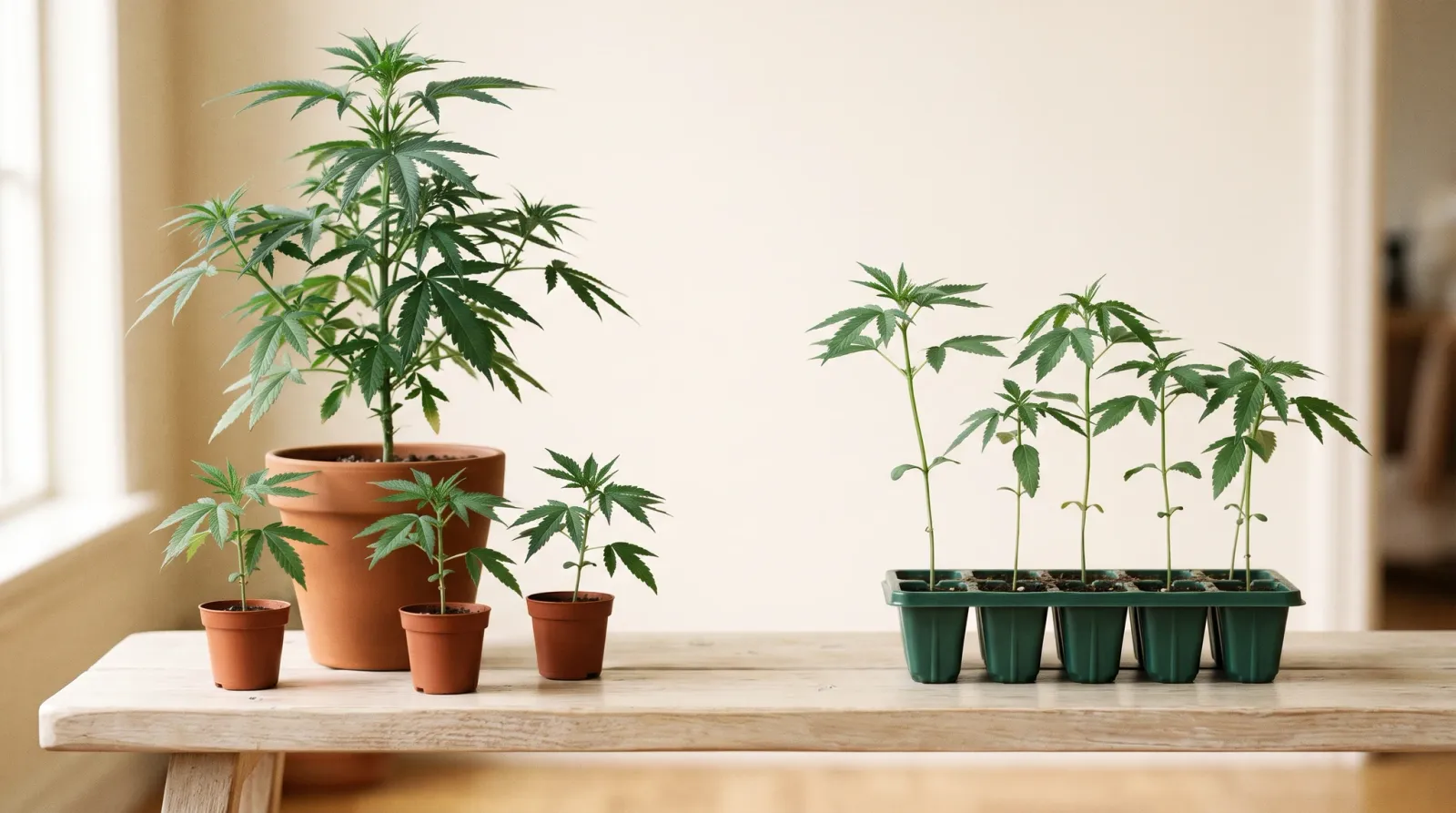
A clone-only strain, or “cut,” is one individual plant that exists only as cuttings of itself; seeds from it are its children, not copies, so they grow into different plants even when they carry the same name. That is why you cannot buy a true clone-only plant in a seed pack. You can buy seeds that came from it, but they are a new generation.
This is not only grower slang. The international rulebook for naming cultivated plants says it in writing: seed-raised plants of a cultivar that is kept by cuttings “are not to be considered the same as, nor be named as” that cultivar, unless they cannot be told apart from it (ICNCP, Art. 2.21). And one US cannabis regulator, Missouri’s, puts the other half plainly: “A clone is genetically identical to a mother plant; therefore, it cannot be used to create or introduce a new strain” (Missouri DCR guidance).
So the short lesson for today in High School: a cut is one plant, copied. A seed is a child.
What is a clone, and what is a cut?
A clone is a group of plants grown from one original plant without seeds, so they keep the same genes. The horticultural code defines a clone as “two or more individuals, originally derived from one plant by asexual propagation, which remain genetically identical” (ICNCP glossary). In practice, a grower snips a branch from a healthy plant and roots it. Our step-by-step guide to taking a cutting covers that technique.
A “cut” is the cannabis name for one specific clone line. When someone says “the original cut,” they mean cuttings that trace back to one particular plant, usually a plant somebody picked out of a seed run because it stood out. That picking step is phenotype hunting: grow many seeds, keep the one keeper, and copy it.
“Clone-only” means that keeper is not sold as seed. The only way to grow that exact plant is to get a cutting from its line.
| A cut (clone) | Seeds from that cut | |
|---|---|---|
| Where it comes from | A rooted branch of one plant | Pollination, even if the plant pollinates itself |
| Genes | The mother’s genome, apart from small mutations | A new mix from two parents, or a reshuffle of one |
| Do they match each other? | Yes, as closely as cuttings can | No, siblings vary |
| Can it carry the mother’s name? | Yes, by the horticultural rule | Not as the same cultivar, by the same rule |
Why can’t you buy a clone-only strain as seed?
You cannot buy that plant as seed because a seed is never a copy of its parent. Cannabis plants are usually male or female, so they cross with another plant. Researchers describe them as “obligatory out-crossers” (Punja and Holmes, 2020). The genome is also “highly heterozygous,” which means each plant carries two different versions of many genes. That is exactly why growers keep cuttings: “to retain genetic identity, clonal propagation of cultivars is very common” (Fleming et al., 2023).
Each seed gets a new combination of those gene versions. The children of one plant are siblings, and siblings differ.
Can a clone-only plant make seeds at all?
Yes, and this is the part many pages get wrong. A female cut can make seed. Spraying a female plant with silver thiosulphate makes it grow male flowers, and their pollen sets seed that grows into female plants (Mohan Ram and Sett, 1982). A 2024 review calls silver thiosulfate the “most effective” option for this kind of feminized seed (Timoteo Junior and Oswald, 2024).
But the seeds are still a new generation. The same review says these offspring need checking for “the declining effects of inbreeding,” and that “male flowers in progeny have been noted.” So the honest correction is not “a clone-only plant cannot make seeds.” It is “its seeds are not the same plant.”
Doesn’t self-pollinating keep it the same?
No. Self-pollination reshuffles one plant’s two gene versions instead of mixing two plants. A classic genetics study crossed pure-CBD and pure-THC plants. The first generation was all mixed. When those mixed plants were selfed, their offspring split into pure CBD, mixed and pure THC types in a “1:2:1 proportion” (de Meijer et al., 2003). That was one gene in a controlled cross, but the lesson carries: a plant with two different versions of a gene gives children that differ.
Breeders who want uniform seed have to work for it. A 2026 study notes that cannabis shows “high levels of genetic variability even within a single cultivar,” and built more uniform seed only by inbreeding lines over several rounds and then crossing them (Garcia-de Heer et al., 2026). Breeders can also try backcrossing to make seed that resembles a cut. Resembling is the goal, not copying.
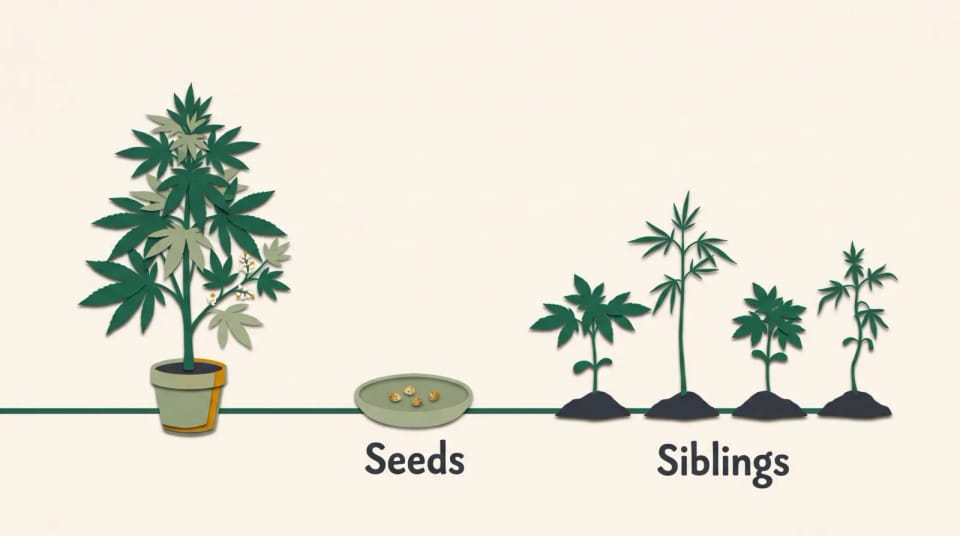
A female cut can be pushed to make pollen and seed. The seedlings are its children: they vary, so none of them is the original plant.
How is a cut kept alive?
A cut lives as long as someone keeps a living copy of it. The usual way is a mother plant: a plant kept in vegetative growth so growers can take cuttings from it again and again. Each rooted cutting can become a new mother. Lose every copy, and that cut is gone.
There are backups. Labs keep plants as tiny shoots in sterile jars, called tissue culture or micropropagation. Some go further and freeze shoot tips. One study froze tissue from 13 commercial cannabis genotypes in liquid nitrogen. Between 43.3 and 80 percent survived, and the regrown plants were similar to controls for most traits, with some differences in minor cannabinoids and terpenes (Downey et al., 2021). The same paper notes that the industry “relies on clonal propagation of elite genetics.”
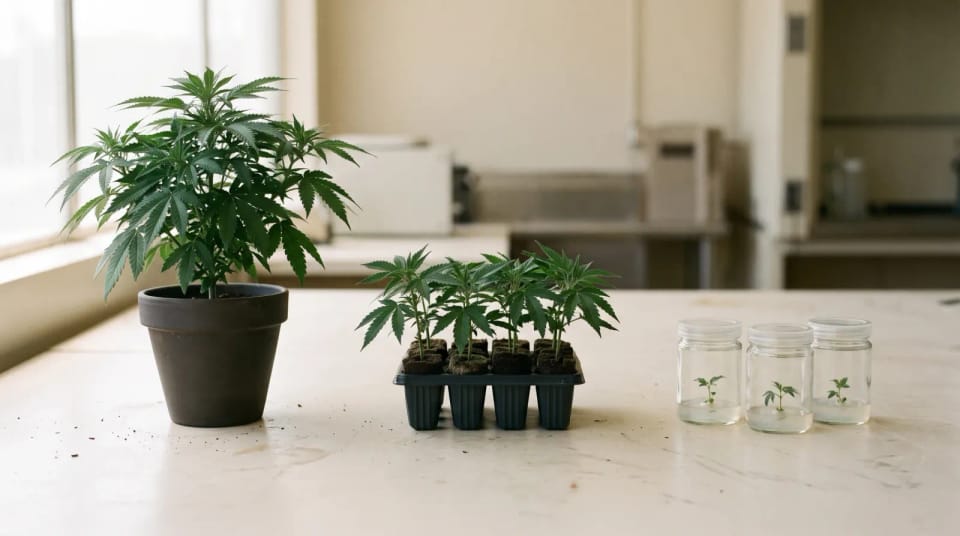
A mother plant, rooted cuttings and tissue culture are three ways to keep the same cut alive. Lose every living copy and the cut is gone.
Does a cut change over time?
Maybe a little, and the evidence is honestly unsettled. “Genetically identical” is a useful rule, but it is an approximation.
When researchers sequenced one cannabis plant at its bottom, middle and top, they found millions of genetic variants, and a share of them were unique to each part of the plant (Adamek et al., 2021). They found no high-impact mutation. They suggested that this kind of buildup “could impact” long-term fidelity and might “potentially contribute” to the decline some producers report. That was one plant of one cultivar, and the study did not measure potency or yield.
Tissue culture studies disagree. One found that mutations grew with the number of times a plant was re-cultured (Adamek et al., 2024). A 2026 study of three cultivars kept in culture for 60 weeks found mutations mostly appeared early and then seemed to plateau (Lefebvre et al., 2026). An older study, using a coarser test, found plants after 30 passages matched their mothers, with “insignificant differences in THC content” (Lata et al., 2009).
So “old cuts lose potency because of genetic drift” is not a demonstrated fact. It is a question. Other explanations exist too.
Can a cut carry a disease with it?
Yes. A cutting takes whatever is inside the mother plant. Hop latent viroid “primarily spreads via vegetative cuttings, contaminated tools and by other mechanical means,” and most infected cannabis plants show no symptoms (Adkar-Purushothama et al., 2023). Researchers have found it in symptom-free stock plants and in rooted cuttings. Clean-up is possible: growing new plants from tiny shoot tips “yielded a high frequency of pathogen-free plants, depending on the genotype” (Punja et al., 2025). Seed is not a clean escape either: in the same work, infected female plants gave up to 100 percent infected seedlings. Our hop latent viroid explainer covers the full story.
How do you read “cut” on a menu?
Read it as the producer’s claim, not a verified identity. Cannabis has no seed or variety registry. One genetics team wrote that distinctive cannabis varieties “are ostracized from registration and therefore nearly impossible to verify” (Schwabe and McGlaughlin, 2019). In their dispensary samples, most strains had at least one genetic outlier, though many looked stable once outliers were removed.
Missouri’s guidance shows how one regulator handles this. A clone must keep its mother’s name, and name corrections need documents showing “origin and breeding lineage.” The regulator adds that it “will not rely on or entertain arguments for identifying strains by genetic testing or heritage” (Missouri DCR guidance). That is one state, but the point travels: names are checked by paperwork, not by DNA. Larger studies agree that strain names “often do not reflect a meaningful genetic identity” (Sawler et al., 2015). Our DNA testing of strain names walks through those studies, and our guide to what strain names mean explains how names get stretched.
Here is a simple way to use the word:
- Read the name as a claim. A cut name tells you what the producer says the plant is.
- Ask where the cut came from. A clear answer about the source plant beats a famous name with no history.
- Check the lab report. A cut keeps the same plant, but the result can still vary. Growing conditions still change chemistry, so compare cannabinoids and terpenes on the certificate of analysis.
- Keep your own notes. Log the producer, the batch and how it worked for you. The High IQ app can track how a strain worked for you, so your next choice rests on your own record.
A cut makes the plant repeatable. It does not make the experience guaranteed. If a product ever gives you symptoms that worry you, such as chest pain, fainting or a racing heart that does not settle, stop and talk to a clinician.
For a worked example of how one famous name gets passed around and argued over, see our OG Kush history.
Key takeaways
- A cut is one plant, kept alive as cuttings. A clone-only strain is a cut that is not sold as seed.
- Seeds from a cut are its children. They vary, so none of them is the original plant.
- A clone-only plant can make seeds, including feminized seeds. The seeds are a new generation.
- Whether old cuts drift or decline is not settled. Viroids travel in cuttings and are a separate, proven risk.
- On a menu, “cut” is the producer’s claim. Judge it by its source and lab report.
FAQ
Can I buy clone-only strain seeds online?
You can buy seeds that came from a clone-only plant, but they are not that plant. Each seed is a new combination of genes, so the plants grow differently from the parent and from each other. The only way to grow the exact plant is from a cutting of its line.
What does “elite cut” mean?
“Elite cut” is grower slang for a cut that people prize, usually a keeper picked from a seed run. The word “elite” is a reputation, not a test result. No registry or lab standard defines it, so treat it like any other strain name on a menu.
Do clones lose potency over time?
Nobody has shown that they do. One sequencing study found a single plant carries many small mutations, and producers report decline, but no study here measured potency loss in a cut over years. Viroid infection, which often has no symptoms, and poor mother plant care are other possible explanations.
Is a self-pollinated clone still the same strain?
No. Self-pollination reshuffles the plant’s two versions of each gene, so its seedlings differ from the parent and from each other. The horticultural naming rule says seed-raised plants of a cutting-kept cultivar are not to be named as that cultivar unless they cannot be told apart from it.
What is the difference between a clone and an S1 seed?
A clone is a rooted cutting with the mother’s genome. An S1 is the common grower name for a seed made when a plant pollinates itself, often after a treatment makes a female grow male flowers. The S1 is the plant’s child, so it can differ from the mother.
Sources
- Brickell CD, et al., eds. International Code of Nomenclature for Cultivated Plants, 8th ed. Scripta Horticulturae 10. ISHS, 2009. Full text (PDF)
- Missouri Department of Health and Senior Services, Division of Cannabis Regulation. Entering marijuana strain names in the statewide track and trace system. Guidance dated June 18, 2026.
- Punja ZK, Holmes JE. Hermaphroditism in marijuana (Cannabis sativa L.) inflorescences. Frontiers in Plant Science. 2020;11:718. PMID 32670310
- Fleming H, Chamberlain Z, Zager JJ, Lange BM. Controlled environments for cannabis cultivation to support “omics” research studies and production. Methods in Enzymology. 2023;680:353-380. PMID 36710019
- de Meijer EP, et al. The inheritance of chemical phenotype in Cannabis sativa L. Genetics. 2003;163(1):335-346. PMID 12586720
- Mohan Ram HY, Sett R. Induction of fertile male flowers in genetically female Cannabis sativa plants by silver nitrate and silver thiosulphate anionic complex. Theoretical and Applied Genetics. 1982;62(4):369-375. PMID 24270659
- Timoteo Junior AA, Oswald IWH. Optimized guidelines for feminized seed production in high-THC Cannabis cultivars. Frontiers in Plant Science. 2024;15:1384286. PMID 39539297
- Garcia-de Heer L, et al. Weeding out variability: a proof-of-concept for producing uniform F1 hybrid Cannabis sativa L. using single-seed descent. Horticulture Research. 2026;13:uhag038. PMID 42170633
- Downey CD, Golenia G, Boudko EA, Jones AMP. Cryopreservation of 13 commercial Cannabis sativa genotypes using in vitro nodal explants. Plants. 2021;10(9):1794. PMID 34579326
- Adamek K, Jones AMP, Torkamaneh D. Accumulation of somatic mutations leads to genetic mosaicism in cannabis. The Plant Genome. 2022;15(1):e20169. PMID 34806848
- Adamek K, Jones AMP, Torkamaneh D. Somatic mutation accumulations in micropropagated cannabis are proportional to the number of subcultures. Plants. 2024;13(14):1910. PMID 39065436
- Lefebvre V, et al. Micropropagation of Cannabis sativa: genetic and epigenetic stability assessment over multiple generations. Journal of Cannabis Research. 2026;8. PMID 41715196
- Lata H, Chandra S, Techen N, Khan IA, ElSohly MA. Assessment of the genetic stability of micropropagated plants of Cannabis sativa by ISSR markers. Planta Medica. 2010;76(1):97-100. PMID 19637112
- Adkar-Purushothama CR, Sano T, Perreault JP. Hop latent viroid: a hidden threat to the cannabis industry. Viruses. 2023;15(3):681. Full text
- Punja ZK, Scott C, Tso HH, Munz J, Buirs L. Transmission, spread, longevity and management of hop latent viroid. Plants. 2025;14(5):830. PMID 40094815
- Schwabe AL, McGlaughlin ME. Genetic tools weed out misconceptions of strain reliability in Cannabis sativa. Journal of Cannabis Research. 2019;1:3. PMID 33526091
- Sawler J, et al. The genetic structure of marijuana and hemp. PLOS ONE. 2015;10(8):e0133292. PMID 26308334





