Hermaphrodite Cannabis: What Really Causes Male Flowers on Female Plants
Hermaphrodite cannabis grows male flowers when genetics meet a trigger. Silver and hormones reliably cause it; light leaks and heat lack a controlled test.

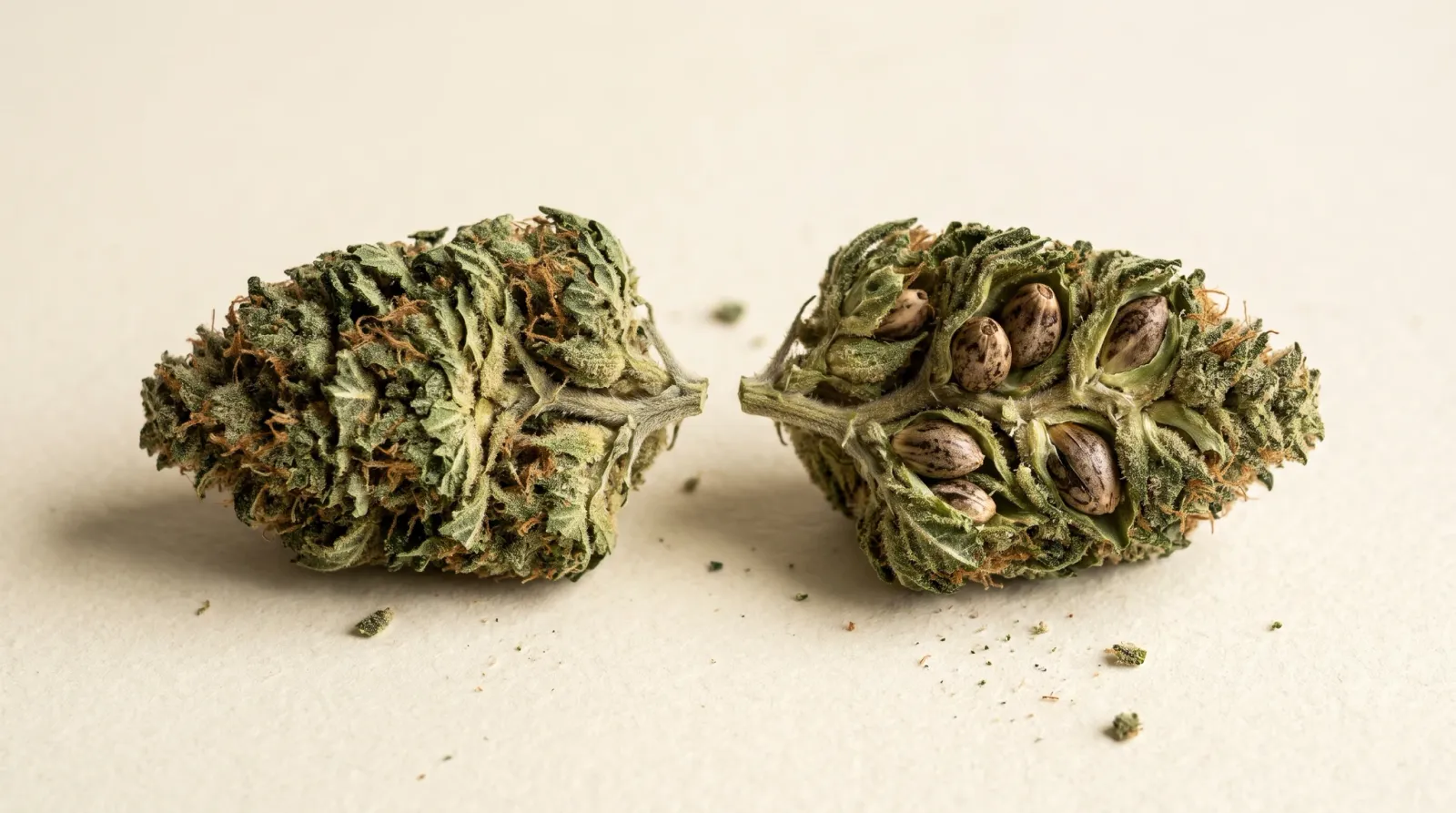
A female cannabis plant grows male flowers when its genetics and a trigger line up, and the triggers that controlled tests have confirmed are mostly chemicals, not the light leaks and heat that most grow guides blame. Silver compounds, and in older work gibberellin hormones, reliably push females to make pollen. The usual stress list is far thinner on evidence than its confidence suggests.
Here is the line worth sending to the friend who swears by sealing every pinhole: the light-leak rule has no controlled cannabis test behind it. The only study of leaks near grow-room doors scouted 403 plants and found male flowers on 28 of them (6.9%), with no link to distance from the door. Its author then says the study cannot settle the question, because the leaks were too dim to measure. Oliver, SURG, 2024
This lesson in High School maps each suspected trigger to what the research actually found, explains how to spot male flowers early, and lays out what they mean for your harvest. Several older articles here state light leaks and stress as settled causes in a line or two; this page is where we test those claims.
What is a hermaphrodite cannabis plant, and what are nanners?
A hermaphrodite cannabis plant, or “hermie”, is a female plant that also forms male flower parts. Growers call the banana-shaped anther clusters “nanners”. Cannabis is normally dioecious: separate male and female plants, with XX females and XY males.
In the best-described commercial survey, researchers in a licensed Canadian facility checked about 1,000 plants of three strains weekly with a hand lens over two production cycles. They found anthers on 5-10% of plants. Whole inflorescences converted to male flowers on only 2 of 1,000. Punja and Holmes, Frontiers in Plant Science, 2020 Those numbers describe three strains in one facility. They are not a typical rate for every grow.
The anthers usually appear as small yellow clusters, a few millimetres long, tucked inside the bract and surrounded by the white stigmas. They are easy to miss at arm’s length.
Is it a hermie or just pistils?
It is a hermie only if you see anthers. Pistils are the thin white or orange hairs every female flower carries; our guide to what pistils really are covers their colour change. Anthers look different: pale yellow to green, sac-like or curved like a tiny banana, and they grow out from inside the bract rather than reaching outward as fine hairs.
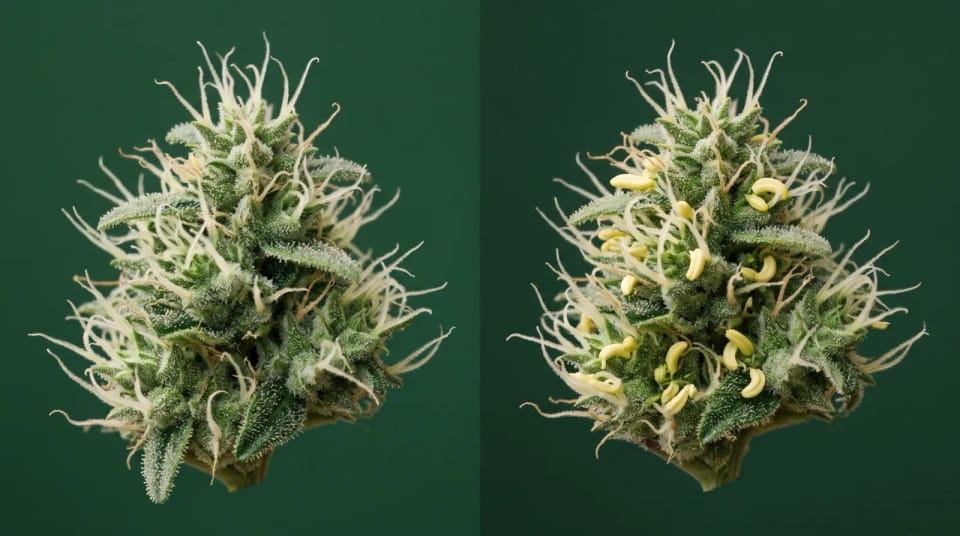
Pistils are fine hairs reaching outward. Anthers, the so-called nanners, are small yellow sacs growing out of the bract. Researchers describe them as clusters a few millimetres long, so a hand lens helps.
Swollen calyxes late in flower can fool you too. If you are unsure, look again with magnification in a few days. A true anther keeps its sac shape and may split open to shed pollen.
When do male flowers show up?
Male flowers most often show up in mid-to-late flower. A 2026 review places the first anthers in weeks four to seven of flowering and stresses that detection has to come before the pollen is released. Richards et al., Plants, 2026 If you want the flowering weeks in order, see our seed-to-harvest timeline.
Where you look matters. In the light-leak survey, every one of the 28 plants with male parts had them low on the stem or on small side inflorescences, not on the main top. Oliver, 2024
What actually causes male flowers on a female plant?
Two things have strong support: genetics and specific chemistry. The review that pulls the field together concludes that genetic and hormonal factors have the best evidence, and that environmental stressors are better treated as risk factors than confirmed causes. Richards et al., 2026
Genetics. In a 1954 study of hemp, female lines differed significantly in how readily they formed male flowers. Borthwick and Scully, Botanical Gazette, 1954 Cannabis sex is polygenic, with no single master switch, and the same review says current evidence has not identified any specific cultivar with a confirmed predisposition. A 2025 preprint points to an ethylene-making gene on the X chromosome as the leading candidate behind hemp lines that carry both flower types by design. Carey et al., bioRxiv preprint, 2025 That work concerns those hemp lines, not why one plant in your tent threw nanners. Genetics is also why breeders grow many seeds to find one plant.
Chemistry. Silver compounds block ethylene action in the plant, and they reliably turn female flowers male. Silver nitrate and silver thiosulphate produced fertile male flowers on genetically female plants as early as 1982. Mohan Ram and Sett, 1982 In a 2021 breeding study, silver thiosulphate gave hundreds of male flowers per treated plant, while untreated controls gave none. Flajsman et al., Frontiers in Plant Science, 2021 A 2026 study found that both XX and XY plants can undergo complete floral sex reversal when ethylene is modulated. Monthony et al., The Plant Journal, 2026
Gibberellins are the conflicted case. A 1972 study induced male flowers on females with several gibberellins and blocked the effect with abscisic acid. Ram and Jaiswal, Planta, 1972 The 2021 study’s gibberellin spray showed no significant effect in drug-type plants. Flajsman et al., 2021
Do light leaks, heat or pruning cause hermaphrodite cannabis?
Not on the evidence available. Each of these is plausible, and none has a clear controlled cannabis result. Here is the stressor-by-stressor map, with each row tied to a study you can open.
| Suspected trigger | What controlled work found | How strong |
|---|---|---|
| Light leaks in the dark period | 403 plants, 6.9% with male parts, no relationship to distance from the door. The author says the design could not measure the light. Oliver, 2024 | Inconclusive |
| Heat | No cannabis or hemp heat experiment found; the review’s heat evidence comes from cucumber and wheat. Richards et al., 2026 | None found |
| Cold | Low temperature during or just before flower induction gave more male flowers on female hemp. Borthwick and Scully, 1954 | One old hemp study |
| Very bright light | Full-intensity natural light gave male flowers on more female hemp plants than dimmer light. Borthwick and Scully, 1954 | One old hemp study |
| A sudden move to very short days | Moving plants to photoperiods much shorter than needed to flower gave more male flowers. Borthwick and Scully, 1954 | One old hemp study |
| Nitrogen level | Did not greatly change how many male flowers formed. Borthwick and Scully, 1954 | Weak |
| Hard cutting back, or a week of constant light or dark | Cutting to two nodes gave about 1.7 male-flower inflorescences against 1.0 on controls, both “only a few”. Untreated plants given a week of constant light, constant dark or 18/6 grew no male flowers. Flajsman et al., 2021 | Small, one population |
| Drought | Seven females grew male flowers after reduced watering combined with the switch to 12 hours; no denominator or untreated control was reported. Wizenberg et al., Plants, 2023 | Anecdote-grade |
| Silver compounds | Reliable conversion to male flowers. Mohan Ram and Sett, 1982 | Strong |
The surprise for most growers is the temperature row. Heat has no cannabis test. Cold made more male flowers in 1954. That study used one hemp variety, “Kentucky”, and only its abstract is open, so treat it as a lead, not a rule.
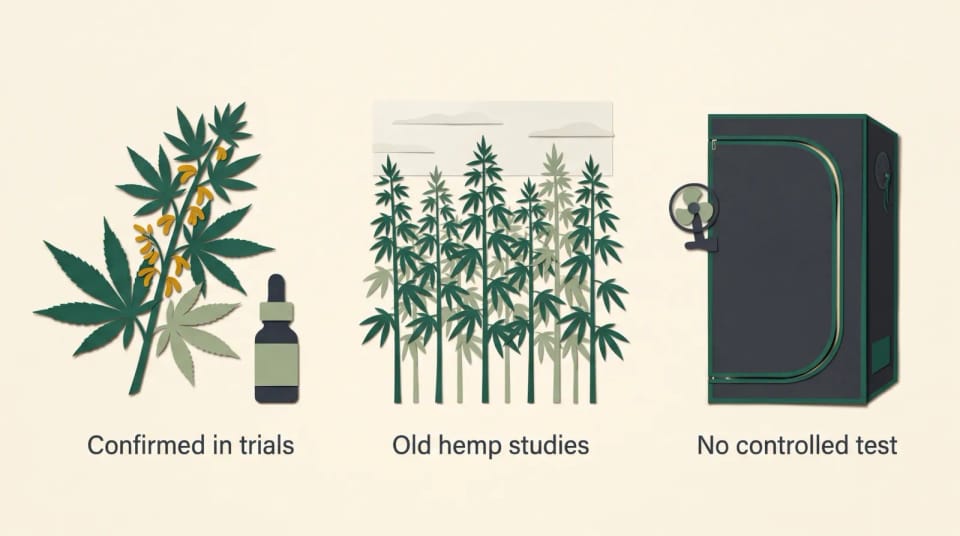
Chemical treatments reliably make male flowers on females. Cold, bright light and short days come from one 1954 hemp study. Light leaks, heat and pruning have no clear controlled cannabis result.
Two cautions keep this honest. First, a null result is not proof of safety. The light-leak study used distance from the door as a stand-in for light, and its meter read zero even close to the worst door, so it could not measure what it set out to test. Second, the small 2021 experiment found nothing for cutting back or a week of darkness, but with a handful of plants per group, that is “not shown”, not “never happens”.
Notice also what the best survey reported: most herming happened under standard production conditions, with no variable manipulated. Punja and Holmes, 2020 Stress may raise the risk. The evidence that it is the main cause is not there yet. Heat, pH and nutrient trouble each leave their own leaf symptoms; see our list of other grow problems and how to diagnose them. That page and our defoliation guide still repeat the stress line without a source; treat that line as unproven.
Do feminized seeds turn hermaphrodite more often?
Nobody has shown that in a study we could open. No source compares hermaphrodite rates between feminized and regular seed, and the 2026 review says no cultivar predisposition is confirmed. Richards et al., 2026
What is known is how feminized seed is made. Breeders treat a female with a silver compound so it grows male flowers, then use that pollen on another female. Because the pollen comes from an XX plant, it carries only X chromosomes. The 1954 hemp study already noted that pollen from male flowers on female plants gave seed that grew into females only. Borthwick and Scully, 1954 Self-pollinated seed from a masculinized female is called an S1, which our page on what an S1 seed is explains. For the broader comparison, see feminized, autoflower and regular seeds.
Whether seed from a spontaneous hermie carries a higher herm tendency into the next generation is untested in what we found. Seedlings grown from hermaphrodite seed in the 2020 survey tested female on a genetic marker. Punja and Holmes, 2020 That says nothing either way about whether they herm later. If you want to make seed on purpose, our guide to how breeders make seed on purpose covers controlled crosses.
Can you still harvest a plant with male flowers?
Yes, the flowers are still harvestable, but the measured facts say a pollinated harvest changes. Here is what the studies show:
- The pollen works. Pollen from hermaphrodite flowers germinated at 10-30% in the 2020 survey, and three seed-bearing inflorescences held 34, 48 and 22 seeds, most of which germinated. Punja and Holmes, 2020
- It is weaker than a true male’s. Cosexual plants made far less pollen than males, though some of it was viable. Wizenberg et al., 2023
- Pollinated flower measured lower in cannabinoids. In two chemovars, fertilization cut total cannabinoids by about 75% in the THC-rich plant and 60% in the CBD-rich plant. Lipson Feder et al., Frontiers in Plant Science, 2021 That is two lines with small groups, not a prediction for your plant.
What to do with the plant itself, whether to pluck anthers, isolate it or harvest early, lives in grower experience, not in trials. We found no peer-reviewed test of any of those methods. The one firm point from the research is timing: decide before the anthers open.
Scientists are working on instruments too. A 2022 study used a hand-held Raman spectrometer to tell hermaphrodites from males and females. Goff et al., Molecules, 2022 For now, careful eyes and a hand lens remain the practical method.
Is hermie bud safe to smoke?
No source we opened addresses the safety of consuming flower from a hermaphrodite plant, so we will not call it safe or unsafe. The measured differences are seeds and lower cannabinoid levels. If you smoke a seeded harvest and want to compare it with your earlier jars, the High IQ app lets you log how each strain worked for you. If you get chest pain, wheezing or breathing trouble after smoking any cannabis, talk to a clinician.
Sources
- Punja ZK, Holmes JE. Hermaphroditism in marijuana (Cannabis sativa L.) inflorescences: impact on floral morphology, seed formation, progeny sex ratios, and genetic variation. Frontiers in Plant Science, 2020.
- Richards CD, et al. Hermaphroditism in Cannabis sativa L.: impacts, inducers, and industry implications. Plants, 2026.
- Oliver W. Investigating the effects of dark period light exposure on sex expression in female Cannabis sativa. SURG, 2024.
- Borthwick HA, Scully NJ. Photoperiodic responses of hemp. Botanical Gazette, 1954.
- Flajsman M, et al. Production of feminized seeds of high CBD Cannabis sativa L. by manipulation of sex expression and its application to breeding. Frontiers in Plant Science, 2021.
- Wizenberg SB, et al. Cosexuality reduces pollen production and fitness in Cannabis sativa L.. Plants, 2023.
- Lipson Feder C, et al. Fertilization following pollination predominantly decreases phytocannabinoids accumulation and alters the accumulation of terpenoids in cannabis inflorescences. Frontiers in Plant Science, 2021.
- Mohan Ram HY, Sett R. Induction of fertile male flowers in genetically female Cannabis sativa plants by silver nitrate and silver thiosulphate anionic complex. Theoretical and Applied Genetics, 1982.
- Ram HYM, Jaiswal VS. Induction of male flowers on female plants of Cannabis sativa by gibberellins and its inhibition by abscisic acid. Planta, 1972.
- Monthony AS, et al. Sex-specific ethylene responses drive floral sexual plasticity in Cannabis sativa. The Plant Journal, 2026.
- Carey SB, et al. An X-linked sex determination mechanism in cannabis and hop. bioRxiv preprint, 2025.
- Goff NK, et al. Non-invasive and confirmatory differentiation of hermaphrodite from both male and female cannabis plants using a hand-held Raman spectrometer. Molecules, 2022.
Key takeaways
- A hermie is a female plant that also grows male flowers; anthers (“nanners”) are yellow sacs inside the bract, not pistil hairs.
- Silver compounds reliably cause it. Gibberellin results conflict.
- Light leaks, heat and pruning have no clear controlled cannabis result. The only light-leak study was inconclusive.
- Cold, bright light and sudden short days raised male flowers in one 1954 hemp study.
- Genetics matter, but no cultivar or seed type has a confirmed tendency.
- Scout weekly from weeks four to seven of flower, low on the plant, before any pollen is released.
FAQ
Do light leaks cause hermies?
That has not been shown. The only study found no link between door distance and male flowers in 403 plants, and its author says the design could not measure the light. A 2026 review calls the evidence mixed and asks for controlled experiments.
Does stress cause hermaphrodite cannabis?
Stress is a plausible risk factor, not a confirmed cause. In the best-described survey, plants grew male flowers under standard conditions with nothing manipulated, and a small 2021 experiment found none after a week of total darkness. Chemical triggers and genetics have much stronger evidence.
Can a hermaphrodite plant pollinate itself?
Yes. Pollen from hermaphrodite flowers is viable, and in the 2020 survey the seed it set germinated well. It can also pollinate neighbouring females, which is why timing matters.
Are seeds from a hermaphrodite plant feminized?
They come from pollen made by an XX plant, so they tend to grow into females; that is the principle behind feminized seed. Whether they inherit a stronger tendency to herm has not been tested in the studies we found.
Can autoflowers turn hermaphrodite?
Autoflowers are still cannabis plants, and nothing in the research exempts them. No study we opened measured hermaphrodite rates in autoflowers specifically, so there is no number to give. For how they differ, see how photoperiod plants flower.





