Male vs Female Cannabis Plants: What Each Early Sign Actually Proves
Male vs female cannabis plants: pollen sacs at a node mean male, white pistil hairs mean female, and height proves nothing. Here is what the studies show.

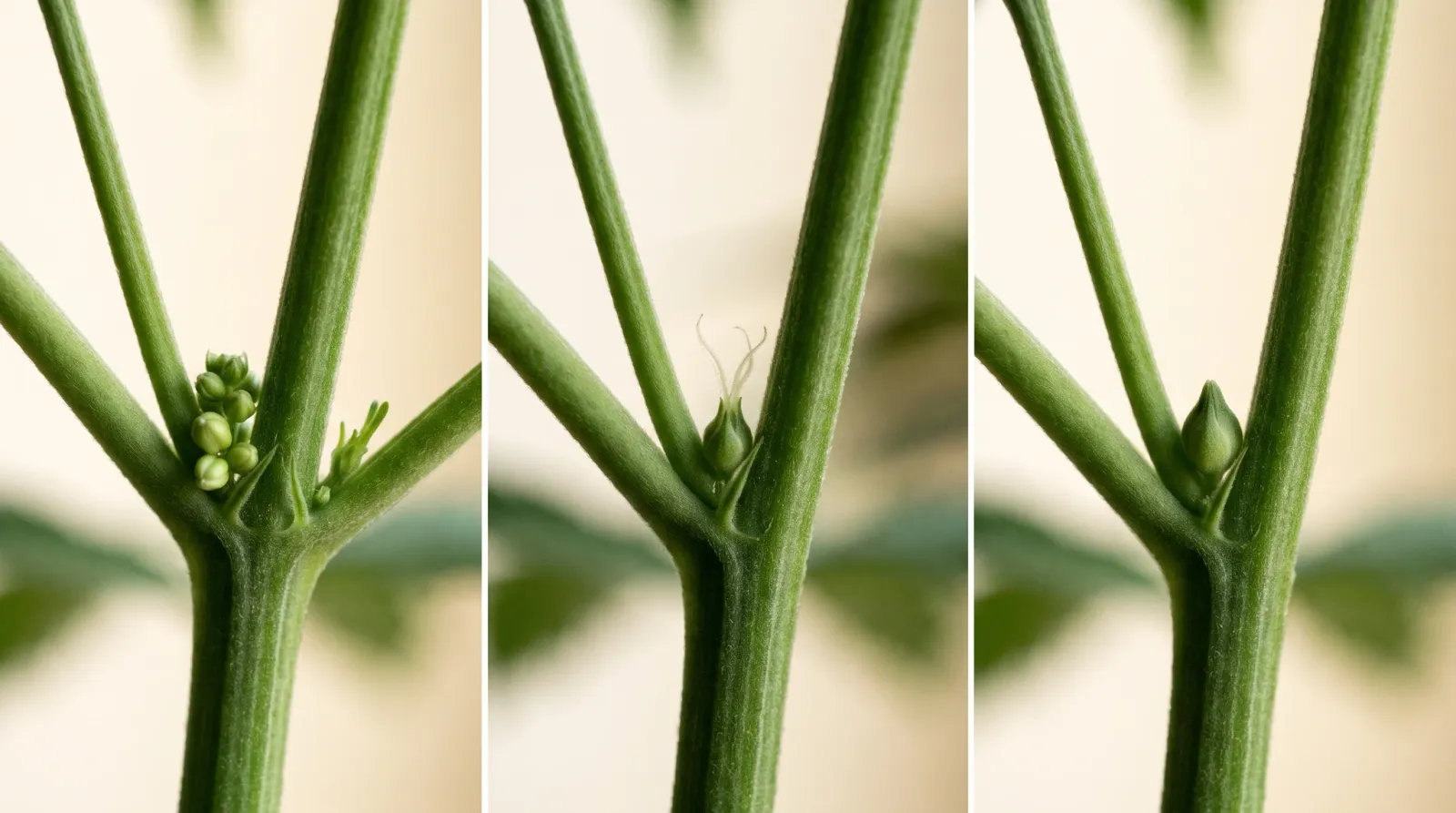
You can only prove a cannabis plant’s sex when its first flowers form at the nodes: a cluster of round, hairless pollen sacs means male, white pistil hairs mean female, and a small bud with neither proves nothing yet. Height, stem thickness and leaf shape are hints at best. Seed shape and seedling looks are not reliable at all, and several research groups say so directly. Prentout et al., 2025
Here is why it matters. In one controlled study, a fertilized female plant lost about 60 to 80 percent of her cannabinoids. Meanwhile, the “tell” many growers trust most, a taller, stretchier seedling, did not hold across the two cultivars measured in a 112-plant study. Lipson Feder et al., 2021; Campbell et al., 2021 A taller seedling is not a male. Only a flower is proof, and a missed male can cost most of the potency.
This High School guide shows where to look, what each sign proves, how sure the evidence is, and what to do with a male once you find him.
Why does the sex of a cannabis plant matter?
Cannabis is mostly dioecious: an individual plant usually makes either male flowers or female flowers. Sex is set by chromosomes, XX for females and XY for males, the way it is in people. A 2020 genome study found more than 500 sex-linked genes on the cannabis sex chromosomes. Prentout et al., 2020
Growers care because the resin-heavy flowers people buy come from unpollinated female plants. Male plants shed pollen. When that pollen reaches a female, she sets seed. In commercial production, a 2020 study notes, “male plants are destroyed as seed formation reduces flower quality.” Punja and Holmes, 2020
If you are still choosing seed, start with feminized, autoflower and regular seeds. Regular seed can grow either sex. Feminized seed is bred to skip most of this work.
How early can you tell if a cannabis plant is male or female?
You can tell when the first flowers form at the nodes, not on a fixed week. The sex is decided long before you can see it. One gene study found male and female hemp plants already expressed different genes at very early vegetative stages. Shi et al., 2025 But a gene is not something a grower can see.
What you can see is a small solitary flower where a leaf stalk joins the main stem. Botanists call these “bracts and solitary flowers (colloquially referred to as pre-flowers).” In one cultivar tracked from seed to senescence, they appeared at nodes 7 to 12. Hesami et al., 2023 A separate study on female cuttings found these flowers form under long days. They depend on the plant’s age, not on a light change. Spitzer-Rimon et al., 2019
So count nodes, not days. Week counts vary too much to trust. One study grew two chemical types side by side in a growth chamber. The first male flowers appeared 63 days after sowing in one type and 106 days in the other. Yoshimatsu et al., 2004
A sexing timeline, labelled by how sure we are
Most online charts give confident week counts with no source. Here is the honest version. Each row says where the number comes from.
| What to watch for | When it was seen | How sure the evidence is |
|---|---|---|
| Stipules (small spurs) at nodes 5 and 6 as the plant leaves its juvenile phase | One cultivar, under long days | One study, one cultivar Hesami et al., 2023 |
| First solitary flowers (“pre-flowers”) at the nodes | Nodes 7 to 12 in one cultivar | One study, one cultivar Hesami et al., 2023 |
| Male flower clusters at the leaf axils | “Around 4 weeks of age” under 24-hour light; maturing over weeks 4 to 6 | One study, three strains; the start of the clock is unclear Punja and Holmes, 2020 |
| First male flowering | 63 days after sowing in one type, 106 in another | One study, two chemical types Yoshimatsu et al., 2004 |
| “Males at 3 to 4 weeks, females at 4 to 8 weeks” | Repeated widely online | Grower-reported, no source found |
The node counts come from photoperiod plants. If you grow autoflower versus photoperiod plants, do not mix their timelines. Treat any autoflower week chart, including the pre-flower row in our autoflower week-by-week guide, as grower guidance rather than a measured rule. For where nodes fall in the whole life cycle, see the seed-to-harvest timeline.
What does a male cannabis pre-flower look like?
A male flower is a smooth, round sac on a short stalk, with no hair, and males usually form them in clusters. People often compare them to tiny grapes or balls. In the 2020 study, male flowers formed in clusters at the leaf axils, matured over the next two weeks, and then shed “large amounts of pollen.” Punja and Holmes, 2020
One sac is easy to misread. Several sacs together, with no white hair anywhere on the plant, is a much stronger sign.
What does a female pre-flower look like, and can it have no hairs?
A female flower is a small teardrop-shaped calyx, and the proof is one or two fine white hairs, called pistils or stigmas, growing out of its tip. Those hairs are the parts that catch pollen. Our guide to what pistils are explains how they change color as flower matures.
Here is the trap most guides skip: a female pre-flower can exist with no visible hair yet. In a study of female medical cultivars under long days, one cultivar’s solitary flowers “were not fully developed and stigmata were not visible.” After 5 days of short days, the stigmata showed. Spitzer-Rimon et al., 2019 So a hairless bud is not a male by default. It may be a female that has not grown her hairs yet.
| What you see at the node | What it proves | What to do |
|---|---|---|
| One or more white pistil hairs | Female | Keep her, and keep checking for male parts later |
| A cluster of round, hairless sacs on short stalks | Very likely male | Confirm, then remove him before the sacs open |
| One small bud with no hairs | Nothing yet | Wait a few days and check the next nodes |
| Nothing at the nodes | Not flowering yet | Keep counting nodes |
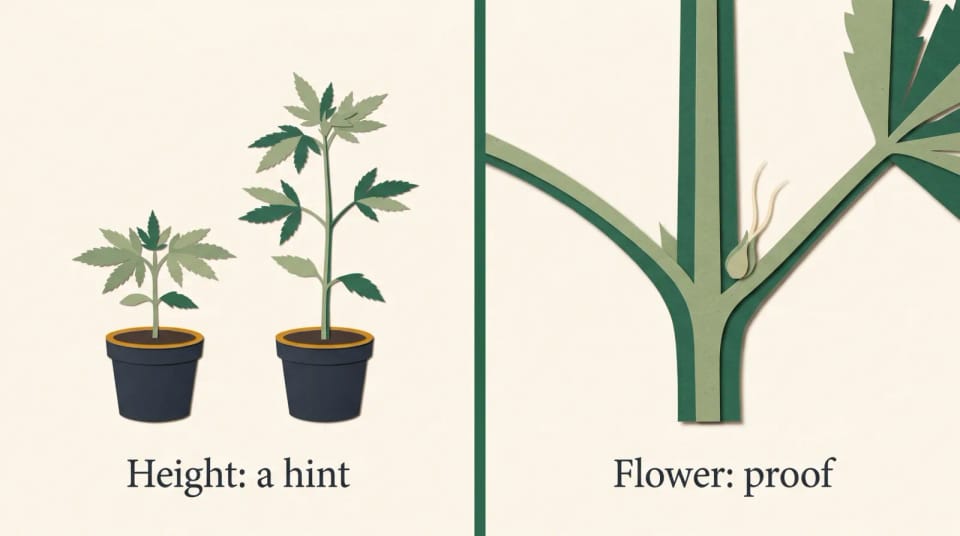
Plant shape can lean one way in one cultivar and the other way in the next. Only the flower at the node settles it.
Can you tell by height, stem or leaf shape?
No, not reliably. These are the most shared tips, and the evidence behind them is weak.
- Height and stretch. A study of 112 hemp plants in two cultivars measured seedlings in their second week. Males had longer seedling stems (hypocotyls), “but this difference depended on the cultivar.” The authors concluded the plants show no significant sexual dimorphism at the seedling stage. Campbell et al., 2021
- Taller males in a grow room. The 2020 study did photograph males growing faster and taller than females. That photo came from one seed batch of one strain. Punja and Holmes, 2020 It is a hint in that batch, not a rule for yours.
- Leaves, even with instruments. A study scanned hemp leaves with a hyperspectral sensor and machine learning. Sex classification was error-free at flowering but only 60 to 87 percent accurate in early growth. Its authors wrote that males and females “are visually indistinguishable during early growth.” Matros et al., 2023
If a laboratory sensor misses up to 40 percent of plants before flowering, your eye will not do better. Use soft cues only to decide which plant to inspect first.
Can you tell the sex from the seed?
No. No visual method sorts seeds or seedlings by sex. A 2025 study states that “the sexual dimorphism at immature plants is too subtle for reliable phenotypic sexing.” Prentout et al., 2025 A second team wrote that it “is not possible to phenotypically distinguish male and female plants before flowering.” Riera-Begue et al., 2025
An older Italian study reached the same view: the visible differences appear “in a late stage of plant development.” Moliterni et al., 2004
Seed color, size, stripes and shape tell you about the seed’s maturity and handling. They do not tell you its sex. For what does matter at the start, see our guide to germinating seeds.
Is a DNA test worth it?
A leaf DNA test is the only method shown to sex a seedling accurately, so it is worth it when you need the answer early and have the budget. The test looks for DNA markers found only on the male Y chromosome.
- A multiplex PCR test sexed about 200 plants from 12 hemp-type cultivars with a 99.5 percent true positive rate. Prentout et al., 2025
- A second PCR method reached 100 percent accuracy on more than 500 samples from 14 hemp-type cultivars and 6 crosses. Riera-Begue et al., 2025
- A commercial lab ran 8,200 leaf samples through a qPCR male test and reported more than 98.5 percent accuracy. Torres et al., 2022
- DNA sexing of two-week-old plants was first shown in 2010. Techen et al., 2010
Two cautions. Most of this testing used hemp-type cultivars, so accuracy in every drug-type cultivar has not been shown. And the 2021 seedling study noted that molecular tools are unaffordable for most growers. Campbell et al., 2021 For a few plants from regular seed, waiting for the flower is free and works.
Do feminized seeds always grow female plants?
No. Feminized seed grows female plants, but a female plant can still form male flower parts. In commercial indoor grows of three all-female strains, hermaphroditic anthers appeared on 5 to 10 percent of plants. They showed up in weeks 4 to 7 of flowering. Punja and Holmes, 2020
The reason is that sex is chromosomal but flower type can shift. A 2026 review describes how silver compounds make female plants grow male flowers, which is how feminized seed is made, and how other treatments push genetic males toward female flowers. Dubas et al., 2026 Stress-induced cosexual plants still made viable pollen in another study, though true males made far more. Wizenberg et al., 2023 Rare exceptions exist too: one 2024 paper reported an XY plant that grew both flower types. Garcia-de Heer et al., 2024
The practical rule: even with feminized seed, check your females for anthers through flowering.
What happens if a male pollinates your females?
The female sets seed, and in one controlled study her flowers lost most of their cannabinoids. Researchers crossed a THC-rich female and a CBD-rich female with several pollen sources. After fertilization, phytocannabinoids fell by an average of 75 percent in the THC-rich female and 60 percent in the CBD-rich female. Lipson Feder et al., 2021
Read that number carefully. It is one lab, two female chemovars and four to six plants per group. The THC-rich female lost 60 to 80 percent with every male type tested. The CBD-rich female lost about half, except with one pollen source, which left her unchanged. Monoterpenes, the lighter aroma compounds, followed the cannabinoid drop. The ratio between cannabinoids stayed about the same. So pollination makes the flower weaker, not different.
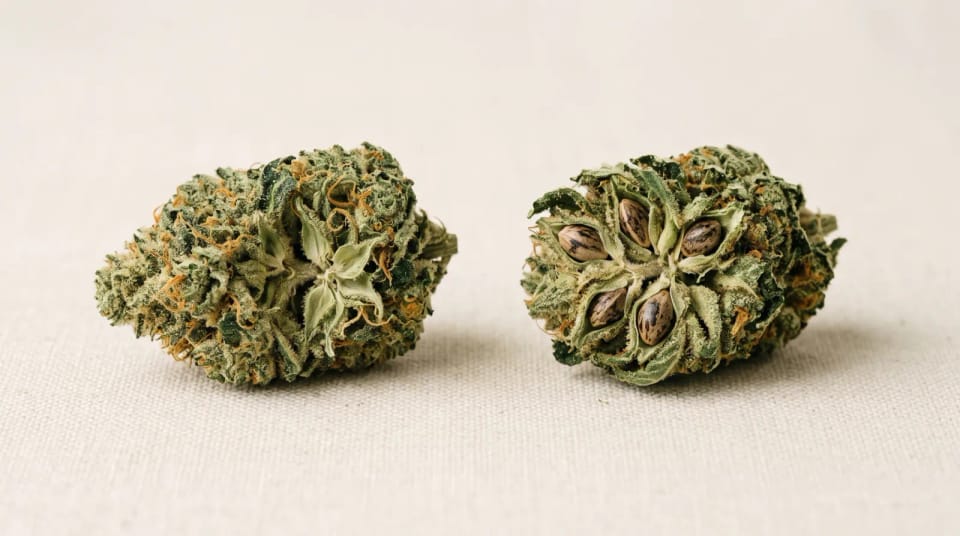
Seeds are the visible sign of pollination. The cost you cannot see is the cannabinoid drop measured in the controlled study above.
How far does pollen travel? Outdoors, much farther than people expect. A modelling study of hemp notes that one male flower can release up to 350,000 pollen grains. It adds that recommended isolation distances between hemp fields typically run 1 to 5 km. Nimmala et al., 2024 Those distances describe open fields, not a home tent. No study we found measures spread inside a tent. The safe indoor rule is simple: one male with open sacs in the same space is enough risk, so move him out early.
What do you do with a male cannabis plant?
If you are not breeding, remove him before his pollen sacs open; if you are breeding, isolate him. Male plants in the 2020 study released pollen over two to four weeks, so a late find leaves a long window for damage. Punja and Holmes, 2020
- Confirm the sign. Look for several hairless sacs at more than one node, not a single bud.
- Bag him in place. Slip a plastic bag over the plant before you move it, so closed or opening sacs do not drop pollen on the way out.
- Take him out of the grow space. Then discard him with your green waste. Wash your hands and change your shirt before you touch the females.
- Recheck the room. Look over the remaining plants for a second male you missed and for any female growing anthers.
Breeding is the main reason to keep a male. If that is your plan, read about breeding with a male at home and phenotype hunting.
Online lists claim many other uses for males, from juicing to soil enrichment. We found no evidence for those claims, so we do not repeat them. Two supported points: male hemp plants are part of fibre crops, because males and females differ in stature and fibre properties. Salentijn et al., 2019 Male flowers do contain some cannabinoids, but how much less than female flowers varies widely between studies. In wild low-THC hemp, one analysis found CBD extracts from male and female flowers close (0.8 and 0.9 percent). Nagy et al., 2019 Another found female flowers carried 16.88 times the cannabinoids of male flowers. Chen et al., 2026 Neither result makes male plant material a substitute for flower.
Can you skip sexing altogether?
Yes, with the right starting material. A cutting from a known female is female, because a clone carries its mother’s genetics. Our guide on how cuttings work covers the method, and what a clone-only cut is explains why some strains exist only as cuttings. Feminized seed removes most males, with the anther caveat above. Triploid, seedless cannabis takes a different route to seedless flower.
A note on safety: this guide is about plants, not people. If handling plants or pollen leaves you wheezing, with hives, or with a rash that does not settle, talk to a clinician.
Key takeaways
- Sex is set by XX and XY chromosomes, but you can only see it when flowers form at the nodes.
- White pistil hairs prove female. A cluster of round, hairless sacs points to male. One hairless bud proves nothing yet.
- Height, stem and leaf shape are hints at best. No visual method sexes a seed or seedling.
- Count nodes, not weeks. Published week counts vary with cultivar and conditions.
- In one controlled study, pollination cut a female’s cannabinoids by about 60 to 80 percent.
- Remove males before their sacs open, and keep checking feminized plants for anthers.
FAQ
How soon can you tell the sex of a cannabis plant grown from seed?
You can tell when the first solitary flowers form at the nodes. In one cultivar that was at nodes 7 to 12. Calendar weeks vary with cultivar and growing conditions, so count nodes and inspect each new one. A leaf DNA test can answer within the first weeks if you need to know sooner.
Is my weed plant male or female if the pre-flower has no hairs?
You cannot tell yet. A study of female plants found solitary flowers with no visible stigmas under long days, and the hairs appeared later. Wait a few days and look at the next nodes. A cluster of several round, hairless sacs is the male sign; one hairless bud is not.
Are male cannabis plants taller than females?
Sometimes, but not reliably. In a 112-plant hemp study, males had longer seedling stems only in a way that depended on the cultivar. Use height to decide which plant to check first, never to remove one.
Can a female cannabis plant turn male?
A female plant keeps her XX chromosomes, but she can grow male flower parts under stress or chemical treatment. In one study of three all-female strains, 5 to 10 percent of plants grew anthers during flowering. That is why growers check females for anthers all the way to harvest.
Do male cannabis plants get you high?
Male flowers contain some cannabinoids, but studies disagree on how much less than female flowers. One found female flowers had nearly 17 times more. Male plants are grown for breeding and fibre, not for flower.
Sources
- Prentout D, Razumova O, Rhoné B, et al. (2020). “An efficient RNA-seq-based segregation analysis identifies the sex chromosomes of Cannabis sativa.” Genome Research. PMC full text
- Punja ZK, Holmes JE (2020). “Hermaphroditism in Marijuana (Cannabis sativa L.) Inflorescences: Impact on Floral Morphology, Seed Formation, Progeny Sex Ratios, and Genetic Variation.” Frontiers in Plant Science. PMC full text
- Campbell LG, Peach K, Wizenberg SB (2021). “Dioecious hemp (Cannabis sativa L.) plants do not express significant sexually dimorphic morphology in the seedling stage.” Scientific Reports. PMC full text
- Prentout D, El Aoudati S, Mathis F, et al. (2025). “Promising high fidelity genetic markers for sexing Cannabis sativa seedlings.” G3. PMC full text
- Riera-Begue A, Toscani M, Malik A, et al. (2025). “A simple and reliable PCR-based method to differentiate between XX and XY sex genotypes in Cannabis sativa.” Planta. PubMed record
- Torres A, Pauli C, Givens R, Argyris J (2022). “High-throughput methods to identify male Cannabis sativa using various genotyping methods.” Journal of Cannabis Research. PubMed record
- Lipson Feder C, Cohen O, Shapira A, et al. (2021). “Fertilization Following Pollination Predominantly Decreases Phytocannabinoids Accumulation and Alters the Accumulation of Terpenoids in Cannabis Inflorescences.” Frontiers in Plant Science. doi:10.3389/fpls.2021.753847
- Spitzer-Rimon B, Duchin S, Bernstein N, Kamenetsky R (2019). “Architecture and Florogenesis in Female Cannabis sativa Plants.” Frontiers in Plant Science. PMC full text
- Hesami M, Pepe M, Jones AMP (2023). “Morphological Characterization of Cannabis sativa L. Throughout Its Complete Life Cycle.” Plants. PMC full text
- Matros A, Menz P, Gill AR, et al. (2023). “Non-invasive assessment of cultivar and sex of Cannabis sativa L. by means of hyperspectral measurement.” Plant-Environment Interactions. PubMed record
- Moliterni VMC, Cattivelli L, Ranalli P, Mandolino G (2004). “The sexual differentiation of Cannabis sativa L.: A morphological and molecular study.” Euphytica. Publisher abstract
- Shi J, Toscani M, Dowling CA, et al. (2025). “Identification of genes associated with sex expression and sex determination in hemp (Cannabis sativa L.).” Journal of Experimental Botany. PubMed record
- Dubas E, Krzewska M, Żur I, et al. (2026). “Revisiting sex plasticity in Cannabis sativa L.: A hormonal cross-talk in flower masculinisation.” Plant & Cell Physiology. PubMed record
- Wizenberg SB, Muir-Guarnaccia J, Campbell LG (2023). “Cosexuality Reduces Pollen Production and Fitness in Cannabis sativa L.” Plants. PubMed record
- Garcia-de Heer L, Mieog J, Burn A, Kretzschmar T (2024). “Why not XY? Male monoecious sexual phenotypes challenge the female monoecious paradigm in Cannabis sativa L.” Frontiers in Plant Science. doi:10.3389/fpls.2024.1412079
- Nimmala M, Ross SD, Foroutan H (2024). “Cannabis pollen dispersal across the United States.” Scientific Reports. PMC full text
- Salentijn EMJ, Petit J, Trindade LM (2019). “The Complex Interactions Between Flowering Behavior and Fiber Quality in Hemp.” Frontiers in Plant Science. PubMed record
- Nagy DU, Cianfaglione K, Maggi F, et al. (2019). “Chemical Characterization of Leaves, Male and Female Flowers from Spontaneous Cannabis (Cannabis sativa L.) Growing in Hungary.” Chemistry & Biodiversity. PubMed record
- Chen Y, Qi G, Zhang J, et al. (2026). “Comparative analysis of gene expression and metabolites in female and male Cannabis sativa flowers.” iScience. PubMed record
- Techen N, Chandra S, Lata H, ElSohly MA (2010). “Genetic identification of female Cannabis sativa plants at early developmental stage.” Planta Medica. PubMed record
- Yoshimatsu K, Iida O, Kitazawa T, et al. “Growth characteristics of Cannabis sativa L. cultivated in a phytotron and in the field.” Bulletin of the National Institute of Health Sciences, 2004;122:16-20. PMID 15940897. PubMed record





