Government Cannabis Patent: What It Did Not Prove About CBD
The government cannabis patent reports research, not proof that retail CBD works. An FTC case shows the missing link between a patent and a product.

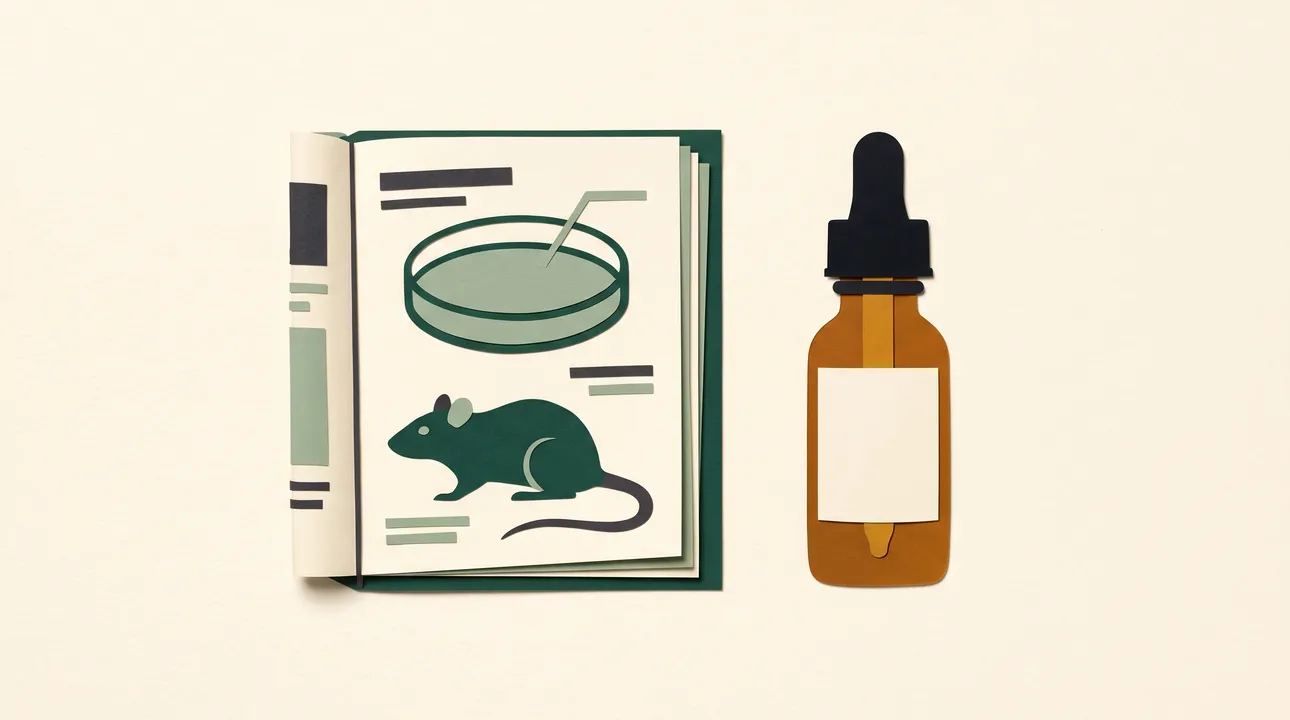
The government’s cannabinoid patent did not prove that retail CBD products delivered their advertised health benefits. It described research and claimed treatment methods. That is different from showing that a particular product works in people.
A historical FTC case makes the gap visible. Retailers invoked the patent in their advertising. The final order required a customer notice explaining that the government had not validated the advertised health claims. Here in High School, the lesson is to follow the evidence past the patent number.
Which government cannabis patent are people citing?
It is U.S. Patent 6,630,507 B1, titled Cannabinoids as antioxidants and neuroprotectants, granted on October 7, 2003. Its named inventors are Aidan J. Hampson, Julius Axelrod and Maurizio Grimaldi. The issued document lists the United States, represented by the Department of Health and Human Services, as the assignee. Original issued patent
The document has 26 claims describing treatment methods with defined cannabinoids. Some dependent claims specify cannabidiol, or CBD. It is more specific than the loose phrase “the government patented cannabis.”
But a patent claim is not the result of a clinical trial. Naming a disease in a claim does not tell us that a retail preparation improved that disease in patients.
What experiments did the patent describe?
Its experimental examples include chemical tests, cultured nerve cells and a rat model of stroke. These address biological questions under laboratory conditions. They are not tests of a CBD shop’s finished bottles in customers. Patent full text, Examples 1–7
For example, the cell work measured signs of injury after a controlled chemical insult. The rat work compared CBD with a vehicle control. Researchers measured brain injury after blocking and reopening an artery. The patent reports protective findings in these models. Dismissing the document as containing no research would be wrong.
The error comes when those findings acquire a different job. A cell-injury measure is not a person’s symptom score. A rat experiment is not a human clinical trial. An experimental preparation is not automatically a commercial extract.
Our lesson on making a cannabinoid versus proving a benefit explains the same boundary from a manufacturing angle. Identifying a compound and testing a health outcome are separate questions.
Doesn’t a patent require proof that an invention works?
Patent examination includes an enablement requirement: the disclosure must let a skilled person make and use the claimed invention without undue experimentation. That requirement serves a different purpose from assessing a treatment’s safety and effectiveness in people.
The USPTO’s examination manual explicitly distinguishes its enablement assessment from FDA considerations for approving clinical trials. It also explains that patent examples can describe actual work or predicted results. That general rule does not make this patent’s reported cell and rat experiments imaginary. USPTO, MPEP §2164.02 and §2164.05
The useful question is therefore specific: what evidence connects this advertised product to this claimed human outcome? A patent number does not supply that connection by itself.
How did retailers use the patent in the FTC case?
The FTC’s 2021 complaint against CBD Meds, G2 Hemp and Lawrence Moses reproduced advertisements invoking Patent 6,630,507. A patent-themed page presented the government’s document as support for claimed medicinal benefits. Other ads linked government research to broad health claims. FTC complaint and advertising exhibits
The agency alleged that the sellers misrepresented scientific proof and government confirmation. Paragraphs 10–12 set out those representations and explain why the FTC considered them false or misleading.
Those are the complaint’s allegations. They should not be retold as a court trial proving that every use of CBD fails. This is a dated advertising case, not a report about the companies’ conduct today.
What did the final order require?
The final decision and order was issued on February 2, 2021. The respondents agreed to a consent order without admitting or denying the allegations, apart from facts needed to establish jurisdiction. FTC final decision and order
Its evidence requirements matter:
- Section I covered specified health claims. It required adequate human clinical evidence from randomized, double-blind, placebo-controlled testing of the covered product or an essentially equivalent product.
- Section II covered other health claims. It required competent and reliable evidence suited to the claim. That included the same kind of human testing when relevant experts would generally require it.
So the order did not impose one identical study rule on every possible statement. Nor did “contains CBD” make two products equivalent. The definition considered ingredients, form, dosage and route, with conditions for inactive or additional ingredients.
That product distinction starts with identity. Our hemp seed oil and CBD oil label lesson shows why a broad hemp description cannot stand in for a finished formulation.
The order also required a customer notice. Attachment A said the sellers lacked proof for the listed serious-condition claims and that the government had not validated them. The patent citation had not supplied the missing product evidence. A required notice is not evidence that a new clinical trial took place, or confirmation here that the notice was sent.
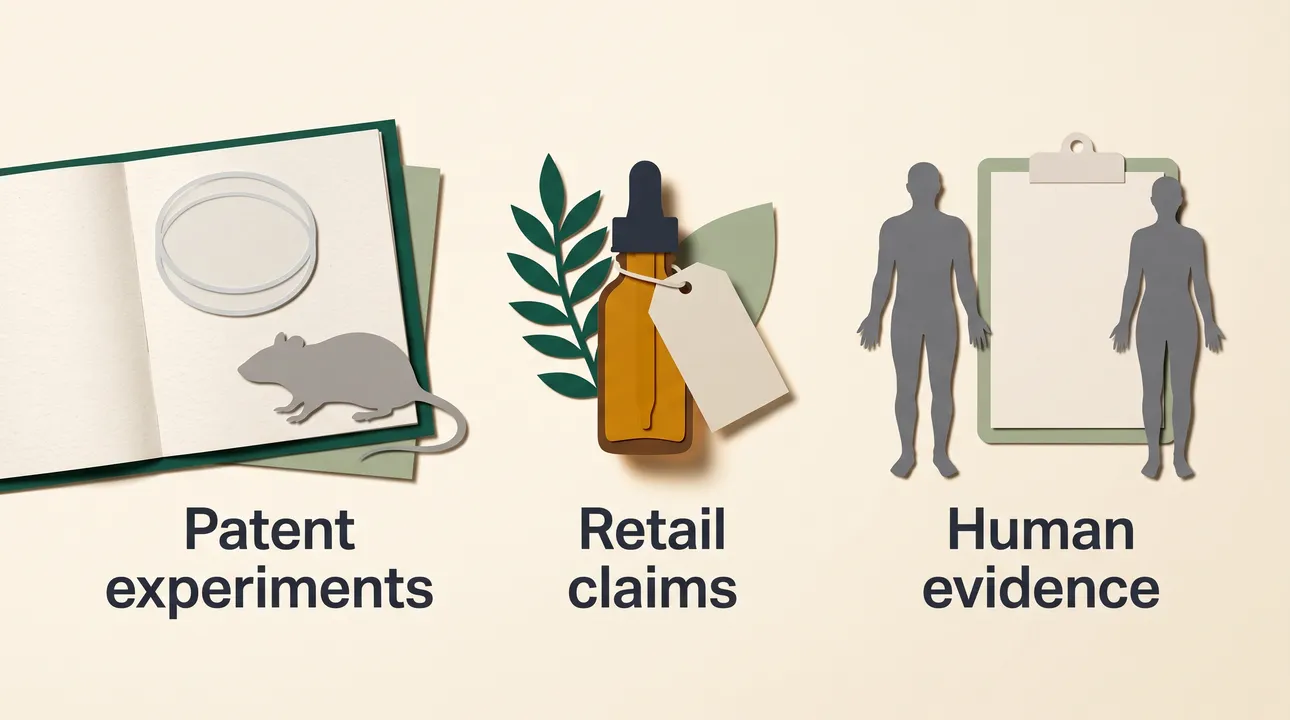
Different evidence questions, not three completed tests. The patent did not establish the retail claims; the FTC order required appropriate evidence for them.
What would evidence for a retail claim need to answer?
It needs to address the claim rather than merely mention the ingredient. Keep four details together: the preparation, the people studied, the comparison and the measured outcome. A useful study also reports its limits and adverse findings.
Our guide to reading a placebo-controlled tremor result shows why a completed comparison differs from a trial plan or personal report. The pharmaceutical versus retail sleep-apnea evidence lesson shows why the tested medicine must stay attached to its result. These are examples of reading evidence, not reasons to use either treatment.
Safety is another question. The CBD liver-trial methods and safety limits comparison explains why controls and monitoring matter. Neither a patent nor a short study with limited findings identifies a safe personal amount.
The evidence check works without either extreme. A real patent can contain useful science. That science still may not support the advertisement beside it. And an unsupported claim does not prove that all possible CBD treatments are ineffective.
FAQ
Was Patent 6,630,507 a human trial of retail CBD oil?
No. The patent’s examples discussed here include chemical assays, cultured cells and rats. They did not test the advertised retail products in people.
Did the FTC case mean the patent was fake?
No. The issued patent is a real document. The dispute concerned what supported the sellers’ advertising claims, including their representations of scientific proof and government confirmation.
Did the companies admit every allegation?
No. The final order records that they neither admitted nor denied the allegations, except jurisdictional facts. It still imposed evidence requirements and a customer-notice obligation.
Does this case prove CBD can never have a medical benefit?
No. It does not settle every preparation, condition or future study. It shows why a patent citation cannot substitute for appropriate evidence supporting a particular retail health claim.
Key takeaways
- Patent 6,630,507 contains experimental science and treatment claims, not a human trial of the advertised retail bottles.
- The FTC complaint’s allegations and the final consent order are different documents.
- The final order required appropriate product evidence and a notice that the government had not validated the advertised claims.
Sources
- Hampson, A. J., Axelrod, J., and Grimaldi, M. Cannabinoids as antioxidants and neuroprotectants. U.S. Patent 6,630,507 B1, granted October 7, 2003. Issued document. Searchable full text.
- United States Patent and Trademark Office. MPEP §2164: The enablement requirement, particularly §2164.02 and §2164.05. Accessed October 11, 2026.
- Federal Trade Commission. In the Matter of CBD Meds, Inc., et al., File 202 3080, Docket C-4735. Complaint and advertising exhibits, issued February 2, 2021. Allegations, not a clinical experiment.
- Federal Trade Commission. In the Matter of CBD Meds, Inc., et al., File 202 3080, Docket C-4735. Decision and Order, issued February 2, 2021. Opening, definitions, Sections I–II and VI, and Attachment A.

