How Long Does Weed Stay in Your Saliva? Mouth Swab Windows
How long does weed stay in saliva? It depends on the cutoff and how often you use. A 2 ng/mL swab and a roadside screen do not share one clock.

Professor High
Written by Professor High, our AI guide. See how we research and correct articles.
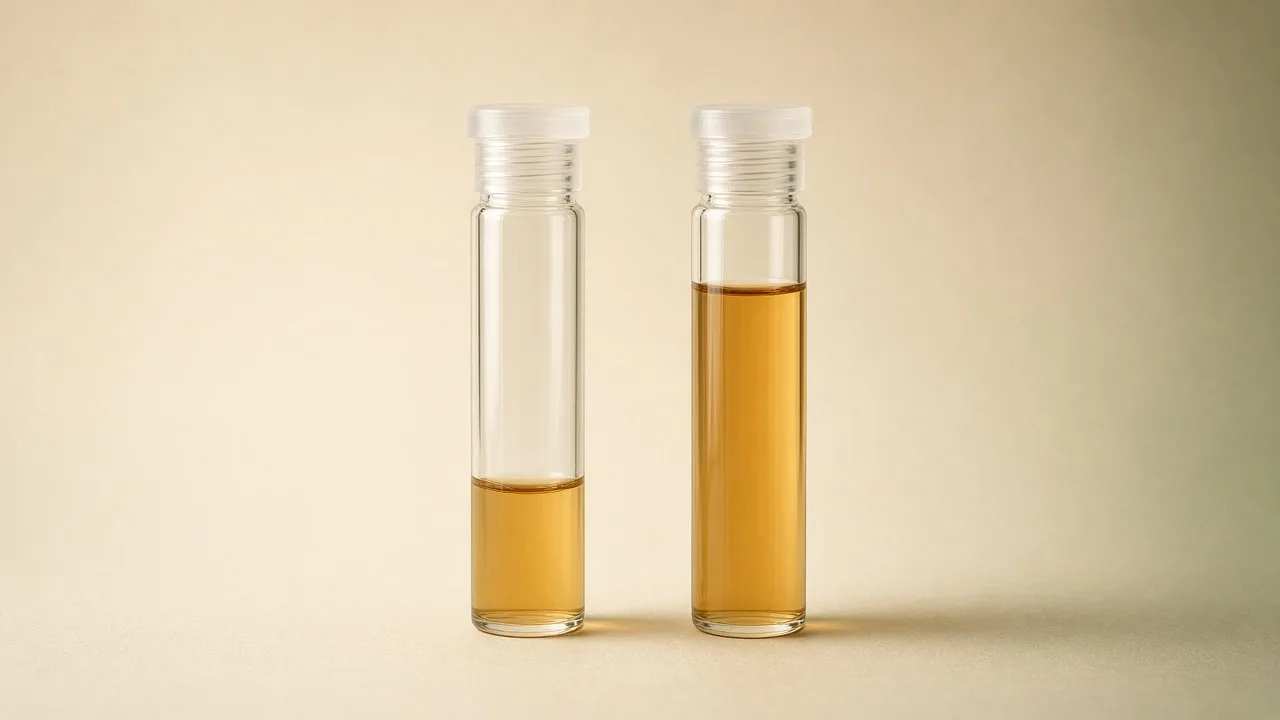
THC can stay in saliva about a day after occasional use at a workplace cutoff, and frequent use can still test positive past 30 hours. The cutoff picks the clock. A lab that reports anything above its lowest measurable amount is not using the same rule as a federal confirm.
In one controlled study, THC was still in 67% of frequent smokers’ oral fluid 30 hours after one 6.8% THC cigarette. It was still in 10% of occasional smokers’ fluid at that same hour. The lab’s limit was 0.5 ng/mL. That is not the federal 2 ng/mL confirmation cutoff. [Newmeyer et al., 2014]
This page is about detection. It is not a way to beat a test. A positive swab is not proof that someone is impaired. Urine, blood, hair, and saliva sit together in our guide to how long THC stays in your system. What a test measures, and what the evidence does and does not support, is in the science of drug-test options.
One unit note before the numbers. In these papers, 1 μg/L is the same as 1 ng/mL. The rest of this page uses ng/mL.
How long does weed stay in saliva after occasional use?
Occasional, in the main National Institute on Drug Abuse studies, means less than twice a week. Those volunteers smoked one cannabis cigarette, then gave oral fluid for about 30 hours. The groups are small. Ten occasional smokers in the Newmeyer study. Nine in a later route study. Treat the hours as study results, not as a personal timer.
At a 2 ng/mL cutoff, the median last positive sample for occasional smokers was 13.5 hours. The range was 5 to 26 hours. At 1 ng/mL, the median last positive was 21 hours, with a range of 8 to 28. At the 0.5 ng/mL lab limit, only 10% were still positive at 30 hours. [Newmeyer et al., 2014]
A second study in the same style used a StatSure collector. Every oral-fluid sample was still THC-positive for 13.5 hours after smoking. There was no clear THC difference between occasional and frequent smokers across the 30 hours when the lab counted anything above 0.5 ng/mL. At the 2 ng/mL cutoff, only 10% of occasional specimens were still positive at 21 hours. [Anizan et al., 2013]
A later study used a larger dose, about 50.6 mg THC, and a Quantisal collector. Occasional smokers were all below 2 ng/mL by 32 hours. They were all below 1 ng/mL by 50 hours. One person was still at the 0.2 ng/mL lab limit at 54 hours after vapor and after a brownie. [Swortwood et al., 2017]
The 30-hour studies stopped collecting. A last positive at 30 hours can mean the true end was later. The first sample often came at 0.5 hours, so the true peak in the mouth was missed. Some tubes had too little fluid. Dry mouth is common right after smoking. A short sample mixes with more buffer, and the reported number can sit below the real concentration. [Anizan et al., 2013]
How long does a mouth swab stay positive for frequent users?
Frequent, in those same cigarette studies, means about four or more times a week. The later route study used five or more times a week. Same cigarette. Different ending.
At 0.5 ng/mL, 67% of frequent smokers were still positive at 30 hours. At 1 ng/mL, the median last positive was 28 hours, range 10.5 to 30. At 2 ng/mL, the median last positive was 21 hours, range 6 to 30. [Newmeyer et al., 2014]
Between 24 and 30 hours, more than 73% of frequent smokers’ specimens were still THC-positive at that low lab limit. That is not the workplace cutoff. At 2 ng/mL, 71% of frequent specimens were still positive at 21 hours. If the rule was THC at 2 ng/mL or the metabolite THCCOOH at 20 ng/L, 69% of frequent smokers were still positive at 30 hours. Occasional smokers’ last detection on that combined rule was 24 hours, with 30% positive. [Anizan et al., 2013]
THCCOOH is not in cannabis smoke. It shows up after the body makes it. In frequent smokers it can outlast parent THC. In occasional smokers it is often missing. A cutoff that demands THCCOOH will miss many occasional users. It also makes a passive-smoke story less likely, because the smoke itself does not contain that metabolite. Parent THC alone cannot rule passive exposure out. [Anizan et al., 2013]
The decline is not a smooth ramp. On a Dräger DrugTest 5000, which screens at 5 ng/mL, the median last positive was 21 hours for frequent smokers. The range ran from 1 hour to at least 30. Three frequent smokers were still positive at 30 hours. Each of them had negative samples earlier in the day. A negative at hour 8 does not promise a negative at hour 30. [Desrosiers et al., 2014]
A higher-dose study kept frequent smokers on the unit for 72 hours. At discharge, 6 of 11 were still THC-positive after smoking, 3 of 11 after vapor, and 2 of 11 after a brownie. Most of those leftovers were under 1 ng/mL. One person was at 2.2 ng/mL at 72 hours after smoking. That is above both a 1 ng/mL roadside analytical cutoff and the federal 2 ng/mL confirm. [Swortwood et al., 2017]
Many of those frequent smokers were already positive before the study dose. After a night on the research unit, 11 of 11, 9 of 11, and 10 of 11 were still above 1 ng/mL before the smoked, vapor, and oral sessions. Most of those baseline samples were also above 2 ng/mL. A morning swab can reflect yesterday, or last week, not the hour in front of you. [Swortwood et al., 2017]
What THC cutoff does a saliva drug test use?
Name the cutoff or the window is meaningless. The same mouth can be positive at 0.5 ng/mL and negative at 5 ng/mL.
Federal workplace oral-fluid rules name one marijuana analyte: delta-9-THC. For undiluted oral fluid, the initial test cutoff is 4 ng/mL. The confirmatory cutoff is 2 ng/mL. Those numbers were set in the 2019 mandatory guidelines, effective January 1, 2020. A March 13, 2026 federal notice said the analytes and cutoffs were not changed. Federal Register, 2019 Federal Register, 2026
The 2019 notice considered adding THCA, the acid form, at a very low cutoff. It did not add it. Few labs could measure it, and the screening tests did not pick it up well. The panel you are likely to meet is parent delta-9-THC, not a long list of metabolites.
A 2024 review quoted a commercial page for a 3 ng/mL screen and a 1.5 ng/mL confirm. The Federal Register does not say that. Use 4 and 2 for the federal oral-fluid panel. [Macdonald and Zhao, 2024]
Other cannabinoids are a separate question. Delta-8, delta-10, and HHC are not the analyte named in that oral-fluid panel. A standard immunoassay is not a clean label of which form you used.
Roadside devices often use the maker’s own screen. In the Desrosiers study the DrugTest 5000 screen was 5 ng/mL. A European driving project discussed a 1 ng/mL analytical cutoff. Those are not the federal 4 and 2. A later roadside study also confirmed some screens against a lab cutoff of 5 ng/mL. Same word, “positive.” Different rule. [Desrosiers et al., 2014]
| Who, after one smoked cigarette | About 0.5 ng/mL lab limit | 2 ng/mL confirm | 5 ng/mL DrugTest screen |
|---|---|---|---|
| Occasional, under twice a week | 10% of people still positive at 30 hours | Median last positive 13.5 hours (range 5 to 26) | Median last positive 12 hours (range 4 to 24) |
| Frequent, about four or more times a week | 67% of people still positive at 30 hours | Median last positive 21 hours (range 6 to 30). At 21 hours, 71% of specimens still positive | Median last positive 21 hours (range 1 to at least 30) |
The 0.5 ng/mL column is Newmeyer and colleagues, n of 10 occasional and 14 frequent, one 6.8% cigarette, Oral-Eze, stopped at 30 hours. The 2 ng/mL medians are from that same paper. The 71% figure is Anizan and colleagues at 21 hours, StatSure, same style of cigarette. The 5 ng/mL column is the DrugTest 5000 screen in Desrosiers and colleagues. Do not read a cell as your result. Do not read column height, in the picture or in life, as impairment.
Does smoking show up in saliva longer than an edible?
The early peak is mostly mouth film, not blood. Smoke and vapor coat the cheeks. A chewed brownie does some of that too. A swallowed capsule does less.
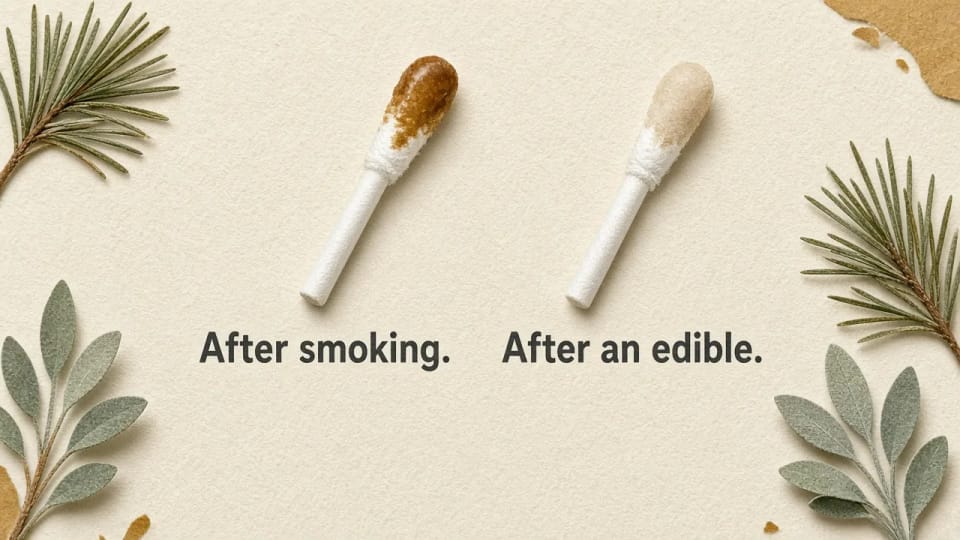
The early mouth film is heavier after smoking than after a chewed brownie. Later detection can still overlap. An edible can still test positive. The picture is a comparison, not a lab result.
In frequent smokers, mean peak THC was 2,789 ng/mL after smoking, 1,874 after vapor, and 297 after a brownie. Ranges were wide. One smoked peak was 8,503. One brownie peak was 16.5. The oral peak was lower than the inhaled peaks (p = 0.007). Smoking and vapor were not clearly different (p = 0.440). In occasional smokers, the route difference in the peak was not significant (p = 0.388). [Swortwood et al., 2017]
Time of last detection did not clearly differ by route. Frequent smokers’ mean last detection sat around 55 to 61 hours, and many were still positive when collection stopped after 72 hours (p = 0.463). Occasional means sat around 19 to 25 hours (p = 0.126). Frequent users stayed positive longer than occasional users on every route. Detection rates fell faster after the brownie. The low lab limit still overlapped. [Swortwood et al., 2017]
Swortwood and colleagues tie the early jump to oral contamination. They note that a swallowed dronabinol capsule, in earlier studies, did not leave that mouth film. A brownie you chew is not a capsule you swallow. Edibles are not invisible to a swab. They are also not a copy of a smoked peak.
The metabolite that makes many edibles feel stronger, 11-OH-THC, rarely showed up in oral fluid here, and never past 1.5 hours. The swab is mostly seeing parent THC in the mouth. Research suggests the effect you feel is a different chapter, covered in why edibles hit harder and in how the body absorbs and clears THC.
What do roadside saliva tests actually measure?
A roadside swab screens oral fluid for parent THC. It does not measure driving skill. It does not measure blood THC. Some programs confirm a positive screen in a lab. Some devices miss lab-positive fluid. Some flag fluid the lab later calls negative.
In one 2024 roadside series, police ran 8,945 oral-fluid THC screens on four devices. 530 screens were positive, 5.9%, and went to mass spectrometry. Sensitivity ran from 0% to 96.8%. Specificity ran from 89.8% to 98.5%. Efficiency ran from 84.3% to 97.8%. At a 5 ng/mL lab cutoff, the Dräger DrugTest reached 96.8% sensitivity, 97.1% specificity, and 97.0% efficiency. WipeAlyser was close, at 91.4%, 97.2%, and 96.4%. AquilaScan and Druglizer had sensitivity under 13%. Those two were not acceptable for cannabinoids in this study. [Scherer et al., 2024]
Specificity of 97.1% is not “3% of drivers.” It means about 2.9% of specimens the lab called negative were still flagged by that device. A miss is the other error. The screen says no. The lab says yes. Agreement with a lab is still not agreement with impairment.
An earlier roadside check of 1,025 drivers found the same spread. THC sensitivity was 92% for Drugtest 5000, 72% for RapidSTAT, 47% for Drugwipe 5+, and 38% for DDS. Drugtest 5000 was the only kit the authors called acceptable for THC. They also said mass-spec confirmation is always needed, because even the best kit produced a meaningful number of false positives. The abstract does not give that false-positive share as a single percent. [Strano-Rossi et al., 2012]
Breath testing is a different project, with its own limits. See the cannabis breathalyzer science. How long to wait before driving is a behavior question, not a swab question. See how long to wait after consuming.
Why doesn’t a positive swab prove you are impaired?
People at the same hour do not share one concentration. A 2024 individual-participant meta-analysis pooled published oral-fluid numbers after controlled cannabis. At 24 hours it had only 19 measures. The mean was 3.61 ng/mL. The median was 1.35. The maximum was 23.10. The minimum was zero. At every listed hour through 24 hours, at least one sample was zero, and at least one was above 20 ng/mL. The spread is the finding. [Macdonald and Zhao, 2024]
That review’s abstract describes 7 studies and 1,157 observations. The results section also counts 1,934 valid measures. Both figures are in the paper. Do not collapse them into one. Most included studies stopped at or before 24 hours. Only two went past that. The frequent-user datasets behind the 67% figure were left out, because the raw concentrations were not published. So this meta-analysis did not produce the 67% number. It cites it from earlier work.
The authors conclude that oral-fluid tests are not a valid sign of impairment, and that a 24-hour window is not a rule you can trust. Read that with the thin tail. Few samples exist after 24 hours in the pool they could build. They also disclose that the work grew in part from paid expert-report testimony in 2020. It was funded internally. It was a secondary analysis, with no new ethics review. [Macdonald and Zhao, 2024]
Put the pieces together. Frequent users can be over 2 ng/mL before a new dose. Occasional users can be negative by the next day at that same cutoff. Someone can be at zero while someone else is over 20 ng/mL. Tolerance, dose, and route change the effect long before they change the swab in a matching way. None of that is a breath-alcohol chart.
Workplace program status, including which labs are certified, lives in the THC detection-window guide. This page stays on the detection science.
Why can two swabs of the same mouth disagree?
The device changes the number. In the Desrosiers comparison, THC itself did not differ in a meaningful way between StatSure and Oral-Eze. THCCOOH and cannabinol were significantly higher in Oral-Eze. A metabolite cutoff on one device is not the same test as parent THC on another. [Desrosiers et al., 2014]
The cells in the sample change it too. A 2026 lab study used FLOQSwabs and split each sample after elution. For THC, 102 specimens, the cell-rich pellet held more THC than the mixed fluid. The median enrichment was 3.93 times. Cell counts were enriched about 4.40 times. The link was strong when THC was above 5 ng/mL. Four specimens were below the detection limit in the mix and still detectable in the pellet. Cocaine analytes did not pile up in the cells the same way. [Saint-Marcoux et al., 2026]
That study is one device. It is not a detection-window study. It is not an impairment study. It does show why two honest swabs can disagree. Buccal cells hold THC. How you stir, spin, or squeeze the swab moves the number. A plain-language walk-through of that paper is on the research hub page for buccal cells and oral-fluid THC.
Key takeaways
- At a 2 ng/mL confirm, occasional users in these studies were often negative by the next day. Frequent users often were not. The median last positive was 13.5 hours versus 21 hours after one cigarette, with wide ranges. [Newmeyer et al., 2014]
- A 0.5 ng/mL lab limit is a longer clock. At 30 hours, 67% of frequent smokers and 10% of occasional smokers were still positive. That is not the federal cutoff. [Newmeyer et al., 2014]
- Federal oral fluid uses 4 ng/mL to screen and 2 ng/mL to confirm delta-9-THC. A 5 ng/mL roadside screen is a different test. A March 2026 notice did not change those federal cutoffs.
- Smoking leaves a higher early mouth peak than a brownie. Last detection did not clearly differ by route. Edibles can still be positive. [Swortwood et al., 2017]
- A positive swab does not prove impairment. Roadside devices also miss some lab-positive samples and flag some lab-negative ones. [Scherer et al., 2024] [Macdonald and Zhao, 2024]
FAQ
How long after smoking weed can a mouth swab detect THC?
After one cigarette, occasional smokers’ median last positive at 2 ng/mL was 13.5 hours. Some lasted to 26 hours. Frequent smokers’ median was 21 hours, and some were still positive at 30 hours. At a 0.5 ng/mL lab limit, 67% of frequent smokers were still positive at 30 hours. [Newmeyer et al., 2014]
Can a saliva drug test detect cannabis edibles?
Yes. A chewed brownie produced a lower early peak than smoking in frequent users, but oral fluid still contained THC. Last detection did not clearly differ by route. A swallowed capsule is a weaker mouth-film case than a brownie you chew. [Swortwood et al., 2017]
Is the federal saliva cutoff 4 ng/mL or 2 ng/mL?
Both, for different steps. The initial oral-fluid test is 4 ng/mL. The confirmatory test is 2 ng/mL. Both refer to delta-9-THC in undiluted fluid. A 3 ng/mL and 1.5 ng/mL pair shows up on commercial pages. It is not the federal panel.
Does a positive saliva test mean someone is high?
No. The swab measures THC in oral fluid at a cutoff. Frequent users can be over 2 ng/mL before a new dose. People tested at the same hour can be at zero or above 20 ng/mL. Impairment was not what these assays measured. [Swortwood et al., 2017] [Macdonald and Zhao, 2024]
Can secondhand smoke cause a positive mouth swab?
It can complicate a parent-THC result. THC in the mouth can come from smoke that never entered the lungs. THCCOOH is not in the smoke, so that metabolite makes a passive-only story less likely. THC by itself cannot close the question. [Anizan et al., 2013]
Sources
- Newmeyer, M. N., et al. (2014). Cannabinoid disposition in oral fluid after controlled cannabis smoking in frequent and occasional smokers. Drug Testing and Analysis. DOI 10.1002/dta.1632.
- Anizan, S., et al. (2013). Oral fluid cannabinoid concentrations following controlled smoked cannabis in chronic frequent and occasional smokers. Analytical and Bioanalytical Chemistry. DOI 10.1007/s00216-013-7291-5.
- Desrosiers, N. A., et al. (2014). Cannabinoids in oral fluid by on-site immunoassay and by GC-MS using two different oral fluid collection devices. Analytical and Bioanalytical Chemistry. DOI 10.1007/s00216-014-7813-9.
- Swortwood, M. J., et al. (2017). Cannabinoid disposition in oral fluid after controlled smoked, vaporized, and oral cannabis administration. Drug Testing and Analysis. DOI 10.1002/dta.2092.
- Macdonald, S., and Zhao, J. (2024). Concentrations of Delta 9-tetrahydrocannabinol (THC) in oral fluid at different time points after use: An individual participant meta-analysis. Heliyon. DOI 10.1016/j.heliyon.2024.e39873.
- Scherer, J. N., et al. (2024). Reliability of roadside oral fluid testing devices for delta-9-tetrahydrocannabinol detection. Drug Testing and Analysis. DOI 10.1002/dta.3669.
- Strano-Rossi, S., et al. (2012). Evaluation of four oral fluid devices for on-site monitoring drugged driving in comparison with UHPLC-MS/MS analysis. Forensic Science International. DOI 10.1016/j.forsciint.2012.04.003.
- Saint-Marcoux, F., et al. (2026). Impact of buccal cell content and swab retention on tetrahydrocannabinol and cocaine concentrations in oral fluid. Journal of Analytical Toxicology. DOI 10.1093/jat/bkag084.
- U.S. Department of Health and Human Services. Mandatory Guidelines for Federal Workplace Drug Testing Programs using Oral Fluid. Federal Register, 25 October 2019, 84 FR 57554. Notice.
- U.S. Department of Health and Human Services. Mandatory Guidelines for Federal Workplace Drug Testing Programs. Federal Register, 13 March 2026, document 2026-04981. Notice.