How to Pass a Drug Test: The Science and Your Options
The honest, science-backed truth about THC drug tests: detection windows, why detox kits just dilute, and the only method that actually works — time.

Let’s start with the honest answer, because you deserve one: there is no reliable trick, drink, pill, or kit that “flushes” THC out of your system on demand. The only method that consistently works is the unglamorous one — time plus abstinence. Everything sold to you in a gas-station box is, at best, a way to temporarily dilute your urine, and labs are specifically built to catch that.
This guide isn’t a cheat sheet. It’s a clear-eyed look at how cannabis drug testing actually works, what the science says about clearance, and how to think about your options honestly. If you want the deeper timeline math, our companion piece on how long THC stays in your system goes even further into detection windows.
Quick disclaimer: This is educational, not medical or legal advice. We do not cover how to adulterate, substitute, or tamper with a test — those acts are detectable, often illegal, and in many places carry consequences worse than a positive result.
Why THC Is So Hard to Clear
Most recreational drugs are water-soluble — your body processes them, your kidneys flush them, and they’re gone in a day or two. THC is different because it is intensely lipophilic, meaning it loves fat. After you consume cannabis, THC is rapidly pulled out of your bloodstream and stashed in your fat cells, where it can sit dormant for weeks. How that THC got in matters too — an edible’s two-hour onset and slower metabolism can extend your window compared with inhalation, and choosing between flower, edibles, and concentrates shapes how much THC you load in.
Your liver doesn’t look for THC itself, though. It breaks THC down into metabolites. The key one is 11-nor-9-carboxy-THC (usually written THC-COOH). This metabolite is inactive — it won’t get you high — but it’s the molecule nearly every urine test hunts for. THC slowly leaches back out of fat storage and gets converted to THC-COOH over time. So your body keeps producing detectable metabolites long after the high has faded. That’s also why the high itself is so short compared to the detection window, a gap we break down in how long a cannabis high lasts.
Researchers studying this in monitored settings found that during abstinence, the slow release of THC from fat tissue is the rate-limiting step in clearing your system [Goodwin, 2008]. Body composition matters too: studies link higher BMI to longer detection windows, because more adipose tissue means a bigger THC reservoir [Goodwin, 2008]. If you’re curious how cannabis interacts with body fat and metabolism generally, we cover that in does marijuana affect your metabolism.
Detection Windows by Test Type and Frequency
There’s no single number. Detection depends on the test, the cutoff threshold, your frequency of use, and your individual biology. The table below reflects ranges reported across controlled studies — treat them as estimates, not guarantees.
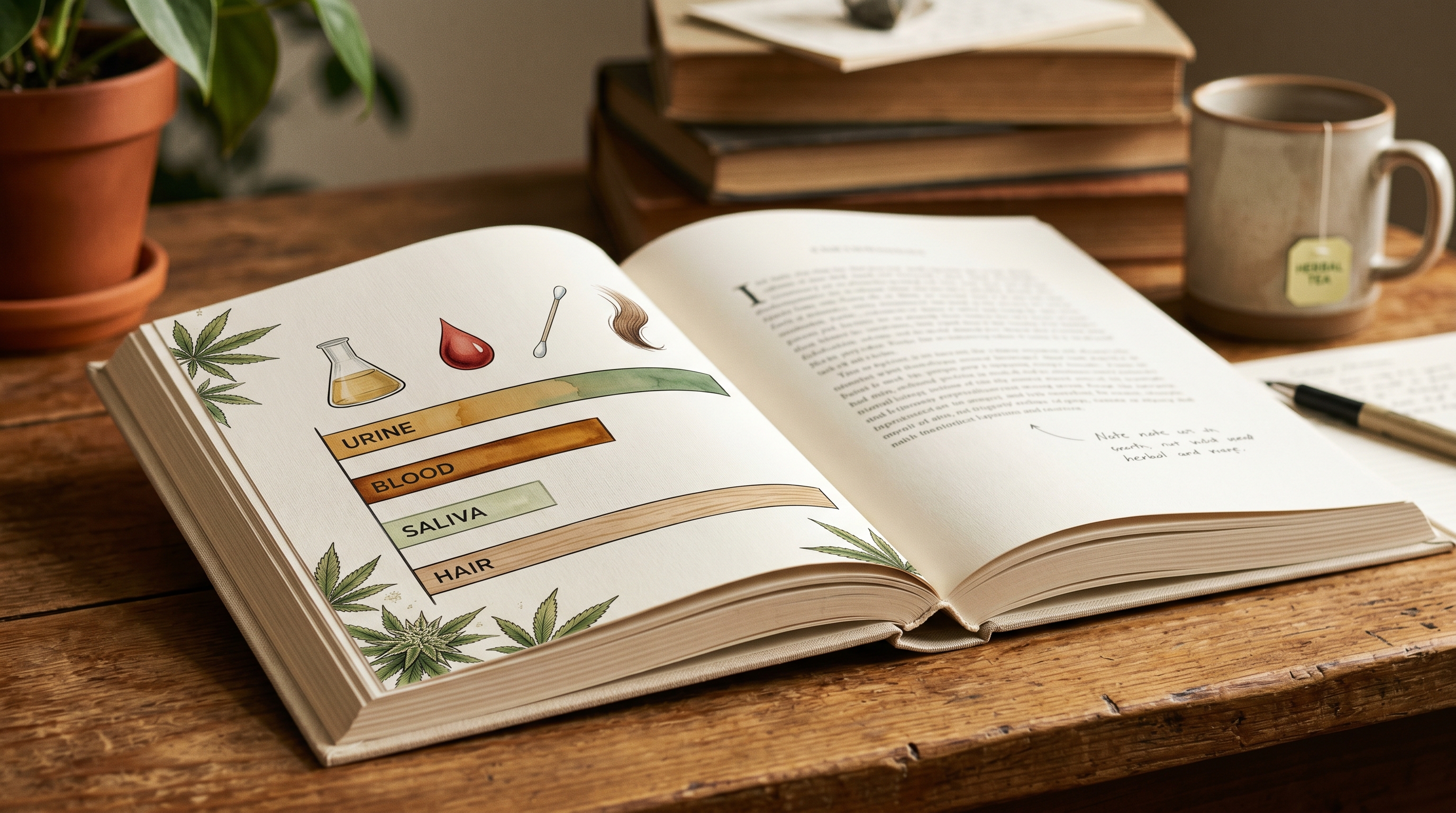
| Test Type | Single / Light Use | Moderate Use | Daily / Heavy Use |
|---|---|---|---|
| Urine (most common) | 1–3 days | ~7–10 days | 2–4 weeks, up to 30+ |
| Blood | A few hours to 1–2 days | 2–7 days | Up to ~1 month |
| Saliva (oral fluid) | ~24 hours | 1–3 days | Up to ~3 days |
| Hair | Detectable after ~7 days, then up to 90 days | Up to 90 days | Up to 90 days |
A few important caveats. Urine is the workhorse of workplace testing, and the standard federal confirmatory cutoff for THC-COOH is 15 ng/mL (screening immunoassays often use 50 ng/mL). In documented cases, heavy users have produced positive urine results for 77 days or longer during monitored abstinence — these are outliers, but they’re real.
Hair is the longest-memory test. Because hair grows roughly one centimeter per month, a standard 1.5-inch sample reflects about the last 90 days. Interestingly, THC-COOH incorporates into hair extremely poorly compared to other drugs, so hair testing has its own quirks and a higher rate of interpretation debate.
Blood and saliva are the “recent use” tests — they’re what you’d encounter in an impairment context. If your concern is driving rather than employment, the timing math is very different, and we walk through it in how long to wait to drive after consuming. Older adults metabolize cannabis more slowly, so our guide for seniors is worth a look if that applies to you, and first-timers should skim what to expect as a new user.
Why Detox Drinks and Kits Mostly Just Dilute
Walk into any smoke shop and you’ll see a wall of “detox” drinks and seven-day “cleanse” kits promising a clean test. Here’s what’s actually happening when you use one: you chug a large volume of liquid, you pee a lot, and your urine becomes temporarily diluted. The THC-COOH is still being produced by your body — you’ve just thinned it out below the cutoff for a few hours.
A controlled study put this to the test directly [Cone, 1998]. Researchers had cannabis users drink a gallon of fluid — plain water, a popular “herbal detox tea,” and a diuretic. The finding was blunt: the herbal products performed no better than plain water. After about two quarts of any fluid, samples frequently flipped from positive to negative purely from dilution. The conclusion was that the products’ claims “appear to be unfounded.”
The problem is that labs anticipated this decades ago. Every legitimate testing program runs specimen validity testing alongside the drug screen, measuring:
- Creatinine — a waste product excreted at a steady rate. A reading below 20 mg/dL flags a sample as dilute; below 2 mg/dL means it’s not really urine.
- Specific gravity — how “dense” the urine is. Below 1.003 (water is 1.000) signals dilution.
- pH and oxidants/nitrites — these catch chemical adulterants outright.
So when a detox drink “works,” the sample often gets reported as dilute. Many programs treat that as a failed or invalid test, and some require an observed retest. The B-vitamins in those drinks have one job: they dye your over-diluted urine yellow again so it doesn’t look suspiciously clear. That’s cosmetic, not chemical. And the masking agents and “instant cleansers” that cross into actual adulteration? Validity panels are built to detect nitrites, oxidants, and abnormal pH. Tampering with a federally regulated test can also be a crime. We don’t recommend it, and we won’t tell you how.
What Actually Helps: Time, Abstinence, and a Dose of Patience
Here’s the part nobody selling a kit wants you to hear. The evidence-based reality is short:
- Stop consuming. The clock only starts when the last THC enters your body. This is the single highest-impact thing you can do, and it’s free.
- Give it time. Your body clears THC-COOH on its own schedule, governed by fat release. You can’t meaningfully accelerate fat metabolism on a deadline.
- Support your baseline health. General hydration, normal sleep, and a balanced diet keep your body functioning normally — they won’t “flush” THC, but a healthy system is your best ally over weeks.
The exercise nuance is worth understanding. Because THC hides in fat, you’d think burning fat would help — and the truth is genuinely counterintuitive. One study found that 35 minutes of moderate exercise caused a small but statistically significant rise in blood THC in regular users, as lipolysis (fat breakdown) released stored THC back into circulation [Wong, 2013]. So hitting the gym hard right before a test could theoretically nudge your levels up short-term. The good news: a separate monitored study found that exercise and even a day of fasting produced no major lasting change in urine THC-COOH levels. The takeaway: don’t exercise heavily in the 24 hours before a test, but don’t expect a treadmill marathon to clean you out either. Time does the work, not sweat. (If you’re an athlete weighing cannabis around training, see how it affects VO2 max and exercise performance and athletic recovery.)
If your bigger goal is resetting your relationship with cannabis rather than passing one test, a planned tolerance break is a far more useful framework — and abstinence to pass a test is essentially a tolerance break with a deadline.

At-Home Test Strips: Your Best Honest Tool
If there’s one product genuinely worth your money, it’s an at-home urine test strip — the same THC immunoassay tests employers use, available cheaply online. These won’t help you cheat; they help you know. By testing yourself at home, you can see whether you’re already reading below the cutoff before you walk into the real thing.
A few tips for using them well:
- Match the cutoff. Strips come in 50 ng/mL and more sensitive 20 ng/mL versions. Buy the one matching (or stricter than) your real test so you’re not caught by a surprise.
- Test your first morning urine — it’s the most concentrated and gives you a worst-case reading.
- Test repeatedly over several days to watch your trend, since metabolite levels fluctuate as fat releases THC unevenly.
- A negative at home is reassuring, not a guarantee — lab confirmatory tests are more sensitive than strips.
This is honest harm reduction: instead of gambling on a magic drink, you’re gathering real data about your own body.
False Positives: When the Test Gets It Wrong
Initial drug screens use immunoassays — fast, cheap antibody tests that look for molecules shaped like THC-COOH. The catch is that antibodies aren’t perfectly specific, so some unrelated compounds can trigger a false positive. Documented culprits for THC screens include:
- Efavirenz, an HIV antiretroviral, which is well-documented to cross-react.
- Pantoprazole, a proton-pump inhibitor for acid reflux, in certain assays.
- NSAIDs like ibuprofen and naproxen — rarely, and assay-dependent.
Here’s the reassuring part: this is exactly why any positive screen is considered presumptive and should be confirmed by a second, far more specific method — GC-MS or LC-MS/MS. These confirmatory tests identify THC-COOH by its precise molecular fingerprint, so genuine false positives from medications get sorted out at confirmation. If you take a prescription medication and get an unexpected positive, that’s a legitimate reason to request confirmatory testing.
One more myth to retire: CBD and hemp products. Pure CBD won’t trigger a THC test, but many “full-spectrum” CBD products contain trace THC — and this is exactly why understanding full-spectrum vs broad-spectrum vs isolate CBD matters. Use enough of a full-spectrum product and you can accumulate enough THC-COOH to fail — the test isn’t wrong, your product just wasn’t THC-free. The same trap applies to the gray-market hemp-derived THC and delta-8 vs delta-9 products that are now everywhere; “legal hemp” still produces THC-COOH. We unpack the body’s own cannabinoid chemistry in anandamide, your body’s natural THC.
Harm Reduction and Knowing Your Rights
A drug test is a stressful, high-stakes moment, so a few grounding principles:
- Don’t tamper. Substitution and adulteration are detectable and, for regulated tests, can carry legal penalties that dwarf a positive result. A dilute or adulterated specimen often counts as a fail anyway.
- Know what you’re being tested for and why. Pre-employment, random, post-incident, and probation tests all have different rules and consequences.
- Disclose medications honestly when asked, and request confirmatory testing if you have a legitimate prescription.
- Understand local law. Cannabis policy varies wildly by state and employer, and your housing and tenancy can be affected too — our guide on whether your landlord can ban cannabis covers that side.
- Plan ahead. If you know testing is part of your life, the only durable strategy is managing your use proactively rather than scrambling.
The most empowering move is understanding your own patterns — how your body responds, how long you actually take to clear, and what genuinely helps you feel your best. For a broad foundation of practical habits, our roundup of 100 cannabis tips every consumer should know is a solid next read.
Frequently Asked Questions
Can I pass a urine test in 24 hours after smoking? If you’re a one-time or very light user, a single use might clear in 1–3 days, so it’s possible but not guaranteed. For regular or daily users, 24 hours is almost never enough — metabolites can linger for weeks.
Do detox drinks actually work? They don’t remove THC; they temporarily dilute your urine, and a controlled study found they performed no better than plain water. Labs flag dilution via creatinine and specific gravity, so the result is often a failed or invalid test.
Does drinking tons of water help? Only by diluting, which validity testing catches. Over-hydrating can also be dangerous. Normal hydration is fine; “water loading” is not a reliable strategy.
Will exercise burn off the THC faster? No — and intense exercise right before a test may briefly raise your blood THC by releasing it from fat. Long-term it doesn’t meaningfully change urine results. Avoid hard workouts in the 24 hours before testing.
How do I know if I’ll pass? Use an at-home test strip matched to your test’s cutoff, on your first morning urine, across several days. It’s the only honest way to check yourself in advance.
Can a medication make me fail? Some drugs (efavirenz, pantoprazole, occasionally NSAIDs) can cross-react on the initial screen, but confirmatory GC-MS/LC-MS/MS testing distinguishes them from real THC use.
Key Takeaways
There’s no shortcut. Anyone selling you one is really selling dilution and hope. The science is consistent. THC-COOH leaves on its own timeline. That timeline is set by how slowly your fat releases stored THC. To sum up:
- Time plus abstinence is the only reliable method. Everything else is noise.
- Detox drinks just dilute your urine. Labs flag dilution, and a dilute sample often counts as a fail.
- Don’t exercise hard right before a test. It can briefly raise your blood THC.
- Use an at-home test strip to check yourself honestly before the real thing.
- Never tamper. It’s detectable, often illegal, and rarely worth it.
The most useful thing you can do is understand your own body. The High IQ app helps you track your consumption patterns, so the next test is never a surprise.
Sources
- Goodwin RS, et al. Urinary Elimination of 11-Nor-9-carboxy-THC in Cannabis Users During Continuously Monitored Abstinence. Journal of Analytical Toxicology. PMC2587336
- Urinary THC and metabolite concentrations following cannabis use: A systematic review. PubMed. 41707818
- ACMT Position Statement. Interpretation of Urine for Tetrahydrocannabinol Metabolites. ACMT PDF
- Cone EJ, et al. In Vivo Adulteration: Excess Fluid Ingestion Causes False-Negative Marijuana and Cocaine Urine Test Results. PubMed. 9788521
- Thermo Fisher Scientific. Specimen Validity Testing. SmartNotes PDF
- Wong A, et al. Exercise Increases Plasma THC Concentrations in Regular Cannabis Users. Macquarie University. Publication
- Can Physical Exercise or Food Deprivation Cause Release of Fat-Stored Cannabinoids? PMC. PMC4270258
- False-Positive Interferences of Common Urine Drug Screen Immunoassays: A Review. ResearchGate. 263704375


