Will Delta-8, Delta-10, or HHC Show Up on a Drug Test?
Delta-8 and delta-10 reliably trigger THC drug tests, and HHC often does too. Here is the science on why hemp cannabinoids are not test-safe.

Let me give you the short answer before anything else, because if you are reading this with a test coming up, you do not have time for suspense.
Used delta-8 THC or delta-10 THC? Assume you will fail a standard drug test. Used HHC? Assume the same, even though the science there is a little blurrier. The “it’s legal hemp” label that let you buy these at a gas station does not mean “it’s invisible on a urine screen.” Those are two different questions. Two different sets of rules answer them.
I know that is not what the marketing implied. So let me walk you through it. Why can’t your body tell these cannabinoids apart the way a lawyer can? And what does the actual evidence say for each one?
How a Drug Test Actually Works
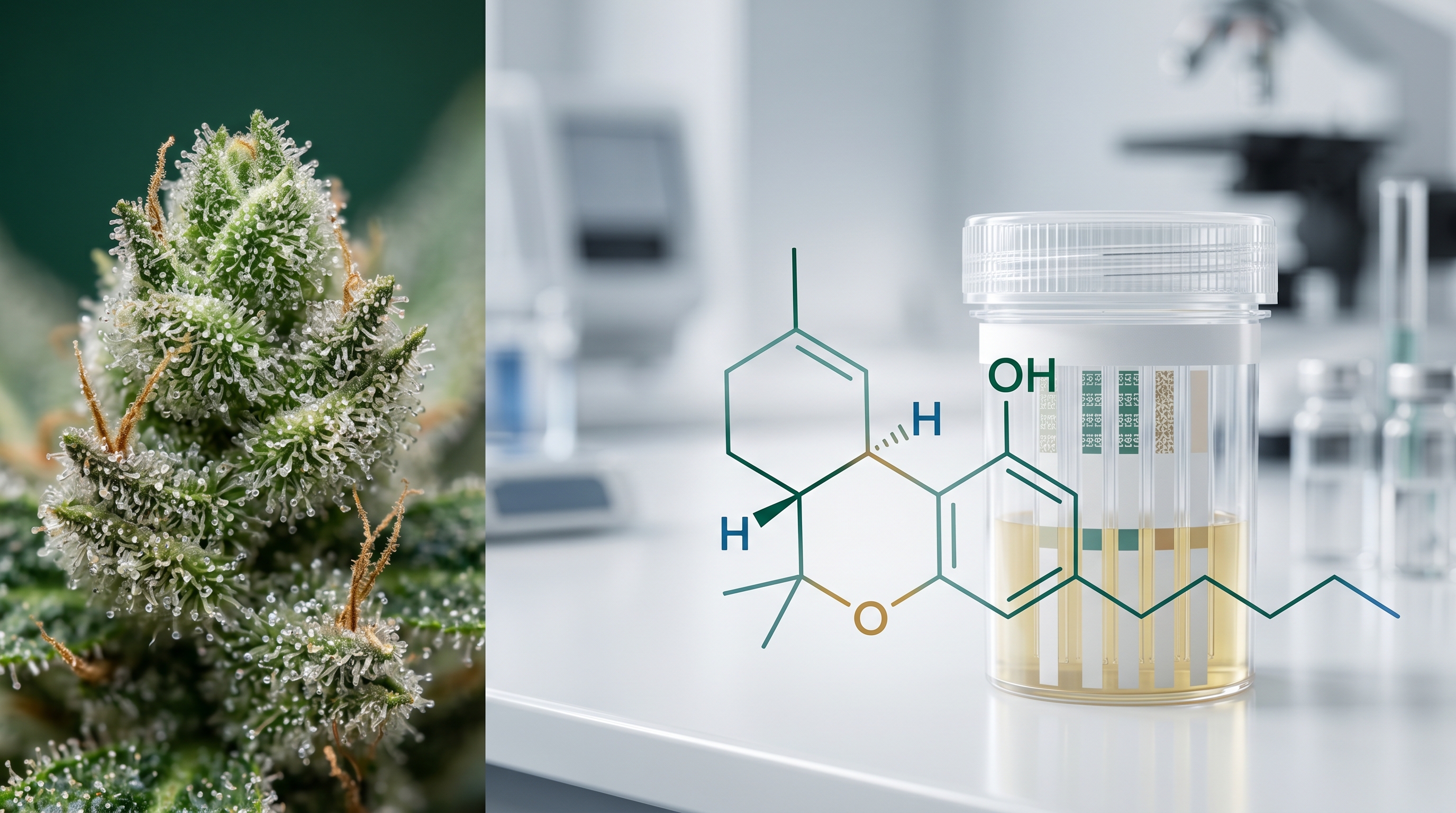
Here is the part almost nobody explains. A standard cannabis drug test is not looking for THC. It is looking for what your liver makes after THC.
When you consume delta-9 THC, your body breaks it down fast. Less than one percent of the original delta-9 leaves your body unchanged in urine. Instead, your liver turns it into a metabolite called 11-nor-9-carboxy-THC, usually written as THC-COOH. That carboxy metabolite is fat-soluble. It lingers for days to weeks. And it is the real target of every routine urine cannabis screen.
The first-pass test is an immunoassay. Think of it as a cheap, fast antibody. It has been trained to grab onto the shape of THC-COOH. If enough of that shape shows up to cross a cutoff (often 50 ng/mL, sometimes 20 to 25 ng/mL), the test flags a “presumptive positive.” A confirmation test using mass spectrometry then verifies it.
Here is the catch that matters for everything below: antibodies recognize shapes, not legal categories. The immunoassay was built for the delta-9 metabolite. But it will happily grab anything with a close enough molecular shape. And the carboxy metabolites of delta-8, delta-10, and HHC are extremely close in shape. We cover the broader timeline in our guide on how long THC stays in your system, and the harm-reduction options in how to pass a drug test.
Delta-8 and Delta-10: Assume a Positive
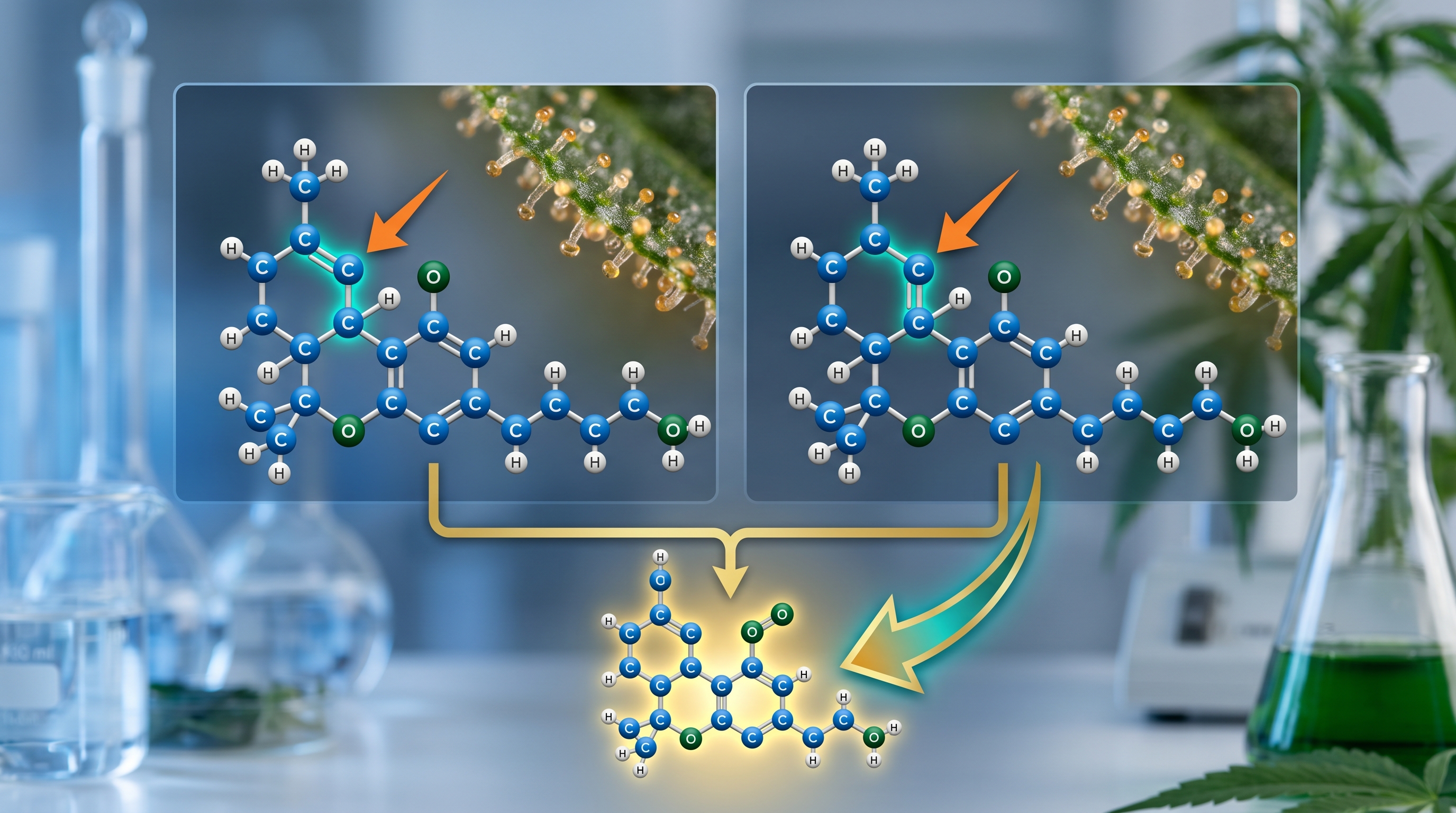
Delta-8 THC is the most-studied of the bunch, and the verdict is not subtle. Delta-8 and delta-9 differ by the position of a single double bond. That is it. One bond. As you might expect from molecules that similar, their metabolites are nearly identical too: delta-8 produces 11-nor-9-carboxy-delta-8-THC (Δ8-THC-COOH), which differs from the delta-9 metabolite by that same single bond.
Antibodies cannot tell them apart. In a 2021 case series, four kids exposed to delta-8 products all screened positive for cannabinoids on standard immunoassays. DEA-assisted lab testing then found the delta-8 carboxy metabolite in every one of them [Watson, 2023]. Quest Diagnostics flagged the same problem in public. Because the two metabolites share a molecular weight and nearly identical chemistry, “a presumptive test for a person who has used a delta-8 product may give a false-positive for delta-9-THC” [Kain, 2021].
A broader lab study put six commercial immunoassay kits (Abbott, Roche, Siemens, Thermo Fisher, and more) up against a panel of hemp-derived analogs. Every kit cross-reacted with delta-8 THC, its metabolites, and all of the delta-10 THC chiral analogs [Sloop, 2023]. Delta-10 is even less studied than delta-8. But it breaks down the same way into a carboxy-THC, and it trips the same screens.
Then there is the contamination problem, which makes the question almost moot. Delta-8 and delta-10 are not pulled from the plant in any real amount. They are converted from CBD in a lab. That conversion is messy. Industry labs report that “delta-8 products are not pure and various amounts of delta-9 THC remain from the chemical conversion, meaning they test positive for both substances” [Coleman, 2022]. One workplace lab saw delta-8 in 4 percent of cannabis-positive samples in 2018. By 2022, that number had climbed to 20 percent.
So you have two independent paths to a positive: the analog’s own metabolite cross-reacting, plus residual delta-9 contamination from sloppy manufacturing. For a deeper look at how these molecules differ in the first place, see delta-8 vs delta-9 THC. It is also worth knowing that this same conversion chemistry can produce genuinely sketchy byproducts, which is why we wrote about the toxic ketene risk in some acetylated cannabinoids, and why lab testing standards still fail consumers.
HHC: Riskier Than You Think, Murkier Than the Forums Claim
HHC (hexahydrocannabinol) is where the internet gets the most confidently wrong, in both directions. You will find blogs swearing HHC is “undetectable,” and you will find others insisting it is identical to THC. The honest answer sits uncomfortably in between, and it leans toward risky.
HHC is THC with the double bonds hydrogenated, which is why it is more chemically stable. Your liver still oxidizes it. That produces metabolites that include 11-nor-9-carboxy-HHC (HHC-COOH) and 11-OH-HHC. Here is the key research finding: those HHC metabolites cross-react with the THC-COOH immunoassay in many tests.
A 2024 Swedish study tracked this in the real world. After HHC hit the recreational market, the rate of “false positive” THC screens in routine urine and oral-fluid testing jumped from under 2 percent to over 10 percent. Spiking experiments confirmed that HHC and HHC-COOH were cross-reacting with the cannabis antibodies [Helander, 2024]. A WHO critical review reached the same conclusion. HHC metabolites are cross-reactive with THC-COOH, so “exposure to hexahydrocannabinol could cause a positive reading for THC-COOH without consumption of delta-9-tetrahydrocannabinol” [Coghlan, 2024].
So why do I keep saying “uncertain”? Because the evidence is genuinely mixed in ways that should make you cautious, not relaxed:
- It is test-dependent. Controlled-dosing studies found urine strips and ELISA serum tests caught HHC use, but some saliva tests (like the DrugWipe 5S) showed little to no cross-reactivity. The brand of test on the day matters.
- It is dose- and timing-dependent. HHC blood levels drop fast. One study saw fluctuating urine results where the same person tested positive, then negative, then positive depending on hydration and timing.
- It is hard to prove either way. Forensic researchers have found that HHC-COOH actually appears as a minor metabolite of ordinary delta-9 THC too, so its presence alone cannot cleanly confirm HHC use. The analytical science is still settling.
Translation: HHC will frequently trigger a standard cannabis screen, sometimes will not, and even the labs are still arguing about the edge cases. That is not a margin you want to bet a job on. And as with delta-8, HHC products carry contamination risk, including residual delta-9 from manufacturing. If you want the fuller chemistry rundown, read what is HHC and is it safe and the HHC vs THCP showdown. The same “novel cannabinoid” gold rush also gave us THCP, the super-potent analog and raw acid forms like THCA flower.
“Legal” Does Not Mean “Test-Safe”
This is the trap, and it is worth saying plainly. The 2018 Farm Bill made hemp-derived cannabinoids federally legal, as long as they stay under 0.3 percent delta-9 THC by dry weight. That is a legal threshold about a specific molecule. Lawmakers wrote it.
A drug test does not read the Farm Bill. It reads molecular shapes. Your employer’s policy, a court’s probation terms, or the federal workplace panel almost always say “marijuana metabolite” or “THC.” And the immunoassay behind that word will flag delta-8, delta-10, and often HHC right alongside delta-9. The legality of the purchase has no bearing on the chemistry of your urine three days later.
If you are subject to testing, the source being “hemp” buys you nothing on the panel. This is the same confusion we untangle in hemp vs cannabis regulations and the reason your dispensary labels can be misleading. Even federal rescheduling to Schedule III does not change how a urine screen reads your sample.
Detection Windows: How Long Are We Talking?
Because these analogs metabolize so similarly to delta-9, labs expect their detection windows to roughly resemble delta-9’s. And delta-9’s window is the part people underestimate. As a rough guide for urine, the most common test:
- Single or occasional use: a few days, often up to about 3 days.
- Moderate, several-times-a-week use: roughly 5 to 7 days.
- Daily use: commonly 10 to 15 days.
- Heavy, long-term daily use: carboxy-THC has been detected up to around 30 days after last use, because it stores in fat and releases slowly [Berkland, 2025].
Blood and saliva windows are much shorter (hours to a couple of days) but are less common for employment testing. Many things shift these numbers: dose, body fat, hydration, metabolism, and frequency. There is no magic countdown. We break the full timeline down in how long THC stays in your system. Worth noting: feeling sober is not the same as testing clean. See how long a cannabis high actually lasts and, for the road, how long to wait before driving.
What to Do If You Are Facing a Test
A little honest harm reduction, because pretending people will never be in this spot helps nobody:
- Stop now, and count backward honestly. If your test is soon and you have used any of these recently, the most reliable move is time and abstinence. There is no verified same-day fix that beats a properly run lab test.
- Do not assume a relabeled cannabinoid is a loophole. Delta-8, delta-10, and HHC are not stealth-mode THC. Treat them exactly like cannabis when a test is on the line.
- Be cautious about “detox” products. Most are unproven, and aggressive dilution can flag a sample as adulterated, which can be worse than a positive in some programs.
- If you have a prescription or a legitimate explanation, say so up front. A confirmation lab can sometimes distinguish delta-8 from delta-9, but only if they are asked to look. A medical review officer is the right person to hear your context.
- Know your specific program’s rules. Federal panels, employers, and courts differ. The cutoff and the confirmation method change what is possible.
For the deeper science and the realistic options, our companion piece how to pass a drug test is the honest version, not the snake-oil version.
The Bigger Picture: Know What You Are Actually Taking
The reason this question is so confusing is that the hemp-analog market sells names while your body responds to molecules. Delta-8, delta-10, and HHC were created in part to sidestep a legal definition, but biology never agreed to that deal. This is the same theme that runs through everything we write: a label is not a measurement.
That is exactly why we built High IQ around understanding what a cannabinoid actually does in your body rather than trusting the marketing on the jar. If you want to consume intentionally, start by knowing what is really in the product and how it behaves, not just what the package promises. See how to find your ideal high, our take on intentional cannabis use, and the 100 tips every consumer should know.
Key Takeaways
If you remember nothing else, remember this:
- Delta-8 and delta-10 will almost certainly fail a standard test. Their carboxy metabolites look like delta-9’s, and products often carry real delta-9 too.
- HHC is risky, not safe. It cross-reacts on many screens. “Undetectable” is a myth, even if a few tests miss it.
- “Legal hemp” is a legal label, not a test result. The immunoassay reads molecular shapes, not the Farm Bill.
- Expect a delta-9-style detection window. That can mean a few days for light use, up to a month for heavy daily use.
- Time and abstinence are the only reliable plan. Detox kits are mostly unproven, and over-dilution can flag your sample.
Frequently Asked Questions
Will delta-8 show up on a drug test? Almost certainly yes. Delta-8’s carboxy metabolite is structurally nearly identical to delta-9’s and cross-reacts with standard immunoassays. Products also often contain residual delta-9. Treat delta-8 as test-positive.
Does delta-10 THC fail a drug test? Yes, expect it to. Laboratory studies show all delta-10 chiral analogs cross-react with commercial cannabis immunoassays, and delta-10 metabolizes to a carboxy-THC just like its cousins.
Is HHC really undetectable? No. This is a common myth. HHC metabolites cross-react with THC-COOH screens in many tests, and real-world data showed HHC use driving up positive cannabis screens. Some saliva tests miss it, but you should not gamble on which test you will get.
Can a lab tell the difference between delta-8 and delta-9? Sometimes, with advanced mass spectrometry, and only if asked. Routine confirmation panels were historically built for delta-9 only. A delta-8 metabolite can even interfere with delta-9 quantification, producing unreportable results.
The product was legal hemp. Doesn’t that protect me? Not on a drug test. Federal hemp legality is about the delta-9 percentage in the product, not about what your urine looks like afterward. The immunoassay does not check legality.
How long do these stay in my system? Expect a window similar to delta-9 THC: a few days for occasional use, up to roughly two weeks for daily use, and as long as about 30 days for heavy long-term use, since carboxy metabolites store in fat.
Sources
- DEA TOX / UCSF Clinical Toxicology, “Delta-8-Tetrahydrocannabinol Exposure and Confirmation in Four Pediatric Patients,” PMC10050257. pmc.ncbi.nlm.nih.gov/articles/PMC10050257
- Quest Diagnostics, “Delta-8-THC: A new synthetic cannabinoid poses problems for testing” (2021). questdiagnostics.com
- National Institute of Justice / Office of Justice Programs, “The Cross-Reactivity of Cannabinoid Analogs (Delta-8-THC, Delta-10-THC and CBD), Their Metabolites and Chiral Carboxy HHC Metabolites in Urine of Six Commercially Available Homogeneous Immunoassays.” nij.ojp.gov
- Helander A. et al., “Appearance of hexahydrocannabinols as recreational drugs and their effect on cannabis drug testing,” Scandinavian Journal of Clinical and Laboratory Investigation (2024). tandfonline.com
- WHO Expert Committee on Drug Dependence, “Hexahydrocannabinol 47th ECDD Critical Review.” cdn.who.int
- Aegis Sciences, “What Did My Patient Actually Take? An Overview of Cannabinoids and Semi-Synthetic Cannabinoids” (2026). aegislabs.com
- “Detection of 11-nor-9-carboxy-hexahydrocannabinol (HHC-COOH) as metabolite of both HHC and Δ9-THC in routine forensic samples,” Journal of Pharmaceutical and Biomedical Analysis (2025). sciencedirect.com
- ORASURE, “Delta-8-THC impact on drug testing” (2022). orasure.com
- Restek, “LC-MS/MS Analysis of THC Isomers & Metabolites in Whole Blood and Urine” (2025). discover.restek.com
This article is educational and not medical or legal advice. Drug-testing policies, cutoffs, and consequences vary widely. If you are facing a test with real stakes, consult a qualified professional.


