How Terpenes Shape the Way You Experience Music
Discover the science behind why cannabis changes how music sounds—and how specific terpenes may tune your auditory experience.

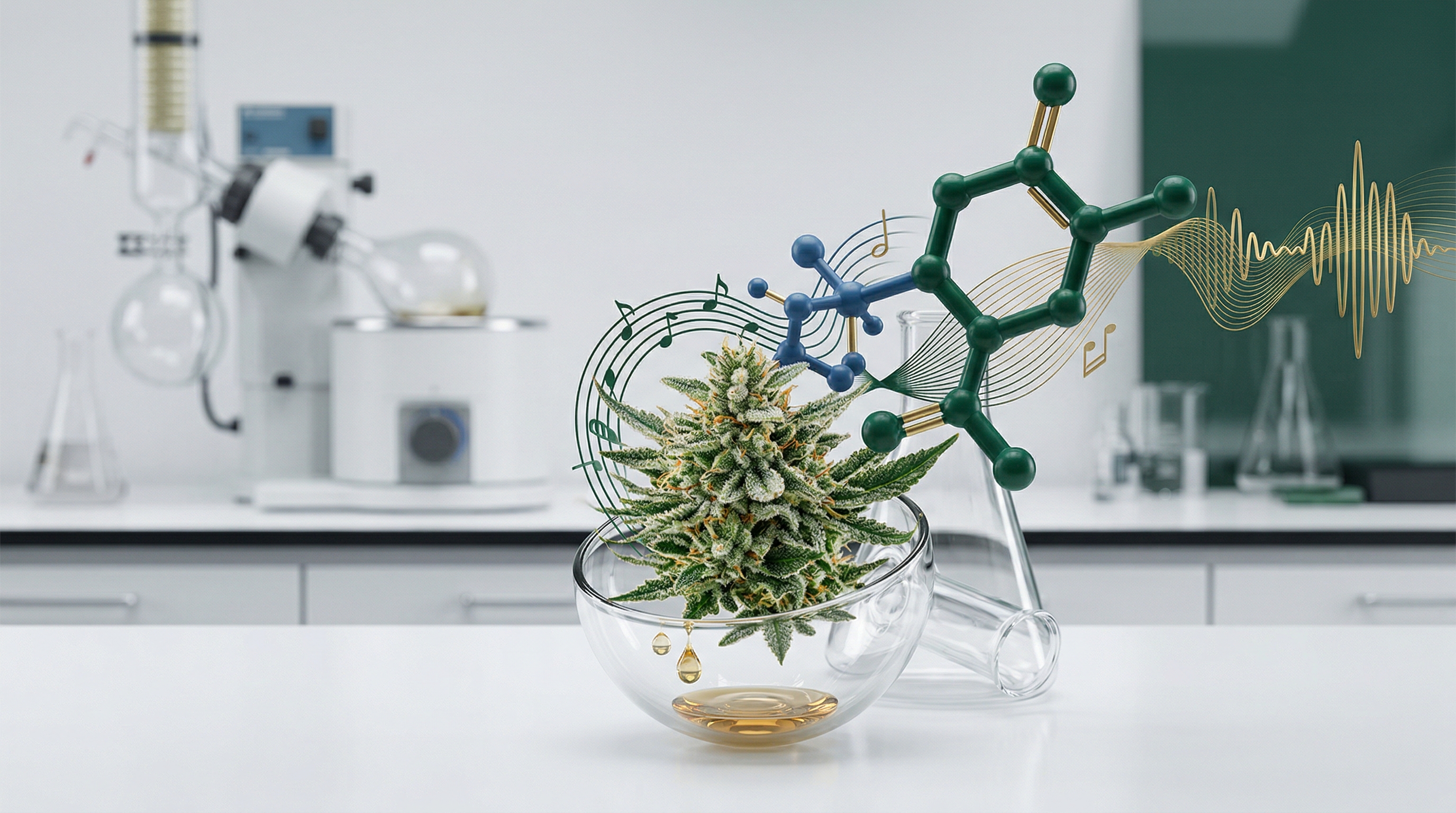
Cannabis does something unusual to music. The same song you’ve heard a hundred times can suddenly reveal layers you never noticed—a texture in the bass, an emotional current in a chord change, a rhythm that feels physical rather than just audible. Terpenes, the aromatic compounds that define each strain’s character, may be one of the key reasons why. This guide explores what the research says about how specific terpenes interact with your brain’s auditory and emotional systems—and how you can use that knowledge to shape your next listening session.
Why Does Music Sound So Much Better When You’re High?
You press play on a familiar song, take a deep breath, and suddenly you’re hearing things you’ve never noticed before—a subtle guitar lick buried in the mix, the texture of the vocalist’s breath before a note, the way the bass seems to vibrate through your entire body. If you’ve ever consumed cannabis and put on headphones, you know exactly what this feels like.
This isn’t just your imagination. Research suggests that cannabis genuinely alters auditory processing, and the specific terpenes in what you consume may play a bigger role in shaping that experience than most people realize. A study by Fachner and Rösing found that cannabis users showed measurable changes in how their brains processed music, including enhanced focus on specific frequency ranges and altered perception of timing.
But here’s the part most people miss: not every cannabis experience sounds the same. Some sessions make music feel warm and enveloping. Others sharpen every detail into crystalline focus. Still others seem to unlock an almost physical connection to rhythm and groove. The emerging science of terpenes—the aromatic compounds that give cannabis its scent and significantly contribute to its effects—may help explain why.
In this deep dive, we’ll explore how individual terpenes interact with your brain’s auditory and emotional pathways, what the research actually says, and how you can use the High Families framework to curate your next listening session. And if you want to hear music literally composed from terpene profiles, check out our AI-generated strain soundtracks at the music hub.

How Cannabis Alters Auditory Perception
To understand why terpenes matter for music, you first need to understand what cannabis does to the hearing brain.
Your auditory cortex—the region responsible for processing sound—is rich in CB1 receptors, the primary binding sites for THC in the central nervous system. When THC activates these receptors, it appears to disrupt your brain’s normal pattern of sensory gating: the process by which your brain decides what sounds deserve conscious attention and what to filter out [Dissanayake et al., 2013].
Think of sensory gating like a club bouncer. Normally, it lets the “important” sounds through—speech, alarms, your name being called—and keeps background noise in the background. THC seems to relax that bouncer considerably, allowing more auditory information to reach conscious awareness. That’s why you suddenly notice the shaker buried in a mix or the reverb tail on a snare drum.
THC also affects temporal processing of sound. Research by Tart found that cannabis users frequently reported music seeming to slow down, with individual notes feeling more distinct and separated. This likely relates to THC’s influence on the brain’s internal clock mechanisms in the cerebellum and basal ganglia.
Now, here’s where terpenes enter the picture.
What the Research Says About Terpenes and Neurochemistry
Terpenes aren’t just about aroma. These compounds cross the blood-brain barrier and interact with neurotransmitter systems that directly influence how you perceive and emotionally respond to sound. According to the landmark review [Russo, 2011], terpenes work synergistically with cannabinoids in what researchers call the entourage effect—and this synergy may be precisely why two people consuming the “same” strain can have wildly different experiences. Learn more in our guide to the entourage effect explained.
Here’s a deeper look at the six terpenes most relevant to the music-cannabis connection.

Myrcene — Deep Immersion and Bass Appreciation
Myrcene is the most abundant terpene in commercial cannabis. Earthy, musky, and herbal, it’s the defining terpene of the Relax High Family—strains that tend toward heavy body sensations and couch-lock.
Research suggests myrcene may enhance THC’s ability to cross the blood-brain barrier, potentially amplifying the full scope of cannabis’s auditory effects [Russo, 2011]. This could explain the characteristic “immersive” quality of high-myrcene sessions: music doesn’t just sound good, it seems to fill the room and settle into your body. Listeners often report that bass-heavy genres—dub, hip-hop, ambient drone, trip-hop—feel almost physical when myrcene is prominent. The low end isn’t just heard; it’s felt.
Myrcene’s sedating properties also reduce the mental chatter that competes with focused listening. If you’ve ever found yourself unable to think about anything except the music, a dominant myrcene profile may be partly responsible.
Limonene — Mood Elevation and Emotional Peaks
Limonene is the bright, citrusy terpene characteristic of strains in the Uplift High Family. Studies on citrus-derived limonene have demonstrated increased serotonin and dopamine activity in key brain regions [Komiya et al., 2006].
This matters enormously for music. Dopamine is the neurochemical most closely associated with musical pleasure—it’s the chemical behind the “chills” or frisson you get during a powerful chorus. A PET imaging study [Salimpoor et al., 2011] demonstrated that peak emotional responses to music correlate with dopamine release in the nucleus accumbens, the brain’s primary reward center.
A terpene that may elevate dopamine activity could therefore amplify the emotional intensity of music: euphoric engagement with a melody, stronger emotional responses to chord progressions, heightened appreciation for a vocalist’s performance. Limonene-forward profiles tend to pair beautifully with emotionally dynamic genres—soul, R&B, orchestral music, singer-songwriter fare—where the emotional arc of a song is the point.
Linalool — Calm Focus and Emotional Depth
Linalool is the floral, lavender-scented terpene shared between cannabis and dozens of flowering plants. It’s a core component of the Uplift High Family and plays a central role in stress reduction and emotional regulation.
Mechanistically, linalool acts on GABA receptors—the brain’s primary inhibitory system [Elisabetsky et al., 1995]. A 2021 review in Frontiers in Psychiatry highlighted linalool’s potential as a brain health compound, noting its anxiolytic properties and influence on attention pathways. By promoting GABAergic activity, linalool may reduce neural “noise,” potentially creating a cleaner perceptual canvas. Some researchers compare this effect to reducing static on a radio signal—the music doesn’t get louder, but it gets clearer.
Listeners often describe linalool-rich sessions as emotionally open and focused: less mental distraction, more presence with the music. This makes linalool-forward strains well suited to emotionally demanding listening—albums that require your full attention, music that deals in grief or longing, or any session where you want to feel rather than just hear.
Alpha-Pinene — Alertness and Detail Perception
Pinene is the sharp, piney terpene most common in conifer trees—and in a notable subset of cannabis strains. Unlike myrcene and linalool, pinene tends to promote alertness and mental clarity. Research suggests alpha-pinene acts as an acetylcholinesterase inhibitor, potentially improving memory retention and focus [Miyazawa et al., 2005]. It also appears to counteract some of THC’s short-term memory effects.
For music listening, this translates to enhanced detail perception: the ability to track multiple musical elements simultaneously, follow complex harmonic progressions, or appreciate intricate arrangements. Jazz, classical music, progressive rock, and other compositionally dense genres tend to reward the attentive, detail-oriented listening state that pinene may help foster. If you find that some cannabis experiences make music feel overwhelming or hard to follow, a pinene-forward profile might be a better fit for you.
Beta-Caryophyllene — Body Relaxation and Rhythm
Caryophyllene is uniquely positioned among terpenes: it’s the only terpene known to directly activate CB2 receptors, making it both a terpene and a functional cannabinoid [Gertsch et al., 2008]. It’s the peppery, spicy terpene that defines the Relief High Family.
While CB2 receptors are primarily associated with the immune system and peripheral tissues, emerging research suggests they also play a role in emotional regulation and physical comfort. For music, caryophyllene’s primary contribution may be body-level engagement: the physical sensation of rhythm, the satisfying ache of a deep groove, the full-body response to percussion. Listeners report that caryophyllene-rich strains enhance the physical dimension of music rather than its cognitive or emotional dimension—making genres like funk, house, and reggae feel especially satisfying.
Terpinolene — Energetic and Creative Listening
Terpinolene is the complex, multi-faceted terpene that anchors the Energy High Family. Floral, piney, herbal, and slightly citrusy all at once, terpinolene is associated with uplifting, energetic, and creatively stimulating effects.
In music terms, terpinolene profiles tend to support active, engaged, exploratory listening—the kind of experience where you’re discovering an artist for the first time, diving into a deep catalog, or letting music take you somewhere unexpected. Experimental music, ambient electronic, psychedelic rock, and genre-bending artists are well-paired with terpinolene’s tendency to keep the mind curious and moving.

The Entourage Effect: Terpene Combinations and Unique Listening Experiences
Individual terpenes tell only part of the story. In real-world cannabis, terpenes work in concert with one another and with cannabinoids—and the combination often produces effects that no single compound could generate alone. This is the entourage effect, and it may be the most important concept for understanding why your listening experience varies so dramatically from strain to strain.
Consider a few illustrative combinations:
- Myrcene + Linalool (common in many indica-leaning strains): The sedating depth of myrcene combined with linalool’s mental clarity creates a paradoxical “focused relaxation”—body heavy, mind calm and present. Ideal for immersive listening to emotionally complex albums.
- Limonene + Terpinolene (characteristic of some Energy High Family strains): The mood lift of limonene plus the exploratory energy of terpinolene creates an enthusiastic, curious listening state. Perfect for discovering new artists.
- Caryophyllene + Myrcene (found in many relief-oriented strains): Physical relaxation from both compounds, with caryophyllene’s CB2 activity adding emotional grounding. Great for rhythm-forward music and physical movement.
The Entourage High Family specifically represents strains with complex, multi-terpene profiles—and many users report that these strains create the most nuanced and rewarding music experiences, precisely because the full chemical complexity maps onto the full complexity of layered musical arrangements.
How High Families Map to Music Listening
The High Families system offers a practical framework for matching your cannabis choice to your intended listening experience. Rather than thinking in terms of “indica vs. sativa”—a distinction that has little chemical validity—you can use terpene families to predict the character of your experience.
| High Family | Key Terpenes | Listening Experience |
|---|---|---|
| Uplift | Limonene, Linalool | Emotional peaks, euphoric engagement, felt melodies |
| Energy | Terpinolene, Ocimene | Detail perception, rhythmic focus, exploratory listening |
| Relax | Myrcene | Immersive, body-centered, bass-forward, ambient |
| Entourage | Multi-terpene | Layered, nuanced—ideal for complex compositions |
Want to go deeper? The cannabis terpenes guide covers the full spectrum of common terpenes and their effects. And for the fascinating science of why music sounds different when you’re high, read Why Does Music Sound Better High: The Science Behind Cannabis.
Terpenes, Soundtracks, and the Music Hub
One of the most compelling expressions of the terpene-music connection is the idea of music as a terpene fingerprint. Each cannabis strain has a unique chemical signature—its own blend of myrcene, limonene, caryophyllene, and dozens of other compounds. What would it sound like if that profile were translated into music?
At our music hub, we’ve done exactly that. Every strain in our database has an AI-generated soundtrack built from its terpene and cannabinoid profile—the instrumentation, tempo, key, and mood all derived from the strain’s chemistry. A high-myrcene strain sounds like slow, bass-heavy ambient music. A terpinolene-dominant strain sounds urgent and exploratory. It’s a literal translation of terpene science into sound.
Practical Tips for Terpene-Matched Listening
- Read the terpene panel, not just the strain name. Two batches of the same cultivar can have different terpene ratios depending on growing conditions, curing time, and storage. The terpene profile on the label is what matters.
- Start low and go slow. Higher doses of THC can cause auditory overstimulation or anxiety, which tends to make music feel overwhelming rather than enhanced. The sweet spot for most listeners is a moderate dose where sensory gating is loosened but emotional regulation remains intact.
- Match the terpene to the genre. Limonene-forward strains for emotional music; myrcene for ambient and bass-heavy genres; pinene for compositionally complex music; terpinolene for discovery and exploration.
- Keep a listening journal. The interplay between terpenes and music perception is highly individual. Tracking what you consume alongside what you listen to will reveal your personal patterns far more reliably than any general guide.
- Check your High Family before the session. Knowing whether you’re in Relax, Uplift, or Energy territory before you press play sets useful expectations.
A Word on Terpene Measurement and Real-World Limits
Before you start chasing specific terpene percentages on lab reports, there’s an important practical caveat: terpene profiles are not stable.
Terpenes are volatile compounds. They begin degrading at harvest and continue to degrade during drying, curing, and storage. A product’s lab-tested terpene profile was accurate at the time of testing—but by the time it reaches you, the actual concentrations may be different. Heat, light, air, and time all affect terpene levels. This means the printed label is a useful guide, not a precise measurement.
There’s also a question of individual variation. The same terpene profile will interact differently with different people’s neurochemistry, tolerance, and current emotional state. These articles describe tendencies in the research literature—not predictions. Your experience remains the most reliable data source you have, which is why a personal listening journal is genuinely useful.
A note on the science: Most terpene research has been conducted in isolated systems, cell cultures, or animal models—not in humans specifically engaged in music listening. The connections drawn here between terpene neurochemistry and music perception are scientifically plausible and grounded in established pharmacology, but they have not been directly tested in controlled human studies. This is a field in productive early development. Treat these frameworks as informed starting points for your own exploration, not settled conclusions.
Important: Cannabis affects everyone differently. If you have a personal or family history of psychosis, schizophrenia, anxiety disorders, or are pregnant or nursing, consult a healthcare provider before use. Nothing in this article constitutes medical advice.
Key Takeaways
- Cannabis alters auditory processing by activating CB1 receptors in the auditory cortex, reducing sensory gating, and changing temporal perception of sound.
- Terpenes modulate that experience by interacting with serotonin, dopamine, and GABA systems—each shaping a different dimension of how music feels.
- Myrcene may deepen immersion and physical bass response; limonene may amplify emotional peaks; linalool may promote calm, focused listening; pinene may sharpen detail perception; caryophyllene may enhance rhythmic body engagement; terpinolene may foster exploratory energy.
- The entourage effect means terpene combinations produce experiences no single compound could generate alone.
- The High Families framework translates this science into practical guidance for matching strains to listening intentions.
FAQs
Does indica or sativa matter for music enhancement?
The indica/sativa distinction is based on plant morphology, not chemistry. What actually shapes your experience is the terpene and cannabinoid profile. A “sativa” with high myrcene may feel very different from one with high terpinolene. Focus on terpenes and High Families instead of the outdated leaf-shape classification.
Can CBD-rich strains enhance music too?
Some users report that CBD promotes a calm, clear-headed state that enhances focused listening without the intensity of high-THC experiences. CBD may reduce THC-related anxiety while preserving auditory enhancement—making Relax and balance-oriented strains worth exploring for music listening.
Why does music sometimes sound worse when I’m high?
Too much THC can overstimulate the auditory cortex and trigger anxiety, which shifts your brain into a threat-detection mode rather than a pleasure mode. This is why dosing matters—and why terpenes like linalool, which may promote calm, can help keep the experience enjoyable.
Where can I find a strain’s terpene profile?
Every strain page on This Is Why I’m High includes a full terpene breakdown, its High Family classification, and its AI-generated soundtrack. Start with the cannabis terpenes guide if you’re new to reading terpene panels.
Sources
- Dissanayake, D.W.N., Zachariou, M., Bhatt, D.K., & Mason, R. (2013). “Effects of cannabinoids on auditory processing.” Neuroscience. DOI: 10.1016/j.neuroscience.2013.01.063
- Elisabetsky, E., Marschner, J., & Souza, D.O. (1995). “Effects of linalool on glutamatergic system in the rat cerebral cortex.” Neurochemical Research. PMID: 8584694
- Fachner, J. & Rösing, H. (2008). “Music and altered states of consciousness.” In Music That Works. Springer Vienna.
- Gertsch, J., Leonti, M., Raduner, S., et al. (2008). “Beta-caryophyllene is a dietary cannabinoid.” Proceedings of the National Academy of Sciences. PMID: 18574142
- Komiya, M., Takeuchi, T., & Harada, E. (2006). “Lemon oil vapor causes an anti-stress effect via modulating the 5-HT and DA activities in mice.” Behavioural Brain Research. PMID: 16780969
- Miyazawa, M. & Yamafuji, C. (2005). “Inhibition of acetylcholinesterase activity by bicyclic monoterpenoids.” Journal of Agricultural and Food Chemistry.
- Russo, E.B. (2011). “Taming THC: potential cannabis synergy and phytocannabinoid-terpenoid entourage effects.” British Journal of Pharmacology. PMID: 21749363
- Salimpoor, V.N., Benovoy, M., Larcher, K., Dagher, A., & Bhatt, D.K. (2011). “Anatomically distinct dopamine release during anticipation and experience of peak emotion to music.” Nature Neuroscience. PMID: 21217764
- Tart, C.T. (1971). “On Being Stoned: A Psychological Study of Marijuana Intoxication.” Science and Behavior Books.


