Mold or Trichomes? How to Tell If Cannabis Is Unsafe
Learn the visual clues that separate cannabis trichomes from mold, why home inspection has limits, and when to stop, return, or discard flower.

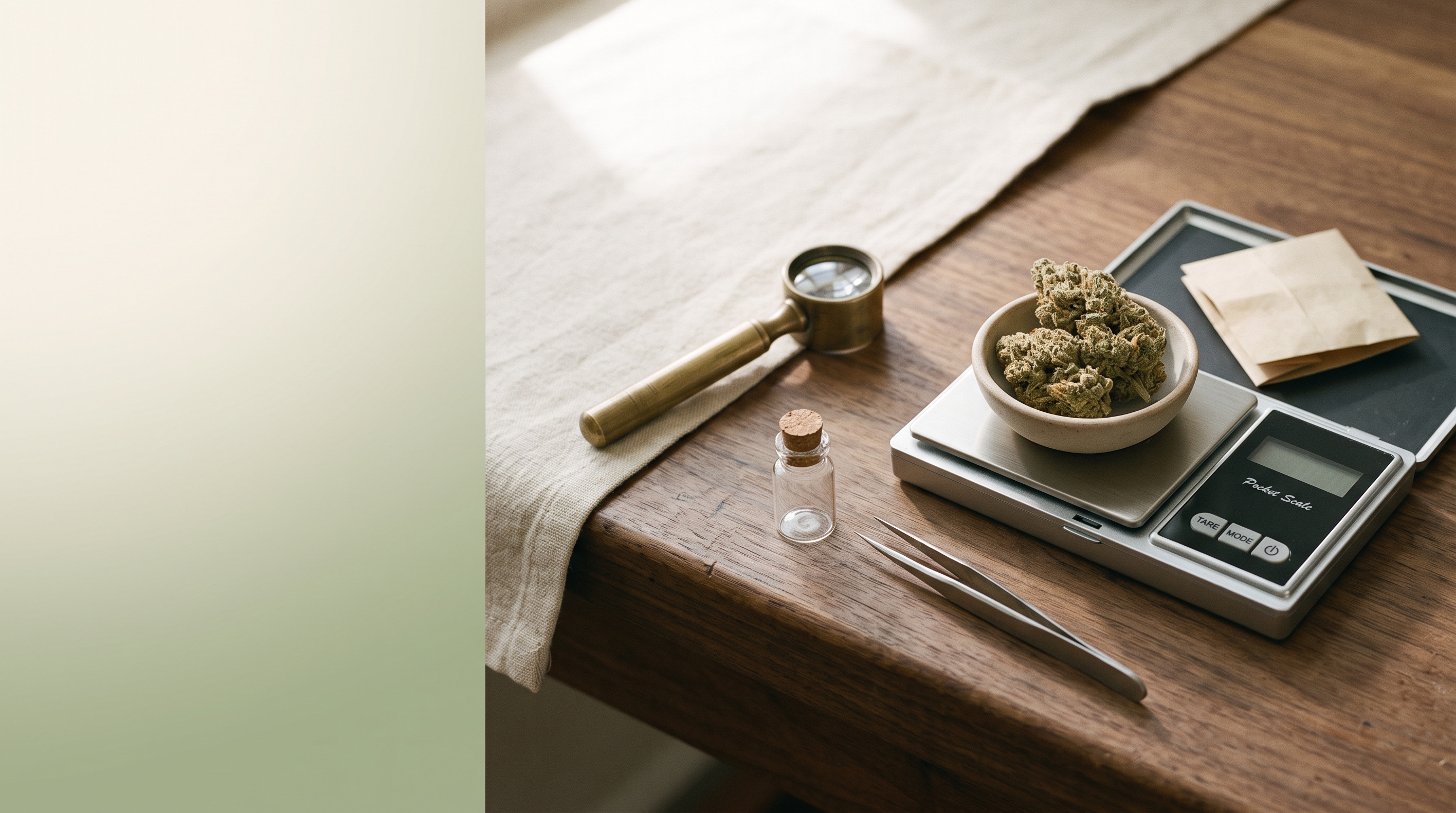
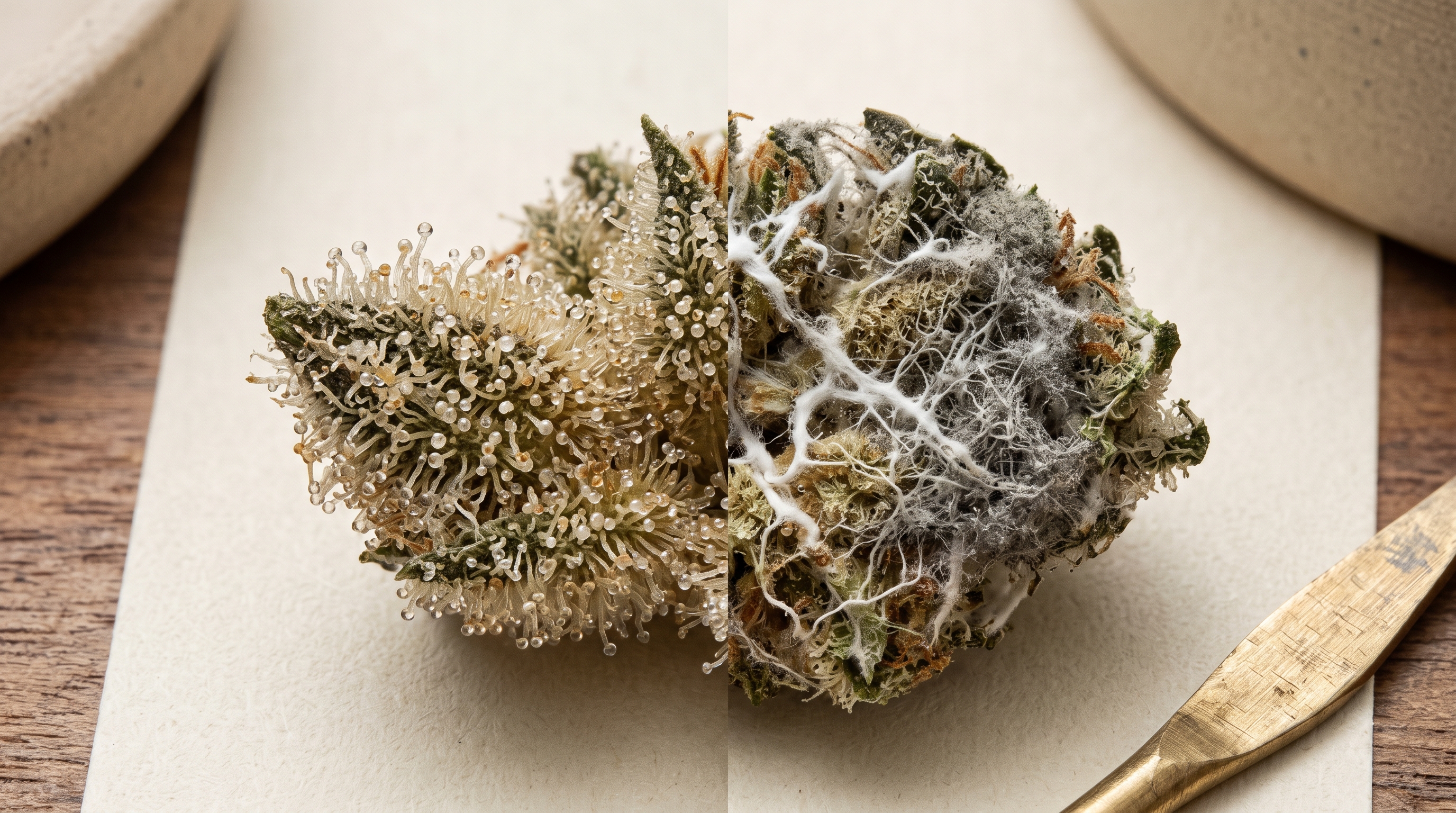
That white coating on cannabis can mean two completely different things. Healthy trichomes look like tiny, organized glass mushrooms: a clear, cloudy, or amber resin head on a stalk. Mold looks irregular: powder, fuzz, wispy threads, web-like growth, or grey-brown decay that spreads across and into the flower.
That distinction is useful, but it is not a home safety test. Some contamination is microscopic, some harmless plant structures look suspicious, and a photo cannot tell you whether a batch passed microbial or mycotoxin limits. If flower looks moldy, smells musty, or makes you genuinely unsure, do not smoke, vape, cook, or eat it. Close the container, preserve the package and lot information, and return or discard it.
This guide will help you recognize obvious warning signs without pretending your phone camera is a laboratory.
Key Takeaways
- Trichomes are separate, rounded glands on stalks. Mold grows as irregular powder, fuzz, threads, or networks and may accompany brown, grey, soft, or collapsed plant tissue.
- Use bright neutral light and modest magnification, but treat them as screening tools. Neither a loupe, smell, nor a photo can certify that cannabis is free of microbes or toxins.
- A musty, basement-like, wet-hay, or sour-ammonia odor is a stop sign. A normal aroma does not prove the flower is safe.
- Do not try to rescue suspect flower. Scraping, washing, heating, cooking, or removing one bad piece cannot establish that the remainder is safe.
- People with weakened immune systems or lung disease need a lower threshold for caution. Ask a clinician about cannabis exposure risks, and seek care for concerning respiratory symptoms.
Mold vs. Trichomes at a Glance
| Clue | More consistent with healthy trichomes | More consistent with mold or mildew | What the clue cannot prove |
|---|---|---|---|
| Shape under a loupe. | Repeating stalks with rounded, bulb-like heads. | Tangled threads, flat dust, fuzzy tufts, branching webs, or chains of particles. | Species, viability, or toxin level. |
| Distribution. | Individual glands arising from flower and small leaves. | Patches that bridge surfaces, fill crevices, or spread across plant tissue. | Whether an unmarked area is clean. |
| Color. | Clear, milky-white, amber, or reddish-brown heads. | White or grey powder; grey-brown fuzz; dark spots with decayed tissue. | Safety by color alone. |
| Texture. | Resinous, tacky, or dry depending on cure. | Unnaturally damp, soft, cottony, dusty, or crumbly around a damaged core. | Moisture or water activity without a meter. |
| Smell. | Familiar plant aromas, from floral and citrus to earthy or fuel-like. | Musty basement, damp cardboard, wet hay, mildew, or sharp ammonia. | Absence of invisible contamination. |
| After gently separating a naturally loose piece. | Plant interior is consistent in color and structure. | Grey-brown interior, soft collapse, fuzzy core, or dust-like plume. | A laboratory pass/fail result. |
The simplest rule is also the safest: organized glands suggest trichomes; disorganized growth or decaying tissue suggests a problem. When the evidence is mixed, do not consume the product.
What Healthy Cannabis Trichomes Actually Look Like
The word frosty causes much of the confusion. Quality flower can look dusted with sugar, especially at arm’s length. Up close, however, that frost resolves into anatomy.
Cannabis makes several kinds of surface hairs, but the resin-rich structures most people notice are capitate glandular trichomes. Mature ones have a stalk topped by a rounded head. The head contains secretory cells and resin rich in cannabinoids and aromatic compounds. Microscopy research shows that their size, density, stalk length, color, and post-harvest condition vary with genetics, age, drying, and handling [Punja et al., 2023].
Clear, cloudy, amber, and reddish-brown heads can all be normal at different stages. Some heads collapse, detach, or wrinkle after drying, and rough handling may leave bare stalks. None of those observations alone means mold.
Look for a repeating pattern:
- round or slightly oval heads.
- a visible stalk beneath many of those heads.
- separate glands rather than a continuous fabric.
- a distribution that follows the flower surface.
- translucence or resin-like shine when the light angle changes.
Our complete guide to cannabis trichomes explains the anatomy, while how to read trichomes with a loupe focuses on maturity. This article owns a different question: whether a suspicious coating should stop consumption.
Dense milky trichomes can resemble powder until magnified. Orange, brown, or pale pistils and plant hairs are also normal; unlike mold, they arise in predictable locations and do not form a branching net. Detached resin heads usually look granular rather than fibrous, but if loose particles cannot be identified confidently, stop there. Pale tissue alone is weak evidence.
What Mold, Mildew, and Bud Rot Can Look Like
Mold is a broad consumer term, not a diagnosis. Cannabis can host many fungi, and the visible signs depend on the organism, plant stage, moisture, and severity. Research has documented powdery mildew on cannabis leaves and flowers. It has also linked Botrytis, Penicillium, and Fusarium with bud rot and post-harvest contamination [Punja et al., 2019].
Powdery mildew: a coating, not crystal heads
Powdery mildew often presents as white or pale-grey material sitting on the surface. Early patches may look flat and dusty. More established growth can appear like flour or talc across a leaf or flower surface.
Under scanning electron microscopy, cannabis powdery mildew forms superficial fungal filaments called hyphae, plus upright structures that produce spores. Those spores can adhere to nearby glandular trichomes [Punja, 2018]. That last detail explains why an infected area may contain both real trichomes and fungal material. The categories do not always appear in tidy, separate halves.
Bud rot: look inside the structure
Bud rot can begin within a dense flower where moisture persists. Warning signs include:
- grey, brown, or tan tissue in the core.
- a section that feels unusually soft, damp, or collapsed.
- fuzzy grey growth between flower structures.
- small leaves that pull away from a dead-looking center.
- a musty odor that intensifies when the container opens.
Do not blow on suspect flower or repeatedly pull it apart; that can spread particles. A fuzzy or decayed interior is enough information to stop.
Web-like growth: threads do not belong there
Fungal mycelium grows as branching filaments. To the eye or loupe, it may resemble cobwebs that bridge plant surfaces. Healthy trichomes do not form a fabric between separate parts of the flower. They arise from the plant surface as individual structures.
Webbing could also come from pests or foreign material. That does not make it consumable: isolate the product and contact the seller.
The Five-Minute Inspection—And Its Limits
Start before you grind. Grinding destroys the spatial clues that separate plant structures from an irregular patch. It can also spread contamination through otherwise clean equipment.
- Leave the flower in or over its container. Do not shake it near your face.
- Use bright, neutral-white side lighting. Rotate the container or flower; resin heads often sparkle as the angle changes, while powdery patches remain matte.
- Use a clean 10x to 30x loupe if you have one. Look for rounded heads on stalks versus threads, fuzz, or a continuous dusty coating.
- Check multiple surfaces without crushing the flower. Pay attention to crevices and any naturally exposed interior.
- Stop at uncertainty. Package it, photograph the product and label, and move to the return-or-discard workflow below.
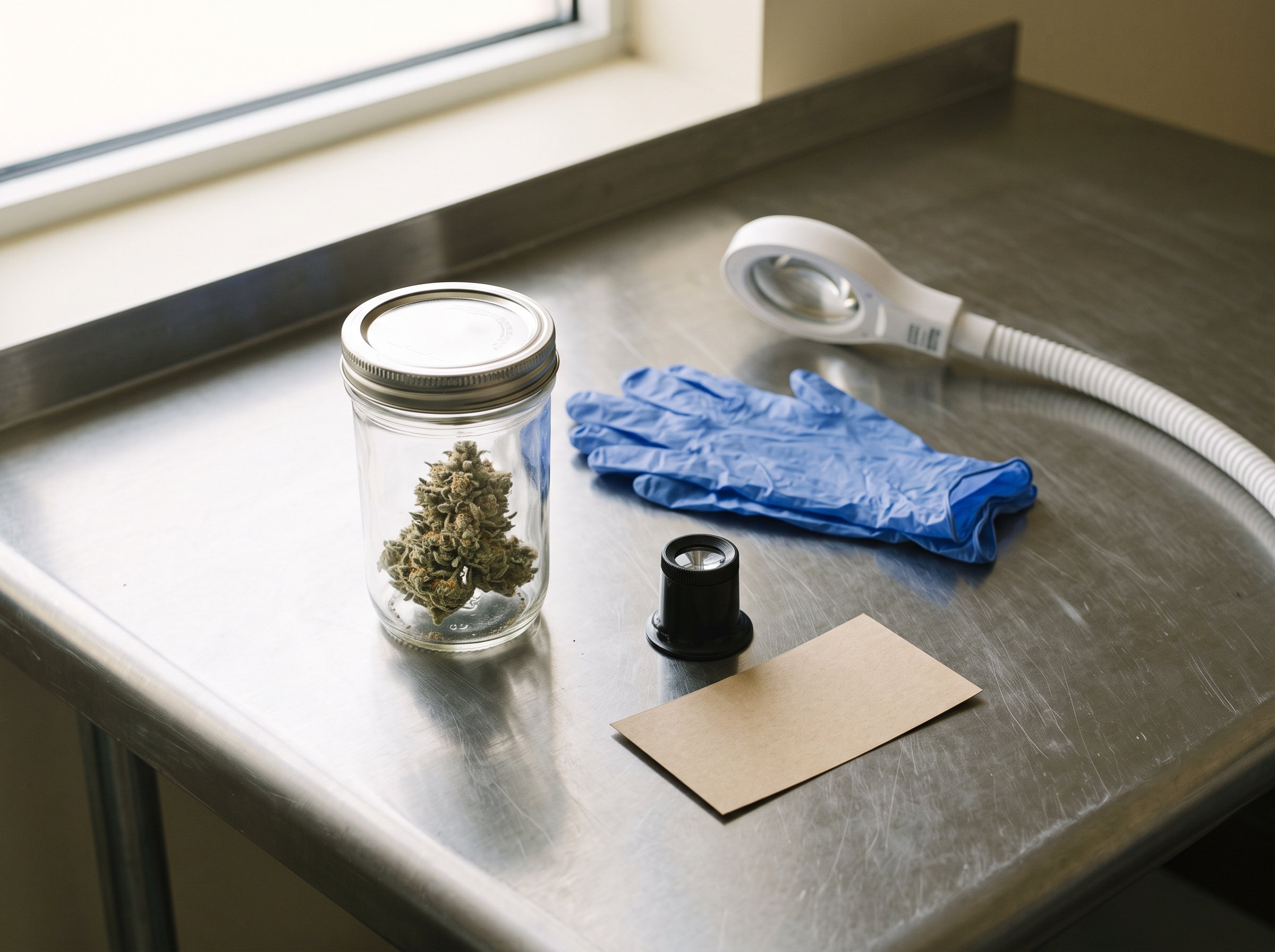
Why lighting can fool you
Warm bulbs can shift color, phone flash can flatten texture, and deep shadows can look grey. Inspect from more than one angle under neutral light, but do not keep manipulating suspect material for the perfect photo.
Why smell can warn—but cannot clear—a product
A musty or damp-cardboard smell is a meaningful reason to stop. Sharp ammonia can indicate an overly wet, poorly controlled cure or other microbial activity. But human smell varies, cannabis aromas are chemically complex, and low-level contamination may have no obvious odor.
In other words: a bad smell can disqualify flower; a normal smell cannot certify it. Our cannabis aroma science guide explains why familiar earthiness can be normal, and our home odor guide addresses environmental smell rather than product safety.
Why photos cannot settle the question
A close-up may help document a complaint. It cannot reliably identify a fungal species, measure live organisms, or detect mycotoxins. Compression, focus, and white balance also distort appearances.
Online votes are not a certificate of analysis. If the answer matters enough to ask strangers, it matters enough not to inhale the sample.
Invisible Contamination and the Mycotoxin Nuance
Visible mold is only one failure mode. A small sequencing study examined 17 dispensary-derived flower samples. Fungal DNA screening detected several Aspergillus and Penicillium species, including some missed by one or more culture-based assays [McKernan et al., 2016]. The limits matter. DNA detection does not prove that an organism is alive, present at a harmful dose, or producing a toxin. The authors and peer reviewers cautioned against treating greater molecular sensitivity as proof that established culture thresholds were inadequate.
That distinction is crucial:
- A toxigenic species is capable of making a toxin under some conditions.
- Detecting that species does not prove a mycotoxin is present.
- A mycotoxin result requires a test for the toxin itself.
- A passed sample represents a tested batch under a jurisdiction’s methods and limits, not a promise that every piece will remain safe after poor storage.
A 2023 review identified more than 100 fungal species reported in the cannabis and hemp mycobiome. It highlighted Aspergillus, Penicillium, Fusarium, and Mucor as organisms of potential concern. The authors also called for more research linking fungal findings, toxin production, exposure, and consumer outcomes [Gwinn et al., 2023]. That supports sound testing and cautious handling—not the claim that every spore equals poisoning.
Real-world surveillance supports the value of regulated testing. Health Canada’s comparison of legal and illegal dried cannabis tested 50 samples from each market. Total yeast and mold exceeded the comparison limit in 73% of illegal samples versus 6% of legal samples. Six illegal samples contained one of the tested mycotoxins; none of the legal samples did. This targeted survey cannot guarantee the condition of every product. It does show why traceable supply and testing matter.
Read our guide to cannabis lab results for the anatomy of a certificate of analysis. Then read why cannabis testing standards can still fail consumers for the limitations of sampling, methods, and jurisdiction-to-jurisdiction rules. Both things can be true: regulated testing reduces uncertainty, and it does not make home inspection obsolete.
Who Should Be Extra Cautious?
Most healthy people breathe ordinary environmental mold spores without developing aspergillosis. The CDC’s aspergillosis guidance identifies weakened immune systems and lung disease as key risk factors. Recent organ or stem-cell transplant recipients face added risk for invasive disease.
Cannabis-specific evidence is concerning but not perfectly causal. A 2020 analysis of commercial insurance claims found a fungal-infection diagnosis was 3.5 times as common among people with a cannabis-use code as among those without one. The authors could not determine cannabis source, consumption route, timing, or whether cannabis caused the infections [Benedict et al., 2020]. Case reports also describe invasive pulmonary aspergillosis in immunosuppressed cannabis users, including a renal transplant recipient exposed during high-dose steroid treatment [Marks et al., 1996]. A case report can flag a plausible hazard; it cannot estimate an average consumer’s risk.
Use a lower threshold for caution if you have:
- an organ or stem-cell transplant.
- cancer treatment or another cause of major immune suppression.
- prolonged or high-dose corticosteroid treatment.
- advanced HIV or another immune-compromising condition.
- chronic lung disease or a history of serious fungal lung infection.
Ask the clinician managing that condition whether inhaled cannabis is appropriate and what product controls matter. Our broader explainers on cannabis and lung health and cannabis and the immune system provide context, but they do not replace personal medical advice.
After a suspected exposure, seek prompt medical advice for persistent or worsening symptoms. These can include cough, shortness of breath, fever, chest pain, or unusual fatigue. This is especially important for higher-risk people. Coughing up blood or severe trouble breathing warrants urgent medical care.
What to Do With Suspect Cannabis
1. Stop using it
Do not smoke it, vape it, eat it, cook with it, or turn it into another product. Do not test it by taking “one tiny hit.”
2. Close and isolate it
Return it to its original container if that can be done without scattering material. Keep it away from other flower, grinders, and shared storage. Wash your hands after handling it.
3. Document the traceability information
Photograph the suspicious area, package, product name, producer, purchase date, lot or batch number, and any QR code. Keep the receipt if you have it. A clear batch number is more actionable to a retailer or regulator than a dramatic macro photo without provenance.
4. Check official recalls and contact the seller
Search your state or country’s cannabis regulator for the product and lot. California, for example, maintains a public cannabis recalls portal that includes microbial-contamination notices. Contact the licensed retailer and producer using official channels and ask about return, quarantine, or complaint procedures.
If you need help judging the retailer’s process, see how to choose a licensed dispensary and what to ask on a dispensary visit. A good operator should care about the lot number and preserve the complaint trail.
5. Return or discard it safely
Follow the retailer’s or regulator’s instructions when a return is available. Otherwise, keep the material sealed and follow local disposal requirements. Do not pass it to someone else.

Why You Should Not Try to Rescue Moldy Flower
The internet offers many home salvage tactics. People suggest scraping off the patch, cutting away the center, washing the buds, drying them harder, baking them, or making edibles. None of those methods identifies the organism or shows how far it spread. They also cannot confirm whether viable spores or toxins remain.
Regulated remediation is not a kitchen trick. The California Department of Cannabis Control’s testing guidance says failed batches may be remediated only by licensed manufacturers under an approved plan and must be retested before sale. That controlled process has documented methods, batch handling, and analytical verification. It is not evidence that a consumer can make suspect flower safe at home.
Discarding a costly jar hurts. A fungal lung infection can hurt much more. Treat the loss as a product complaint, not a salvage project.
How to Reduce the Chance of Mold After Purchase
Prevention is straightforward. Buy sealed, traceable products from licensed retailers where legal. Request the batch certificate when available. Avoid damaged packaging or unexplained moisture. Keep batches separate and use clean, dry, airtight containers in a cool, dark place. Never add fruit peel, bread, or other wet material to rehydrate flower. Investigate condensation, dampness, or a new odor immediately.
Washington’s regulator explains that licensed cannabis testing can include water activity, microbiological screening, and mycotoxin screening, and that consumers may request a certificate of analysis. Requirements vary, so use your own regulator’s terminology and recall system.
For the detailed method, use our complete cannabis storage guide and humidity-pack guide. To evaluate purchase quality before storage becomes the issue, use the flower quality checklist and flower grades explainer.
The Bottom Line
Trichomes are organized resin glands. Mold is disorganized biological growth. That visual rule can help you spot an obvious problem, but it cannot turn a loupe into a microbiology lab.
When flower shows powder, fuzz, web-like threads, a grey-brown core, suspicious dampness, or a musty odor, stop. Keep the package and lot number. Check recalls. Contact the retailer. Return or discard the product rather than trying to rescue it.
The goal is not to become afraid of every cloudy trichome. It is to recognize when uncertainty has crossed the line where one more bowl is no longer worth the experiment.
FAQs
Can moldy cannabis still have normal trichomes?
Yes. Fungal growth can occur on flower that also has genuine glandular trichomes, and powdery mildew spores may adhere to trichome surfaces. Finding some normal stalk-and-head structures does not clear a suspicious patch elsewhere on the product.
Does mold always smell musty?
No. A musty, damp-cardboard, wet-hay, or sour-ammonia odor is a reason to stop, but contamination may have little or no smell. Aroma cannot replace microbial and mycotoxin testing.
Can I remove the moldy piece and use the rest of the jar?
No home inspection can establish that the rest is unaffected. Fungal filaments, spores, or contaminants may extend beyond what you can see. Isolate the whole batch and return or discard it.
Will smoking, vaping, baking, or cooking kill cannabis mold?
Heat may reduce some viable organisms under particular controlled conditions, but a consumer cannot verify exposure, distribution, treatment, or toxin removal. Do not use heating or cooking as a rescue method for suspect cannabis.
Does a passed certificate of analysis mean my flower cannot grow mold later?
No. A certificate reports a sampled batch tested under specific methods and limits. It does not prevent contamination or growth after packaging if the seal fails or storage conditions become too humid. Match the lot number, check the test date, inspect the product, and store it correctly.
Should I use a UV light to check cannabis for mold?
No consumer UV result is definitive. Many natural plant materials fluoresce, different fungi behave differently, and lighting can create false confidence. Neutral visible light, modest magnification, traceable lab results, and a cautious stop decision are more useful.
When should I seek medical care after using suspect cannabis?
Contact a healthcare professional if cough, shortness of breath, fever, chest pain, or unusual fatigue persists or worsens. Do so promptly if you have lung disease or a weakened immune system. Seek urgent care for severe breathing difficulty or coughing up blood.
Sources
- Punja, Z. K., Sutton, D. B., & Kim, T. (2023). Glandular trichome development, morphology, and maturation are influenced by plant age and genotype in high THC-containing cannabis (Cannabis sativa L.) inflorescences. Journal of Cannabis Research, 5, 12. PubMed · DOI
- Punja, Z. K., Collyer, D., Scott, C., Lung, S., Holmes, J., & Sutton, D. (2019). Pathogens and molds affecting production and quality of Cannabis sativa L. Frontiers in Plant Science, 10, 1120. PubMed · DOI
- Punja, Z. K. (2018). Flower and foliage-infecting pathogens of marijuana (Cannabis sativa L.) plants. Canadian Journal of Plant Pathology, 40(4), 514–527. DOI
- McKernan, K., Spangler, J., Zhang, L., Tadigotla, V., Helbert, Y., Foss, T., & Smith, D. (2016). Cannabis microbiome sequencing reveals several mycotoxic fungi native to dispensary grade cannabis flowers. F1000Research, 4, 1422. PubMed · DOI
- Gwinn, K. D., Leung, M. C. K., Stephens, A. B., & Punja, Z. K. (2023). Fungal and mycotoxin contaminants in cannabis and hemp flowers: implications for consumer health and directions for further research. Frontiers in Microbiology, 14, 1278189. PubMed · DOI
- Benedict, K., Thompson, G. R., III, & Jackson, B. R. (2020). Cannabis use and fungal infections in a commercially insured population, United States, 2016. Emerging Infectious Diseases, 26(6), 1308–1310. PubMed · DOI
- Marks, W. H., Florence, L., Lieberman, J., Chapman, P., Howard, D., Roberts, P., & Perkinson, D. (1996). Successfully treated invasive pulmonary aspergillosis associated with smoking marijuana in a renal transplant recipient. Transplantation, 61(12), 1771–1774. PubMed · DOI
Official consumer and regulator resources
- CDC: Aspergillosis Basics, updated April 24, 2024
- Health Canada: A comparison of legal and illegal dried cannabis products, published 2025
- California Department of Cannabis Control: Testing laboratories, accessed August 20, 2026
- Washington State Liquor and Cannabis Board: Understanding test results, accessed August 20, 2026
This article provides general consumer-safety education, not medical diagnosis. Regulations and testing requirements vary by jurisdiction.

