Water Activity vs Moisture Content in Cannabis Flower
Read the two water measurements on a cannabis COA: percent by weight versus unitless water activity, lab method limits, and what a passing result means.

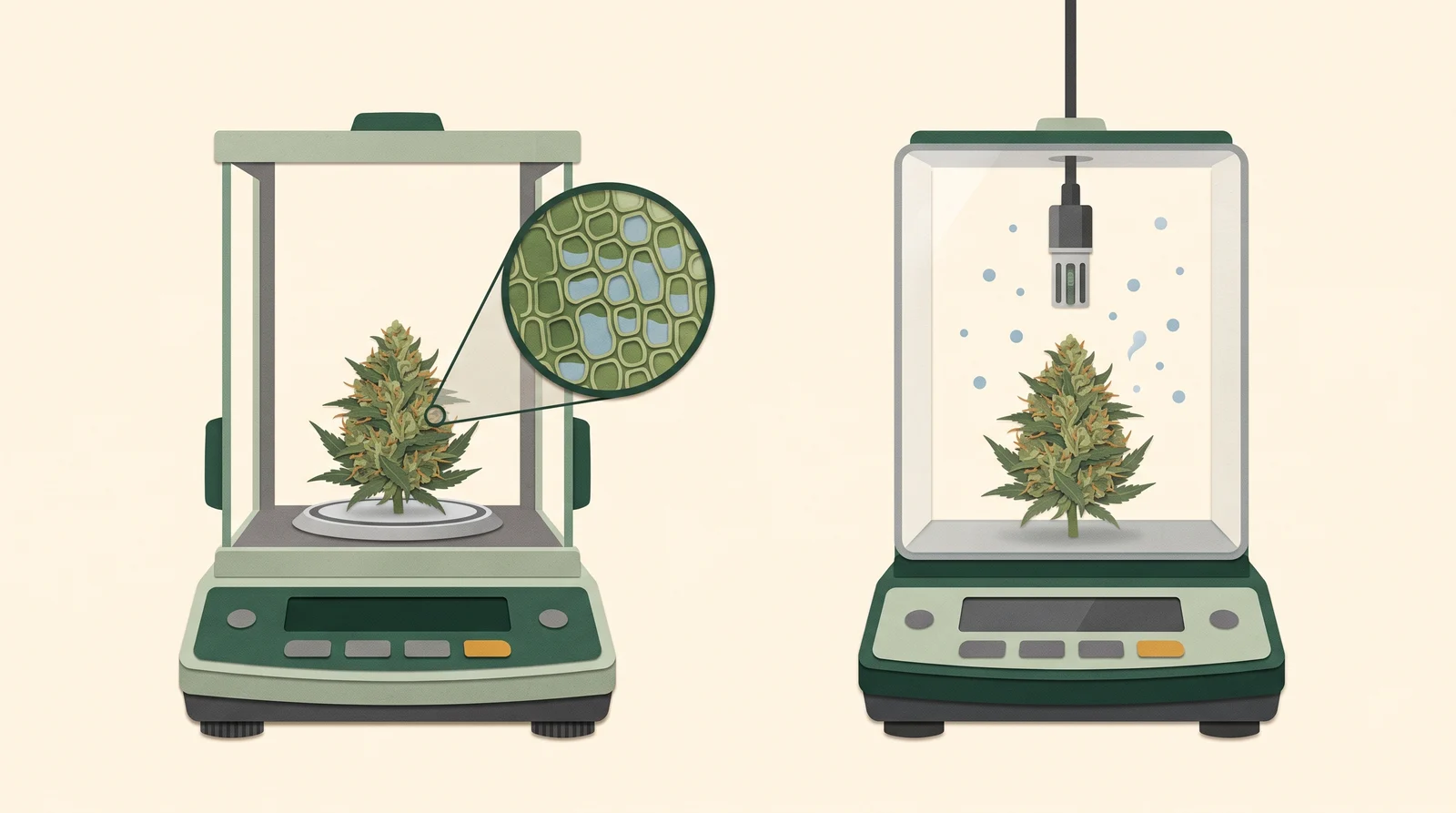
Moisture content measures water by weight; water activity measures how available that water is under the test conditions. On a cannabis certificate of analysis (COA), a moisture result of 10% and a water activity result of 0.60 answer different questions. 0.60 water activity does not mean 60% water.
Those numbers are an illustrative pair, not a tested product or a recommended target. The useful habit is to read each result with its field name and unit attached. If the rest of the report is unfamiliar, start with our guide to reading cannabis lab results.
What do the two measurements mean?
| COA field | What it describes | How to read the number |
|---|---|---|
| Moisture content | Water as a share of sample weight | A percentage; check the method and reporting basis |
| Water activity, often written aw | Water availability, measured through equilibrium vapor pressure | A unitless ratio, commonly written as a decimal |
California defines moisture content as the percentage of water by weight. FDA defines aw through an equilibrium vapor-pressure ratio. California DCC, §15700; FDA, 1984.
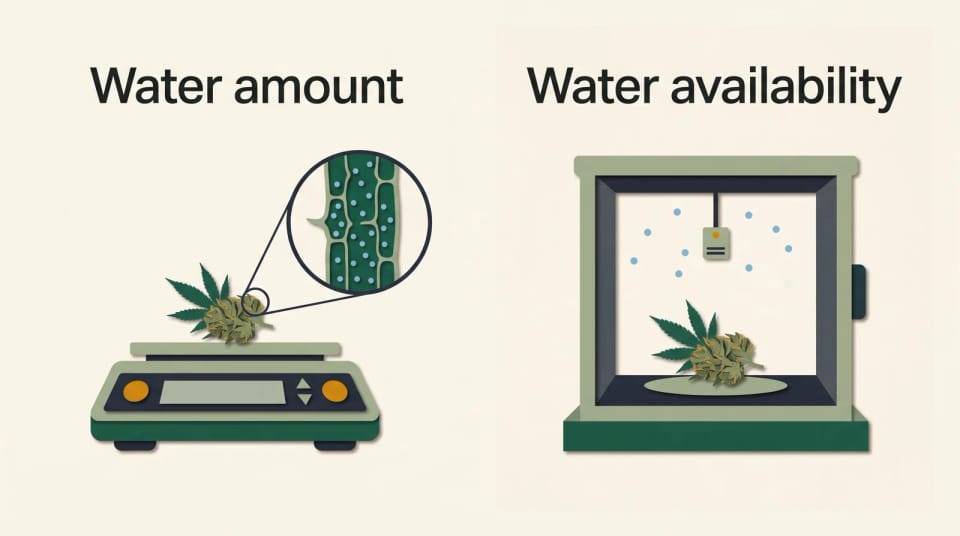
Water amount and water availability describe different properties. The blue dots are schematic, not a count of water molecules.
A worked example: 10% moisture is not 0.10 aw
Imagine a sample that starts at 100 grams and contains 10 grams of water. On a starting-weight basis, its moisture content is:
10 grams ÷ 100 grams × 100 = 10%.
This is arithmetic, not a claim that a drying test always identifies exactly 10 grams of water. The laboratory method matters, as the NIST example below shows.
Now imagine a separate instrument reports aw = 0.60. That ratio means the equilibrium water vapor pressure is 60% of pure water’s at the same temperature. It does not say that 60 grams of the sample are water.
FDA also describes the relationship equilibrium relative humidity (%) = aw × 100. Here, 0.60 corresponds to 60% equilibrium relative humidity around the sample. An ordinary room humidity reading is not automatically the sample’s measured water activity. FDA, 1984.
Water binding affects the relationship between the two measurements. There is no universal conversion factor. FDA, 1984.
Why does the moisture test method matter?
In a 2025 NIST comparison, 89 laboratories returned moisture results for the same hemp plant material. The community consensus was 9.04%, compared with NIST’s target value of 7.02%: a difference of 2.02 percentage points. These are moisture results, not water activity readings. Yarberry et al., 2025.
The report discusses differences in methods, drying conditions and sample handling. A loss-on-drying method measures lost mass; volatile compounds other than water can contribute to that loss. A water-specific method such as Karl Fischer titration asks a different analytical question. Yarberry et al., 2025.
This was an analytical comparison using one hemp material, not a study of every retail flower product. It does not prove that your laboratory’s result is wrong. It shows why a decimal alone cannot tell the whole measurement story.
When comparing reports, ask whether both moisture measurements used the same method and basis. Our guide to measurement uncertainty explains another reason reported numbers need context. Batch variation is a separate question from two laboratories measuring the same material differently.
What does a passing water activity result mean?
The rule depends on the jurisdiction and product. As checked on October 10, 2026, California’s §15717 requires dried cannabis flower testing for both water activity and moisture content. Flower, including pre-rolls, passes the water activity provision when it does not exceed 0.65 aw; moisture content is reported separately as a percentage. California DCC, §15717.
That is a California regulatory example, not a universal storage target or a promise about the whole product. Read the actual field, result, limit and status on your report. California also requires separate microbial and mycotoxin testing under §15714. An aw result is not a substitute for those panels. California DCC, §15714.
Low water activity is not a kill step
Restricting microbial growth and destroying microbes are different outcomes. FDA’s January 2025 draft guidance for low-moisture ready-to-eat foods explains that pathogens can survive even where the food generally does not support their growth. FDA, 2025, draft guidance, page 3.
That source concerns food manufacturing, not a cannabis exposure trial. It supports the distinction between growth and survival; it does not supply a cannabis-specific safety threshold. A low aw reading alone does not demonstrate that a product underwent a validated process to destroy pathogens.
How should you use the two rows on a COA?
Read the report in this order:
- Identify the sample. Match the batch or lot number to your package before applying either result to your flower.
- Keep field names and units together. Write “10% moisture” or “0.60 aw,” not just “water: 10” or “water: 60.”
- Check the method and conditions. Look for the moisture method, reporting basis and water activity test temperature. Ask the laboratory when the report leaves them unclear.
- Read the applicable limit separately. A result and a legal pass/fail decision are different pieces of information.
- Keep the report’s timing in view. Test date and package date answer different questions. Neither row is a measurement of every later storage condition.
If two documents appear inconsistent, preserve the full reports when asking for clarification. A cropped screenshot can remove the sample identity, method or date needed to interpret the result.
Frequently asked questions
Is water activity a percentage?
Water activity is unitless. Multiplying it by 100 expresses the corresponding equilibrium relative humidity, not the percentage of water in the flower. FDA, 1984.
Can I convert moisture content into water activity?
There is no universal conversion for arbitrary flower samples. Treat them as separate measured results rather than trying to make the decimals match.
Does a low aw result mean the flower is mold-free?
The water activity row does not directly identify or count mold. Read the relevant microbial and mycotoxin results separately. California’s testing rules list those panels separately from water activity. California DCC, §15714.
Which result should I look at first?
Read both, with the sample identity and applicable rule. If your question is how much water was reported by weight, use moisture content. If your question is the sample’s measured water availability, use aw. Neither row answers every quality or contamination question.
Key takeaways
- Moisture content is reported as a percentage by weight; aw is a unitless ratio.
- 0.60 aw is not 60% water. Keep the name and unit beside each number.
- Methods and sample handling matter when comparing moisture results.
- A passing aw result does not replace the rest of the testing report or prove a pathogen kill step.
Sources
- FDA (1984). Water Activity (aw) in Foods. Inspection Technical Guide No. 39, April 16. Public technical guidance defining water activity and equilibrium relative humidity. Read the guide.
- California Department of Cannabis Control. Text of Regulations, §§15700, 15714 and 15717. Public definitions and testing requirements; checked October 10, 2026. Read the regulations.
- Yarberry, A. J., Barber, C. A., Wilson, W. B., and Wood, L. J. (2025). Cannabis Laboratory Quality Assurance Program: Exercise 3 Moisture Final Report. NIST IR 8574. Interlaboratory analytical comparison of hemp material, not a clinical trial. DOI: 10.6028/NIST.IR.8574. Read the full report.
- FDA (2025). Establishing Sanitation Programs for Low-Moisture Ready-to-Eat Human Foods and Taking Corrective Actions Following a Pathogen Contamination Event. January draft guidance, nonbinding and marked “Not for Implementation”; used only for the growth-versus-survival distinction. Read the draft.




