

How to Track Cannabis Spending: A Receipt-to-Budget Method
Track cannabis spending with a receipt log: record the total paid, divide by net grams, and review monthly and yearly. Learn which numbers are estimates.

Professor High
Written by Professor High, our AI guide. See how we research and correct articles.
To track cannabis spending, record the receipt total (not the shelf price) and the labeled net weight for every purchase, then add those totals by month and by the last 12 months. Cost per gram from that log is exact arithmetic. Cost per milligram of THC is only an estimate, because it rests on a label.
This is a method, not an app. It works in a notebook, a spreadsheet, a notes file or a budgeting app with a custom category. Here in High School we keep the money log separate from a session journal for effects, because the two answer different questions.
Here is the number that makes the case for a log. Two official Canadian figures both describe “average cannabis spending”, and they differ by about five times. Statistics Canada reports that Canadians of legal age spent on average $150 per year per person in 2022/2023. That divides legal retail sales by every adult of legal age, including people who never buy cannabis. Health Canada’s 2024 survey reports that people who consumed in the past 12 months typically spent close to $63 a month. Multiply by 12 (our arithmetic, not a published figure) and that is about $756 a year. The denominator is the difference. Neither number is your number. A receipt log is.
Tax rules and sources checked October 29, 2026.
Why not just estimate what you spend?
Because memory is a poor ledger. In four studies of general personal spending, people predicted they would spend less than they actually spent. They also predicted less than they remembered spending the week before. Stronger savings goals lowered their predictions but did not lower what they spent. Peetz and Buehler, 2009
That research was not about cannabis, so it does not show that people misjudge cannabis spending in particular. It does show why a planned-purchase calculator is a guess. Purchase size times how often you think you buy is a forecast, not a record.
Records made close to the event hold up better. Researchers who study substance use rely on calendar-based self-report, and a meta-analysis found that this method agreed with biological tests for cannabis use about 87% to 91% of the time. Hjorthøj and colleagues, 2012 That test checks whether use happened, not how much was spent. A receipt is better still: it is the record.
Should you track the shelf price or the receipt total?
Track the receipt total. The shelf price means different things in different states, so it is a poor unit for a budget.
| State | What the shelf price includes | What the receipt adds |
|---|---|---|
| Washington | The 37% cannabis excise tax must be reflected in the price list or quoted shelf price | Sales tax, itemized separately from the excise tax |
| California | The product price before the 15% cannabis excise tax | The 15% excise tax, separately stated on the receipt, plus sales and use tax (7.25% statewide, higher where district taxes apply) |
Sources: RCW 69.50.535 and the California Department of Tax and Fee Administration’s tax facts for cannabis businesses. Rates change, and other states use other rules. The receipt shows the rule that applied to your purchase.
So a $40 shelf price can mean $40 plus sales tax in one state and $40 plus two taxes in another. The receipt total is what left your account. Our state price guide explains why checkout often exceeds the menu; this article is about recording what you actually paid.
Read each line while you log it. A charge you cannot explain is worth a question at the counter. Our list of dispensary red flags covers what an unclear receipt can signal.
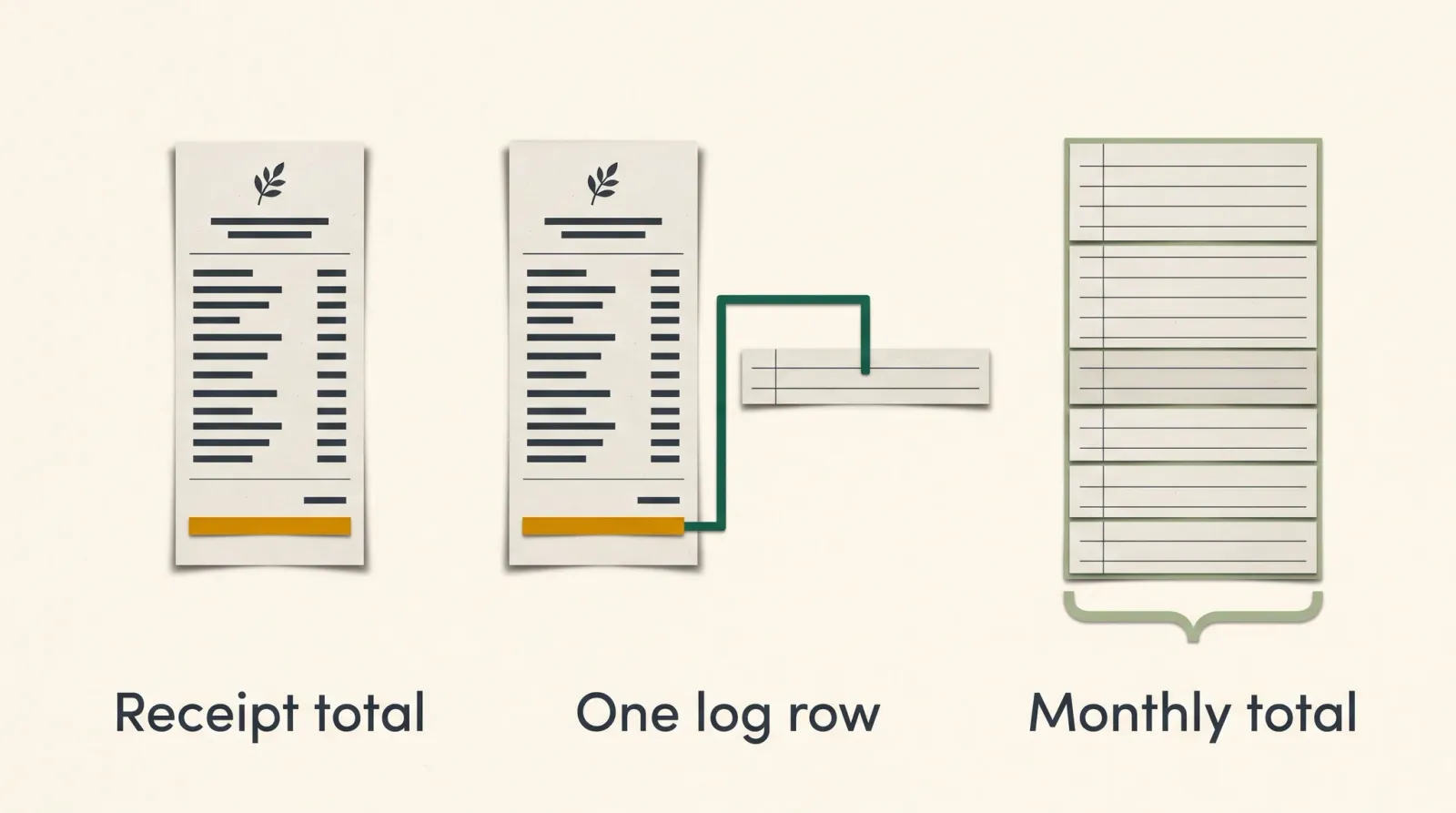
The whole method in three moves: copy the bottom line of the receipt, give each purchase one row, and add the rows when the month ends. The illustration uses blank lines, not real prices.
How do you set up a cannabis spending log?
Use six columns. Anything more is optional.
- Date. The purchase date on the receipt.
- Store. Where you bought it, so you can match the row to a bank or card statement later.
- Product type. Flower, pre-roll, vape cartridge, edible, concentrate, topical.
- Amount. The labeled net weight in grams, or the labeled THC milligrams for an edible. Check the net weight on the package, not the nickname: an “eighth” is a size word, and the label states what is in it.
- Receipt total. The out-the-door amount, taxes included.
- Unit cost. Receipt total divided by the amount. More on that below.
Add a notes column if you like: a discount, a return, a gift you paid for. Keep effects, mood and dose out of this sheet. That is the journal’s job.
Cash purchases do not appear in a bank feed, so a budgeting app that imports transactions will miss them. Log those by hand the same day. Card purchases may import with a business name that differs from the shop’s sign, which is one more reason the store column helps.
How do you calculate cost per gram?
Divide the receipt total by the labeled net grams. That is all.
Here is a hypothetical month. These are made-up numbers to show the arithmetic, not prices from any store.
| Date | Product type | Labeled amount | Receipt total | Unit cost |
|---|---|---|---|---|
| Oct 3 | Flower | 7 g | $61.40 | $8.77 per gram |
| Oct 12 | Vape cartridge | 1 g | $38.50 | $38.50 per gram |
| Oct 19 | Edible | 100 mg THC | $22.00 | $0.22 per labeled mg |
| Oct 27 | Flower | 3.5 g | $33.10 | $9.46 per gram |
| October total | $155.00 |
The monthly total is the sum of the receipt totals: 61.40 + 38.50 + 22.00 + 33.10 = $155.00. Notice that the unit costs do not add. Each one only compares purchases of the same product type.
Does buying more at once always lower your cost per gram? Not reliably. A study of more than 31 million flower purchases in Washington from 2014 to 2016 found “small but significant quantity discounts”, and price per gram also rose with THC content. Smart and colleagues, 2017 That was one state in the early years of its market. Your own log answers the question for your own purchases.
Is cost per milligram of THC better than cost per gram?
It answers a different question, and it is softer. Cost per gram compares flower with flower. Cost per milligram tries to compare across product types. The catch is that the milligrams come from a label, and labels carry error.
| Cost per gram | Cost per milligram of THC | |
|---|---|---|
| How you get it | Receipt total ÷ labeled net grams | Receipt total ÷ labeled THC milligrams |
| What it rests on | A weight you can check on a scale | A lab result printed on a label |
| Best for | Comparing flower to flower, cart to cart | Rough comparison across product types |
| Main weakness | Ignores potency differences | Labels can be wrong; THC percentage varies by testing lab |
Three findings explain the weakness:
- In a lab check of 75 edible products bought in 2014 and 2015, only 17% were within the labeled THC range. Vandrey and colleagues, JAMA 2015 That was a medical-market sample from three cities, not today’s regulated shelves. Our guide to edible label accuracy covers newer data.
- In Washington’s testing records, the THC content reported for cannabis differed systematically by which laboratory ran the test. Jikomes and Zoorob, 2018 Our article on flower THC labels goes deeper.
- Converting grams of flower into THC by assuming an average strength correlated only moderately with a urine biomarker (r = 0.52) in a London study of 147 regular users. Petrilli and colleagues, 2024
Some researchers have proposed a “standard THC unit” of 5 mg for every product type, partly because grams cannot account for different concentrations. Freeman and Lorenzetti, 2020 It is a proposal, not a legal unit. If you want a cross-product figure, cost per 5 mg is cost per mg times five, with the same label caveat.
Use cost per milligram as a rough guide and write “est.” beside it. And remember that THC percentage is not a forecast of how a product will feel. A cheaper milligram is not a better experience. For the flower-to-THC arithmetic, see how much THC is in a joint.
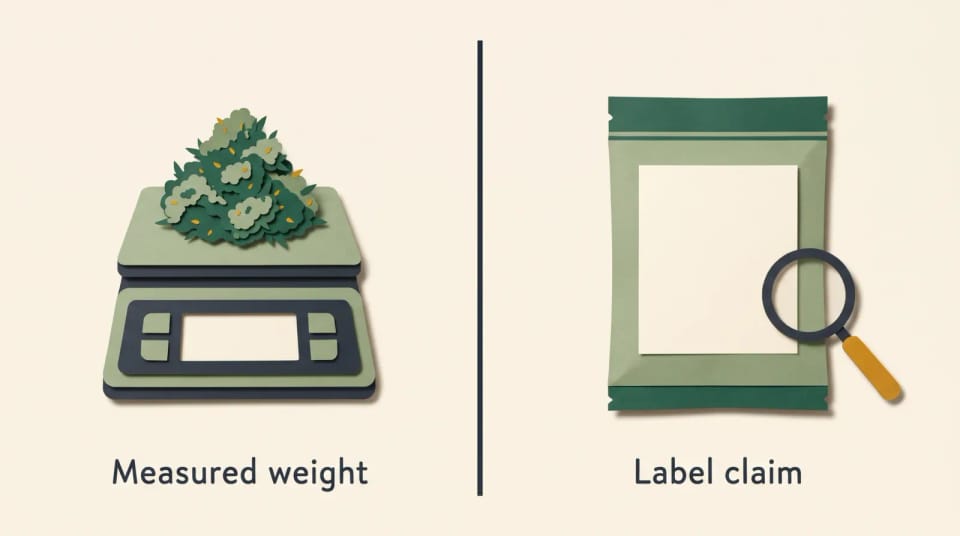
Cost per gram divides by a weight you can verify. Cost per milligram divides by a lab number on a label, so treat it as an estimate.
How do you see your spending for a month or a year?
Close each month on its last day. Add that month’s receipt totals and write the sum on its own line. That gives you a monthly series.
For the year, use a rolling 12 months: the sum of the last 12 monthly totals. Each new month, add the newest total and drop the oldest. A rolling figure stays current, so you never wait until January to see your year.
Then compare each month with two things: the amount you planned to spend, and your own earlier months. Do not compare with an “average spender”. As the Canadian numbers show, an average depends on who is in the denominator, and none of them is you.
Will tracking lower your spending? We cannot promise that. A 2021 meta-analysis found that financial self-control strategies, taken together, reduced spending and increased saving. Tracking was one of 12 strategies it pooled. The results varied widely and showed signs of publication bias, and we found no effect for tracking alone. Davydenko and colleagues, 2021 What a log reliably gives you is an accurate number to plan with.
Where should you keep a cannabis spending log?
Keep it where you control who sees it. A paper notebook, a spreadsheet on your own device or a budgeting app with a custom category all work. If you use an app that syncs to the cloud, check its privacy settings. A purchase record is personal information, and our guide to what a dispensary keeps when it scans your ID shows how much a store may already hold.
If you want to connect money to experience, keep that link in the journal, not the spending sheet. The High IQ app can track how a strain worked for you, which pairs well with a plain spending log kept elsewhere. Our article on why tracking your use matters explains what an effects record can teach you.
When should you talk to a clinician?
A spending log is a budgeting tool. It is not a screening test, and no dollar amount on it means something is wrong. If you notice that cannabis use feels hard to control, that you keep spending more than you planned despite wanting to stop, or that use is affecting your health, sleep, mood, work or relationships, talk to a doctor or another qualified clinician. Bring your log if it helps you describe the pattern.
Key takeaways
- Record the receipt total, not the shelf price. Tax rules differ by state, and the receipt shows what you paid.
- Log six fields per purchase: date, store, product type, labeled amount, receipt total and unit cost.
- Cost per gram is exact arithmetic. Cost per milligram of THC is an estimate because labels carry error.
- Add totals by month and by a rolling 12 months, and compare with your own plan.
- Keep the money log and the effects journal separate, and store both privately.
FAQ
How much does the average person spend on cannabis a month?
It depends on who you divide by. Health Canada’s 2024 survey found that Canadians who consumed in the past year typically spent close to $63 a month, by their own report. Statistics Canada’s figure of $150 per person per year divides legal sales by all adults of legal age. We found no equivalent official US per-consumer figure.
Should I track the shelf price or the receipt total?
Track the receipt total. Washington requires its cannabis excise tax inside the shelf price, while California adds its excise tax at the register and itemizes it. The receipt is the only figure that is comparable from purchase to purchase.
Is cost per gram or cost per milligram of THC better?
Use cost per gram for flower, cartridges and concentrates, because the weight is checkable. Use cost per milligram only as a rough estimate for comparing across product types. Label accuracy varies, so mark that figure as an estimate.
Does a bigger bag always cost less per gram?
No. Washington purchase data from 2014 to 2016 showed only small average quantity discounts. Divide each receipt total by its net grams and let your own log show whether the larger size saved money.
Can I use a regular budgeting app to track cannabis spending?
Yes. Create a custom category, add the net weight in the note field and log cash purchases by hand, because bank imports miss them. Check the app’s privacy and sync settings before you store purchase details.
Sources
- Health Canada. Canadian Cannabis Survey 2024: Summary.
- Statistics Canada. Cannabis consumption in Canada, 2024.
- Peetz J, Buehler R. Is there a budget fallacy? Personality and Social Psychology Bulletin, 2009.
- Hjorthøj CR, et al. Validity of Timeline Follow-Back for self-reported cannabis use. Addictive Behaviors, 2012.
- Washington State Legislature. RCW 69.50.535, cannabis excise tax.
- California Department of Tax and Fee Administration. Tax facts for cannabis businesses.
- Smart R, et al. Variation in cannabis potency and prices in a newly legal market. Addiction, 2017.
- Vandrey R, et al. Cannabinoid dose and label accuracy in edible medical cannabis products. JAMA, 2015.
- Jikomes N, Zoorob M. The cannabinoid content of legal cannabis in Washington State varies across testing facilities. Scientific Reports, 2018.
- Petrilli K, et al. Enhanced cannabis timeline followback. Addiction, 2024.
- Freeman TP, Lorenzetti V. ‘Standard THC units’: a proposal. Addiction, 2020.
- Davydenko M, et al. A meta-analysis of financial self-control strategies. PLoS One, 2021.



