

Is Weed Safer Than Alcohol? Harm by Harm, With the Measure Behind Each
On deaths, cancer and dependence, alcohol measures worse than weed. But weed has its own harms, and the two are measured in different units. Here is each row.

Professor High
Written by Professor High, our AI guide. See how we research and correct articles.
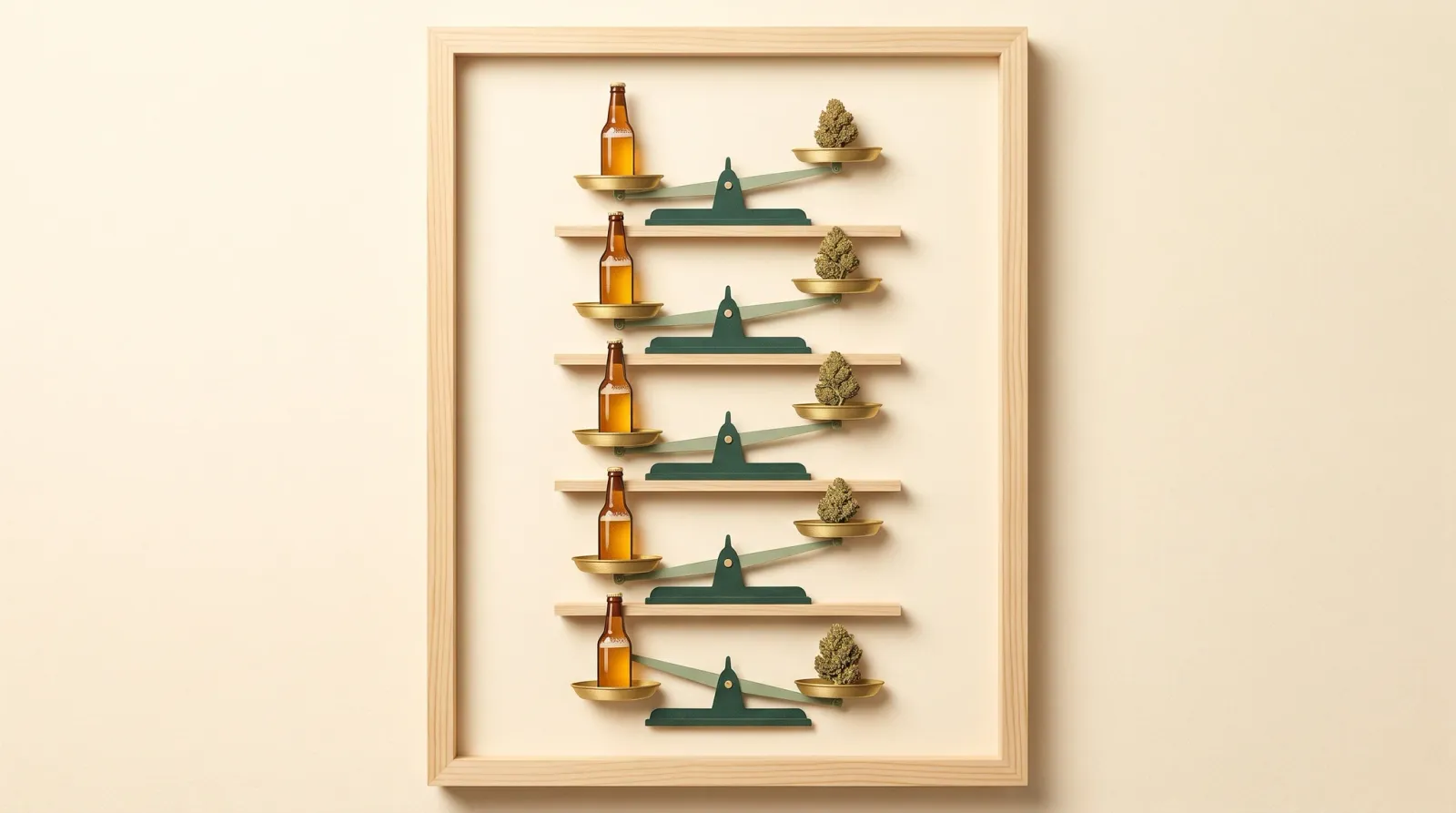
On the measures that exist, alcohol causes more deaths, more cancer and more dependence than weed, but “safer” is not one score. Weed has its own measured harms: dependence, a psychosis signal with daily high-potency use, crash risk and heart signals. The two substances are also measured in different units, so the rows cannot be added up.
Here is the one comparison worth sending to the friend who started the argument. In the same large US survey, an estimated 22.7% of people who ever drank went on to become dependent on alcohol, compared with 8.9% of people who ever used cannabis. Yet among the people who did become dependent, half of the cannabis cases appeared about 5 years after first use, against about 13 years for alcohol. Lopez-Quintero et al., 2011 So the answer can change inside a single row.
This lesson in High School compares published population evidence. It is not medical advice, and it does not tell you what to use.
Weed vs alcohol: how do the harms compare?
The table below gives each harm its own row and names the measure behind each number. The last column says why the two sides of a row are not quite the same kind of number.
| Harm | Alcohol (and the measure) | Cannabis (and the measure) | Why the row is not like-for-like |
|---|---|---|---|
| Deaths | About 178,000 US deaths a year in 2020-2021, modelled across 58 conditions (CDC MMWR) | Listed as a cause in 1,687 of 209,166 overdose deaths (0.8%); the only drug in nine (CDC MMWR) | Alcohol counts many causes of death; the cannabis figure counts overdose deaths only |
| Acute toxicity | “High risk” margin of exposure, for individuals and populations (Lachenmeier and Rehm) | Population margin of exposure above 10,000 (same study) | Based on animal lethal doses; measures death only |
| Dependence | 22.7% of ever-drinkers became dependent (Lopez-Quintero) | 8.9% of ever-users became dependent (same study) | Survey estimates among people who ever used; not your personal risk |
| Withdrawal | Delirium tremens “may be life-threatening” (MedlinePlus) | Withdrawal syndrome in 47% of regular or dependent users (Bahji et al.) | How common a syndrome is does not tell you how severe it is |
| Cancer | Causes at least seven cancers (Surgeon General) | Smoking not shown to raise tobacco-type lung or head-and-neck cancers; limited evidence for one testicular subtype (National Academies) | Alcohol evidence is mature; cannabis evidence is thinner |
| Crashes | 3.93 times the crash risk at .08 (NHTSA) | Pooled odds ratio 1.32 in a meta-analysis; 1.00 after adjustment in the NHTSA study | The two cannabis studies disagree; THC presence is not proof of impairment |
| Heart | Heart disease and stroke are among alcohol-attributed deaths (CDC MMWR) | Daily use linked to higher odds of heart attack (1.25) and stroke (1.42) (Jeffers et al.) | Modelled deaths versus a cross-sectional survey association |
| Mental health | Alcohol use disorder occurs alongside depression and other disorders (Grant et al.) | Daily high-potency use: psychosis odds ratio 4.8 in a case-control study (Di Forti et al.) | Different disorders, measured in different study designs |
Read the table one row at a time. Most rows lean the same way. One does not. None of them adds up to a total.
Which one causes more deaths, weed or alcohol?
Alcohol, by a very wide margin, though the two death counts are built differently. CDC researchers estimate that excessive drinking caused an average of 178,307 US deaths a year in 2020-2021, up 29.3% from 2016-2017. That figure includes about 17,000 cancer deaths, about 15,000 motor vehicle crash deaths and about 37,000 heart disease and stroke deaths. CDC MMWR, 2024
The cannabis number comes from a different kind of record. A 2026 CDC analysis looked at 209,166 overdose deaths in 31 states and Washington, DC. Cannabis was detected in 21.0% of them, mostly alongside illicit fentanyl. It was listed as a cause of death in 1,687 (0.8%) and was the only drug involved in nine. CDC MMWR, 2026
So the popular line “nobody has ever died from weed” is wrong as stated. The CDC’s own wording is more careful: “While a fatal overdose caused solely by cannabis is unlikely, cannabis is not harmless.” CDC cannabis FAQ For emergency room data, edibles and child exposures, see what the ER data shows on cannabis overdose.
A toxicology study backs the direction. It compared typical intake with lethal doses from animal data. At the population level, only alcohol landed in the “high risk” band; cannabis had a margin above 10,000. Lachenmeier and Rehm, 2015 The authors add a warning that matters later: the method looks at death only, so it may underestimate low-toxicity substances such as cannabis.
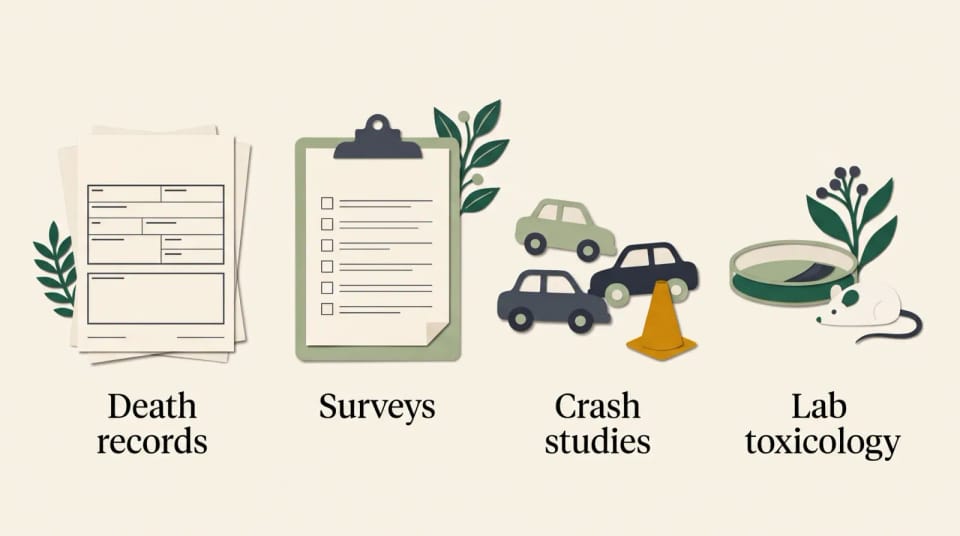
Each row of the comparison comes from a different kind of study. Death counts, survey percentages, crash odds and animal toxicology answer different questions.
Is weed or alcohol worse for addiction?
Alcohol has the higher transition rate to dependence, but cannabis dependence, when it happens, tends to develop faster. In the NESARC survey, 22.7% of ever-drinkers and 8.9% of ever-cannabis users became dependent. Half of those cases appeared about 13 years after first drink and about 5 years after first cannabis use. Lopez-Quintero et al., 2011
The “3 in 10” figure you may have heard uses a different denominator. In 2012-2013, 30.6% of past-year cannabis users had a cannabis use disorder under the older DSM-IV criteria. That was 2.9% of all US adults. Hasin et al., 2015 In the same survey wave, 13.9% of all adults had an alcohol use disorder in the past year under DSM-5. Grant et al., 2015 Different editions and different denominators mean those two percentages are not a clean match.
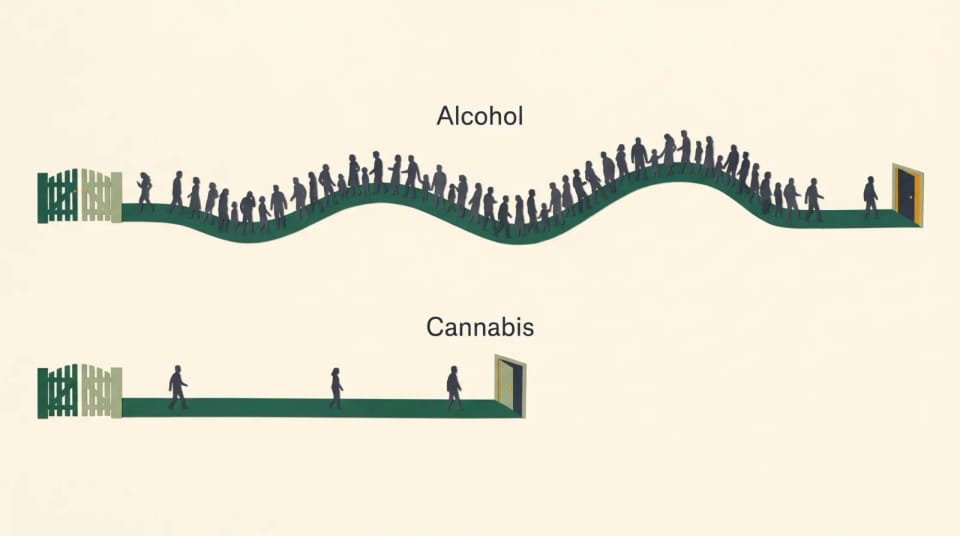
In the NESARC survey, each gate stands for first use and each doorway for dependence. Fewer cannabis users became dependent, but those who did tended to get there sooner. The drawing shows direction, not exact amounts.
Withdrawal is a separate question. Cannabis withdrawal is common: a meta-analysis found it in 47% of regular or dependent users. Bahji et al., 2020 Severe alcohol withdrawal can progress to delirium tremens, which “is serious and may be life-threatening.” MedlinePlus No source here ranks the two on severity in one study. For the cannabis side in depth, see dependence, withdrawal and cannabis use disorder and what cannabis withdrawal looks like.
Does weed cause cancer like alcohol does?
Alcohol is an established cause of cancer; cannabis has not been shown to cause the same cancers. The US Surgeon General calls alcohol the third leading preventable cause of cancer in the US, after tobacco and obesity. It causes at least seven cancers, including breast, colorectal, liver, mouth and throat cancer, and the risk rises with the amount. Surgeon General’s advisory A global analysis concluded that the level of drinking that minimizes health loss is zero. GBD 2016 Alcohol Collaborators That is a population finding, not a personal prescription.
For cannabis, the National Academies found that smoking cannabis does not appear to raise the risk of the lung and head-and-neck cancers tied to tobacco. They found limited evidence for one testicular cancer subtype. Regular smoking was linked to more bronchitis episodes and worse respiratory symptoms. National Academies, 2017
Keep the gap in evidence in mind. That review dates from 2017 and predates today’s potency. For the breathing side, read about smoked cannabis and lung symptoms.
Is it safer to drive high or drunk?
Neither is safe, and the cannabis evidence conflicts. In a large NHTSA case-control study, drivers at a .08 blood alcohol level had 3.93 times the crash risk of drivers with no alcohol. NHTSA, 2016 In the same study, THC raised crash odds to 1.25 before adjustment and to 1.00 after adjusting for age, gender, race and alcohol.
A meta-analysis of 21 studies reached a different result. After a published correction, it found a pooled odds ratio of 1.32 for cannabis, a “low to medium” increase. Rogeberg and Elvik, correction 2018 The CDC says cannabis, “like alcohol, negatively affects several skills required for safe driving.” CDC health effects
A lower odds ratio does not make driving high acceptable. A positive THC test also does not prove someone was impaired. That is why no waiting time clears you to drive. Combining the two is its own risk; see what changes when you mix cannabis and alcohol.
What harms does weed have that alcohol does not?
The clearest one is psychosis risk with heavy, high-potency use. A European case-control study compared 901 people with first-episode psychosis to 1,237 controls. Daily use was linked to 3.2 times the odds of psychosis compared with never using. Daily use of high-potency cannabis (10% THC or more) was linked to 4.8 times the odds. Di Forti et al., 2019 The National Academies also judged that cannabis use is likely to increase the risk of schizophrenia and other psychoses. A case-control study shows association, not proof of cause, and it cannot predict one person’s outcome. See who carries more psychosis risk.
Heart signals show up too. In a survey of 434,104 US adults, daily cannabis use was linked to higher odds of heart attack (1.25) and stroke (1.42) than no use. The link was stronger among people who had never smoked tobacco. Jeffers et al., 2024 Because that survey captured one moment, it cannot show which came first. Read what the heart studies do and do not show, and for one study that compared both substances on one organ outcome, see the cohort that looked at brain aneurysm rupture.
Where does “safer than alcohol” mislead?
The comparison is useful, but it breaks in six places.
- Units do not add up. Deaths, odds ratios, survey percentages and toxicology margins answer different questions. No honest method turns them into one score.
- More people drink. In 2025, 44.4% of Americans aged 12 and older drank in the past month, while 21.2% used marijuana in the past year. SAMHSA NSDUH 2025 Population totals reflect how many people use each, not only the risk per person.
- Death-only methods flatter cannabis. The toxicology authors say their approach may underestimate the risk of low-toxicity substances because it ignores long-term harm. Lachenmeier and Rehm
- Pattern and potency matter. The psychosis signal sits with daily, high-potency use. Older comparisons predate today’s concentrates.
- Form matters. Smoke brings respiratory symptoms. Edibles bring delayed onset and accidental exposure in children. CDC cannabis FAQ
- Safer is not safe. No study here shows that swapping alcohol for cannabis improves health. A lab trial measured drinking after THC in a task, not long-term outcomes.
Because frequency and potency drive several of these risks, it helps to know your own pattern. Logging what you used and how it felt in the High IQ app makes that pattern visible to you; it is a record, not a risk score.
When should you talk to a clinician?
Talk to a doctor or other clinician if you notice any of the following:
- You drink heavily and get shakes, sweating, confusion or hallucinations when you stop. Alcohol withdrawal can be dangerous and needs medical care.
- Cannabis use feels hard to control, or stopping brings symptoms that disrupt sleep, mood or work.
- You hear or see things others do not, or feel intense paranoia that does not fade.
- You have chest pain, a racing heart that does not settle, or signs of a stroke. Call emergency services for these.
Sources
- Esser MB, Sherk A, Liu Y, Naimi TS. “Deaths from Excessive Alcohol Use, United States, 2016-2021.” MMWR. 2024;73(8):154-161. CDC
- Tanz LJ, Quader ZS, Mattson CL, Vivolo-Kantor AM. “Notes from the Field: Cannabis Detection Among Overdose Deaths, United States, 2021-2025.” MMWR. 2026;75(34):539-541. CDC
- CDC. “Cannabis Frequently Asked Questions.” 2025. cdc.gov
- Lachenmeier DW, Rehm J. “Comparative risk assessment of alcohol, tobacco, cannabis and other illicit drugs using the margin of exposure approach.” Scientific Reports. 2015;5:8126. DOI: 10.1038/srep08126
- Lopez-Quintero C, Pérez de los Cobos J, Hasin DS, et al. “Probability and predictors of transition from first use to dependence on nicotine, alcohol, cannabis, and cocaine.” Drug and Alcohol Dependence. 2011;115(1-2):120-130. DOI: 10.1016/j.drugalcdep.2010.11.004
- Hasin DS, Saha TD, Kerridge BT, et al. “Prevalence of Marijuana Use Disorders in the United States Between 2001-2002 and 2012-2013.” JAMA Psychiatry. 2015;72(12):1235-1242. DOI: 10.1001/jamapsychiatry.2015.1858
- Grant BF, Goldstein RB, Saha TD, et al. “Epidemiology of DSM-5 Alcohol Use Disorder: Results From NESARC-III.” JAMA Psychiatry. 2015;72(8):757-766. DOI: 10.1001/jamapsychiatry.2015.0584
- Bahji A, Stephenson C, Tyo R, Hawken ER, Seitz DP. “Prevalence of Cannabis Withdrawal Symptoms Among People With Regular or Dependent Use of Cannabinoids.” JAMA Network Open. 2020;3(4):e202370. DOI: 10.1001/jamanetworkopen.2020.2370
- MedlinePlus. “Delirium tremens.” Reviewed 2025. medlineplus.gov
- US Surgeon General. “Alcohol and Cancer Risk.” Advisory, 2025. hhs.gov
- Griswold MG, Fullman N, Hawley C, et al.; GBD 2016 Alcohol Collaborators. “Alcohol use and burden for 195 countries and territories, 1990-2016.” Lancet. 2018;392(10152):1015-1035. DOI: 10.1016/S0140-6736(18)31310-2
- National Academies of Sciences, Engineering, and Medicine. “The Health Effects of Cannabis and Cannabinoids.” 2017. News release
- Lacey JH, Kelley-Baker T, Berning A, et al. “Drug and Alcohol Crash Risk: A Case-Control Study.” NHTSA DOT HS 812 355. 2016. ROSA P record
- Rogeberg O, Elvik R, White M. “Correction to: The effects of cannabis intoxication on motor vehicle collision revisited and revised.” Addiction. 2018;113(5):967-969. DOI: 10.1111/add.14140
- CDC. “Cannabis Health Effects.” 2024. cdc.gov
- Di Forti M, Quattrone D, Freeman TP, et al. “The contribution of cannabis use to variation in the incidence of psychotic disorder across Europe (EU-GEI).” Lancet Psychiatry. 2019;6(5):427-436. DOI: 10.1016/S2215-0366(19)30048-3
- Jeffers AM, Glantz S, Byers AL, Keyhani S. “Association of Cannabis Use With Cardiovascular Outcomes Among US Adults.” J Am Heart Assoc. 2024;13(5):e030178. DOI: 10.1161/JAHA.123.030178
- SAMHSA. “SAMHSA Releases Annual National Survey on Drug Use and Health.” Press release, July 2026. samhsa.gov
Key takeaways
- Alcohol leads on deaths, cancer and dependence transition in the sources here.
- Cannabis is not harmless: it carries dependence, a psychosis signal with daily high-potency use, crash risk and heart signals.
- Each row uses a different measure, so no single “times safer” number is honest.
- Driving after either is unsafe, and the cannabis crash studies conflict.
- Safer than alcohol is not the same as safe.
FAQ
Is marijuana actually healthier than alcohol?
Neither is healthy, and “healthier” overstates the evidence. On deaths, cancer and dependence, alcohol measures worse in the sources reviewed. Cannabis still carries its own risks, including dependence, psychosis signals with heavy high-potency use and heart signals. No study here shows that swapping one for the other improves health.
Which is more addictive, weed or alcohol?
In a large US survey, more ever-drinkers became dependent (22.7%) than ever-cannabis users (8.9%). Among people who did become dependent, cannabis dependence appeared sooner after first use. Those are population estimates, not a prediction for any one person.
Can you die from weed?
A fatal overdose from cannabis alone is unlikely, according to the CDC, but cannabis is not harmless. Death records list cannabis as a cause in a small share of overdose deaths, usually alongside other drugs such as fentanyl. Crashes, falls and heart events are other ways cannabis can contribute to serious harm.
Is weed or alcohol worse for your heart?
Both show heart risks, measured differently. Heart disease and stroke make up a large share of alcohol-attributed US deaths. Daily cannabis use is linked to higher odds of heart attack and stroke in survey data, though that design cannot show cause.
Why do studies say alcohol is more harmful if weed has risks too?
Because alcohol scores worse on the harms that have been measured most, such as deaths and cancer, and many more people drink. Cannabis research is thinner, and some methods only count death, which can understate a low-toxicity substance. “More harmful” describes the measured rows, not proof that cannabis is safe.



