

Can You Join the Military If You Smoked Weed? What the 2026 Rules Say
Past weed use alone does not bar enlistment. A failed MEPS drug test means a 90-day wait, a second failure is permanent, and lying is the real risk.

Professor High
Written by Professor High, our AI guide. See how we research and correct articles.

Yes, in most cases you can join the military if you smoked weed in the past: admitted past use is recorded and evaluated, not an automatic bar. What actually blocks or delays an applicant is a positive drug test at the Military Entrance Processing Station (MEPS), a diagnosed substance use disorder, certain convictions, or a lie on the paperwork. 32 CFR 66.6
Here is the line worth sending to the friend who is panicking before MEPS: a failed MEPS drug test is a 90-day timeout, not a lifetime ban. The second failed test is the permanent one. Under the Department of Defense testing instruction, a first positive makes an applicant ineligible “for a period of 90 days from the date of test administration,” a retest can follow on the 91st day at the Service’s discretion, and a second positive permanently disqualifies. DoDI 1010.16, section 6.6
This guide covers enlisted accession rules in the United States. Each branch can be stricter than the Department of Defense baseline, so treat it as a map for your conversation with a recruiter, not a substitute for one.
Rules and official pages checked October 29, 2026.
Does smoking weed in the past disqualify you from the military?
Not by itself. The federal enlistment regulation says drug use can be self-admitted, discovered during the medical screening, or identified by the drug and alcohol test. It then says a current or past history of drug abuse or dependence “may be” medically disqualifying, with the MEPS chief medical officer deciding case by case. 32 CFR 66.6(b)(9)
At MEPS, the medical provider asks whether you have ever used marijuana, alcohol or other drugs and records the answer. A “yes” leads to a second question: does that use meet the criteria for a use disorder? The provider can use your health questionnaire, a supplemental questionnaire and a behavioral health consultation to decide. USMEPCOM Regulation 40-1
The Air Force says it plainly on its recruiting page: illegal drug use is usually disqualifying, but preservice marijuana use with no legal proceedings does not, in itself, disqualify you. Air Force requirements
You will see forum posts claiming a magic number of times you can have used. No current official source we found uses a per-use count. Count-based tables existed in older Service manuals, which is where that folklore comes from. Do not plan around one.
Four different situations, four different rules
Most confusion comes from mixing up four separate questions. They run on different rules.
| Your situation | What it triggers | Source |
|---|---|---|
| You used cannabis in the past and say so | Recorded at MEPS; evaluated for a use disorder; not a waiver by itself | 32 CFR 66.6, USMEPCOM Reg 40-1 |
| You test positive at MEPS | Ineligible for 90 days; a waiver is needed and considered only after the wait; a second positive is permanent | DoDI 1010.16, 32 CFR 66.7 |
| You have a diagnosed substance-related disorder | A medical disqualifier under the accession medical standards | DoDI 6130.03, Volume 1 |
| You have a marijuana conviction | Possession is treated as misconduct; sale or trafficking as major misconduct; waiver rules vary by branch | 32 CFR 66.7 |
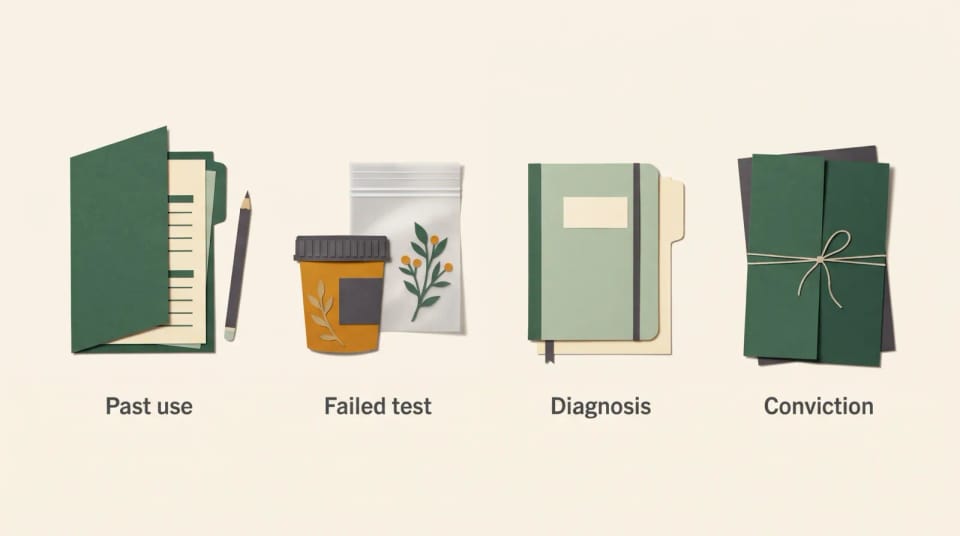
Admitted past use, a positive MEPS test, a diagnosed disorder and a conviction each run on a different rule. Only the last three can need a waiver.
Notice what is missing from that table: a waiver for admitted past use on its own. The sourced triggers for a drug waiver are a positive test, a qualifying conviction or a diagnosis. 32 CFR 66.7(a)(4)
What does the military actually test for and screen for?
Testing is not a recruiter’s choice. Federal law requires every person applying for original enlistment to be tested for drug and alcohol use and evaluated for dependency. A person who refuses cannot be accepted, and a person found dependent on drugs or alcohol is denied entrance. 10 U.S.C. 978
Under the testing instruction, a positive result counts as use. It does not matter, for this purpose, whether you say it was a one-time thing. DoDI 1010.16, section 6.6 If you want the science of how long THC can show on a urine test, our guide to how long THC stays in your system covers detection windows. It is not a guide to beating a test, and tampering at MEPS is its own serious problem.
Hemp products count too. Delta-8 and similar products can produce a THC-positive result, which our explainer on whether delta-8, delta-10 or HHC show up on a drug test walks through.
What happens if you fail the drug test at MEPS?
You enter a fixed sequence. The Department of Defense rule is the floor; a branch can add to it.
- First positive. You are not eligible for 90 days from the date of the test. DoDI 1010.16, section 6.6
- The wait. A MEPS provider may refer you for a behavioral health consultation to document that you do not meet criteria for a substance use disorder.
- Day 91. At the Service’s discretion, you may return for retesting and processing.
- The waiver. A drug waiver is required after a positive test. It can be considered only after the disqualification period ends, and approval is not automatic. 32 CFR 66.7
- Second positive. A second positive test for any drug on the panel is a permanent disqualification.
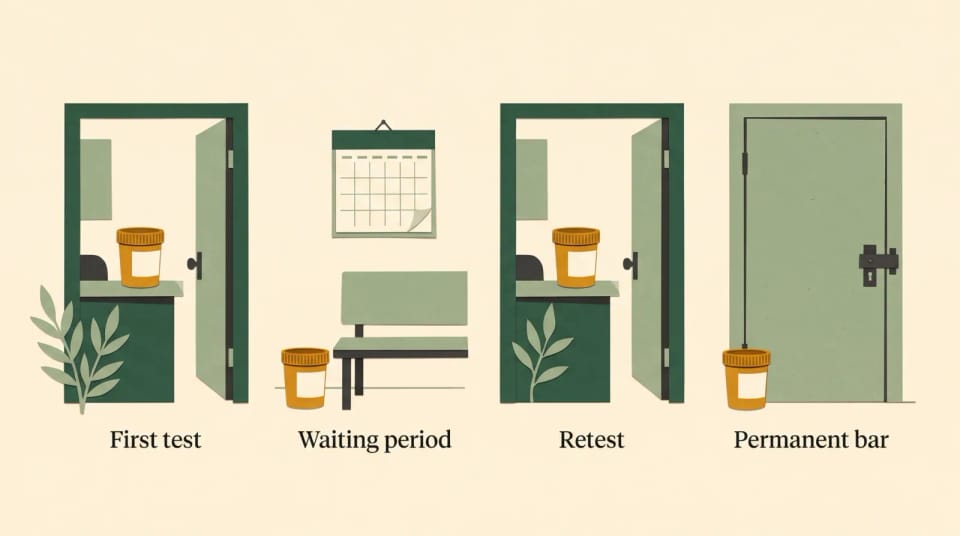
The Department of Defense floor: a first positive means a 90-day wait and one possible retest. The second positive is the permanent one. Branches can be stricter.
How the Army handles it
The Army’s enlistment regulation, effective April 20, 2026, follows the same pattern. A first positive for marijuana means a 90-day wait before a retest, with the recruiting battalion commander as the waiver authority for the Regular Army and Army Reserve. A second positive bars enlistment in all Army components. A first positive for cocaine or another non-marijuana drug means a one-year wait. AR 601-210
How the Air Force and Space Force handle it
In 2022, the Department of the Air Force announced a two-year pilot. Applicants who test positive for THC at MEPS could retest after 90 days if granted a waiver. Waivers were limited to applicants with an AFQT score of 50 or higher, a high school diploma, no major moral violations, and otherwise full medical qualification. Before the pilot, a THC positive meant a permanent bar for those components. Department of the Air Force announcement We did not find an official statement on whether that pilot continued or ended, so ask your recruiter for the current rule.
The Navy, Marine Corps and Coast Guard
The Navy’s recruiting page describes a zero-tolerance policy for drug use and points to a waiver process. Navy requirements We did not find a current public primary rule on THC retests for the Navy, Marine Corps enlisted ranks or the Coast Guard. Do not assume the Army or Air Force rule carries over. Officer commissioning programs can also be stricter than enlisted ones.
What changed for the Army in 2026?
Since April 20, 2026, the Army no longer requires a waiver for a single conviction for possession of marijuana or a single conviction for possession of drug paraphernalia. The change is listed in the regulation’s summary of changes. AR 601-210 News coverage of the announcement ran in March 2026, alongside an increase in the Army’s maximum enlistment age. NewsNation
Two limits remain. Two or more possession convictions within three years still need a waiver, and so does any sale or trafficking offense. The Department of Defense baseline already separates these: possession of marijuana or paraphernalia is a “misconduct” offense, while sale, distribution or trafficking of cannabis is “major misconduct.” 32 CFR 66.7
This is an Army rule. It does not change what other branches require.
A diagnosis is not the same as past use
The medical standards for enlistment list “any history of substance-related and addictive disorders,” except caffeine and tobacco, as disqualifying. DoDI 6130.03, Volume 1 The key word is disorder. A clinical diagnosis is a different thing from having used cannabis, which is why MEPS asks the use question first and the disorder question second. Our explainer on what a cannabis use disorder is explains how that diagnosis is made.
The Army adds that drug dependence not in sustained remission is disqualifying. AR 601-210
When to talk to a clinician: if your use feels hard to control, you have tried to cut back and could not, or stopping brings sleep, mood or appetite problems, talk to a doctor or a licensed counselor. That conversation is about your health, and it is separate from any recruiting decision.
Does legal weed, a medical card or rescheduling change any of this?
No change to accession testing was found. Military rules follow federal law, not state law. A state medical card, covered in our guide to getting a medical marijuana card, does not override them. The same gap shows up in civilian life, where state legalization does not reach federal jobs and clearances.
On April 23, 2026, the Justice Department announced an order placing FDA-approved marijuana products and marijuana products under a qualifying state medical license in Schedule III. U.S. Department of Justice The Congressional Research Service notes that recreational marijuana remains in Schedule I and lists military service among the collateral consequences of marijuana’s federal status. CRS In Focus IF12715
For the details, see what the April 2026 Schedule III rule covers and why the broader rescheduling hearing was paused in September. We found no Department of Defense or Service statement changing enlistment drug rules after April 2026.
Do you have to tell your recruiter you smoked weed?
Tell the truth when you are asked. Concealment, not past use, is the move that can turn a fixable problem into a crime. Under the Uniform Code of Military Justice, a person who obtains enlistment “by knowingly false representation or deliberate concealment as to his qualifications,” and receives pay or allowances, faces punishment as a court-martial may direct. 10 U.S.C. 904a, Article 104a
The question also comes back later. The security clearance form, the SF-86, asks whether you have illegally used any drugs in the last seven years, and it defines illegal by federal law even where state law permits use. Its penalty statement says knowingly falsifying or concealing a material fact “is a felony which may result in fines and/or up to five (5) years imprisonment.” The same form says truthful answers to the drug questions will not be used as evidence against you in a later criminal proceeding. Standard Form 86 The Army’s waiver packet itself includes an SF-86. AR 601-210
If you have read our guide on federal gun law and cannabis, the pattern will feel familiar: a federal form asks about cannabis, and the false answer is the bigger legal risk.
If a recruiter suggests leaving something off, remember that your signature goes on the form, not theirs. If you already gave a false answer, talk to a lawyer before your next step.
Will past weed use affect a security clearance later?
It can matter, but it does not decide the outcome by itself. National intelligence guidance from December 2021 says prior recreational marijuana use “may be relevant to adjudications but not determinative.” Adjudicators weigh the whole person, including how often and how recently you used, and they expect applicants to stop using once they sign the SF-86. ODNI clarifying guidance on marijuana We did not find updated guidance issued after the April 2026 order.
Some Army jobs look back further. Positions in the Personnel Reliability Program disqualify anyone who used cannabis in the 120 days before applying. AR 601-210
Do recruits with a marijuana history do worse?
One study says mostly no, with one exception. RAND analyzed Army records for recruits who joined between 2001 and 2012. Recruits with a documented marijuana history were about as likely as others to complete their first term and make sergeant. They were less likely to leave for health or performance reasons, but more likely to be separated for drug abuse. RAND RR-4431-A
That group was small, fewer than 1 percent of recruits, and the data predate most state legalization. RAND It is an observational finding about who performed how, not proof that cannabis history causes anything, and it is not current Army policy.
What happens after you enlist?
The rules change once you are in. The Army requires recruiters to tell applicants that the Army does not tolerate marijuana use and that use in service may be punished under the UCMJ. AR 601-210 A state law or a medical card does not change that. Past use is a screening question; in-service use is a disciplinary one.
Key takeaways
- Admitted past cannabis use is recorded and evaluated at MEPS; by itself it is not an automatic bar.
- A first positive MEPS test means a 90-day wait; a second positive is permanent.
- A diagnosed substance-related disorder and certain convictions are separate disqualifiers with their own rules.
- Since April 20, 2026, the Army does not require a waiver for a single marijuana possession conviction.
- State legalization and the 2026 Schedule III order did not change enlistment testing.
- Lying on enlistment or clearance forms is the real legal risk.
FAQ
Can you join the military if you smoked weed once?
Usually, yes. Federal enlistment rules treat admitted past use as something MEPS records and evaluates, not an automatic disqualification. The main question is whether your use meets the criteria for a substance use disorder. Each branch can be stricter, so confirm with a recruiter.
If I test positive for THC at MEPS, am I banned for life?
No, not after a first positive. Department of Defense rules make you ineligible for 90 days, and you may return for retesting on the 91st day at the Service’s discretion. A waiver is still needed and is not automatic. A second positive is a permanent disqualification.
Can the military find out about weed use I did not disclose?
It can. Federal law requires a drug test for every new applicant, MEPS asks about past use during the medical screening, and the SF-86 asks about drug use in the last seven years. Concealing a disqualifying fact to get enlisted is an offense under Article 104a of the UCMJ.
Does a marijuana possession conviction stop you from enlisting?
It depends on the branch and the record. Since April 20, 2026, the Army does not require a waiver for a single possession conviction, but two or more within three years, or any sale or trafficking offense, still need one. Other branches follow their own rules on top of the Department of Defense baseline.
Does a medical marijuana card help you enlist?
No. Military accession rules follow federal law, and a state medical card does not change the drug test or the screening questions. The April 2026 Schedule III order covered state-licensed medical products but did not change enlistment testing.



