Powdery Mildew on Cannabis: Prevention and Treatment Guide
White powdery spots on your cannabis? Learn to identify, prevent, and treat powdery mildew with humidity control, airflow, and safe organic sprays.


You walk into the grow room, coffee in hand, ready to admire your best plant yet. Then you see it: a faint dusting of white powder on a fan leaf, like someone sneezed flour across your canopy. Your stomach drops, because deep down you already know what it is. Powdery mildew is the single most common fungal problem cannabis growers face, and it is also one of the most preventable. The frustrating part is that by the time you can see it clearly, the fungus has usually been quietly colonizing your tent for days.
I am Professor High, and I want to walk you through this calmly, because panic leads to bad decisions like spraying buds with the wrong product two weeks before harvest. Powdery mildew is beatable. The key is understanding what it actually is, the precise conditions that invite it in, and a treatment plan that changes completely depending on where your plant is in its life cycle. Get those three things right and you will never lose a harvest to white powder again.

What Powdery Mildew Actually Is
Powdery mildew (often abbreviated WPM, for white powdery mildew) is not a single organism but a group of obligate fungal pathogens. On cannabis, the usual culprit is a species in the Golovinomyces genus. The word “obligate” matters here: this fungus can only survive on living plant tissue. It sends thread-like structures into the surface cells of your leaves to steal nutrients, while the white “powder” you see is a mat of mycelium and thousands of spores ready to launch onto the next leaf.
What makes WPM sneaky is that, unlike most molds, it does not need standing water or soaking-wet leaves to germinate. It thrives in relatively dry air as long as the humidity is moderately high and the airflow is poor. That is why growers who keep their leaves bone dry are still shocked to find it. The spores are also microscopic and travel on the faintest air current, on your clothes, on a new clone, or in through an intake fan.
Telling It Apart From Trichomes
Beginners panic when they see frost on their buds and assume it is mildew. Here is how to tell the difference. Trichomes are translucent, sparkly, and three-dimensional, like tiny glass mushrooms, and they are most concentrated on the buds and sugar leaves. Powdery mildew is flat, matte, and chalky, like dust sitting on the surface, and it shows an “upper-leaf bias,” appearing first on the tops of fan leaves rather than the flowers. A simple test: a fine paintbrush or a damp paper towel will smear and lift powdery mildew off the leaf, while trichomes stay put. If you want certainty, press clear tape to the spot, stick it on dark paper, and look under a loupe; mildew shows branched threads and oval spores. If you want a refresher on what healthy frost should look like, our guide on how to read trichomes for harvest timing walks through it with a microscope.
The Conditions That Cause It
Powdery mildew does not appear by bad luck. It appears because your environment handed it an invitation. Three factors do most of the work.
High humidity. WPM spores germinate happily when relative humidity (RH) climbs above roughly 55 to 60 percent. The denser your canopy, the worse it gets, because thick foliage traps a humid microclimate around the leaves even when your room reading looks fine.
Poor airflow. This is the big one. The fungus, in the words of more than one grower, “has a hard time settling in a grow room where the air is being moved.” Stagnant pockets of still air let spores land and reproduce undisturbed. Leaves touching each other create the same dead-air trap on a smaller scale.
Temperature swings. Powdery mildew loves the comfortable 68 to 77°F (20 to 25°C) range that cannabis also loves. The real trouble comes when temperatures swing, especially the lights-off drop. When warm, moisture-laden air cools, its relative humidity spikes and can briefly push leaf surfaces toward condensation, the exact window WPM exploits.
The cleanest way to think about all three at once is vapor pressure deficit, or VPD, which combines temperature and humidity into a single number describing how “thirsty” the air is. A well-managed VPD keeps a thin, drying boundary of air around every leaf. If that concept is new to you, spend ten minutes with our VPD growers guide; it is the single best mental model for preventing every fungal problem, not just this one.

Why Late Flower Is the Danger Zone
Here is the part that turns a manageable problem into a heartbreaking one. In veg and early flower, you have a full toolbox of sprays and the leaf surface area to apply them. Late in flower, that toolbox slams shut.
Dense, trichome-rich buds are the perfect trap for mildew: they hold a humid microclimate, their nooks shelter spores from airflow, and their sticky surfaces grab anything you spray. You cannot safely apply most foliar treatments to swelling buds because residue gets locked into the flower you are about to dry, cure, and inhale. Oils and soaps ruin terpene profiles and can leave a film. And once mildew has colonized a bud, you cannot truly clean it out; the mycelium is woven into the tissue.
There is a stubborn myth that drying and curing “kills” powdery mildew and makes it safe, since the obligate fungus dies without living tissue. The dead spores and mycelial fragments are still there, and combusting or vaporizing them sends those particles straight into your lungs. That brings us to the part I will not soften.
A note on safety: I am Professor High, not your physician. Research and public-health guidance suggest that inhaling or ingesting moldy cannabis may trigger coughing, allergic reactions, and respiratory irritation, and that people who are immunocompromised may face a more serious risk of fungal infection. Living powdery mildew can also cause allergic and respiratory reactions in growers handling infected plants. None of this is medical advice. When buds are visibly affected, the genuinely safe move is to discard them, and if you have a compromised immune system or any health concern, talk to a qualified medical professional before consuming any cannabis you are unsure about.
Visible mold is also a compliance failure in licensed markets, and visible powdery mildew is one of the most common reasons a batch gets pulled from shelves. The takeaway is blunt: prevention is not optional, because the late-flower cure mostly does not exist.
The Prevention Checklist
Prevention is environmental discipline plus a few habits. Run through this list before and during every grow.
- Hold humidity in range by stage. Aim for 55 to 65 percent RH in early veg, then step down: roughly 50 to 60 percent in late veg, 45 to 55 percent in early flower, and 40 to 45 percent in late flower. A dehumidifier is the best money a humid-climate grower can spend.
- Move the air, always. Run at least two fans: one oscillating fan to gently rustle the canopy so no leaf sits in dead air, and one exhaust fan pulling stale air out and fresh air in. You want the leaves to flutter, not whip.
- Space your plants. Give each plant room so leaves are not pressed against neighbors. Crowding creates the humid, still pockets WPM loves.
- Defoliate strategically. Remove the shaded, crowded fan leaves deep in the canopy to open up airflow and eliminate landing spots. Do not strip the plant bare; just relieve congestion.
- Manage the lights-off temperature drop. Keep the day-to-night swing modest so cooling air does not spike RH toward condensation. Targeting a stable VPD does this automatically.
- Quarantine and inspect new arrivals. Clones and even seeds carried from another room are the most common way mildew enters a clean space. Isolate and watch new plants for a week.
- Sterilize between cycles. Wipe down tents, pots, fans, and tools. Spores can overwinter on surfaces and ambush your next run.
- Inspect daily. Catching one chalky spot on one fan leaf is the difference between a five-minute fix and a lost harvest. Check the tops of leaves first.
- Choose resistant genetics. Some lineages shrug off fungal pressure. Classic mold-resistant picks include Northern Lights, and breeders increasingly select for resistance in fast, hardy hybrids.
If you are dialing in the climate side of all this, our deep dive on grow room humidity, temperature, and CO2 covers the equipment and targets in detail, and understanding the full seed-to-harvest timeline helps you know which RH target applies right now.
Treatment: It Depends Entirely on the Stage
This is where most growers go wrong, so I built you a table. The right move for powdery mildew is completely different in veg than it is the week before harvest. Find your stage, then act.
| Growth stage | Safe to treat? | Recommended approach | What to avoid |
|---|---|---|---|
| Seedling / early veg | Yes, fully | Improve airflow first. Wipe visible spots, then spray neem oil (preventive, this is the only window for it), potassium bicarbonate, or a 1:3 milk-to-water solution. | Overwatering and high RH that caused it in the first place. |
| Late veg | Yes | Potassium bicarbonate spray every 7 to 10 days; Bacillus subtilis biofungicide; defoliate congested growth. Last good window for oil-based sprays. | Letting it spread into the stretch before flower flip. |
| Early flower | Cautiously | Potassium bicarbonate (rinses cleaner than oils) and biofungicides, lights-off, on leaves only. Remove badly infected leaves entirely. | Neem oil and heavy soaps near forming buds; residue and flavor taint. |
| Late flower | No, essentially not | Do not spray buds. Remove and discard infected material, drop RH hard, isolate the plant, and consider harvesting early if it is spreading. | Any foliar spray on buds. “Washing” buds. Hoping curing makes it safe. |
| Post-harvest / storage | Prevention only | Dry and cure with disciplined humidity; discard anything visibly affected. | Storing damp buds, which invites mildew and worse molds. |
How to Use the Core Treatments
Potassium bicarbonate is the workhorse. It rapidly raises the pH at the leaf surface, which the fungus cannot tolerate, and it rinses away more cleanly than oils. A common recipe is about one tablespoon per gallon of water, sometimes with a few drops of dish soap as a surfactant. Apply with the lights off to avoid leaf burn, and repeat every 7 to 10 days. This is one of the few treatments many growers will still use cautiously in early flower, on leaves only.
Neem oil works as a preventive and early-veg knockdown, with azadirachtin disrupting the fungal life cycle. The hard rule: neem is for early veg only. Never use it once buds are forming, because the oil leaves a residue and an unpleasant taste on flower.
Milk spray sounds like folk medicine but has real backing; a roughly 1-part-milk-to-3-parts-water (or up to 1:9) solution sprayed in the light appears to suppress mildew, likely through proteins that react with sunlight. It is gentle and food-safe, making it a friendly veg-stage option.
Biological controls like Bacillus subtilis outcompete the fungus on the leaf surface and fit nicely into an integrated pest management routine alongside the practices above.
Physical removal is non-negotiable at every stage. Wipe early spots off leaves with a damp paper towel, and bag-and-discard heavily infected leaves and any affected buds rather than composting them in place, where spores spread.
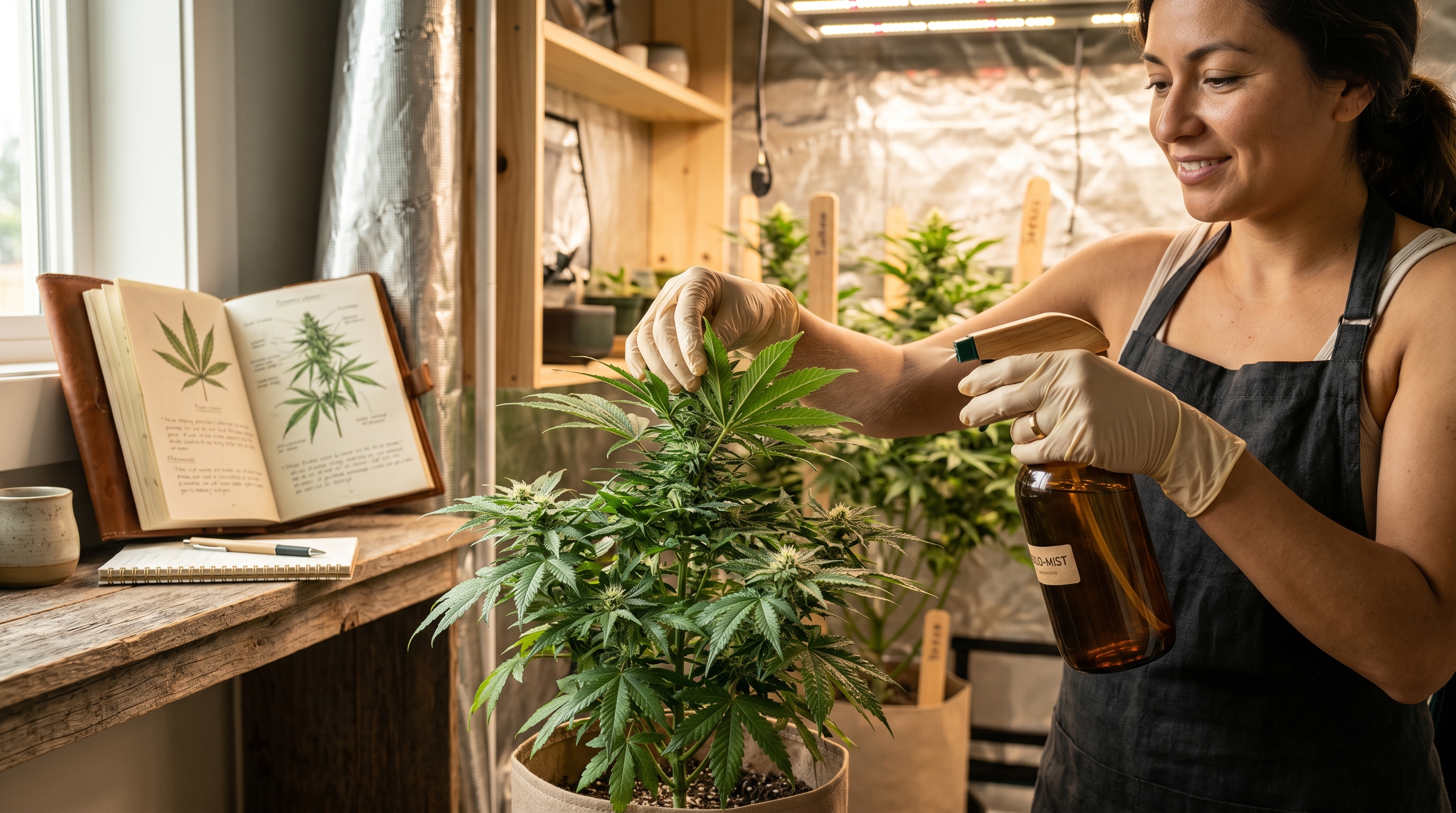
Powdery Mildew Is Not Your Only Foe
Once you start managing humidity and airflow, you protect against the whole rogues’ gallery of grow-room problems, not just WPM. The same stagnant, humid conditions invite bud rot (Botrytis) deep in dense colas, and a stressed, poorly ventilated plant is also more attractive to pests. If you are battling more than fungus, our guides on eliminating fungus gnats and identifying and treating spider mites round out an integrated defense. And when you do reach a clean, mildew-free finish, lock it in with proper drying and curing and smart long-term storage with humidity packs, because mildew can still strike a damp jar.
From the Grow Room to Your High
It might seem strange for a strain-intelligence platform to care this much about a leaf fungus, but it is all connected. A plant fighting powdery mildew is a stressed plant, and stress changes its chemistry, blunting the terpene and cannabinoid profile that gives each cultivar its character. A clean, healthy Northern Lights finished without fungal pressure expresses its myrcene-forward, deeply relaxing nature far more fully, the kind of profile that anchors our Relax High family. The same goes for a sparkling Blue Dream or a bright Sour Diesel; their signature limonene-driven lift and caryophyllene body only come through when the flower is grown clean and dried right.
That is the through-line of everything we do at High IQ. Whether you grow your own or buy from a dispensary, the goal is the same: understand what is actually in your cannabis so you can predict how it will make you feel. Healthy plants produce honest terpene profiles, and honest profiles let you find the calm or creative experience you are actually after. Track what works for you, learn your patterns, and the guesswork disappears.
The Bottom Line
Powdery mildew is a problem of environment, not of luck. Keep humidity in the right range for your stage, keep the air moving, give your plants room to breathe, and inspect every single day. If you catch it early in veg, you have a deep toolbox: potassium bicarbonate, neem, milk spray, and biologicals will knock it down. If you let it reach late flower, your only honest options are removal, isolation, and accepting that affected buds should be discarded, because no spray and no cure makes moldy flower safe to inhale. Prevention is not just easier than treatment here. It is, for the most part, the only treatment that truly works.
Stay observant, keep that air moving, and your harvest stays clean.
Sources
- Royal Queen Seeds — Powdery Mildew on Cannabis: How to Detect, Prevent, and Treat It
- Grow Weed Easy — White Powdery Mildew on Cannabis Plants: Identification and Solution
- Trichome Analytical — Powdery Mildew on Cannabis: Detection Myths and Realities
- Ziel — Cannabis Mold on Buds, Plants and Safety Risks for Consumers
- Ed Rosenthal — Cannabis Powdery Mildew Prevention and Treatment


