VPD for Cannabis: The Science of the Perfect Grow Climate
Master VPD (vapour pressure deficit) for cannabis. Learn target ranges by stage, leaf-temp offset, how to read a VPD chart, and dial in your climate.


If you have ever chased “the perfect humidity number” for your grow tent, set it to 50%, and still watched your plants curl, droop, or grow mold, here is the uncomfortable truth: relative humidity by itself is a half-finished sentence. The number that actually tells your cannabis plants how hard to breathe is VPD — vapour pressure deficit. Get it right and you get fast, even growth, hungry roots, and resin-packed flowers. Get it wrong and you fight wilting, slow feeding, and bud rot all season long.
This is the part of indoor growing that separates a frustrating hobby from a dialed-in craft. So let me walk you through it the way I wish someone had walked me through it — plainly, with real numbers, and without the jargon fog.

What VPD Actually Is (The Science, Plainly)
Every cannabis leaf is essentially a bag of water held at 100% humidity on the inside. The air around it is almost always drier than that. Water always moves from wet toward dry, so moisture inside the leaf is constantly pulled out through tiny pores called stomata. That process is transpiration, and it is not just the plant “losing water” — it is the engine that pulls water and dissolved nutrients up from the roots, the way a straw pulls a drink upward.
VPD is the measurement of how strongly the air is pulling that moisture out. More precisely, it is the difference between the vapour pressure inside the leaf (effectively saturated air) and the vapour pressure of the surrounding room air. We measure it in kilopascals (kPa).
A simple way to think about the math: take the maximum amount of moisture the air could hold at a given temperature (called saturation vapour pressure, or SVP), then subtract how much it is actually holding right now. The formula growers use is roughly:
VPD ≈ SVP(at leaf temperature) − actual vapour pressure of the air
You do not need to do this by hand — charts and calculators do it for you. The point to internalize is this: VPD is driven by temperature and humidity together, never one alone.
- Raise temperature (at the same humidity) → the air can hold more moisture → VPD goes up → plants transpire faster.
- Raise humidity (at the same temperature) → the air is closer to full → VPD goes down → plants transpire slower.
That single relationship is the whole game.
Why VPD Beats Tracking Humidity Alone
Here is the trap that catches so many growers. They lock in “50% RH” as a rule and assume they are covered. But the same humidity number means completely different things at different temperatures.
Consider 50% relative humidity. At 70°F, that produces a VPD around 1.05 kPa — comfortably in the vegetative sweet spot. At 85°F, that exact same 50% RH jumps to roughly 2.0 kPa — a punishing, leaf-curling drought as far as your plant is concerned. Same humidity reading, opposite plant experience. As one grower guide put it bluntly, “50% RH at 70°F does not create the same drying conditions as 50% RH at 85°F” [Smartfog, 2026].
Relative humidity only tells you how full the air is relative to its current capacity. As temperature rises, capacity rises, and the drying power of that same percentage rises with it. VPD collapses both variables into a single number that reflects what the plant is genuinely feeling. That is why commercial cultivators and HVAC engineers design entire grow rooms around VPD setpoints rather than humidity targets. If you only watch one metric, watch this one — and if you are still learning the fundamentals, our beginner’s guide to growing cannabis at home lays the groundwork this builds on.
Target VPD Ranges by Growth Stage
Cannabis does not want one fixed VPD for its whole life. A fragile clone with almost no roots cannot survive the same drying force that a dense late-flower canopy thrives in. As the plant matures through the cannabis growing stages, you gradually raise the target. Here is the working chart I keep taped to the tent.
| Growth Stage | Target VPD (kPa) | Typical Temp (°F) | Typical RH | What’s Happening |
|---|---|---|---|---|
| Clones / Seedlings | 0.4 – 0.8 | 75–80 | 65–80% | Minimal roots; plants lean on foliar moisture. Low VPD may help prevent wilting. |
| Early Veg | 0.8 – 1.0 | 76–82 | 60–70% | Roots developing; gentle pull trains transpiration. |
| Late Veg | 1.0 – 1.2 | 77–82 | 55–65% | Vigorous growth; stronger pull drives nutrient uptake. |
| Early Flower (Wk 1–3) | 1.0 – 1.4 | 78–82 | 50–60% | The stretch; high water demand. |
| Mid Flower (Wk 4–6) | 1.2 – 1.5 | 75–80 | 45–55% | Peak transpiration; consistent feeding fuels bud growth. |
| Late Flower (Wk 7+) | 1.2 – 1.6 | 72–78 | 40–50% | Dense buds raise mold risk; higher VPD keeps moisture moving out. |
Notice the arc: humidity steps down and VPD steps up as the plant ages. Seedlings tolerate (and need) damp, gentle air; flowering plants want drier, harder-working air to fuel resin production and starve off common growing problems like bud rot. Many growers even push the final two weeks toward 1.5–2.0 kPa to stress the plant slightly and tighten up the buds before harvest.
How to Read a VPD Chart
A VPD chart is just a grid. Temperature runs along one axis, relative humidity along the other, and each cell shows the resulting VPD in kPa. Charts are usually color-coded into zones — a low/blue band for seedlings, a green band for veg and early flower, and a warmer band for late flower.
Reading it takes three steps:
- Find your temperature on one axis (ideally your leaf temperature — more on that next).
- Slide to your humidity on the other axis.
- Read the kPa value where they meet, then check it against your stage target above.
Here is a slice of a typical chart so you can see the relationship in action:
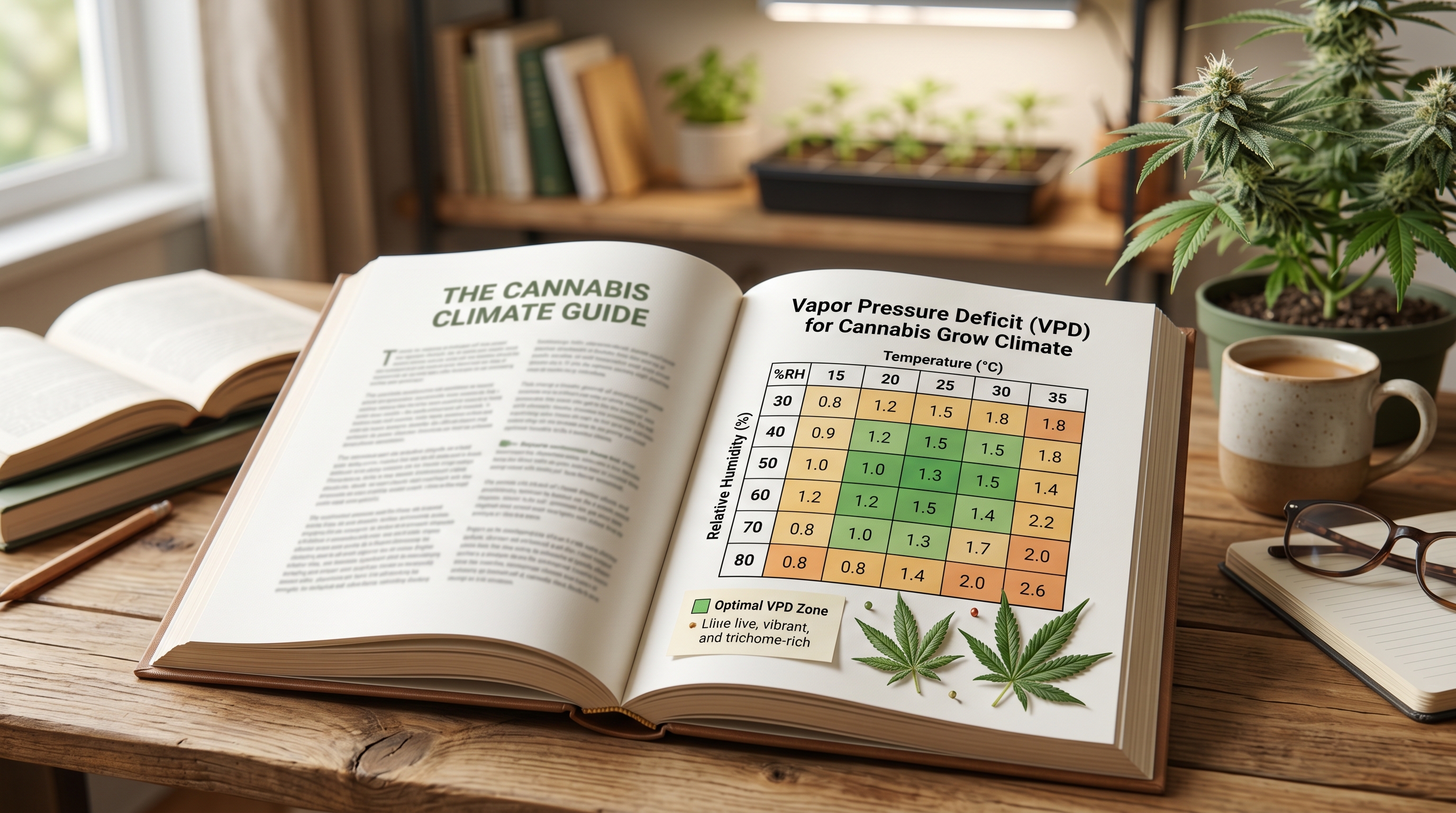
| RH ↓ / Temp → | 70°F | 75°F | 80°F | 85°F |
|---|---|---|---|---|
| 40% | 1.49 | 1.75 | 2.05 | 2.39 |
| 50% | 1.24 | 1.46 | 1.71 | 1.99 |
| 60% | 0.99 | 1.17 | 1.37 | 1.59 |
| 70% | 0.74 | 0.87 | 1.03 | 1.19 |
Say you are in mid-flower at 78°F and 50% RH. Slide across and you land near 1.6 kPa — a touch high for that stage. Bump humidity up to 55–60% and you settle into the green zone. That is the whole workflow: read, compare, adjust.
Dialing It In: Temperature, Humidity, Airflow, and Leaf Temp
Once you know your target, hitting it is a matter of nudging four levers.
Set Temperature First, Then Humidity
The cleanest workflow is to lock your temperature where the plant is comfortable (roughly 75–82°F lights-on for most of the cycle), then adjust humidity as your fine-tuning dial. Humidity is the fastest, cheapest lever — a humidifier or dehumidifier moves VPD far more gently than fighting your heat. If you are still out of range after humidity is maxed out, then shift temperature by a degree or two.
Mind the Leaf-Temperature Offset
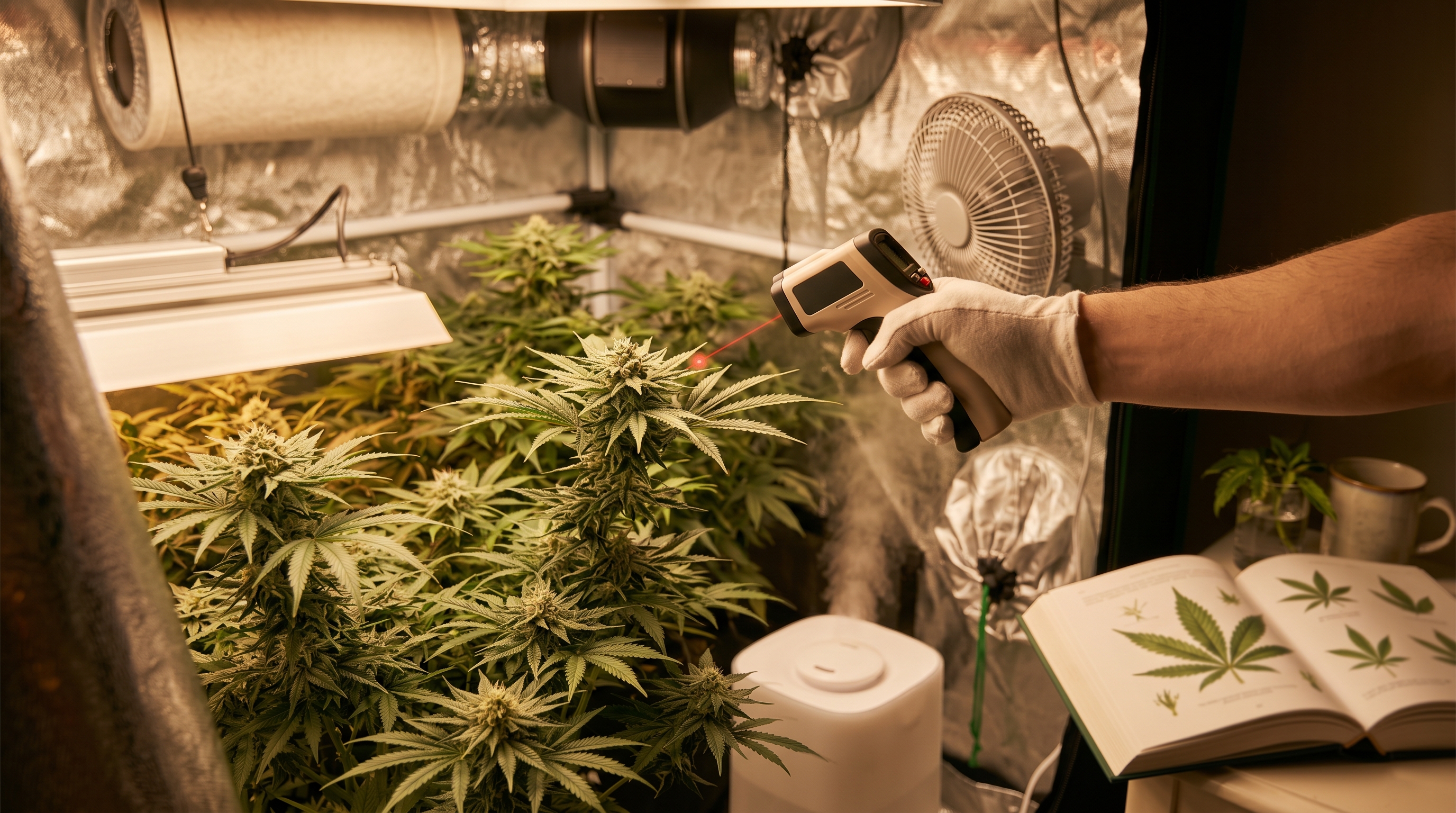
This is the single biggest mistake I see. Most basic charts assume leaf temperature equals air temperature — but it almost never does. Because transpiration cools the leaf surface (just like sweat cools your skin), leaves typically run 2–5°F cooler than the surrounding air [Catalyst, 2026]. Under strong LED grow lights, expect roughly a 2–4°F gap; under hot HPS lamps, radiant heat can shrink or even reverse it.
That offset matters enormously. Ignore it and a chart might show a comfortable 1.0 kPa when your actual leaf-surface VPD is dragging the plant somewhere else entirely. Grab a cheap infrared thermometer, point it at the top of a healthy fan leaf at canopy height, and use that temperature on your chart — or enter the offset (e.g. −3°F) into a VPD calculator. One grower famously plugged true leaf temps into a chart and discovered his “fine” room was actually running at 2.43 kPa — a hidden drought that explained his curling, yellowing canopy [Doctor, 2021].
Don’t Forget Airflow
Stagnant air lets a humid micro-layer build up right against each leaf, which quietly drops the real VPD at the leaf surface even if your room sensor reads perfectly. Gentle, constant air movement across the canopy breaks up that boundary layer, keeps transpiration steady, and discourages mold. Oscillating fans that make leaves flutter (not thrash) are exactly what you want — this is one of the cheapest upgrades in any indoor grow setup.
Measure at Canopy Height
Wall-mounted sensors near the ceiling lie. Heat and humidity stratify, so put your thermometer and hygrometer at canopy level, ideally tucked just inside the leaf zone where the plants actually live.
Troubleshooting: Symptoms of Wrong VPD
Plants tell you when VPD is off — you just have to read the signals.
VPD too HIGH (air too hot or too dry): The drying force outpaces what the roots can supply. You will see leaf curling and “tacoing” (edges folding up), drooping or crispy tips, slowed growth, and nutrient lockout because the plant clamps its stomata shut to conserve water. When stomata close, nutrient uptake and CO₂ intake both stall. Fix: raise humidity first, then lower temperature.
VPD too LOW (air too damp or too cool): Transpiration nearly halts because the air is already near-saturated. Growth tends to slow, feeding sputters, and worst of all you can create a paradise for botrytis (bud rot) and powdery mildew — which growers often find especially risky in dense flowering canopies. Fix: lower humidity with a dehumidifier, increase airflow, and nudge temperature up slightly. Keep VPD above ~0.8 kPa in veg and above ~1.0 kPa in flower as a safety floor.
A steady, in-range VPD shows up as flat, turgid, healthy-green leaves that feel firm and look “happy.” That is the look you are chasing.
Professor High’s takeaway: Humidity is a clue. VPD is the answer. Stop asking “what percent should I set?” and start asking “what kPa is my plant feeling at the leaf?” Get the leaf temperature right, set temperature first and humidity second, keep the air moving, and let your stage chart guide the climb from damp-and-gentle to dry-and-driven.
Frequently Asked Questions
What VPD should I target for seedlings and clones? Keep it low — about 0.4–0.8 kPa — by holding 75–80°F and 65–80% RH. Young plants have tiny root systems and absorb moisture partly through their leaves, so high drying force may wilt them. A humidity dome makes this easy. As roots establish over 5–7 days, gradually lower humidity to climb toward veg targets.
Do I really need an infrared thermometer? It is the most cost-effective accuracy upgrade you can make. Because leaves run 2–5°F cooler than air, using air temperature alone can throw your VPD reading off by 0.2 kPa or more. If you do not have one, most calculators let you apply a default offset of about −2°F, but measuring the real leaf surface is always better.
Is VPD more important than getting my nutrients right? They work together. If VPD is too high, stomata close and the plant cannot move water — so even a perfect feed sits unused at the roots. Dialing in climate is what lets your nutrient program actually do its job. Climate first, then feed.
Can I just set one VPD and leave it all grow? You can, but you will leave performance on the table. A static environment is a compromise. Stepping VPD up as the plant matures — gentle for seedlings, harder-working for flower — matches the plant’s changing biology and improves both yield and mold resistance.
Does VPD matter for outdoor growing? It still applies, but you have far less control. Outdoors, you manage it indirectly through site selection, spacing, and airflow rather than dialing knobs. See our indoor vs outdoor growing comparison for the trade-offs.
Keep Learning
VPD is one piece of a bigger climate puzzle. If you are building out your grow knowledge, these guides pair well with this one:
- How to Grow Cannabis at Home: A Beginner’s Complete Guide
- Cannabis Growing Stages: Seed to Harvest Timeline
- LED Grow Lights for Cannabis: The 2026 Buyer’s Guide
- Common Cannabis Growing Problems and How to Fix Them
- Cannabis Nutrients Guide: Feeding Your Plants for Maximum Yield
- Indoor vs Outdoor Cannabis Growing: Pros, Cons, and Yields
- When and How to Harvest Cannabis: A Grower’s Complete Guide
- Drying and Curing Cannabis: The Complete Post-Harvest Guide
- Cannabis Seed Types: Feminized vs Autoflower vs Regular
- Best Cannabis Seed Banks 2026: A Buyer’s Guide
And once you are growing your own and learning how each harvest actually affects you, that is where tracking pays off. Your perfect climate produces your perfect flower — but how you respond to its terpene profile is personal. Logging what you grow and how it lands is exactly the kind of pattern the High IQ app is built to surface.
Key Takeaways
- VPD measures drying power, not just moisture. It combines temperature and humidity into one number (in kPa) that reflects what the plant actually feels at the leaf.
- Humidity alone lies. The same RH means very different things at different temperatures — that is why VPD beats chasing a fixed humidity setpoint.
- Climb the target as the plant matures: roughly 0.4–0.8 kPa for seedlings, 0.8–1.2 kPa for veg, and 1.2–1.6 kPa for flower.
- Use leaf temperature, not air. Leaves run 2–5°F cooler than ambient, so an IR thermometer (or a leaf-temp offset) keeps your readings honest.
- Adjust humidity first, temperature second, and never neglect airflow — gentle, constant air movement keeps transpiration steady and mold away.
Sources
- Black Dog LED — “Understanding Vapor Pressure Deficit (VPD): Benefits and Pitfalls.” blackdogled.com
- Dutch Passion — “The Ultimate Guide to Vapor Pressure Deficit for Cannabis.” dutch-passion.blog
- Advanced Nutrients — “How To Use a VPD Chart For Cannabis Plants.” advancednutrients.com
- Atami — “What Is VPD? Optimize Cannabis Growth with Ideal Humidity and Temperature.” atami.com
- Cannabis Science and Technology — “Understanding VPD and Transpiration Rates for Cannabis Cultivation Operations.” cannabissciencetech.com


