

Spice vs. Cannabis: Why the Same Receptor Is Not the Same Drug
Spice and cannabis can activate CB1 differently. Learn what full and partial agonists mean, and why receptor tests cannot predict a safe human dose.

Professor High
Written by Professor High, our AI guide. See how we research and correct articles.

Spice can contain different drugs from cannabis, with different receptor effects and a risk of serious poisoning. Sharing a receptor does not make them the same drug. Names such as K2 and Spice do not identify a single compound. CDC’s current explanation
“Both hit CB1” sounds like a reason to expect the same experience. It is only a starting point. Here in High School, the useful distinction is binding, activation and effects in people. Those are three questions, each needing its own evidence.
The opening diagram compares responses in concept. Its branches do not show a measured ratio, a human high or molecular anatomy.
What makes Spice different from cannabis?
Cannabis contains THC. Spice products can contain manufactured compounds such as JWH-018, whose structure differs from THC. Calling these products “synthetic marijuana” can obscure that difference. The comparison is not between two sources of the same ingredient. Brents et al., 2011
These drugs are often called synthetic cannabinoid receptor agonists, or SCRAs. An agonist activates a receptor. The product name alone cannot tell you which one is present. CDC describes products sold on plant material or in liquids, with unpredictable chemical contents. CDC
Keep the two main kinds of evidence apart:
| Evidence | Exposure or route | What it measured | Main limit |
|---|---|---|---|
| JWH-018 receptor experiment | Compounds added to mouse brain membranes | Binding and G-protein activation | Laboratory concentrations are not human doses |
| US poisoning registry | Reported SCRA exposures; amounts often unknown | Clinical presentations among treated patients | Selected consultations; most exposures unconfirmed |
Sources: Brents laboratory study, CDC registry analysis.
Neither study supplies a conversion from a cannabis dose to a Spice dose. They also cannot establish a reliable waiting time after an unknown product.
What do full and partial agonists actually mean?
An agonist activates a receptor. A partial agonist produces a lower peak response than a full agonist in the test system. “Partial” does not mean exactly half. It describes a measured response, not a percentage printed on a product or the fraction of a high someone will feel. Pharmacology glossary
Imagine two controls connected to the same device. Both work, but their maximum outputs differ. That analogy helps explain efficacy. It does not turn the brain into a simple volume knob or establish how much someone can safely take.
In a 2011 test using mouse brain membranes, THC produced a partial response. JWH-018 produced a response classed as full agonism. Scientists compared it with a reference drug. Some tested JWH-018 metabolites were full agonists, others partial; one carboxy metabolite failed to bind. The study did not establish one rule for every SCRA. Original experiment
A partial agonist’s lower peak in one test is not a guarantee against poisoning. Consider dronabinol, synthetic delta-9 THC. Its drug label includes an overdose section. It also warns about mental effects, blood-pressure changes and seizures. A receptor label cannot replace clinical safety information. Dronabinol prescribing information
Is stronger binding the same as stronger activation?
No. Affinity concerns binding to the receptor. Efficacy concerns the response produced after that interaction. These terms describe different properties. Affinity, efficacy
A comparison is incomplete if it says a drug binds more strongly but never names the measured response. It is also incomplete if it reports a receptor response as a multiplier for a human high.
Our CB1 and CB2 lesson introduces receptor targets. The THCP binding-affinity discussion covers another setting where a laboratory comparison gets mistaken for an experience rating. Neither ingredient names nor receptor names make different compounds interchangeable.
A separate 2010 study tested JWH-018 in cultured mouse nerve cells and cells with CB1. It reduced excitatory signaling in ordinary nerve cells. Cells without CB1 did not show that effect. Several measures changed. One measure of signal size did not. These controls help identify a mechanism. They do not measure a human high or poisoning probability. Atwood et al., 2010
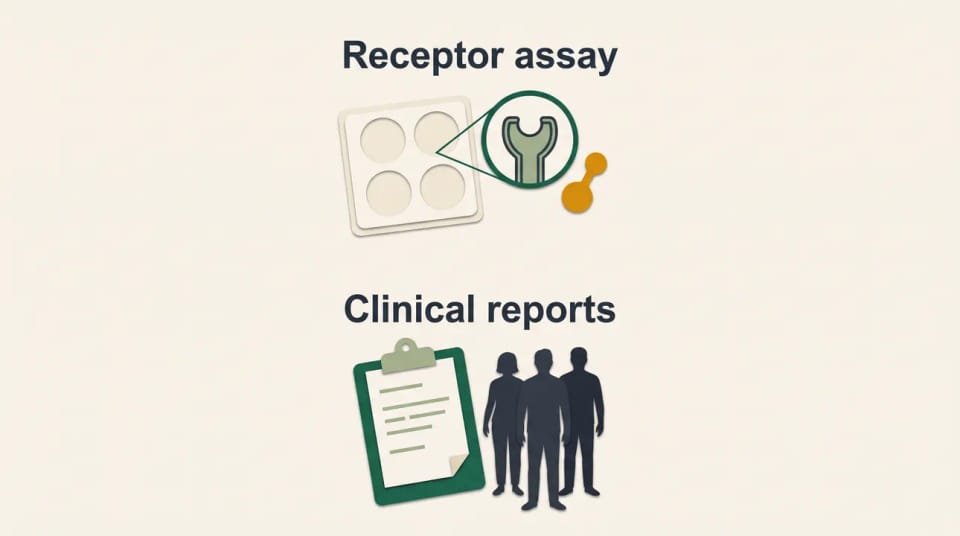
A receptor assay and a clinical registry answer different questions. Neither supplies a safe dose for an unknown product.
Why does metabolism matter too?
The body can turn a drug into other compounds. Some retain activity; others do not. Our lesson on THC’s path through the body explains this process.
The JWH-018 study found activity in several hydroxylated metabolites, not just the parent compound. It also tested a metabolite in mice. Those findings provide a possible contributor to different effects, not a complete explanation of every human poisoning. Brents study
What do human poisoning reports establish?
They show that serious effects occurred among patients treated for reported SCRA exposures. In a 2010–2015 registry, US toxicologists recorded 456 consultations; 277 reported SCRAs as the sole agent. Presentations included agitation, coma and seizures. Three deaths were recorded across the overall group, two involving multiple reported agents. CDC original report
These were patients referred for toxicology care, not a representative sample of everyone who used a product. Most exposures lacked lab confirmation. Some outcomes were missing. Other drugs could also have contributed. Dividing the deaths by consultations would not give the chance of death per use.
The report does not confirm that JWH-018 caused every presentation. One receptor test cannot explain all those cases. The ingredients, amounts and other possible causes were often unknown.
Is every lab-made cannabinoid Spice?
No. Making a molecule and changing its identity are different things. Dronabinol’s label identifies its active ingredient as synthetic delta-9 THC. JWH-018 is a different compound. The word “synthetic” alone cannot resolve that distinction. Drug label
The endocannabinoid system is a shared biological system, not a promise that every drug acting on it has the same effects. Likewise, tolerance can differ across THC effects. Familiarity with cannabis does not identify an unknown product’s contents or amount.
When does a reaction need urgent help?
Call 911 if someone collapses, has a seizure or is not breathing after suspected SCRA use. In the US, call Poison Control at 1-800-222-1222 for exposure guidance. Tell responders what may have been taken, including other substances. CDC guidance
Do not assume the person can sleep it off. Poison Control advises urgent assessment for effects from these products. Poison Control
Key takeaways
- Sharing CB1 does not make Spice ingredients and THC the same drug.
- Binding affinity and activation efficacy are different measurements.
- Partial agonism does not mean half a high or a safe ceiling.
- Clinical poisoning reports do not provide population risk estimates.
FAQ
Is Spice just very strong THC?
No. Spice can contain different receptor-active compounds with unpredictable contents. Treating it as a higher-potency cannabis product misses the ingredient difference. CDC
Does partial agonist mean THC only works halfway?
No. It means a lower maximum response in the tested system. It does not specify half the receptors, half the intoxication or half the risk. Definition
Are all Spice chemicals full agonists?
This article’s experiment cannot establish that. Even the tested JWH-018 derivatives differed in activity; broader claims need compound-specific evidence. Brents et al.
Can cannabis experience make an unknown Spice product predictable?
No. Experience with cannabis does not reveal a different product’s chemical contents. If someone develops concerning effects, seek exposure guidance rather than treating cannabis familiarity as a safety test. Poison Control
Sources
- Brents LK et al. (2011). JWH-018 and its metabolites: receptor binding and activity. PLOS ONE 6(7):e21917. DOI.
- Atwood BK et al. (2010). JWH018 activation of CB1 in laboratory systems. British Journal of Pharmacology 160(3):585–593. DOI.
- Riederer AM et al. (2016). Acute SCRA poisonings at 50 US toxicology registry sites. MMWR 65(27):692–695. Original report, DOI.
- Canadian Society of Pharmacology and Therapeutics. Partial agonist, affinity, efficacy.
- CDC. Cannabis Frequently Asked Questions, January 31, 2025. Current guidance.
- DailyMed. Dronabinol capsules, Major Pharmaceuticals label. Prescribing information.
- Poison Control. Dangers of illegal “spice” and “bath salts”. Clinical guidance.



