Weed Vape Voltage: Why Volts Do Not Tell You the Temperature
Weed vape voltage controls electrical input, not a fixed temperature. Learn why coil resistance, device design, and puffing change what the setting means.

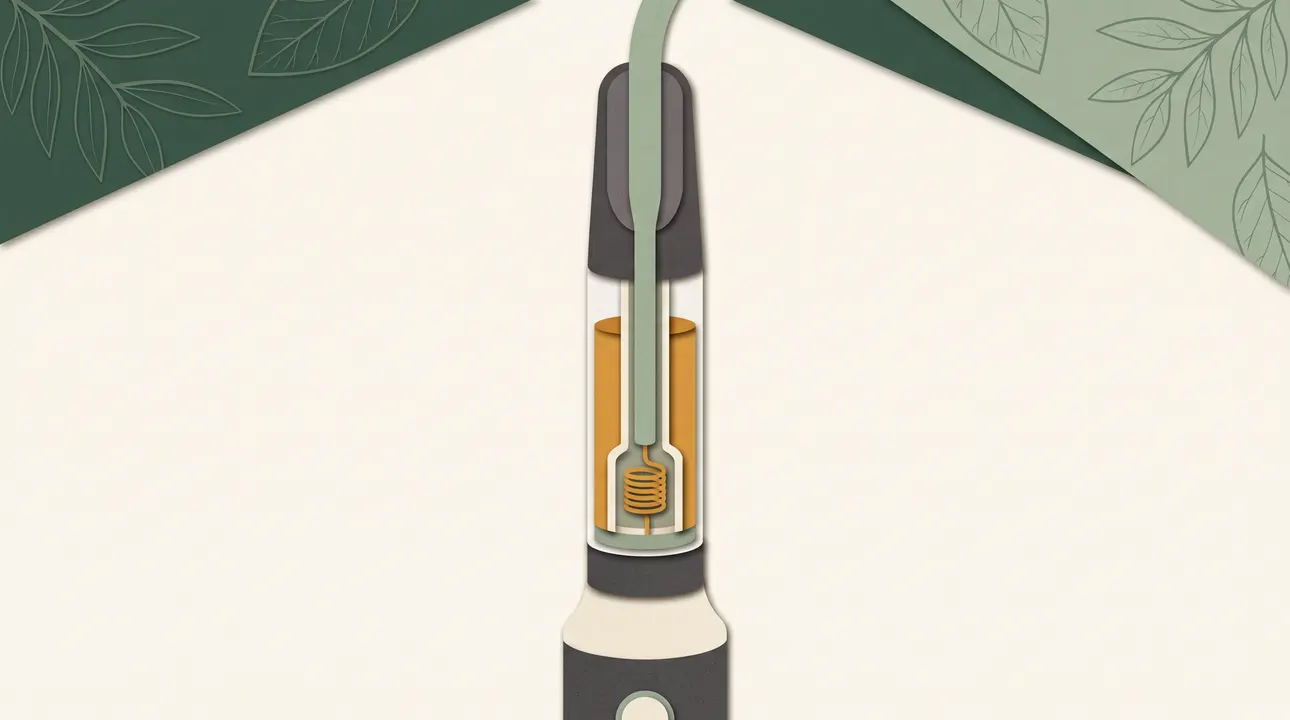
You cannot convert weed vape voltage into one fixed temperature: volts describe electrical input, while the cartridge determines how that input becomes heat. A setting copied from someone else’s battery is not a thermometer reading for yours.
For a simple resistive heater, 3 volts across 1 ohm gives 9 watts; across 2 ohms it gives 4.5 watts. These assumed values teach power, not temperature. OpenStax
The useful distinction is simple: volts, watts, coil temperature, and the temperature at the mouthpiece describe different things. Here in High School, we can separate them without turning a vape lesson into an engineering exam.
This lesson concerns oil cartridges. A flower vaporizer has a different heating arrangement, explained in our dry-herb versus oil vaporizer comparison.
What do volts, ohms, and watts mean on a vape?
Voltage is the electrical push. Current is the flow of electric charge. Resistance opposes that flow and is measured in ohms. Ohm’s law connects the three: voltage equals current multiplied by resistance. Fluke’s electrical primer
Watts measure power: how fast energy is transferred. For a simple resistive heater, power equals voltage squared divided by resistance:
Power in watts = voltage × voltage ÷ resistance in ohms. OpenStax, electrical energy and power
Here is an illustrative calculation, not a recommended vape setting:
| Same electrical supply | Assumed resistance | Calculated power |
|---|---|---|
| 3 volts | 1 ohm | 9 watts |
| 3 volts | 2 ohms | 4.5 watts |
The same voltage supplies twice the power to the lower resistance in this simplified example. No temperature appears in the calculation. Real controllers and changing resistance add further complications; these numbers are a teaching example, not specifications for a particular cartridge.
| Number on the device | What it describes | What it does not establish |
|---|---|---|
| Volts | Electrical potential difference | A particular coil temperature |
| Watts | Rate of energy transfer | The temperature of the aerosol |
| Degrees | A temperature setting or measurement | Which part was measured, unless specified |
That last row matters. Even a number with °C beside it needs a location and a method.
What did researchers actually measure in cannabis cartridges?
A 2022 experiment compared three cannabis cartridge systems with infrared imaging. Its results included:
| Tested system | Electrical setting | Mean measured coil temperature |
|---|---|---|
| Variable-voltage 510 system | 2.4 V | 443 ± 56.1°C |
| Different, fixed-voltage 510 system | 3.2 V | 450 ± 60.8°C |
The ± values show standard deviation: the spread of the measured coil temperatures.
Those different voltages produced similar means. The study supports rejecting a universal volts-to-degrees chart. These were coil measurements, not mouthpiece or lung temperatures. Oar et al., 2022
The limits matter: the cartridges were modified for camera access, and some puffs were deliberately longer than typical draws. PAX funded the work, employed its authors, and made the temperature-controlled comparator. This was a small device experiment, not a clinical safety trial or a survey of every battery. Its figures cannot predict your cartridge’s heat. Study methods and disclosures
Why does the puff matter as well as the setting?
A vape produces an aerosol, a mixture that includes suspended droplets. What leaves a cartridge depends on more than a battery display.
A separate laboratory study tested THC and myrcene mixtures in a cartridge setup. It controlled machine puffing and varied power and mixture composition. THC transfer per puff increased from 8 to 10 watts, then leveled off from 10 to 12 watts. More myrcene also changed delivery and degradation behavior. This was chemistry testing, not a measurement of how much THC entered a person’s blood. Meehan-Atrash et al., 2021
That gives you two separate questions to ask:
- What electrical setting and cartridge produced this aerosol?
- What puff conditions and oil mixture were used to measure it?
“Three volts” answers only part of the first question. “One hit” leaves much of the second unanswered. For the wider difference between controlling a session and measuring a dose, read our cannabis dosing-device guide.
Is coil temperature the same as vapor temperature?
A temperature belongs to the place where it is measured. A reading at a heating element does not, by itself, report the conditions farther along the air path. That distinction is why the cartridge study’s large numbers should not be read as temperatures entering someone’s lungs.
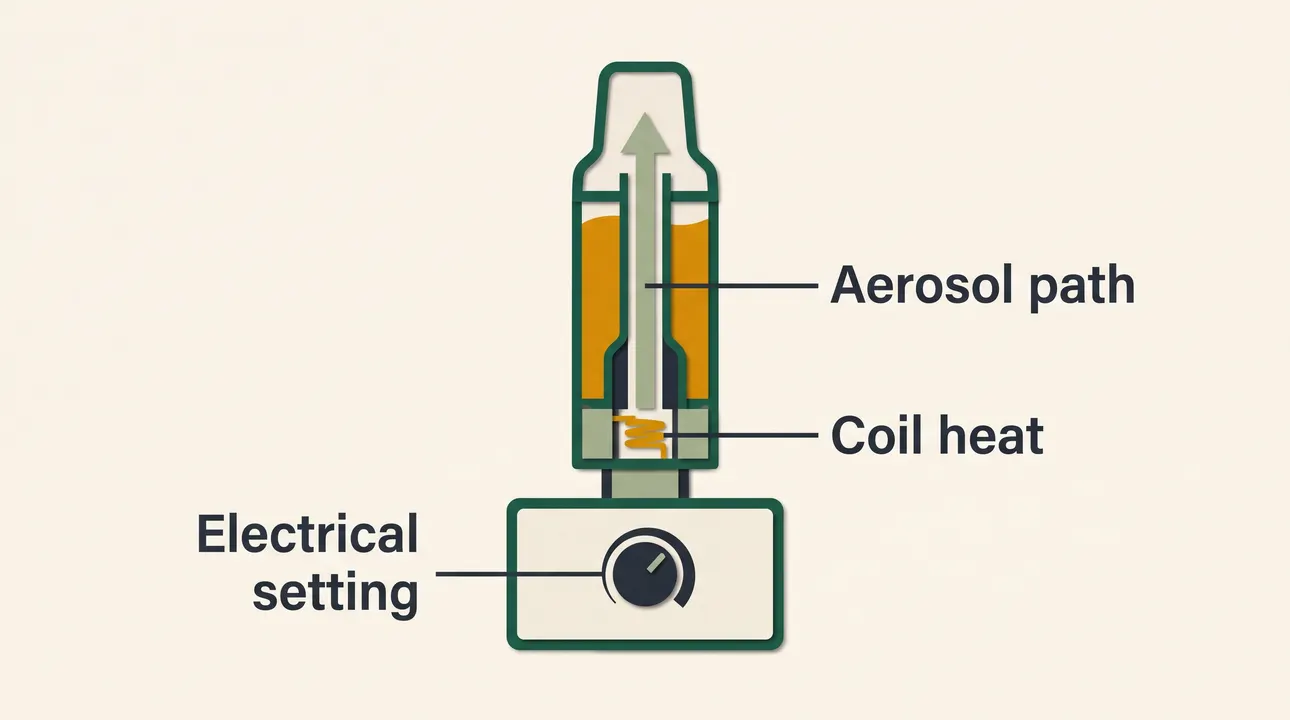
The control, the heating element, and the aerosol path are separate. This is a conceptual diagram, not a thermal measurement.
An oil-cartridge coil reading is also not interchangeable with a flower chamber setting. The hardware heats different material in a different arrangement. Carrying one device’s number into another device’s instructions is a category mistake.
Does lower voltage guarantee safer aerosol?
No setting alone establishes the contents or safety of an aerosol. Separate chamber experiments heated mixtures of cannabis-associated terpenoids across 100–500°C. Emissions changed with temperature and composition, including thermal breakdown products and ultrafine particles. These experiments explain why heating conditions matter; they do not produce a universal safe voltage. Tang et al., 2021
Temperature is also separate from hardware contamination. Our cannabis vape heavy-metals lesson explains why testing oil and testing inhaled emissions answer different questions.
For the broader difference between burning flower and heating it, continue with vaping versus smoking cannabis. A claim about one route does not settle the performance of every device within it.
Use the instructions for the specific battery and cartridge combination. Ask the maker which settings and resistances it supports, and whether any claimed temperature is measured or estimated. If that information is missing, an online conversion chart cannot fill the gap.
Keep battery care separate too. The FDA’s vape battery guidance recommends following manufacturer instructions and avoiding extreme temperatures. Turning down a setting is not a repair for damaged hardware. For actual airway or connection problems, use the clogged-cartridge troubleshooting guide.
Key takeaways
- Voltage is an electrical setting, not a temperature reading.
- Resistance changes the power supplied at the same voltage.
- A coil measurement does not describe every point along the aerosol path.
- Device studies need their methods, limits, and funding attached to their numbers.
- Ask for instructions for your actual hardware combination, not a universal conversion chart.
FAQ
What temperature is 3 volts on a weed pen?
There is no universal answer. A meaningful temperature claim needs the cartridge, operating conditions, measurement location, and method. A voltage number alone leaves those details out.
Is a wattage setting more useful than voltage?
It describes power directly, which helps distinguish electrical input from resistance. It still does not tell you a temperature or a THC dose. Treat the device’s supported range as instructions for that device, not a transferable rule.
Does 510-thread mean every battery and cart work together?
The thread describes the connection. It does not supply the missing operating instructions for every possible pairing. Check the makers’ compatibility guidance before treating a physical fit as permission to use any setting.
Can a temperature-controlled vape prove its aerosol is safe?
No. Temperature control is one operating feature. An aerosol safety claim needs evidence about the finished product’s emissions and relevant exposures; it cannot rest on the control label alone.
Sources
- Oar, M. A., Savage, C. H., Rufer, E. S., Rucker, R. P., & Guzman, J. A. (2022). Thermography of cannabis extract vaporization cartridge heating coils in temperature- and voltage-controlled systems during a simulated human puff. PLOS ONE, 17(1), e0262265. DOI.
- Meehan-Atrash, J., et al. (2021). The influence of terpenes on the release of volatile organic compounds and active ingredients to cannabis vaping aerosols. RSC Advances, 11, 11714–11723. DOI.
- Tang, X., Cancelada, L., Rapp, V. H., Russell, M. L., Maddalena, R. L., Litter, M. I., Gundel, L. A., & Destaillats, H. (2021). Emissions from Heated Terpenoids Present in Vaporizable Cannabis Concentrates. Environmental Science & Technology, 55(9), 6160–6170. DOI.
- Fluke: Ohm’s law, OpenStax: electrical energy and power, and FDA: vape battery guidance. Accessed October 11, 2026.


