Clogged Vape Cart? Fix No Draw, Burnt Hits & Battery Issues
Fix a clogged cannabis vape cart safely. Diagnose no draw, burnt taste, leaks, flashing batteries, and warning signs that mean stop using it.


A clogged vape cart needs a diagnosis, not brute force. For a tight draw, start with the airway. If air moves but no vapor appears, check the battery and connection. For burnt, metallic, or chemical flavor, stop heating. The lowest-risk home checks are gentle and reversible. Bring a cold cart to room temperature, keep it upright, clean only visible residue, and use one short preheat cycle only if the manufacturer supports it.
Do not torch, boil, microwave, dismantle, refill, or pry open a sealed cartridge. Do not push a needle into its center tube. Those tricks can damage the wick, coil, seals, or battery.
This guide covers common 510-thread cartridges and all-in-one cannabis vapes. Hardware varies, so the device manual always outranks a generic tutorial. If you are deciding which format you own, start with the cart-versus-disposable comparison.

The 30-second cart diagnosis
Turn the battery off, or detach the cart if the system allows it. Then use this quick triage:
| What you notice | Most likely category | First safe move |
|---|---|---|
| Draw is tight or completely blocked | Condensation or oil in the airway | Detach, stand upright at room temperature, inspect the mouthpiece |
| Draw feels normal, but there is no vapor | Battery, contact, lockout, or compatibility fault | Check the manual, charge state, connection, and indicator pattern |
| Gurgling, spitting, or oil at the mouthpiece | Flooded center airway | Stop heating, detach, keep upright, blot visible residue |
| Burnt taste after several pulls | Under-saturated or damaged wick/coil | Stop, cool it, stand it upright; retire it if the taste remains |
| Burnt or chemical taste on the first pull | Defective hardware or questionable oil | Stop using it and contact the licensed retailer |
| Cart leaks, cracks, swells, or gets unusually hot | Hardware or battery failure | Stop immediately; isolate it from heat and flammables |
| Oil is very dark, separated, or unexpectedly thin | Age, heat damage, or formulation concern | Compare with the package and COA; do not keep “testing” it |
One clue matters before all others: does air move through the cart when it is detached? If no, the trouble is probably in the air path. If yes, focus on power and contact. This may prevent two common mistakes. One is firing a coil when the problem is electrical. The other is pulling harder until liquid enters the mouthpiece.
Why vape carts clog
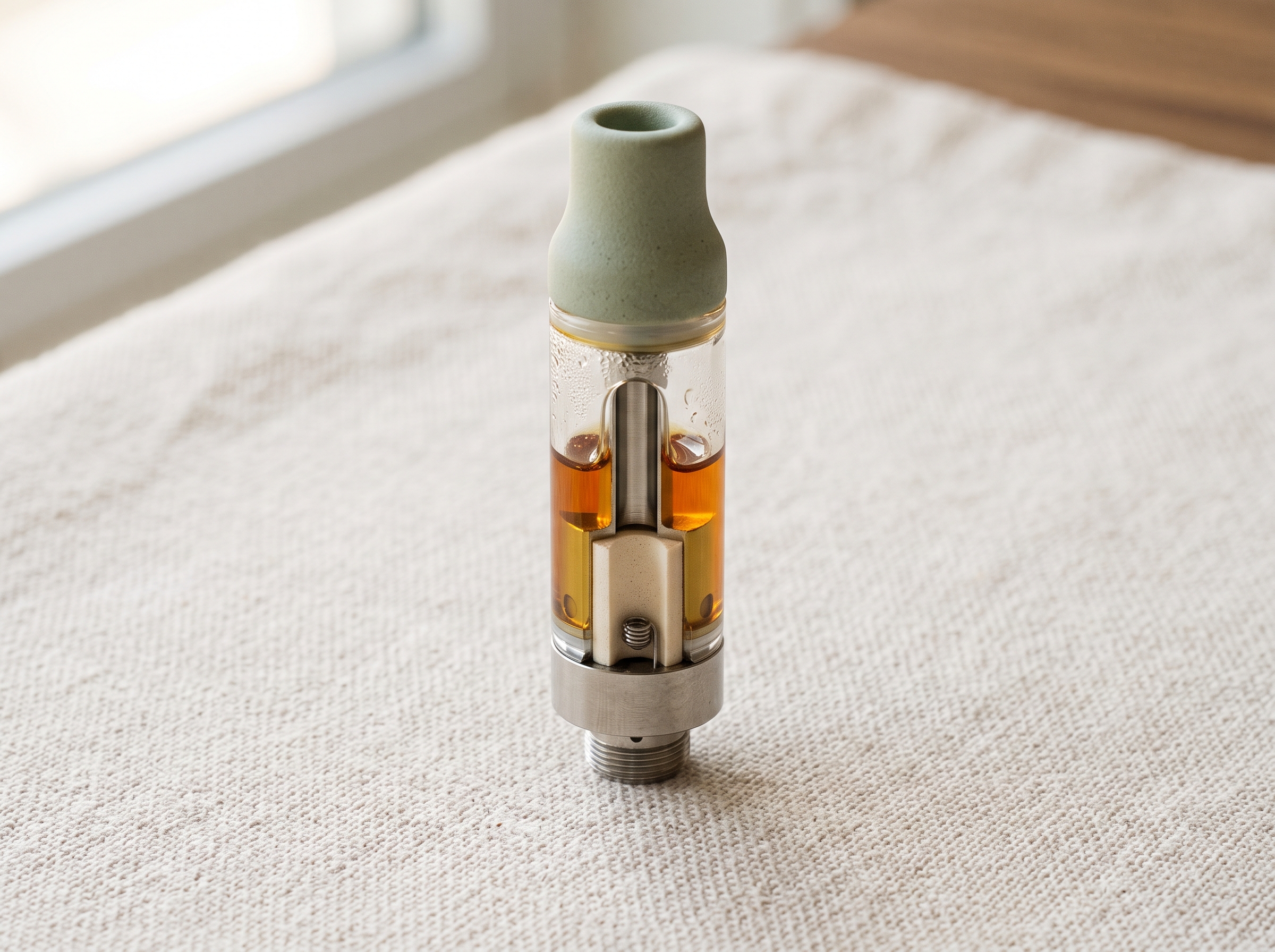
A cartridge is an oil reservoir around an absorbent heating element, with a separate center air path. When the device fires, oil at the wick becomes aerosol and exits through the mouthpiece.
Several things can interrupt that trip:
- Cold, viscous oil moves slowly. It may not replenish the wick or may harden an airway plug.
- Warm, thin oil moves easily. Excessive heat or sideways storage may let oil migrate toward the center air path or seals.
- Condensation accumulates. Aerosol cools inside the mouthpiece and can leave sticky residue.
- Hard pulls can worsen flooding. Strong suction may move more oil toward the airway than the heating system can vaporize.
- Long, repeated pulls can outpace wicking. The coil stays hot while its immediate oil supply falls behind, producing a dry or burnt taste.
- Contacts can become dirty or misaligned. A film of oil, pocket debris, over-tightening, or an incompatible cart can prevent a 510 battery from detecting the coil.
Oil type changes how readily it flows. Distillate, live resin, and rosin are different formulas. The rosin-versus-distillate guide, cured resin versus live resin comparison, and concentrate glossary explain them. Appearance alone cannot prove safety or authenticity.
How to unclog a vape cart safely
1. Stop pulling and detach the cartridge
Repeated hard inhalation can pull condensed oil into the mouthpiece or keep activating an auto-draw battery. Turn off a button battery and detach a compatible 510 cart before inspection.
For a sealed all-in-one, follow its manual. Do not open the shell to reach the airway or embedded battery.
2. Let the cart reach room temperature while upright
Set it upright on a stable surface, away from sun, heaters, cars, children, and pets. Let a cold cart warm naturally without exposing its seals or oil to uncontrolled heat.
Do not use a flame, stovetop, boiling water, microwave, heat gun, or hot hair dryer. Tanks can crack, seals can fail, and batteries can enter dangerous thermal failure. FDA battery guidance advises protecting vape batteries from extreme temperatures.
3. Remove only residue you can see
Blot exterior residue with a clean, lint-free swab. Do not drive a pin, paper clip, toothpick, or drill bit into the center tube. A deep tool can damage internal material or push the clog toward the coil.
If oil has reached the electrical contact, consult the manufacturer. Many reusable batteries can be cleaned while powered off with a barely damp isopropyl-alcohol swab. Let the contact air-dry completely. Not every finish, pod, or sensor tolerates that method, so check first. Never pour liquid into a device.
4. Use preheat only as designed
If the manual lists a preheat mode, reattach the room-temperature cart and run one normal cycle. Manufacturer CCELL recommends built-in preheat for viscous oil and room-temperature, upright storage. That applies to compatible devices; it is not permission to improvise external heating.
After the cycle, take a short, gentle draw. If the device is auto-draw and has no separate preheat mode, do not keep activating it against a complete blockage. Contact the retailer or manufacturer instead.
5. Stop after one cautious retest
If airflow returns and flavor is normal, condensation or temperature-related viscosity was probably responsible. If the cart still gurgles, spits oil, smells electrical, or tastes burnt, retire or return it.
Normal airflow but no vapor: check the battery
When air moves through a detached cart, power may be the problem. Work from the least invasive explanation outward.
- Read the indicator pattern in the manual. Three, five, or ten flashes do not mean the same thing across brands.
- Confirm that the device is unlocked. Many button batteries use a rapid-click lockout, but the sequence varies.
- Charge only as directed. Use the cable, charger, and power limits specified by the manufacturer.
- Inspect for damage or contamination. Oil on a contact, a bent thread, corrosion, a cracked tank, or a dented battery is a stop sign.
- Reconnect gently. Screw-on carts need contact, not force. Over-tightening can compress or misalign the connector.
- Check compatibility. “510-thread” describes the mechanical connection. It does not guarantee that every resistance, airflow sensor, magnetic adapter, or voltage range will work together.
Do not pry up the center contact, bridge it with foil, short terminals, or bypass protection. If a known-good, manufacturer-compatible cart works, the original cart is likely defective. If neither works, the battery may need service or replacement. A vaporizer buyer’s guide can help avoid another compatibility problem.
Battery safety is not optional
Charge on a clean, flat, nonflammable surface where you can see the device. Do not charge on a bed or couch, in extreme temperatures, or unattended. Stop using a battery that is swollen, wet, punctured, hissing, leaking, unusually hot, or giving off an unusual odor. Move away from it and follow local emergency guidance; do not handle a device that is actively smoking or burning.
FDA says vape fires and explosions appear uncommon but can cause serious injury. Do not put an all-in-one device or damaged battery in household trash or curbside recycling. EPA disposal guidance recommends a household hazardous-waste or battery-collection location and warns against removing embedded batteries.
Burnt hits: when to wait and when to quit
A burnt hit usually means the element became hotter than its available oil could support. Triggers include a nearly empty tank, long or repeated pulls, high power, or an under-saturated wick.
Start by stopping. Let the cartridge cool and stand upright. If it is still adequately filled and undamaged, use the lowest manufacturer-supported setting for one short test after the rest period. If the burnt flavor persists, the wick or oil may already be damaged. More power will not repair it.
Research explains why “turn it up” is poor universal advice. In a laboratory comparison of three cannabis cartridge systems, voltage-controlled devices reached higher and more variable coil temperatures than the temperature-controlled system. Voltage alone predicted coil temperature poorly because design and resistance also mattered [Oar et al., 2022]. The industry-affiliated study tested only three systems, so it establishes no magic safe setting. Use the manufacturer’s range and start low.
Heating cannabis terpenoids in a chamber produced ultrafine particles and degradation products that varied by temperature and mixture [Tang et al., 2021]. That controlled chemistry was not a clinical trial, but it argues against chasing a burnt hit with uncontrolled heat. See the dry-herb temperature guide and dry-herb-versus-oil comparison.
Gurgling, spitback, and leaks
Gurgling usually points to liquid in the air channel or around the heating chamber. Spitback means droplets are reaching the mouthpiece. Both are reasons to stop firing the device.
Detach a removable cart, keep it upright, and blot only visible residue. Do not inhale forcefully while firing; that can pull more liquid into the airway. Do not consume leaked oil orally unless the product was explicitly manufactured and labeled for that route. A vape formulation and an edible are not automatically interchangeable.
Retire or return the cart when:
- oil repeatedly reaches the mouthpiece after cleaning the exterior;
- the tank, base, or mouthpiece is cracked or loose;
- oil leaks onto the battery;
- the device heats while idle;
- a new, properly stored cart gurgles from its first use; or
- the oil has separated, changed sharply, or passed its labeled shelf life.
For age and storage questions, use the vape-cart shelf-life guide. It is better to document the batch and request a retailer replacement than to transfer unknown oil into different hardware.
When the product—not the clog—is the problem
Troubleshooting assumes a licensed, regulated source. If the cart came from an informal seller, lacks verifiable batch information, or fails packaging checks, mechanical success proves nothing about safety.
During the EVALI outbreak, many affected people who supplied source information had obtained THC vaping products informally. CDC advised against THC vaping products, especially those from friends, dealers, or other informal sources [Navon et al., 2020]. Use the counterfeit-cart checklist to verify the seller, batch, and manufacturer, and the lab-results guide to understand a COA’s limits.
A study tested 13 commercial cannabis cartridges. Researchers detected chromium, copper, nickel, and smaller amounts of other metals moving into oil and aerosol. The findings implicated device components [McDaniel et al., 2021]. That small sample cannot quantify risk from your cart, but it argues against piercing, rebuilding, or overheating the hardware.
Vaping is not harmless. Laboratory work found biologically active toxicants in cannabis vaping aerosol [Arlen et al., 2025]. Cell and chemical results do not translate directly into personal disease risk. “Smoother” does not mean “safe.” See the vaping-versus-smoking review, consumption-method comparison, and lung-health review.
Seek medical care after vaping if you develop chest pain, shortness of breath, worsening cough, fever, persistent vomiting, confusion, or severe weakness. Call emergency services for severe breathing trouble. Also call for loss of consciousness or a fire or explosion injury. Tell the clinician what product you used. Keep the package if it can be stored safely.
Prevent the next clog
- Store the cart upright at ordinary room temperature, away from sun and temperature extremes.
- Keep the mouthpiece clean and capped when the product provides a cap.
- Use gentle, shorter pulls instead of hard suction and back-to-back sessions.
- Start at the lowest supported setting rather than treating cloud size as a quality score.
- Avoid over-tightening a 510 cart.
- Do not run a cart nearly dry.
- Keep the original package, batch number, receipt, and manufacturer instructions.
- Buy from licensed retailers and verify recalls when flavor, color, or performance changes unexpectedly.
Terpene profile can influence flavor. But metallic, plastic, or persistently burnt taste is not “just the strain.” Learn intended aroma through the terpene guide. Then use High Families to understand experience separately from hardware. A clogged airway is a device event, not an effect profile.
Log the product, batch, oil type, device, setting, and symptom. Patterns such as “only this battery burns carts” become easier to see. High IQ tracks personal product and session patterns without pretending one label predicts everyone.
Frequently asked questions
Can I use a lighter or hair dryer to unclog a cart?
No open flame or uncontrolled external heat. Heat can thin the oil too far, weaken seals, crack glass, damage a battery, or overheat the contents. Let a removable cart reach room temperature naturally and use only a built-in preheat mode approved by its manufacturer.
Can I stick a paper clip down the mouthpiece?
Do not push a tool deep into a sealed cartridge. It can damage internal parts or push residue toward the coil. Wipe only material that is clearly visible and reachable at the exterior opening; return the cart if the airway remains blocked.
Why does my cart blink but not hit?
Blink codes are device-specific. Common categories include low charge, lockout, poor contact, short-circuit protection, or an incompatible cartridge. Check the exact manual, clean only as directed, reconnect gently, and never bypass a protection feature.
Is a burnt cart safe after the flavor goes away?
There is no home test that can confirm it is safe. A brief dry taste may resolve after the wick re-saturates, but persistent burnt, metallic, plastic, or chemical flavor is a reason to stop. Return or replace the cart instead of increasing power.
Why is oil coming through the mouthpiece?
The center airway is probably flooded with oil or condensed aerosol. Stop heating, detach if appropriate, stand the cart upright, and blot visible residue. Repeated spitback, leakage, or a loose mouthpiece means the hardware should be returned or retired.
Key takeaways
Use the smallest reversible fix that matches the symptom. Room temperature, upright storage, a clean exterior contact, and one manufacturer-approved preheat cycle solve the problems worth solving at home. Persistent burnt taste, leakage, physical damage, suspicious oil, or battery heat ends the experiment.
Sources
- Oar, M. A., Savage, C. H., Rufer, E. S., Rucker, R. P., & Guzman, J. A. (2022). Thermography of cannabis extract vaporization cartridge heating coils in temperature- and voltage-controlled systems during a simulated human puff. PLOS ONE, 17(1), e0262265. PubMed · DOI
- Tang, X., Cancelada, L., Rapp, V. H., Russell, M. L., Maddalena, R. L., Litter, M. I., Gundel, L. A., & Destaillats, H. (2021). Emissions from Heated Terpenoids Present in Vaporizable Cannabis Concentrates. Environmental Science & Technology, 55(9), 6160–6170. PubMed · DOI
- McDaniel, C., Mallampati, S. R., & Wise, A. (2021). Metals in Cannabis Vaporizer Aerosols: Sources, Possible Mechanisms, and Exposure Profiles. Chemical Research in Toxicology, 34(11), 2331–2342. PubMed · DOI
- Arlen, M. T., Patterson, S. J., Page, M. K., Liu, R., Caruana, V., Wilson, E. T., Laporte, S. A., Goniewicz, M. L., Harris, C. S., Eidelman, D. H., & Baglole, C. J. (2025). Cannabis vaping elicits transcriptomic and metabolomic changes involved in inflammatory, oxidative stress, and cancer pathways in human bronchial epithelial cells. American Journal of Physiology-Lung Cellular and Molecular Physiology, 328(3), L478–L496. PubMed · DOI
- Navon, L., Ghinai, I., & Layden, J. (2020). Notes from the Field: Characteristics of Tetrahydrocannabinol–Containing E-cigarette, or Vaping, Products Used by Adults — Illinois, September–October 2019. MMWR Morbidity and Mortality Weekly Report, 69, 973–975. CDC · DOI
Public-health and manufacturer guidance
FDA battery safety · EPA vape-device disposal · CCELL clogging and preheat guidance

