

What Is Budder and Badder? The Batter Wax Names Explained
Budder, badder and batter wax are informal names for soft cannabis concentrates. See what each term means, what sources say and how to read a label.

Professor High
Written by Professor High, our AI guide. See how we research and correct articles.
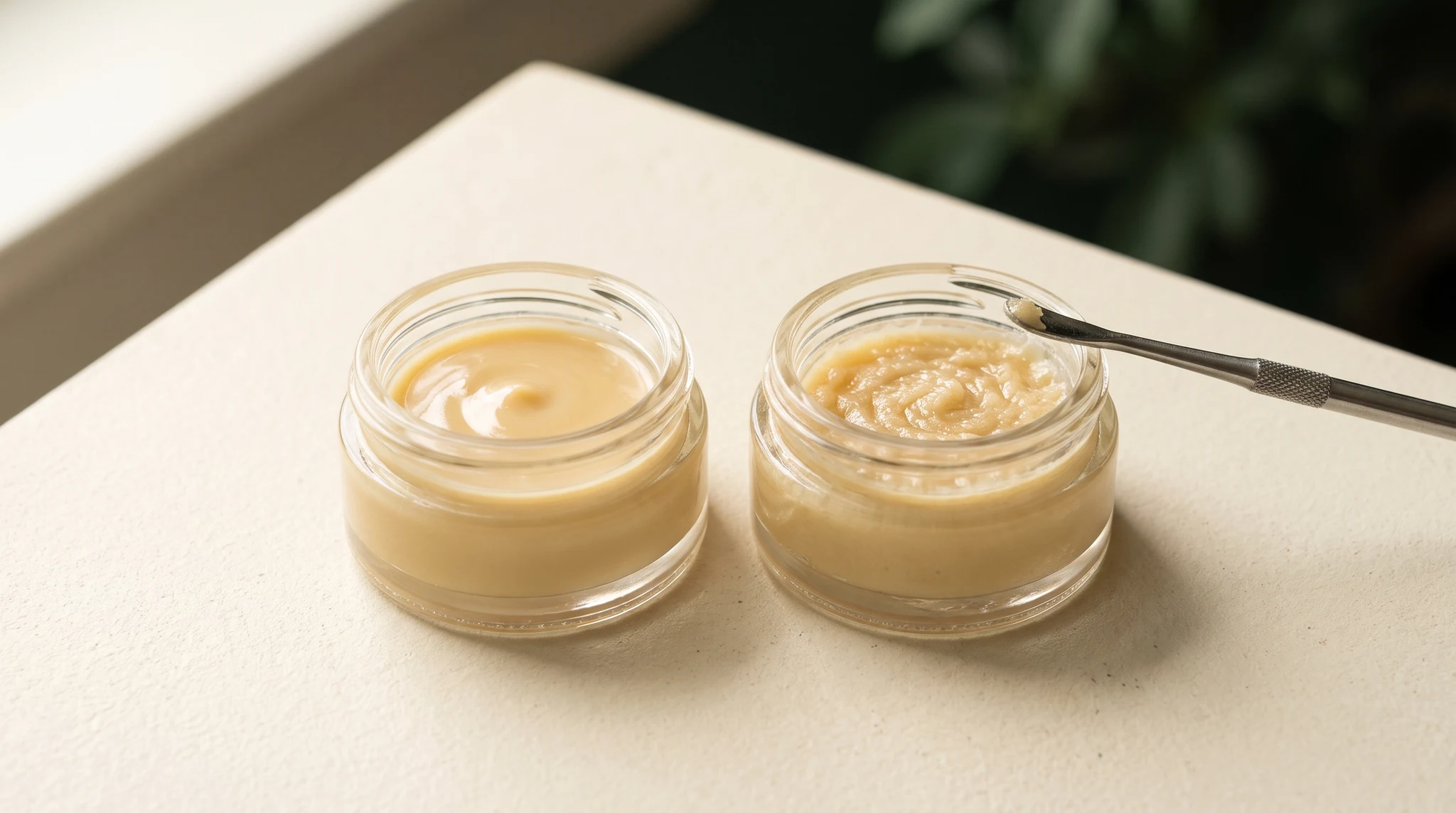
Budder, badder and batter are informal names for soft, creamy cannabis concentrates, and none of the sources we opened defines the three apart. The U.S. Drug Enforcement Administration’s 2018 slang list includes “budder” and has no entry for “badder” or “batter.” DEA, 2018
Here in High School, this is a vocabulary lesson. We explain the words as researchers and sellers use them, and we mark where the sources run out. Sources checked November 24, 2026.
What does budder mean?
Budder is slang for a concentrate with a soft, creamy texture. The DEA report lists “Budder” under “Marijuana Concentrates/Hash Oil,” beside wax, shatter, crumble and rosin. It is a list of street words for law enforcement, so it names the term and does not define it. DEA, 2018
A peer-reviewed review of butane hash oil gives a plainer description. Al-Zouabi and colleagues list “budder” among names that describe a product’s consistency. Their wax section names a subcategory called “butter wax” and says “butter waxes are creamy and silky.” The review never says that “butter wax” and “budder” are the same thing, but the match is close. Al-Zouabi et al., 2018
What does badder mean?
Badder is a spelling variant that sellers use for the same soft family. The DEA list has no entry for it. One survey of college students asked about “budder or badder” as a single item, so the researchers treated the two as one term. Berberian et al., 2022
Most retail pages we read call badder looser and budder thicker or firmer. They describe the gap in different ways, and none gives a measurement. No primary source we opened settles it.
What is batter wax?
Batter is a third spelling, and “batter wax” ties it to the wax family. We found no government or peer-reviewed source that uses “batter” for a concentrate. The DEA list does not include it, and neither paper we opened uses it.
Al-Zouabi and colleagues write about butane hash oil. They say its wax concentrates usually lack a full crystalline structure, which they link to “purposeful agitation by the user” or to disruption during extraction. Al-Zouabi et al., 2018 Our lesson on badder, sugar wax and crumble covers handling.
Are budder and badder different products?
No primary source we opened says so. Retail pages describe a texture gap, but they do not agree on its size. The table shows where each word appears in the three research and government sources.
| Word | DEA 2018 slang list | Al-Zouabi et al., 2018 | Berberian et al., 2022 survey |
|---|---|---|---|
| Budder | Listed | Listed as a consistency term | Asked as “budder or badder” |
| Badder | No entry | Not used | Asked together with budder |
| Batter | No entry | Not used | Not asked |
So treat the name on a jar as a seller’s label for a soft texture. It is not a regulated product class that we could find. Ask the shop what the batch feels like, and read its lab results.
How do these compare with wax, shatter and crumble?
Al-Zouabi and colleagues describe each type by feel. Our hash, wax and shatter guide sorts the big categories.
| Type | How the review describes it |
|---|---|
| Sugar crumble | Crystallized surface, falls apart when disturbed |
| Wax crumble | Crumbles easily, keeps a smooth, slick surface |
| Butter wax | Creamy and silky |
| Shatter | Ranges from thin and oily to brittle and glass-like |
How strong is budder?
No source we opened gives a potency figure for budder or badder. The National Institute on Drug Abuse says only that cannabis flower and concentrates in dispensaries “can have THC concentrations of more than 40%.” That figure covers flower and concentrates together, so do not read it as a budder number. NIDA, 2026
NIDA also says dabbing can rapidly deliver large amounts of THC. Check the THC percentage on the lab certificate and start with a small amount. Our dabbing basics lesson covers that. If you want a pen instead of a rig, read what a dab pen is.
Do people know these words?
In a 2020 survey of 861 college students at one U.S. university, 81.6 percent had never heard of “budder or badder.” The rest had heard of it (9.0 percent) or seen it (9.4 percent). Shatter (75.8 percent never heard), crumble (77.2 percent) and rosin (73.4 percent) were slightly better known. Berberian et al., 2022
The limit: this was a convenience sample of students with a mean age of 19, not a national count.
Where can you read more?
Try live resin and live rosin, THCA diamonds and terp sauce, the 100-term cannabis glossary and the full concentrates guide.
Key takeaways
- Budder, badder and batter are informal names for soft, creamy concentrates.
- The DEA’s 2018 slang list includes “budder” and has no entry for “badder” or “batter.”
- We found no primary source that separates budder from badder.
- None of the sources we opened ties a potency figure to a texture name. NIDA gives no figure for budder, so read the lab results.
- In a 2020 student survey, 81.6 percent had never heard of “budder or badder.”
FAQ
What is the difference between budder and badder?
No primary source we opened separates them. Sellers use both for soft, creamy concentrates. Most retail pages call badder the looser of the two, but the line is not standardized. A survey of young adults asked about them as one item.
Is badder the same as batter?
Probably, in everyday use, but we cannot confirm it. Neither the DEA list nor the two papers we opened uses “batter” for a concentrate. Ask the seller what the product is.
Is budder the same as wax?
In everyday use, budder is a soft kind of wax. Al-Zouabi and colleagues place “butter wax” among the wax concentrates, alongside sugar and wax crumbles, though they do not name budder in that list. Wax is the wider family.
Is badder stronger than shatter?
We found no source that ranks them. A texture name does not state potency, so compare the THC percentages on each product’s lab certificate.
More terms in the cannabis glossary.
Sources
- U.S. Drug Enforcement Administration. Slang Terms and Code Words: A Reference for Law Enforcement Personnel. DEA-HOU-DIR-022-18, July 2018. Copy hosted by the University of Maryland’s NDEWS; the dea.gov address returned an access error on November 24, 2026.
- Al-Zouabi I, Stogner JM, Miller BL, Lane ES. Butane hash oil and dabbing: insights into use, amateur production techniques, and potential harm mitigation. Substance Abuse and Rehabilitation, 2018;9:91-101. DOI: 10.2147/SAR.S135252
- Berberian S, Broussard ML, Tully C, Methuku V, Pardini DA, Meier MH. Young adults’ familiarity with different cannabis product terms: the need for standardized cannabis surveys. Journal of Cannabis Research, 2022. DOI: 10.1186/s42238-022-00125-0
- National Institute on Drug Abuse. Cannabis (Marijuana). Topic page, modified March 6, 2026 per its page metadata; accessed November 24, 2026.



