THCA Diamonds and Terp Sauce: What You're Actually Buying
Diamonds are crystallised THCA that does nothing until you heat it. The sauce carries the terpenes. Here's why the sauce decides how it feels.

Professor High
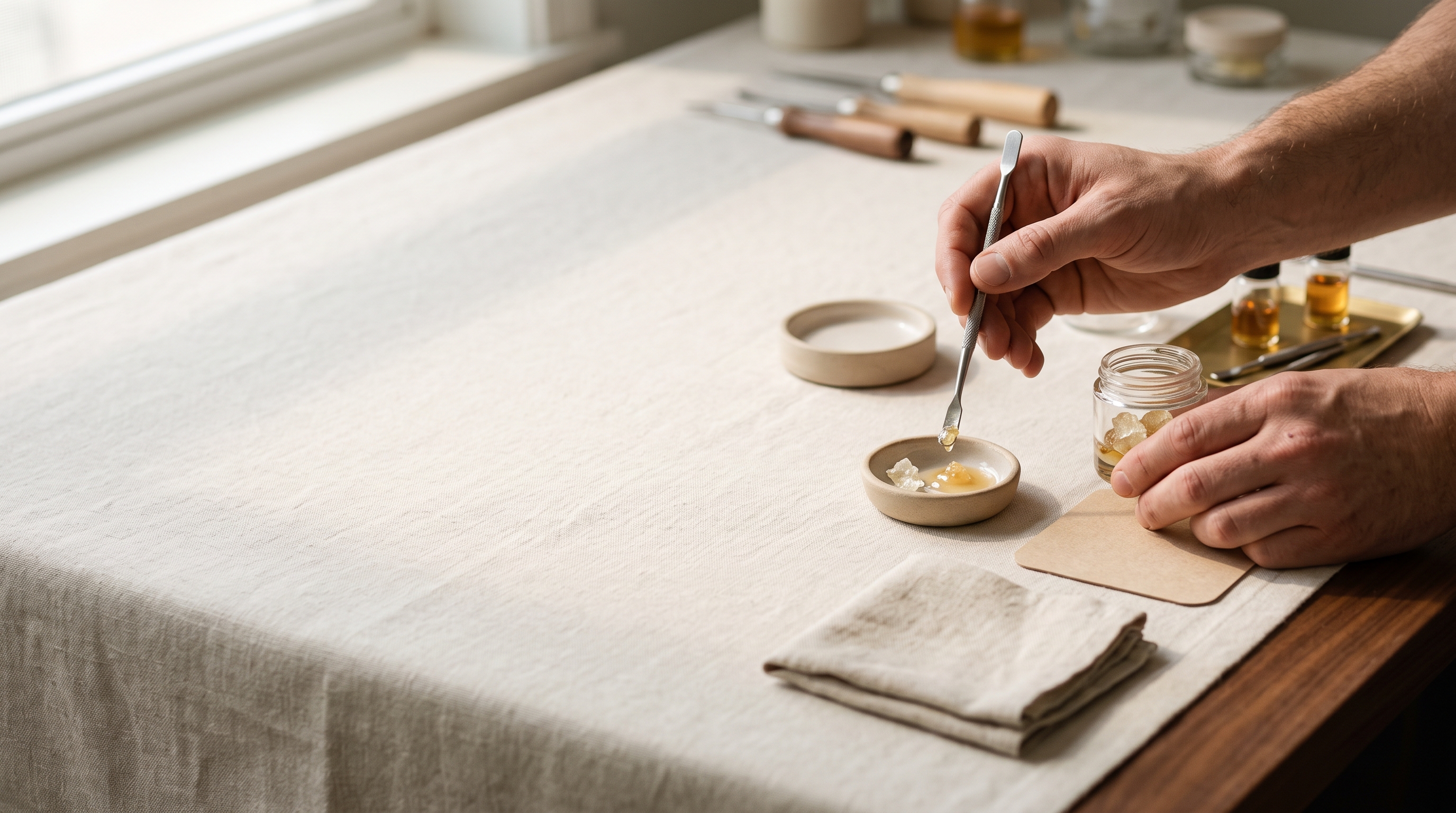
You spent sixty dollars on a gram because the label said 96% THCA and the jar looked like a geode. You took a dab. It hit hard, tasted like almost nothing, and twenty minutes later you could not have told anyone what strain it was.
Meanwhile your friend’s forty-dollar gram of live rosin tested at 74% and tasted like someone had opened a bag of lemons in your sinuses.
This is the single most common complaint about diamonds and sauce, and it is not mysterious. It happens because the number on the jar describes the part of the product that does the least to shape your experience, and says nothing about the part that does the most.
Here is what is actually in that jar.
What a diamond actually is
A THCA diamond is a crystal. Not a metaphor — an actual crystalline solid, grown the way rock candy grows in a jar of sugar syrup, from a supersaturated solution of one compound that slowly falls out and locks into a repeating lattice.
The compound is tetrahydrocannabinolic acid A, usually written THCA-A or just THCA. It is what the cannabis plant actually makes. The living plant does not produce THC in any meaningful quantity. It produces THCA in the glandular trichomes on its flowers and leaves, where it appears to serve a protective role, and where it can account for up to 90% of the plant’s total THC content. That THCA slowly converts to THC during storage and curing, and rapidly converts during smoking, vaping, or baking (Moreno-Sanz, 2016).
If you want the fuller picture of where these compounds live and why, our guide to cannabis trichomes covers the anatomy, and what THCA is and how it works covers the molecule itself.
Because THCA is a well-behaved, chemically stable molecule with a strong tendency to crystallise, extractors can grow it into visible crystals ranging from sugar-grain specks to chunks the size of a pea. High-grade diamonds routinely assay above 90% THCA and the cleanest can push past 99%.
The part almost nobody says out loud
THCA does not get you high.
That is not a hedge or a technicality. In humans, THCA-A does not produce psychoactive effects the way THC does (Moreno-Sanz, 2016). A jar of pure THCA diamonds, eaten cold with a spoon, would be an expensive and largely uneventful experience.
What makes diamonds work is decarboxylation — the heat-driven reaction that snaps a carboxyl group off the THCA molecule, releases it as carbon dioxide, and leaves THC behind. Our full explainer on decarboxylation goes deeper, but the short version is that heat is not a delivery mechanism here. Heat is the chemical step that creates the active drug. No heat, no high.
Researchers have measured how fast this happens. Working across 80°C, 95°C, 110°C, 130°C and 145°C, one team found THCA-A decarboxylation follows first-order kinetics, runs about twice as fast as the equivalent reaction for CBDA and CBGA, and proceeds cleanly with no significant side reactions or by-products (Wang et al., 2016). On a hot nail, the reaction is effectively instantaneous.
THCA is not pharmacologically inert, though — just not intoxicating. Preclinical work in cell cultures and mice found THCA-A binds and activates the PPARγ receptor more potently than its decarboxylated form, with neuroprotective effects in a mouse model (Nadal et al., 2017). That is laboratory and rodent evidence only. Nobody has shown it means anything for a person holding a dab rig.
The arithmetic the label does not show you
Decarboxylation costs mass. THCA has a molecular weight of about 358.5; the CO₂ that leaves weighs about 44. What remains is THC at about 314.5.
That ratio — roughly 0.877 — is a hard ceiling. It is the same factor labs use to compute “total THC” on any certificate of analysis.
| Label says | Theoretical max THC after perfect decarb |
|---|---|
| 99% THCA | ~86.8% |
| 96% THCA | ~84.2% |
| 90% THCA | ~78.9% |
| 80% THCA | ~70.2% |
And that is the theoretical ceiling, assuming flawless conversion and zero loss. In a real dab, some material never converts, some is destroyed outright, and some sails past you as vapour you never inhale. The gap between “96% THCA” and what reaches your bloodstream is wide, and it is wider than the four-point gap between two competing jars on the shelf.
What the sauce is
Now the interesting half.
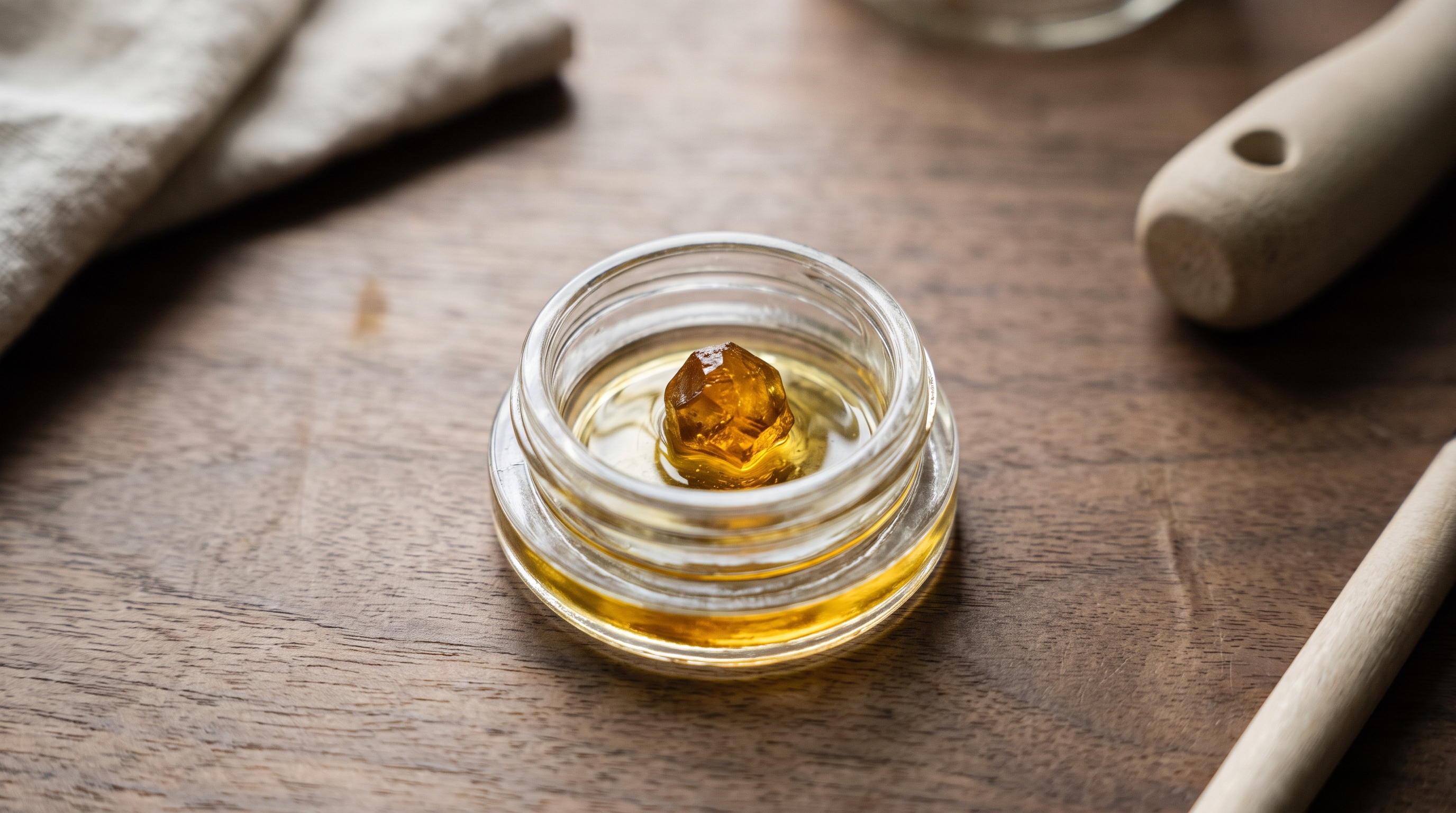
When THCA crystallises out of an extract, it leaves everything else behind. The liquid surrounding the crystals — the mother liquor, in the language of crystallisation chemistry — is what the industry calls sauce, terp sauce, or HTFSE (high terpene full spectrum extract).
The sauce is where essentially the entire chemical personality of the plant ends up:
- Terpenes and terpenoids — myrcene, limonene, caryophyllene, linalool, pinene, terpinolene, humulene and dozens of minor ones. This is all of the aroma and all of the flavour.
- Minor cannabinoids — CBG, CBC, THCV, CBN and others, in small but non-zero amounts.
- Flavonoids and other plant compounds that do not crystallise.
A well-made sauce commonly tests somewhere in the range of 5–15% total terpenes. A distillate, by comparison, has been stripped to near-zero. That difference — a few percentage points of mass — is the whole reason one gram tastes like Zkittlez and another tastes like warm plastic.
Our complete terpene guide goes deeper on the individual compounds, and terpene bioavailability covers how much of them actually survives the trip.
A note on the word “sauce”
The vocabulary here is genuinely confusing, and the confusion is partly deliberate.
“Sauce” is sometimes used to mean a texture — any wet, runny live resin, as we discuss in live resin vs live rosin. But “diamonds and sauce” as a product is something more specific: a deliberately separated system, where the crystals were grown apart from the liquid and the two were then recombined, often in a controlled ratio.
The difference matters when you are paying for it.
How they are made
There are two honest routes and one dishonest one.
Route 1: jar tech, or “diamond mining”
This is the classic method, and despite what you will read, it is not chromatography. It is recrystallisation.
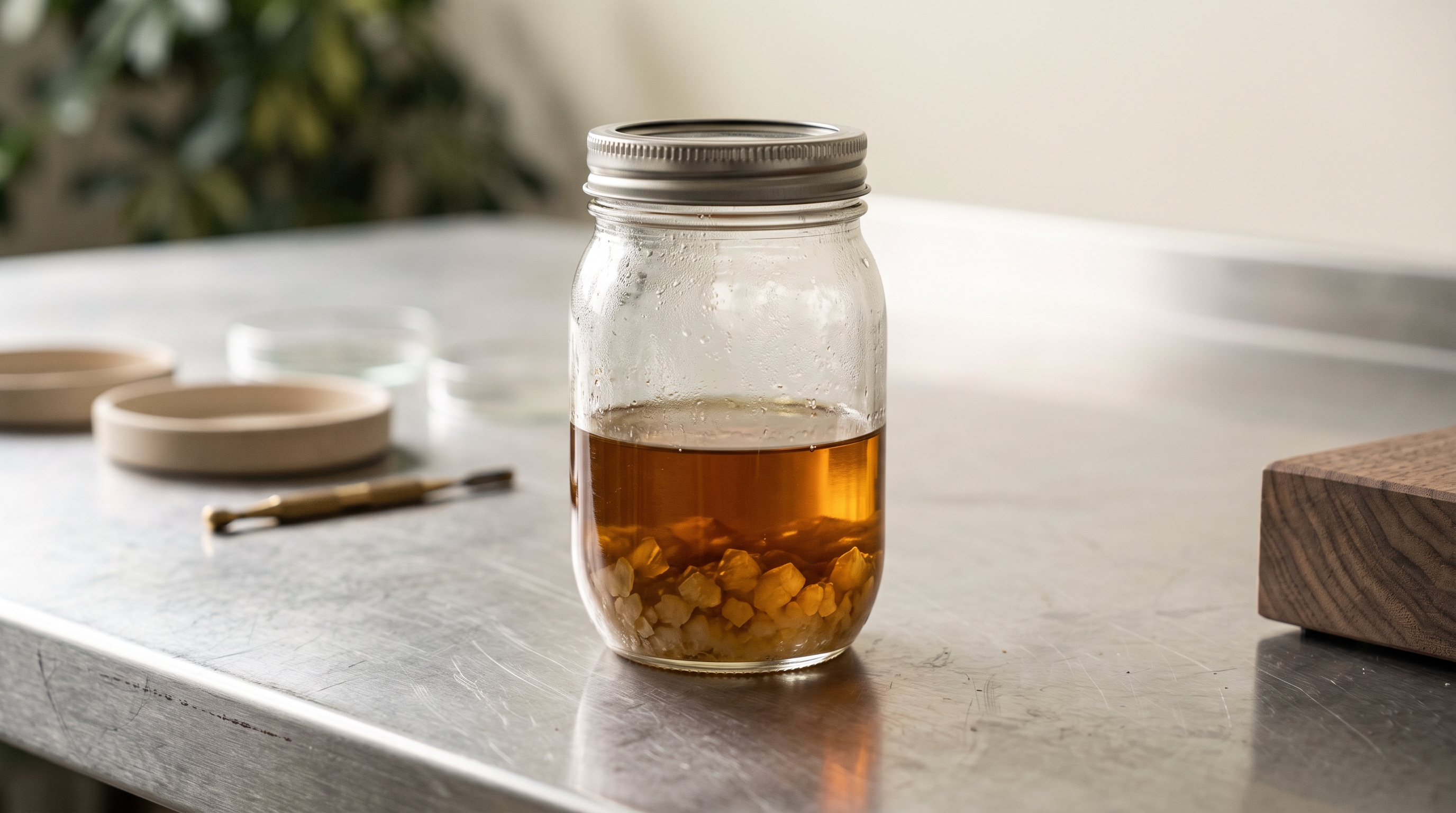
An extractor runs a hydrocarbon extraction — usually butane or a butane/propane blend — and deliberately stops short of purging all the solvent. The resulting slurry goes into a sealed vessel under its own pressure and sits, typically somewhere between warm room temperature and gentle heat, for two to four weeks.
The residual solvent acts as the crystallisation medium. THCA, being the most abundant and most crystallisation-prone compound in the mix, slowly comes out of solution and grows. Everything else stays dissolved.
At the end, the extractor pours off the sauce, collects the crystals, purges both separately, and recombines them. “Mining” is a fair description of the last step — someone physically digs the crystals out of the jar.
Route 2: crystallisation from live resin
Same principle, better starting material. The input is fresh-frozen flower rather than cured, which preserves the volatile monoterpenes that are largely lost during drying. The crystallisation runs slower and cooler.
The diamonds come out much the same — THCA is THCA — but the sauce is dramatically better, because the sauce is the only part where the starting material actually shows up.
Route 3: the one to avoid
Isolated THCA, produced at industrial scale, blended with terpenes that were never in a cannabis plant. Botanical limonene from citrus peel is chemically identical to limonene from cannabis, so this is not fraud in a chemical sense — but the ratios are invented, the minor cannabinoids are absent, and the result tastes like a flavour concentrate because that is what it is. This sits closer to the distillate side of the ledger than to anything you would call full spectrum. It is often cheap. It should be.
Why a big THCA number is a bad predictor
We have argued before that THC percentage is a terrible way to choose cannabis, and that the potency arms race has bred for a number rather than an experience. Diamonds are that argument in its purest form — literally.
Consider two grams of diamonds and sauce, both from competent extractors:
| Jar A | Jar B | |
|---|---|---|
| THCA | 96% | 82% |
| Total terpenes | 1.2% | 9.4% |
| Minor cannabinoids | trace | 3.1% |
| Aroma at room temp | faint | loud, specific |
| Price | $60 | $55 |
Jar A wins on the metric printed in the largest font. Jar B is the one people come back for. The extra 14 points of THCA in Jar A buy you a slightly stronger version of a generic effect. The extra 8 points of terpene in Jar B buy you a particular effect — the difference between euphoric and cerebral, between calm and flatly sedated.
But be honest about the mechanism
This is where a lot of cannabis writing overreaches, so let me not.
The idea that terpenes meaningfully shape the cannabinoid experience is the entourage effect, most influentially set out by Russo (2011), who proposed that phytocannabinoid–terpenoid synergy could explain effects that THC alone does not. We cover the case in detail in the entourage effect and terpene synergy.
But the mechanism is genuinely contested. A careful receptor-pharmacology study tested five common cannabis terpenes — alone and in mixtures — and found no evidence that they bind or modulate CB1 or CB2 receptors, and no change in how THC or CBD behaved at those receptors when terpenes were present. The one possible exception was a weak caryophyllene–CB2 interaction (Finlay et al., 2020).
So: terpenes almost certainly are not making THC hit differently at the cannabinoid receptor. They may work through other receptors, through smell and expectation, through their own independent pharmacology, or through some combination. We do not know.
What is not in dispute is that a high-terpene sauce and a terpene-stripped isolate produce noticeably different experiences for most people. The effect is real even where the explanation is unsettled. If you want a case study in how confidently people assert terpene mechanisms that do not survive scrutiny, read the myrcene 0.5% rule myth.
How to dab them without destroying what you paid for
Temperature is the whole game, and it is where most people waste most of their money.
Terpenes are volatile — that is why you can smell them. They boil off, and they degrade, at temperatures far below what a glowing-red quartz banger delivers. Every degree above the minimum needed to decarboxylate and vaporise the THCA is a degree spent breaking apart the compounds that make the product worth buying.
There is also a safety dimension. Researchers studying the chemistry of myrcene and other common cannabis terpenes under conditions simulating real-world dabbing found the formation of methacrolein, benzene, and other degradation products of concern to human health (Meehan-Atrash et al., 2017).
A follow-up study quantified gas-phase degradants from dabbing and cartridge vaporizers, finding methacrolein, benzene and methyl vinyl ketone, and — notably — that adding terpenes produced higher levels of gas-phase degradation products than THC alone. The same work found overall gas-phase degradant levels were significantly lower in dabbing and vaporizing than in smoking cannabis, while cautioning that this depends heavily on usage patterns and does not address the much higher THC concentration involved (Meehan-Atrash et al., 2019).
Read that carefully, because it cuts both ways: the terpenes you are paying for are also the substrate for some of the degradation. Lower temperatures reduce both problems at once.
Practical temperature guidance
Exact numbers vary with your setup, and anyone quoting a single magic figure is overselling their precision. But the working consensus among people who care about flavour:
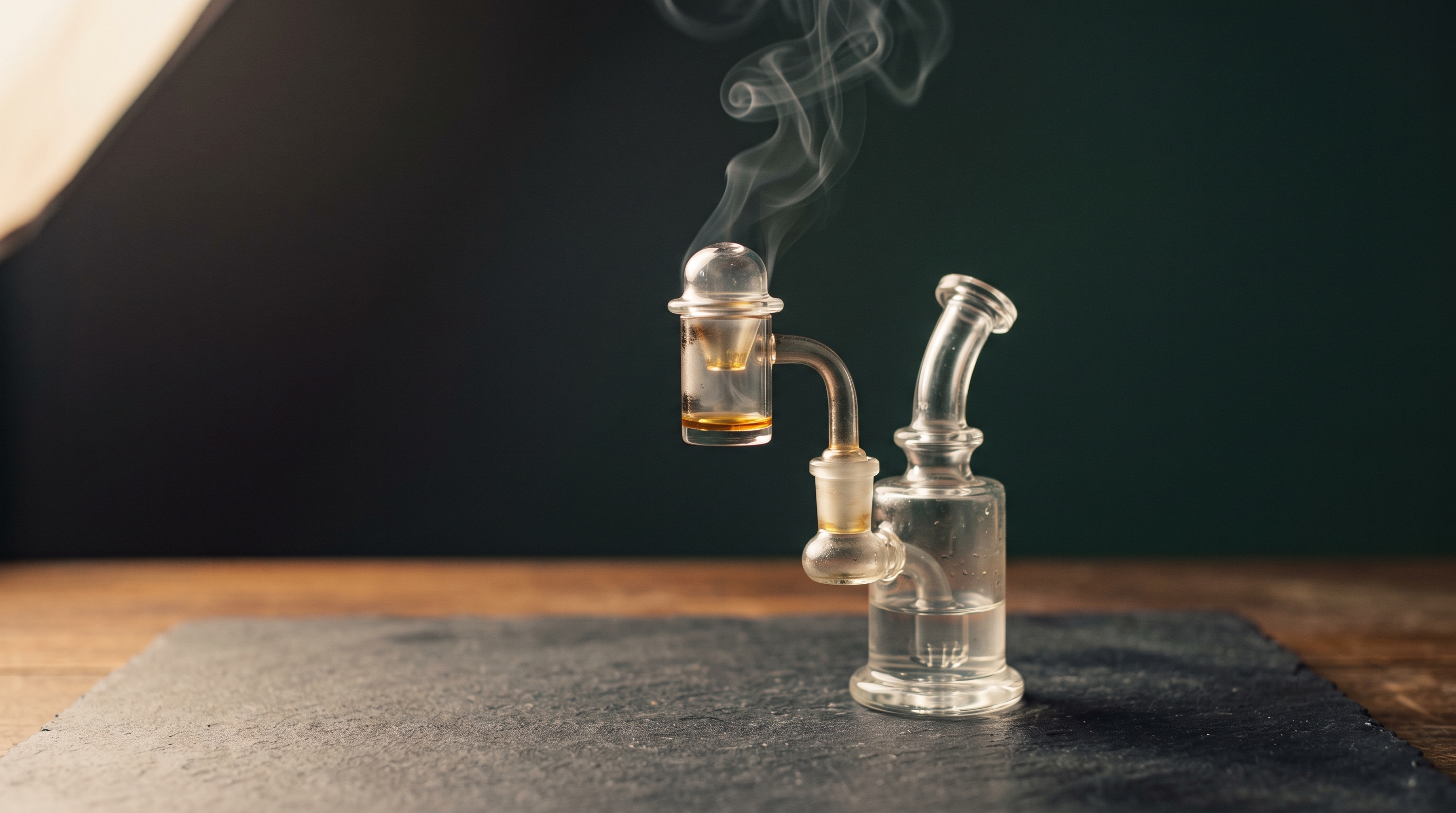
- Heat, then wait. A torch-heated quartz banger should rest 35–60 seconds after the flame comes off. The surface is far hotter than it looks.
- Aim low. Most flavour-focused dabbers target roughly 500–600°F (about 260–315°C). Below that you leave material behind; well above it you are burning terpenes for no additional effect.
- Cap it. A carb cap lowers the pressure over the oil so it vaporises cooler. For low-temp dabbing it is essential, not an accessory. Terp pearls help further by spreading the oil across more surface.
- Consider an e-nail. Temperature control removes the guesswork entirely — see our e-nail and e-rig setup guide.
- Take smaller dabs. At 85% total THC, a dab the size of a grain of rice is a real dose.
The tell that you got it right: the oil pools and evaporates rather than sizzling, and the residue is a light amber film rather than a scorched ring. If you are still assembling a setup, start with banger vs nail and the dab rig buyer’s guide; if you are new to concentrates entirely, dabbing 101 comes first.
One safety aside: none of this applies to semi-synthetic cannabinoids like THC-O acetate, which carry a genuinely different and more serious risk profile. See acetylated cannabinoids and ketene.
Where diamonds sit among the other high-purity products
| Product | THC/THCA | Terpenes | What it is |
|---|---|---|---|
| Diamonds and sauce | 70–90% total | 3–15% | Crystallised THCA recombined with its own mother liquor |
| Bare THCA isolate | 95–99%+ | ~0% | Crystals only, sauce removed and sold separately |
| Distillate | 85–95% | ~0% added back, or botanical | Molecularly distilled THC, stripped of everything else |
| Live resin | 65–85% | 5–15% | Fresh-frozen hydrocarbon extract, not crystallised out |
| Live rosin | 60–80% | 4–12% | Solventless, pressed from fresh-frozen hash |
| Shatter / wax / budder | 65–85% | 1–8% | Cured-material hydrocarbon extracts, different textures |
For how the solvent-free side of this compares, see full melt hash vs bubble hash and cold cure vs fresh press rosin. For the broad map, our complete concentrates guide and the hash vs wax vs shatter comparison cover the full landscape.
The price logic
Diamonds and sauce sit at a strange point on the price curve.
Costs that push up: three to four weeks of a sealed vessel occupying rack space; yield lost at each separate-purge-recombine step; input flower good enough to be worth extracting; and hand labour, because mining crystals is not automated.
Costs that push down: THCA isolate is a commodity, and terpenes can be bought by the litre.
Put those together and the key insight falls out: a cheap jar of diamonds and sauce is almost certainly Route 3. The crystals are commodity isolate and the sauce came from a bottle. A genuinely good jar cannot be cheap, because the expensive input — high-terpene, fresh-frozen, well-grown flower — is unavoidable. If a jar is priced like distillate, treat it as distillate with a garnish.
How to read a diamonds-and-sauce COA
The certificate of analysis is the only thing in the display case that is not marketing. Our full walkthrough on reading cannabis lab results covers the fundamentals; here is what changes for concentrates.
1. Find the terpene panel first. Not the cannabinoid panel — the terpene panel. If there is no terpene panel, that is your answer. Extractors who spent money on terpenes pay to have them measured. Look for total terpenes and a breakdown by compound.
2. Read the terpene profile, not just the total. A jar at 8% total terpenes that is 6% myrcene will feel very different from one at 8% split across limonene, terpinolene and pinene. The composition predicts the character; the total only predicts the intensity of the flavour.
3. Check total THC, not THCA. Total THC should be computed as
THCA × 0.877 + Δ9-THC. If a jar advertises 96% and the COA’s total THC line says 84%,
nobody lied — they just quoted the number before the CO₂ leaves. If the two numbers are
identical, someone is being sloppy.
4. Confirm residual solvents passed. This is non-negotiable for any hydrocarbon extract, and doubly so for jar tech, where residual solvent is deliberately retained during crystallisation. Butane, propane, and any other processing solvent must be below the action limit. A pass on this panel is the single most important safety line on the document.
5. Check the batch and the date. The COA must reference the batch in your hand, not a sample from six months ago. Terpenes degrade in storage — the same reason storage matters for flower.
6. Note what is missing. Pesticides, heavy metals, mycotoxins, microbials. Concentrates concentrate contaminants along with everything else. If those panels are absent rather than passed, ask why. Testing standards are uneven across markets — see why lab testing standards are failing consumers and why dispensary labels are mostly wrong.
Choosing by chemistry instead of by name
The strain name on a diamonds-and-sauce jar tells you what the extractor started with and little else. A badly handled Sour Diesel extract will taste less like Sour Diesel than a well-handled Chemdawg one.
What the name gives you is a starting hypothesis about the terpene profile. Cultivars with loud, stable profiles tend to make better sauce — the gassy GMO Cookies line, the sweet Zkittlez and Runtz family, the dessert-leaning Gelato and Wedding Cake, the sedating Granddaddy Purple and Do-Si-Dos, the bright Super Lemon Haze and Jack Herer. Grouped by how they land, that maps onto the Relax High, Uplift High and Entourage High families more usefully than “indica” or “sativa” ever did — but it is a hypothesis, not a promise. The COA is the evidence.
Which is where the honest conclusion lands. The sauce, not the diamond, is what determines how it feels. The diamond is a purity contest every serious extractor can already win. The sauce is the part that carries the plant, the part that varies, the part that is expensive to do well — and the part the label prints in the smallest font.
So the only reliable way to know what a particular jar does to you is to record it: the terpene profile, the temperature you ran, and what actually happened. Two people can dab the same gram and land in genuinely different places, and no COA predicts that. The High IQ app is built for exactly this — logging what you consumed alongside what it did, until your own pattern becomes visible.
One last thing worth saying plainly: at 80% total THC these products build tolerance fast. If dabs have stopped feeling like anything, that is information, not a reason to take bigger ones — see our tolerance break guide. And if you are still weighing formats, how to choose between flower, edibles and concentrates and consumption methods ranked by bioavailability are the place to start.
FAQ
Can you eat THCA diamonds raw?
You can, but you will not get high. THCA-A does not produce psychoactive effects in humans in the way THC does (Moreno-Sanz, 2016); it requires heat to decarboxylate into THC. Some people take raw acidic cannabinoids deliberately for non-intoxicating reasons — see CBDA and THCA in raw cannabis — but that is a different goal from dabbing.
Are bigger diamonds better?
No. Crystal size reflects how slowly and undisturbed the crystallisation ran, not purity or quality. A jar of large showpiece crystals in a thin, characterless sauce is worse value than sugar-sized crystals in a loud one. Big diamonds photograph well, which is most of why they exist.
Why does my 95% jar feel weaker than a 70% live rosin?
Three likely reasons stacking together. The 0.877 conversion factor means 95% THCA is at most about 83% THC. High-temperature dabbing destroys a chunk of what remains. And the terpene fraction that shapes the character of the effect is far higher in the rosin. The rosin is not more potent — it is more complete, and it is being consumed more efficiently.
What is HTFSE, and is it the same as sauce?
HTFSE stands for high terpene full spectrum extract. In practice it usually refers to the sauce fraction sold on its own, without the diamonds recombined. It is the same material, just sold separately — and it is worth trying, because it isolates the variable this whole article is about.
How should I store diamonds and sauce?
Cold, dark, and airtight. The diamonds are chemically stable; the sauce is not. Terpenes are volatile and will escape a poorly sealed container, and light and heat accelerate cannabinoid degradation. A sealed glass container in a refrigerator is the standard approach — let it come to room temperature before opening, so condensation does not form inside.
Is dabbing safer than smoking?
Partly, and with real caveats. One study found gas-phase degradant levels were significantly lower in dabbing and vaporizing than in cannabis smoking — while explicitly cautioning that this varies with usage patterns and does not address the much higher THC concentration involved (Meehan-Atrash et al., 2019). The same research group has documented that terpenes themselves produce concerning degradation products under dabbing conditions (Meehan-Atrash et al., 2017). Lower temperatures meaningfully reduce this. “Lower risk on one axis” is not “safe”.
Sources
-
Moreno-Sanz, G. (2016). Can You Pass the Acid Test? Critical Review and Novel Therapeutic Perspectives of Δ9-Tetrahydrocannabinolic Acid A. Cannabis and Cannabinoid Research. 10.1089/can.2016.0008 — PubMed
-
Wang, M., Wang, Y.-H., Avula, B., Radwan, M. M., Wanas, A. S., van Antwerp, J., Parcher, J. F., ElSohly, M. A., & Khan, I. A. (2016). Decarboxylation Study of Acidic Cannabinoids: A Novel Approach Using Ultra-High-Performance Supercritical Fluid Chromatography/Photodiode Array-Mass Spectrometry. Cannabis and Cannabinoid Research. 10.1089/can.2016.0020 — PubMed
-
Nadal, X., Del Río, C., Casano, S., Palomares, B., Ferreiro-Vera, C., Navarrete, C., Sánchez-Carnerero, C., Cantarero, I., Bellido, M. L., Meyer, S., Morello, G., Appendino, G., & Muñoz, E. (2017). Tetrahydrocannabinolic acid is a potent PPARγ agonist with neuroprotective activity. British Journal of Pharmacology. 10.1111/bph.14019 — PubMed (Preclinical: cell culture and mouse models.)
-
Meehan-Atrash, J., Luo, W., & Strongin, R. M. (2017). Toxicant Formation in Dabbing: The Terpene Story. ACS Omega. 10.1021/acsomega.7b01130 — PubMed
-
Meehan-Atrash, J., Luo, W., McWhirter, K. J., & Strongin, R. M. (2019). Aerosol Gas-Phase Components from Cannabis E-Cigarettes and Dabbing: Mechanistic Insight and Quantitative Risk Analysis. ACS Omega. 10.1021/acsomega.9b02301 — PubMed
-
Russo, E. B. (2011). Taming THC: potential cannabis synergy and phytocannabinoid-terpenoid entourage effects. British Journal of Pharmacology. 10.1111/j.1476-5381.2011.01238.x — PubMed
-
Finlay, D. B., Sircombe, K. J., Nimick, M., Jones, C., & Glass, M. (2020). Terpenoids From Cannabis Do Not Mediate an Entourage Effect by Acting at Cannabinoid Receptors. Frontiers in Pharmacology. 10.3389/fphar.2020.00359 — PubMed
This article is educational and is not medical advice. Cannabis concentrates are high-potency products; start small, especially if you are new to them.
