

What Is Shatter? The Glass-Like Cannabis Concentrate
Shatter is a hard, glass-like butane concentrate of cannabis. Here is how it is made, why it snaps, and what the published THC data shows.

Professor High
Written by Professor High, our AI guide. See how we research and correct articles.
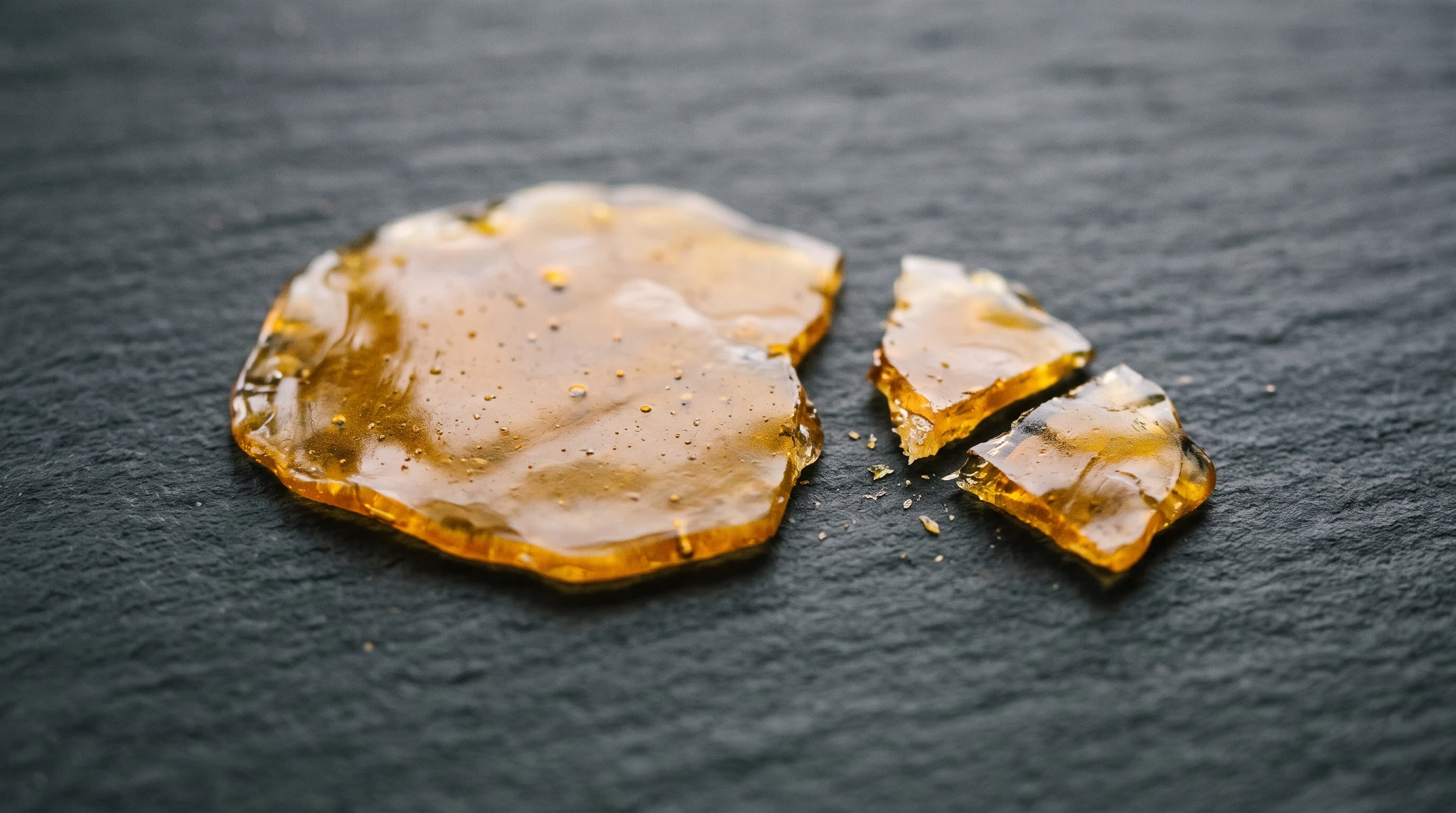
Shatter is a hard, glass-like cannabis concentrate made with butane that snaps into pieces instead of bending. It is a kind of butane hash oil (BHO). People vaporize it. The sources we opened say this type of extract is not meant to be eaten.
Here in High School, we sort concentrates by how they are made. Shatter is the “glass” end of that list. The sections below cover what it is, why it snaps, how strong it really is, and why making it at home is a fire risk. For a side-by-side with other concentrates, read the full hash, wax and shatter comparison.
What is shatter?
Shatter is a concentrate: a product that holds the sticky, active part of the plant without most of the plant material. A review of butane extracts says the two main types of BHO are wax and shatter. It adds that shatter products “vary from a thin, oily consistency to a brittle and glass-like structure,” often depending on temperature, humidity and production techniques (Al-Zouabi et al., 2018).
So “glass-like” describes the best case, not a promise. A slab that bends or sticks to the paper is still shatter. It just did not set hard.
How is shatter made?
Makers pass butane over cannabis buds and leaves. The butane pulls out the resin. They then purge the butane out of the extract, using vacuum at room temperature or in an oven. Small differences in processing give different textures, including shatter, budder, crumble, pull-and-snap and wax (Meehan-Atrash et al., 2017).
The same paper says the process does not heat the extract enough to turn THCA into active THC (the authors cite unpublished data for this). On that basis, the paper says BHO is not orally active and must be vaporized.
Why does shatter snap, and how is it different from wax?
Shatter and wax are both butane extracts. The review ties wax to agitation: it says wax usually lacks a full crystalline structure because of purposeful agitation or unwanted disruption during extraction. Shatter, by that logic, is the extract that kept its structure, though the review does not spell out the steps (Al-Zouabi et al., 2018).
One more specific: the same review says shatter is typically sorted by how translucent it is, but that clarity does not necessarily reflect its quality as users see it. Treat a clear slab as a look, not a lab result. For the texture ladder past shatter, see how wax, badder and crumble differ in texture.
How strong is shatter?
Popular glossary pages put shatter at about 70 to 90 percent THC or higher. We could not find a primary source for that figure. Here is what the sources we opened do say.
| Source | What it measured | THC figure | How to read it |
|---|---|---|---|
| Meehan-Atrash et al., 2017 | BHO in general, citing other work | 50 to 90 percent | A cited range, not a new measurement. |
| Chandra et al., 2019 | Mean delta-9 THC in hash oil (concentrate) samples, US seizures over a ten-year study | 6.7 to 55.7 percent | The yearly mean rose from 6.7 percent (2008) to 55.7 percent (2017). Covers all hash oil, not shatter alone. |
| Popular glossary pages | Shatter | About 70 to 90 percent and up | No primary source found. Unverified. |
The takeaway is that concentrates are far stronger than flower, and the exact number depends on the product. A lab report for the batch in your hand beats any range. For the solvent line on that report, see how to read residual solvents on a lab report.
Is it dangerous to make shatter at home?
Yes. Butane is flammable. The New Jersey Office of the State Fire Marshal warns that the fire and explosion hazard of butane hash oil extraction is great, that people usually do it indoors, and that vapors collect in unventilated spaces where pilot lights and gas stoves can ignite them (NJ Safety Alert 13-1, 2013). In 2022, the Massachusetts Department of Fire Services reported that a man in Pittsfield suffered serious burns while trying to extract hash oil from marijuana (Mass.gov, 2022).
The review above separates amateur open-blasting from closed-loop systems. It calls the closed-loop system the safer one (Al-Zouabi et al., 2018). We do not teach home extraction.
How do people use shatter?
People heat a small piece and inhale the vapor, as in dabbing. Dosing advice is outside this glossary page, so start with a beginner’s dabbing guide and use a very small piece. The heating itself matters too. A lab study found that heating terpenes under dabbing-like conditions formed products of concern, including methacrolein and benzene (Meehan-Atrash et al., 2017). That study tested terpenes under heat, not shatter alone. For how other concentrates compare, see rosin compared with distillate. Unfamiliar terms are in the 100-term cannabis glossary.
Key takeaways
- Shatter is a hard, glass-like butane concentrate, but texture varies by temperature, humidity and technique.
- Shatter and wax are both butane extracts. Agitation during processing is tied to wax, not shatter.
- Shatter is made for vaporizing. One review says BHO is not heated enough to convert THCA, so it is not orally active.
- The 70 to 90 percent THC figure has no primary source we could open. In one US dataset, the yearly mean THC of seized hash oil rose from 6.7 percent in 2008 to 55.7 percent in 2017.
- Making butane extracts at home has caused fires and burns. Buy tested product instead.
FAQ
Why is it called shatter?
People name it for how it breaks: a well-set slab is brittle and cracks like glass. The sources we opened describe that texture but do not say who coined the name.
Can you eat shatter?
Not as is. One paper says BHO is not heated enough during production to convert THCA to THC, so it is not orally active and must be vaporized (Meehan-Atrash et al., 2017).
Is shatter the same as wax?
No, but they share a start. Both are BHO. A review says wax usually lacks a full crystalline structure because of agitation or disruption during extraction. Shatter is the glass-like end of the range.
Is it dangerous to make shatter at home?
Yes. Butane vapor can pool indoors and ignite from a spark or pilot light. State fire officials in New Jersey and Massachusetts have warned about the hazard.
More terms in the cannabis glossary.
Sources
- Meehan-Atrash J, Luo W, Strongin RM. Toxicant formation in dabbing: the terpene story. ACS Omega, 2017;2(9):6112-6117. DOI: 10.1021/acsomega.7b01130
- Al-Zouabi I, Stogner JM, Miller BL, Lane ES. Butane hash oil and dabbing: insights into use, amateur production techniques, and potential harm mitigation. Substance Abuse and Rehabilitation, 2018;9:91-101. DOI: 10.2147/SAR.S135252
- Chandra S, Radwan MM, Majumdar CG, Church JC, Freeman TP, ElSohly MA. New trends in cannabis potency in USA and Europe during the last decade (2008-2017). European Archives of Psychiatry and Clinical Neuroscience, 2019;269(1):5-15. DOI: 10.1007/s00406-019-00983-5
- New Jersey Office of the State Fire Marshal. Safety Alert 13-1: Butane hash oil extraction hazards. January 2013.
- Massachusetts Department of Fire Services. Man badly injured during illicit cannabis extraction process. 2 March 2022.



