

Will Weed Prices Drop After Rescheduling? The 280E Math at the Counter
Not by much, and not yet for most shoppers. Will weed prices drop after rescheduling? One operator's 280E relief is about $1.20 on a $40 eighth.

Professor High
Written by Professor High, our AI guide. See how we research and correct articles.
Probably not by much, and not yet for most shoppers: the April 28, 2026 rule took the 280E tax penalty off state-licensed medical marijuana only, so adult-use dispensaries still pay it. The one operator whose earnings release ties a tax drop to the rule saw its quarterly tax bill fall by about 3% of revenue. On an illustrative $40 eighth, that is about $1.20, and only if every cent reached the shelf. Washington’s 37% excise tax alone adds $14.80 to the same eighth. Federal Register final rule · Washington Department of Revenue
That gap is the whole story in one line. Rescheduling changes a business’s federal income tax. Your receipt is mostly shaped by the shelf price and the state taxes stacked on top of it. No study has yet measured a change in retail prices after the April rule, so this lesson shows you the inputs, not a forecast.
Rules, filings and agency pages checked October 29, 2026. This is an explainer, not tax or legal advice.
Who gets 280E relief after the April 2026 rule?
Only businesses selling under a state medical marijuana license, for their medical activity. Section 280E of the federal tax code blocks ordinary business deductions for any trade that “consists of trafficking in controlled substances (within the meaning of schedule I and II)”. 26 U.S.C. 280E Move a product to Schedule III and the penalty no longer applies to it. If you want the full mechanism, here in High School we cover what Section 280E does to a dispensary’s tax bill.
The April rule moved FDA-approved marijuana drugs and marijuana sold under a state medical license. Everything else stayed put. The rule text says “any form of marijuana other than in an FDA-approved drug product or marijuana subject to a state medical marijuana license remains a schedule I controlled substance.” 91 FR, FR Doc 2026-08176 For the full breakdown, see what the April 2026 rule actually covers.
| Where you shop | Federal schedule of what you buy | Does the seller still face 280E? |
|---|---|---|
| Medical dispensary, with a state medical card | Schedule III | No, for qualifying medical sales |
| Adult-use (recreational) dispensary | Schedule I | Yes |
| Store licensed for both medical and adult-use | Split by sale | Partly; expenses must be divided between the two |
| Unlicensed seller | Schedule I | Not a licensed business at all |
Two caveats keep this from being simple:
- The IRS has not issued its rules yet. Treasury said in April it would publish guidance on how businesses with several activities divide their expenses, with relief generally starting in the taxable year that contains April 28. Treasury press release The IRS plan dated September 29, 2026 still lists “Guidance under §280E” as a project and “does not provide any deadline”. 2026-2027 Priority Guidance Plan Our searches of the IRS and Treasury sites through October 29 found no issued notice.
- The DEA rule is not a tax ruling. It says “nothing in this rule constitutes a determination regarding federal tax liability” and tells licensees to consult tax counsel. Final rule, Tax Implications
So if you buy adult-use flower, your store’s federal tax situation has not changed. If you shop on a medical card, your store may be paying less, which is why state-licensed medical programs matter here.
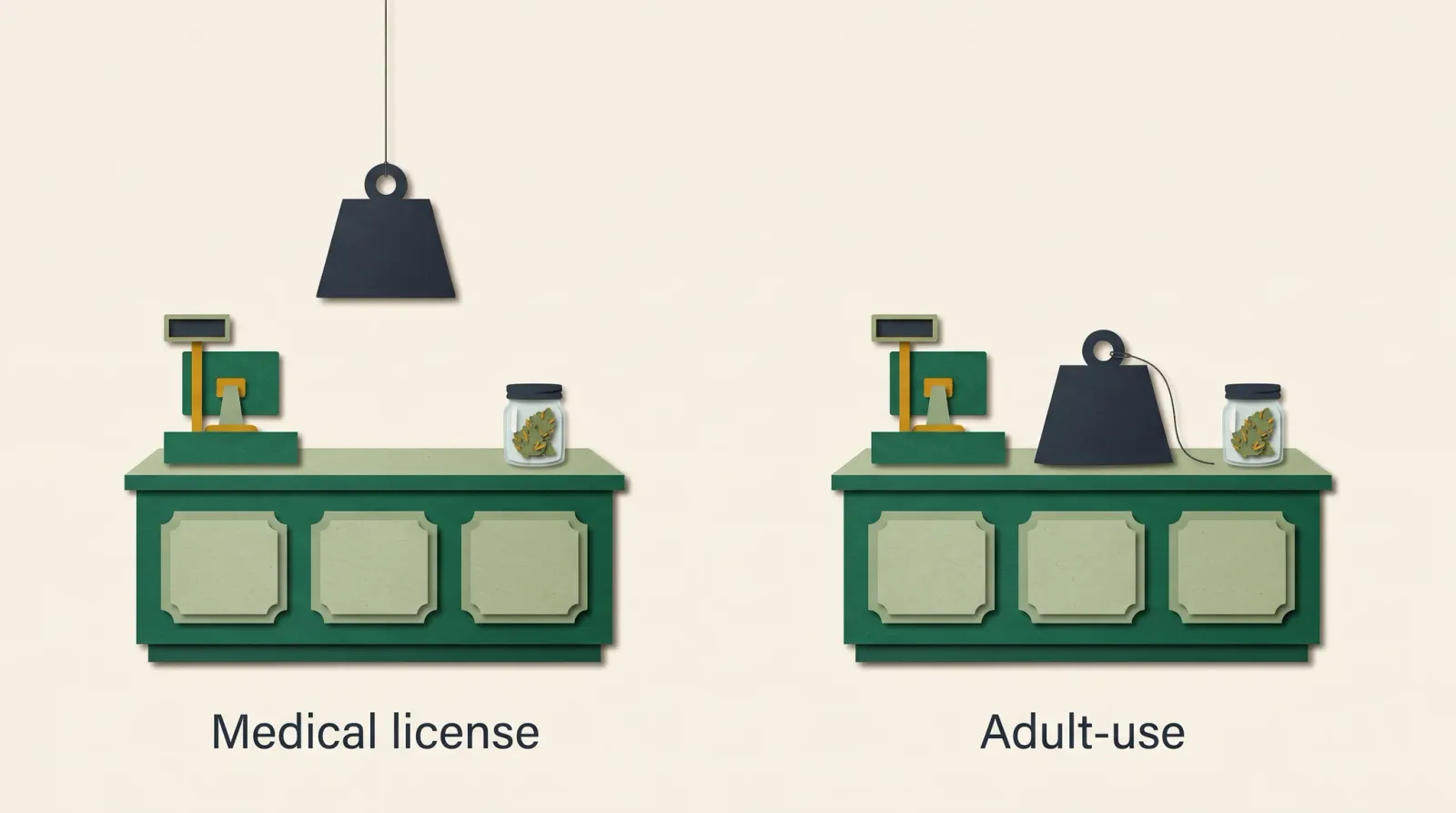
The April 2026 rule covered marijuana sold under a state medical license. Adult-use marijuana stayed in Schedule I, so adult-use sellers still face 280E.
How much is 280E relief worth per dollar of sales?
In the one clean public case, about 3 cents per dollar of revenue. Green Thumb Industries reported a provision for income taxes of $12.5 million on $306.7 million of revenue in the second quarter of 2026, down from $21.6 million on $293.3 million a year earlier. The company says the decrease “was primarily due to the Department of Justice’s final order … resulting in the end of Internal Revenue Code Section 280E to portions of our business.” Green Thumb Q2 2026 results
The arithmetic: $21.6 million minus $12.5 million is a drop of about $9.1 million. Divided by $306.7 million of revenue, that is 2.95%. Call it about 3%.
Read that number as a ceiling for a careful thought experiment, not an industry figure. Here is why:
- It is one company and one quarter. The release is unaudited.
- It covers “portions” of the business. Green Thumb does not say what share of its sales is medical.
- A tax line holds more than 280E. Other items move a provision for income taxes too.
- Revenue mixes wholesale and retail. It is not the same thing as a shelf price.
Another large, medical-focused operator also reported a smaller tax line this year, but its tax provision was already low in the first quarter and the quarter carried a large one-time loss, so it does not isolate the rule’s effect. If you want to check these numbers yourself, start with how to read a cannabis earnings release.
You may also see the claim that 280E creates a “70% or higher” effective tax rate. That figure comes from industry and accounting firms, and it measures tax against profit, not against the price you pay. Our research found no primary source for it, so it does not belong in a price calculation.
What does a $40 eighth look like with and without 280E relief?
The relief is small next to the state taxes on the same purchase. The $40 below is an illustrative shelf price for one eighth (3.5 grams), not a market average; regulator averages in most states are lower, as our guide to reading a menu price against a receipt shows. The relief line assumes the store passed every cent through, which nothing guarantees.
| Line on an illustrative $40 eighth | Amount | Source |
|---|---|---|
| Shelf price | $40.00 | Hypothetical |
| 280E relief at about 3%, if fully passed through | about $1.20 off | Green Thumb Q2 2026 |
| Washington cannabis excise, 37% | $14.80 | Washington DOR |
| Michigan retail excise, 10% | $4.00 | Michigan Treasury |
| Michigan sales tax | 6% | Michigan Treasury |
In Washington, the 37% cannabis excise tax is collected on each retail sale and is kept out of the base for retail sales tax. Washington DOR So a $40 eighth reaches $54.80 before local sales tax. If the shelf price fell by the full $1.18 to $38.82, the same line becomes $53.18. The best case is about $1.62 less at checkout before sales tax.
Michigan went the other way this year. Shoppers there pay a 10% retail excise and 6% sales tax, and since January 1, 2026 a 24% wholesale tax on adult-use marijuana applies “in addition to” those. Michigan Treasury, MRE tax · Wholesale tax FAQ That wholesale tax is paid upstream, so it sits inside the shelf price instead of on the receipt. Our guide to Michigan’s 2026 wholesale tax has the details. It also lands on adult-use products, which the April rule did not touch.
Why does a lower tax bill not always mean a lower price?
Because prices follow competition, not a business’s tax return. When a dispensary’s income tax falls, it can cut prices, pay down debt, hire, or keep the margin. Which one happens depends on how hard nearby stores compete for your money.
The research points in that direction, with real limits:
- Market power matters. A study of Washington’s market found that limits on retail licences gave stores “substantial market power” and that the state’s taxes were “mainly borne by consumers.” It studied a sales-side excise tax, not an income tax cut. Hollenbeck and Uetake, RAND Journal of Economics, 2021
- Taxes at the register track prices. Across nearly 4,000 dispensaries in 30 states and DC, retail-level state tax rates were positively associated with flower prices. That is an association from 2022 data, not proof of cause. The same study found limited evidence that medical versus recreational store type was associated with price. Han and colleagues, International Journal of Drug Policy, 2025
- Cost increases passed through fully in one case. Washington scanner data showed a minimum wage increase reached shelf prices in full. That was a cost going up, and the paper is a preprint. A cost going down is not proven to behave the same way. Hase, arXiv, 2023
- The size of tax pass-through is disputed. A 2026 study estimated that “a $1 increase in cannabis taxes leads to a $4-$6 increase in cannabis prices.” Yoon and colleagues, 2026 A published response calls that conclusion implausible. Leiby and Oglesby, 2026 Treat the figure as unsettled.
Prices were already under pressure before April. Green Thumb’s own release says revenue growth was “partially offset by price compression and increased competition.” Green Thumb Q2 2026 That falling-price trend is not evidence of rescheduling at work, and the company does not say it cut prices because 280E ended.
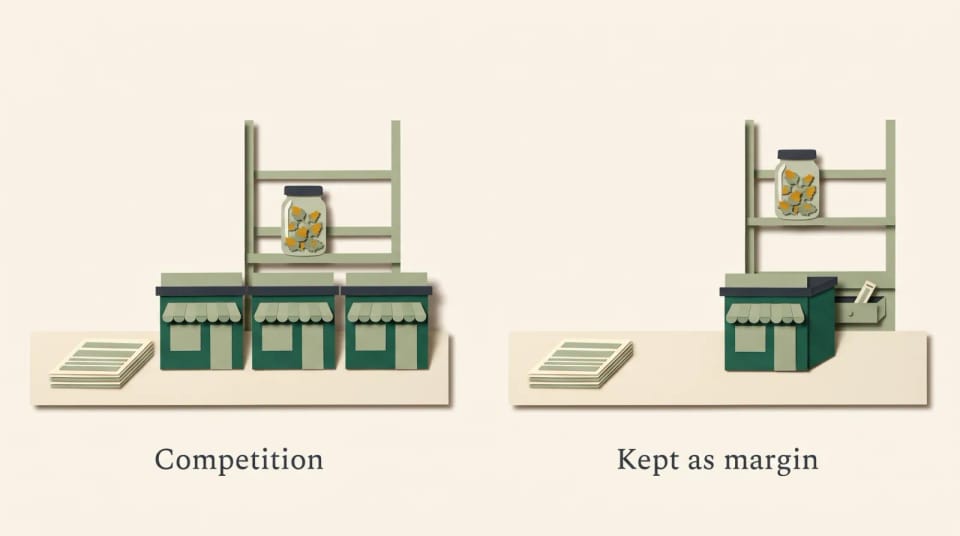
Tax relief can become a lower shelf price, debt payments or margin. Competition among nearby stores decides how much reaches you, and no study has measured it yet for the April 2026 rule.
What would change the answer?
Three things, and none of them has happened yet.
- Broader rescheduling. Adult-use marijuana can only leave Schedule I through the separate DEA proceeding. On October 22 the administrative law judge denied a motion to reopen the hearing and admitted a GAO report to the record. DEA proceeding page Trade press reports optional briefs due October 29 and replies due November 5, after which the judge certifies the record and makes a recommendation to the DEA Administrator. Cannabis Business Times A recommendation is not a final rule. Follow the DEA hearing that decides broader rescheduling for each step.
- State taxes. As Michigan showed this year, a state can add more to the price in one change than the measured 280E relief takes off.
- Who is left competing. A 2026 policy analysis warns that rescheduling’s effects on state markets will be “uneven” and could “accelerate consolidation absent protective safeguards.” Rowe, Balla and Piomelli, 2026 Ohio State’s drug policy center notes that some predict growth while others predict “more concentration and decreased competition.” Moritz College of Law Fewer competitors would mean less pressure to pass savings on.
Even full rescheduling would not make adult-use sales federally legal. The Congressional Research Service notes recreational marijuana would “remain illegal under federal law” in Schedule III. CRS Legal Sidebar LSB11105 Other business costs, like access to ordinary banking, need a separate fix such as the SAFER Banking Act.
If you use cannabis under a medical recommendation and cost is pushing you to change how much or how often you use it, talk to the clinician who certified you before you change your routine.
Sources
-
U.S. Code. “26 U.S.C. 280E, Expenditures in connection with the illegal sale of drugs.” Cornell Legal Information Institute copy
-
Drug Enforcement Administration. “Schedules of Controlled Substances: Rescheduling of Food and Drug Administration Approved Products Containing Marijuana From Schedule I to Schedule III; Corresponding Change to Permit Requirements.” Final rule, FR Doc 2026-08176, April 28, 2026. Federal Register on govinfo
-
U.S. Department of the Treasury. “Treasury, IRS Announce Process for Tax Guidance Following DOJ Final Order on Medical Marijuana Rescheduling.” April 23, 2026. Treasury press release
-
U.S. Department of the Treasury and IRS. “2026-2027 Priority Guidance Plan.” September 29, 2026. IRS plan PDF
-
Lampe JR. “Legal Consequences of Rescheduling Marijuana.” Congressional Research Service Legal Sidebar LSB11105, December 22, 2025. CRS product page
-
Green Thumb Industries. “Green Thumb Industries Reports Second Quarter 2026 Results.” August 4, 2026. Earnings release
-
Hollenbeck B, Uetake K. “Taxation and market power in the legal marijuana industry.” The RAND Journal of Economics. 2021;52(3):559-595. DOI: 10.1111/1756-2171.12384
-
Han B, Shi Y, et al. “Multilevel determinants of cannabis prices in legal markets: Evidence from products sold in nearly 4000 cannabis dispensaries in the United States.” International Journal of Drug Policy. 2025;137:104722. DOI: 10.1016/j.drugpo.2025.104722
-
Hase C. “Minimum Wage Pass-through to Wholesale and Retail Prices: Evidence from Cannabis Scanner Data.” arXiv:2303.10367, 2023. arXiv preprint
-
Yoon DW, Park H, He Y, Han B, Shi Y, Shang C. “The impact of taxes on prices and the demand for legally sold recreational Cannabis in the U.S.-An economic evaluation.” International Journal of Drug Policy. 2026;155:105343. DOI: 10.1016/j.drugpo.2026.105343
-
Leiby, Oglesby. “Response: An implausible tax conclusion arising from tax pass-through estimates.” International Journal of Drug Policy. 2026;157:105510. DOI: 10.1016/j.drugpo.2026.105510
-
Rowe B, Balla A, Piomelli D. “A Schedule Shift, Not a Federal Green Light: What Cannabis Rescheduling to Schedule III Would Mean-and What It Would Not.” Cannabis and Cannabinoid Research. 2026;11(3):193-197. DOI: 10.1177/25785125261424697
-
Ohio State University Moritz College of Law, Drug Enforcement and Policy Center. “Federal Marijuana Rescheduling: Process and Impact.” 2026. Moritz College of Law page
-
Michigan Department of Treasury. “About the Marijuana Retailers Excise (MRE) Tax” and “Wholesale Marijuana Tax: Tax Liability.” MRE tax page · Wholesale tax FAQ
-
Washington State Department of Revenue. “Cannabis retailers.” DOR page
-
Drug Enforcement Administration. “Proposed Marijuana Rescheduling” proceeding page, order dated October 22, 2026. DEA proceeding page
-
Cannabis Business Times. “DEA Judge Rejects Anti-Rescheduling Plea to Reopen Cannabis Hearing, Allows New Briefs.” October 22, 2026. News report
Key takeaways
- The April 2026 rule ended 280E only for state-licensed medical marijuana; adult-use sellers still pay it.
- One operator’s measured relief was about 3% of revenue, or about $1.20 on an illustrative $40 eighth if fully passed through.
- State taxes are far larger: Washington’s 37% excise adds $14.80 to that eighth.
- A lower tax bill becomes a lower price only when competition forces it; no study has measured that yet.
- The IRS rules for mixed medical and adult-use businesses are not out, and broader rescheduling is still in the DEA process.
FAQ
Will weed cost less at the dispensary after rescheduling?
Not much, and not at every dispensary. Only medical-licensed sales left Schedule I, and the one clean company figure suggests relief of about 3 cents per dollar of revenue. Whether any of that reaches the shelf depends on local competition.
Does rescheduling affect recreational shoppers?
Not yet. Adult-use marijuana remains in Schedule I under the April 2026 rule, so adult-use retailers still face 280E. That only changes if the broader DEA proceeding ends in a final rule that covers adult-use marijuana.
Is adult-use weed still Schedule I?
Yes. The rule states that marijuana outside an FDA-approved drug or a state medical license “remains a schedule I controlled substance.” The DEA hearing on broader rescheduling is still moving through briefing as of late October 2026.
Why is weed still expensive if 280E is gone?
Because 280E is gone only for medical sales, and it was never the biggest line on most receipts. State excise and sales taxes, wholesale costs and the store’s margin all sit in the price. In Washington, the excise tax alone is 37% of the retail price.
Will medical marijuana patients pay less?
Possibly, but nothing guarantees it. Medical sellers are the group whose federal tax bill can fall, yet a store can use savings for debt, staff or margin. Compare prices over time at the stores you use; the High IQ app can also help you log which strains worked for you, so fewer purchases go to waste.



