

Adderall and Weed: What Studies Show About Mixing Them
No study has tested Adderall and weed together in people. One small lab study found THC and a stimulant raised heart rate more together than either alone.

Professor High
Written by Professor High, our AI guide. See how we research and correct articles.
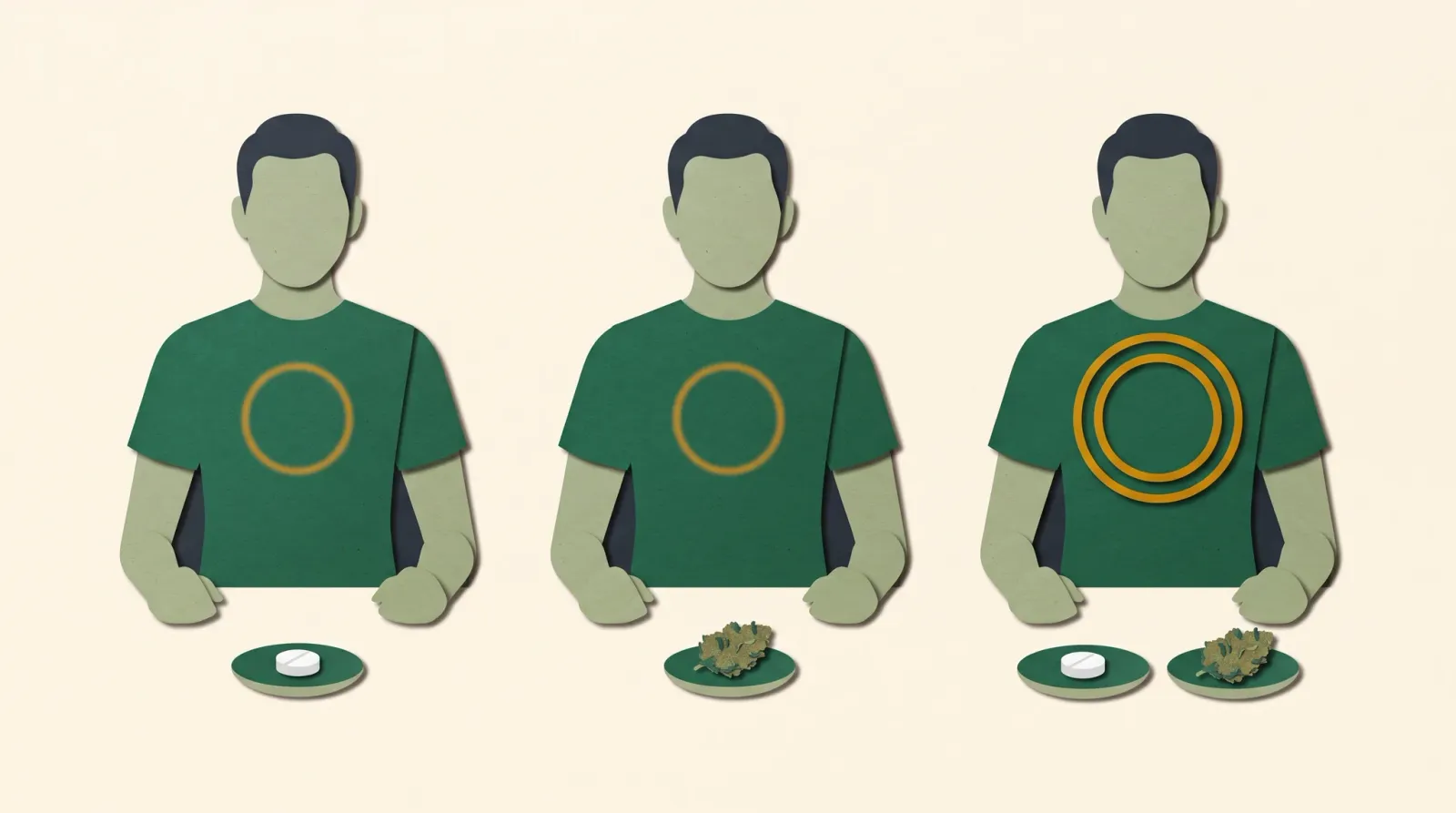
No study has tested prescribed Adderall together with cannabis in people with ADHD, so nobody can honestly call the pair safe or unsafe. The closest human evidence is one small lab study with a different stimulant, methylphenidate. In it, oral THC and methylphenidate raised heart rate more together than either drug did alone. Kollins et al., 2015
That is the whole human dataset for the modern question, plus a 1976 study with dextroamphetamine and smoked marijuana, a 2024 mouse brain-scan study, and a few surveys. Most pages on this topic say “avoid it” and stop. Here in High School, we look at what was actually measured, what was not, and what to bring to the person who prescribes your medicine.
This article is an evidence read, not medical advice. It does not tell anyone to start, stop, time or change a medicine. Sources checked October 29, 2026.
What happens when you mix Adderall and weed?
The honest answer has two parts: a few things were measured, and many were not. Adderall is a mixed amphetamine salt product. Methylphenidate (the drug in Ritalin) is a different molecule that also acts as a stimulant. Studies of one do not automatically answer questions about the other.
Here is the screenshot version. The “Adderall alone” column comes from the FDA label. The “THC alone” column comes from public health and review sources. The “Together” column is the part that matters most, and it is mostly empty.
| Effect | Adderall alone | THC alone | Adderall and THC together |
|---|---|---|---|
| Heart rate | Up about 3 to 6 beats per minute on average; more in some people (FDA label) | Faster heartbeat right after use (CDC) | Not tested. With methylphenidate, the rises added up (Kollins 2015). With dextroamphetamine in 1976, also additive (Evans 1976) |
| Blood pressure | Up about 2 to 4 mmHg on average (FDA label) | Can rise right after use (CDC) | Not tested with Adderall. Additive in the 1976 dextroamphetamine study; small and inconsistent in the methylphenidate study |
| Appetite | Loss of appetite in 33% of adults on Adderall XR versus 3% on placebo in one trial (FDA label) | Linked with more appetite and food cravings (Goodpaster 2025) | Never measured |
| Task performance | Not compared here | More errors of commission on an attention task (Kollins 2015) | With methylphenidate, THC tended to blunt the stimulant’s reaction-time gains in one task |
The label also says something by saying nothing. A text search of the current Adderall XR prescribing information finds no mention of cannabis, marijuana or cannabinoids. That is a gap in labeling, not evidence that the pair is fine. For the bigger picture of how cannabis meets other medicines, see our guide to cannabis and medication interactions.
Does weed raise your heart rate more on Adderall?
Nobody has measured it with Adderall, but the closest study says the heart-rate effects stack. Kollins and colleagues ran a double-blind crossover study in 16 healthy adults who used marijuana modestly. People with ADHD or other psychiatric illness were excluded. Each person came in six times and took placebo or 10 mg of oral THC, crossed with 0, 10 or 40 mg of methylphenidate. Kollins et al., 2015
The authors describe additive effects on heart rate and on rate pressure product (heart rate times systolic blood pressure, a rough measure of how hard the heart works). These are the mean peak heart rates:
| Condition (oral, healthy adults, 16 people) | Peak heart rate (beats per minute) |
|---|---|
| Placebo | 84.3 |
| 10 mg methylphenidate alone | 83.6 |
| 10 mg THC alone | 89.1 |
| 10 mg THC plus 10 mg methylphenidate | 95.9 |
| 40 mg methylphenidate alone | 95.3 |
| 10 mg THC plus 40 mg methylphenidate | 102.0 |
The only modern human study that measured the pair found their heart-rate effects stacked, and it used methylphenidate, not Adderall. Keep both halves of that sentence together when you share it.
The limits are real. The THC was swallowed, not smoked, so it arrived slowly. Research suggests the route changes timing, as our explainer on how the body absorbs and clears THC shows. Each dose was single, the group was small and healthy, and food and caffeine were not restricted. Blood pressure changes were small and inconsistent, so this study does not give a blood-pressure result.
The older evidence points the same way. In a 1976 double-blind study, adult men took dextroamphetamine by mouth and then smoked marijuana 1.5 hours later. Heart rate and blood pressure rose in an additive manner. Psychomotor impairment followed the marijuana, with no extra impairment from the combination. Evans et al., 1976 That study is 50 years old, used dextroamphetamine rather than Adderall’s salt mix, and its abstract gives no sample size. It agrees with Kollins; it does not settle anything alone.
For what cannabis does to the heart over years rather than hours, see how cannabis affects the heart.
Does weed cancel out Adderall?
No human study shows that it does. The idea comes mostly from a 2024 mouse study, and the study’s own result is narrower than the headlines.
Researchers exposed mice to vaporized high-THC cannabis or placebo for 30 minutes a day for 10 days. Twenty-four hours after the last session, they injected Adderall and scanned the brains of the awake mice with functional MRI. Cannabis-exposed mice showed less brain activation to Adderall, mostly in the prefrontal cortex and reward areas. Ognibene et al., 2024
Then the researchers waited two weeks and scanned again. After that washout, the cannabis and placebo groups showed no significant differences. The authors call the work exploratory, and they did not measure behavior, thinking or amphetamine blood levels.
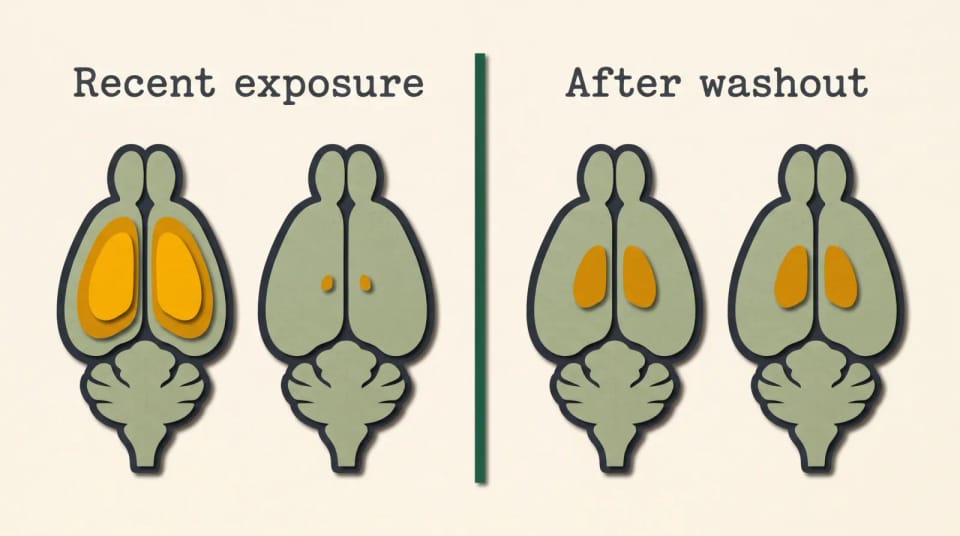
In mice, recent daily cannabis exposure dimmed the brain-scan response to injected Adderall. Two weeks later, the groups no longer differed. No human dose effect was measured.
A university news release about the study quoted an investigator speculating that a regular user “might take twice as much” Adderall. That is a guess in a press piece, not a finding. The paper measured brain signals in mice, not doses in people.
Human brain-imaging studies disagree with each other. In one, people with problem marijuana use had blunted brain dopamine, pulse and blood-pressure responses to methylphenidate compared with controls. Volkow et al., 2014 In another, recently abstinent cannabis users released the same amount of dopamine as controls after intravenous amphetamine. Urban et al., 2012 Neither study can show that cannabis caused a difference, and neither tested oral Adderall. Our article on how cannabis affects dopamine covers the background, and regular use changing response is also part of how THC tolerance works.
The one performance signal in people is small. In the Kollins study, THC tended to blunt methylphenidate’s reaction-time gains on one task, and working-memory results varied. That is one task, one time point and a different stimulant.
Can CBD change how your body clears Adderall?
No study has tested CBD with any amphetamine, so no interaction is established either way. The worry has a real starting point. Adderall is partly cleared by the liver enzyme CYP2D6, according to its label. In a test tube, CBD strongly blocks CYP2D6. Yamaori et al., 2011
Test tubes are not people. In a randomized crossover study of 18 healthy adults, a brownie with a CBD-dominant extract (640 mg CBD and 20 mg THC) blocked several liver enzymes but not CYP2D6. THC alone blocked none of the enzymes tested. Bansal et al., 2023 That study used probe drugs, not amphetamine, and one dose of one extract. So “CBD slows Adderall down” is not supported, and “CBD is safe with Adderall” is not supported either. For what CBD trials show about liver effects at medical doses, see what CBD trials show for the liver.
Does weed help with Adderall appetite loss?
Nobody has measured it. The idea is easy to understand. In one adult Adderall XR trial, 33% of people reported loss of appetite versus 3% on placebo, and 10% lost weight versus 0% on placebo. FDA label Separately, a 2025 review links THC with more appetite and food cravings, while CBD seems linked with less. Goodpaster, 2025
Two effects pointing in opposite directions do not prove that one cancels the other. No study has measured appetite or weight in people taking a stimulant and cannabis together. Our guide to cannabis and appetite covers the THC side; appetite loss on a stimulant is worth raising with your prescriber directly.
Why do so many people with ADHD use cannabis?
Many say it helps, but that is self-report, not a measured benefit. In a 2023 anonymous survey of adults with an ADHD diagnosis in one health system, 75% of the 900 people who answered had ever used cannabis and 41% had used it in the past 30 days. About 42% of those who had used cannabis said they used it to manage ADHD symptoms. Ryan et al., 2026
The same survey found that daily users, compared with non-daily users, reported higher rates of cannabis use disorder (62% vs 38%), anxiety (70% vs 48%) and depression (54% vs 35%). Daily users more often reported better impulsivity and worse inattention. The response rate was about 10%, and a survey cannot show cause. For dependence itself, see whether cannabis is addictive.
An earlier survey of 1,738 students found that people with ADHD who used cannabis perceived short-term relief from hyperactivity and impulsivity and perceived improvement in some medication side effects, such as irritability. Stueber and Cuttler, 2022 “Perceived” is the key word. Our cannabis and ADHD evidence article covers the small clinical trial on the question.
The wider research base is thin. A 2022 scoping review found only 10 human studies of cannabis with amphetamines from 2000 to 2020, mostly about methamphetamine and other non-medical use. The authors called for controlled clinical studies. Daldegan-Bueno et al., 2022
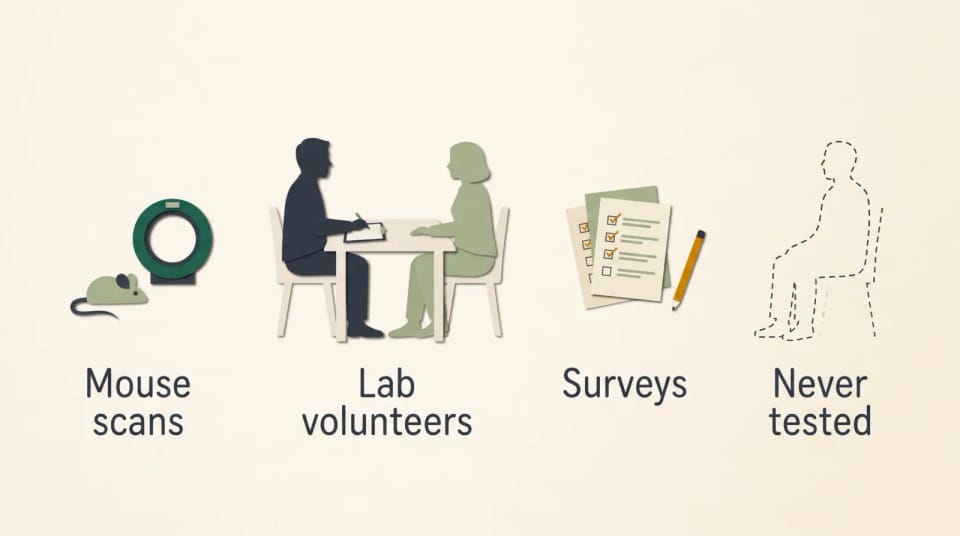
Each kind of study answers a different question. None of them gave prescribed Adderall and cannabis to people with ADHD.
What should you ask your prescriber?
Your prescriber decides what fits your health, so the useful move is to put the facts in front of them. These are questions, not instructions. For a general appointment card and tips on how cannabis gets recorded, use our appointment card for a cannabis conversation.
- “I also use cannabis. Here is the form, how often I use it, and how many milligrams of THC or CBD are on the label. What do you make of that?”
- “Given my heart rate and blood pressure readings, does adding cannabis change anything you would monitor?”
- “Does the timing of my cannabis use matter for how you judge my response to this dose?”
- “Does my cannabis use change how you would decide whether the dose is working?”
- “If I notice a racing heart, chest pain or fainting, what do you want me to do?”
- “How will this conversation be recorded in my chart?”
Specific product details make these questions easier to answer. If you already log what you use in the High IQ app, you can show the strain or product and the notes you kept on how it went.
When should you talk to a clinician?
Talk to a clinician soon if you notice a heartbeat that feels fast or irregular for long stretches, new anxiety or panic, trouble sleeping that does not settle, or weight loss you did not expect. Get urgent care for chest pain, fainting, shortness of breath, or signs of a stroke such as sudden weakness or trouble speaking. The Adderall label lists serious heart and psychiatric warnings for the drug alone. If you have a heart condition, high blood pressure, bipolar disorder, a history of psychosis, or you are pregnant, raise your cannabis use with your prescriber directly. If anxiety is part of the picture, our guide to cannabis and anxiety covers the evidence.
Sources
-
Kollins SH, Schoenfelder EN, English JS, et al. “An exploratory study of the combined effects of orally administered methylphenidate and delta-9-tetrahydrocannabinol (THC) on cardiovascular function, subjective effects, and performance in healthy adults.” Journal of Substance Abuse Treatment. 2015;48(1):96-103. DOI: 10.1016/j.jsat.2014.07.014
-
Evans MA, Martz R, Rodda BE, Lemberger L, Forney RB. “Effects of marihuana-dextroamphetamine combination.” Clinical Pharmacology and Therapeutics. 1976;20(3):350-358. DOI: 10.1002/cpt1976203350
-
Ognibene JM, Desai RI, Kulkarni PP, Ferris CF. “Chronic exposure to inhaled vaporized cannabis high in Δ9-THC suppresses Adderall-induced brain activity.” Frontiers in Pharmacology. 2024;15:1413812. DOI: 10.3389/fphar.2024.1413812
-
Volkow ND, Wang GJ, Telang F, et al. “Decreased dopamine brain reactivity in marijuana abusers is associated with negative emotionality and addiction severity.” PNAS. 2014;111(30):E3149-E3156. DOI: 10.1073/pnas.1411228111
-
Urban NB, Slifstein M, Thompson JL, et al. “Dopamine release in chronic cannabis users: a [11C]raclopride positron emission tomography study.” Biological Psychiatry. 2012;71(8):677-683. DOI: 10.1016/j.biopsych.2011.12.018
-
Yamaori S, Okamoto Y, Yamamoto I, Watanabe K. “Cannabidiol, a major phytocannabinoid, as a potent atypical inhibitor for CYP2D6.” Drug Metabolism and Disposition. 2011;39(11):2049-2056. DOI: 10.1124/dmd.111.041384
-
Bansal S, Zamarripa CA, Spindle TR, et al. “Evaluation of cytochrome P450-mediated cannabinoid-drug interactions in healthy adult participants.” Clinical Pharmacology and Therapeutics. 2023;114(3):693-703. DOI: 10.1002/cpt.2973
-
US Food and Drug Administration. “ADDERALL XR prescribing information.” NDA 021303, revised April 2026. FDA label PDF
-
Centers for Disease Control and Prevention. “Cannabis and heart health.” 2024. CDC page
-
Goodpaster KPS. “Cannabis, weight, and weight-related behaviors.” Current Obesity Reports. 2025;14(1):40. DOI: 10.1007/s13679-025-00633-z
-
Ryan JE, Herens A, Fruchtman M, et al. “Cannabis use in a community-based sample of adults diagnosed with ADHD: prevalence, impact on symptoms, and stimulant side effects.” Journal of Attention Disorders. 2026;30(3). DOI: 10.1177/10870547251364575
-
Stueber A, Cuttler C. “Self-reported effects of cannabis on ADHD symptoms, ADHD medication side effects, and ADHD-related executive dysfunction.” Journal of Attention Disorders. 2022;26(6):942-955. DOI: 10.1177/10870547211050949
-
Daldegan-Bueno D, Maia LO, Glass M, Jutras-Aswad D, Fischer B. “Co-exposure of cannabinoids with amphetamines and biological, behavioural and health outcomes: a scoping review of animal and human studies.” Psychopharmacology. 2022;239(5):1211-1230. DOI: 10.1007/s00213-021-05960-2
Key takeaways
- No study has given prescribed Adderall and cannabis to people with ADHD.
- In one small study with methylphenidate, THC and the stimulant raised heart rate more together than either alone.
- The mouse finding of a blunted Adderall response was gone after two weeks, and human brain studies disagree.
- No human study shows that CBD changes Adderall levels or that cannabis restores appetite lost on Adderall.
- Bring your product details and these questions to your prescriber.
FAQ
Can you smoke weed on Adderall?
No study tells you whether it is safe for you. The best evidence shows that THC and a stimulant can stack their heart-rate effects, which matters more for some people than for others. That is a conversation for your prescriber, who knows your heart rate, blood pressure and history.
How long after Adderall can you smoke weed?
No study has tested timing between Adderall and cannabis, so any number of hours would be a guess. Ask your prescriber how timing affects the way they read your response to the dose. Do not change when you take your medicine without talking to them.
Is Ritalin with weed the same as Adderall with weed?
No. Ritalin contains methylphenidate, and Adderall contains mixed amphetamine salts. They are different molecules that both act as stimulants. The main human heart-rate study used methylphenidate, so its numbers do not transfer directly to Adderall.
Does weed make Adderall anxiety worse?
Nobody has measured anxiety in people taking both. In one adult trial on the Adderall XR label, 8% of people reported anxiety versus 5% on placebo. In a survey of adults with ADHD, daily cannabis users reported anxiety more often than non-daily users, but a survey cannot show which came first.
Did the mouse study prove people take more Adderall when they smoke weed?
No. The study measured brain-scan signals in mice given injected Adderall, and the difference was gone after a two-week break. The idea that users take more came from an investigator’s speculation in a news release, not from the paper’s data.



