

Best Terpenes for ADHD? What the Evidence Does and Does Not Show
Looking for the best terpenes for ADHD? No trial has tested a single terpene in people with ADHD. Here is each terpene's attention evidence, graded.

Professor High
Written by Professor High, our AI guide. See how we research and correct articles.

No terpene has been shown to help ADHD. Searches of PubMed and ClinicalTrials.gov run on October 29, 2026 found no published trial of a single, isolated cannabis terpene in people with ADHD. The closest evidence is one small questionnaire study of medical cannabis patients, a handful of small attention experiments in healthy adults, and rodent work that points in both directions.
That is not what most “best terpenes for ADHD” lists say. They pair limonene with focus, pinene with alertness and linalool with calm, and they rarely say what kind of study sits behind each line. So here in High School we did the unglamorous part: we graded every popular claim on one scale and wrote the grade next to it.
Here is the specific to send the friend who swears by citrus strains for focus: limonene, the “focus” terpene, lowered an attention brain signal in the one human study that isolated it. The 19 students in that experiment showed a smaller P300 response under limonene, and the authors read it as less selective attention, not more. Tamura et al., Brain and Behavior, 2025
If you came here for strain picks, our ADHD strain guide explains how strain names are classified. This article stays with the terpenes and the evidence behind them.
How do you grade the evidence for a terpene?
We used a six-step scale built for this article. The grade describes the best study we found for that terpene and an attention or alertness outcome. It does not describe how popular the claim is.
| Grade | What the best evidence is |
|---|---|
| 0 | No relevant study found |
| 1 | Cell or enzyme work only |
| 2 | Animal behaviour |
| 3 | Healthy adults, short-term, attention or alertness outcome |
| 4 | People with ADHD, survey or observational study |
| 5 | People with ADHD, randomized controlled trial of that compound |
A grade 5 is the only rung that could answer “does this terpene help ADHD?” Everything below it can only suggest where to look.
Which terpenes have evidence for attention or ADHD?
None reaches grade 5, and only one terpene shows up at grade 4, for a reason that has nothing to do with ADHD scores.
| Terpene | Best attention evidence found | What it showed | ADHD grade |
|---|---|---|---|
| Limonene | Grade 3 (19 healthy students, EEG) | Lower P300 signal, read as reduced selective attention | 0 |
| Alpha-pinene | Grade 2 (rats) and a grade 3 null (healthy adults) | Alone, tended to worsen rat accuracy at the top dose; no effect alone in people | 0 |
| Linalool | Not tested alone; lavender oil studies only | Lavender lowered some scores in one study and held attention in another | 0 |
| Beta-myrcene | Grade 3 (10 healthy adults) | Worse speed control and more divided-attention errors | 0 |
| Beta-caryophyllene | Grade 2 (mice) | Higher doses impaired attentional control | 0 |
| 1,8-cineole (eucalyptol) | Grade 3, mixed | A correlation in one aroma study, nulls in two others | 0 |
| Terpinolene | Nothing found in our searches | No attention study turned up | 0 |
| Trans-β-farnesene | Grade 4, indirectly | Higher in heavier-using patients; not linked to ADHD scores | 4 at best |
The table is a search record, not proof of absence. We did not search Embase, Scopus, Web of Science, non-English journals or conference abstracts. A rigorous trial published tomorrow would change a grade, and we would update this page.
What did the one ADHD terpene study actually measure?
It measured how much cannabis people used, not whether a terpene improved their ADHD. In 2020, researchers in Israel surveyed adult medical cannabis patients who also reported an ADHD diagnosis. Fifty-nine answered, and the team could calculate cannabinoid and terpene doses for 27 of them from the products they used. Hergenrather et al., Rambam Maimonides Medical Journal, 2020
Patients were split two ways: by how much they used each month, and by their score on an adult ADHD symptom scale. The heavier-using group consumed more THC, CBD and several minor cannabinoids, plus one terpene, trans-β-farnesene. Ten other terpenes, including limonene, linalool, alpha-pinene, beta-myrcene and beta-caryophyllene, did not differ between the dose groups.
The comparison readers care about is the second split. The patients with lower ADHD scores used more CBN, a minor cannabinoid. The results text names no terpene among the differences between the low-score and high-score groups. The authors state plainly that the design cannot support causal conclusions: it was a self-report snapshot with no before-treatment baseline.
So when a product page calls trans-β-farnesene an ADHD terpene, the nearest published human data says only this: people who used more cannabis took in more of it.
Does limonene help focus?
Not in the evidence we found, and the one direct human test points the other way. In the 2025 EEG experiment, 19 university students watched for rare targets on a screen while breathing no odor, pure limonene, or lemon essential oil. Tamura et al., 2025
Limonene significantly reduced the size of the P300, a brain wave linked to noticing a task-relevant target. Lemon oil did not significantly reduce it. The students rated the odors about equally pleasant and arousing, so liking the smell does not explain the gap. The study was small and short, and the limonene was given at a higher concentration than the lemon oil contained.
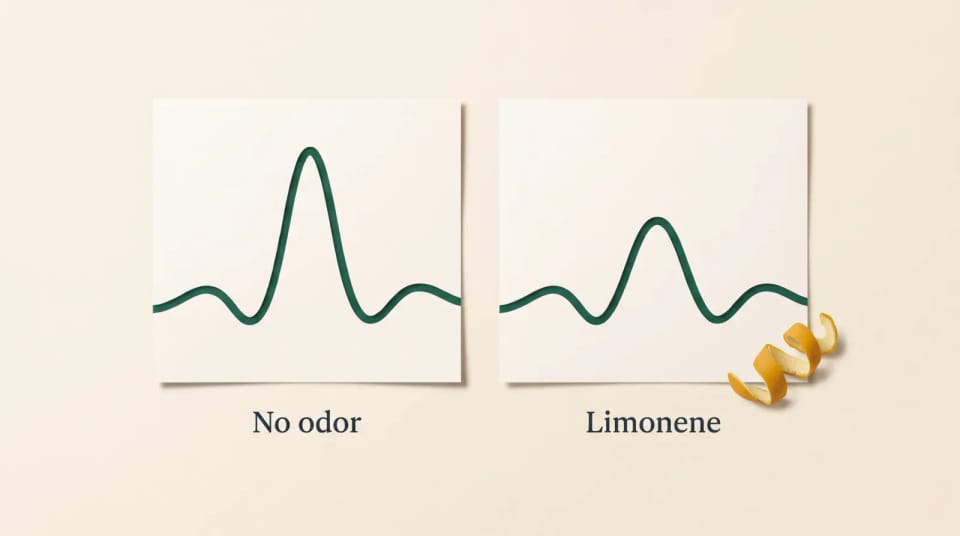
In 19 healthy students, limonene lowered the P300 attention signal. That is one small experiment, not an ADHD result, but it runs against the focus claim.
For limonene’s chemistry and where it shows up, see our limonene explainer. The rat data adds little support: in a 2026 vigilance study, limonene on its own had no effect on attention. Moore et al., Psychopharmacology, 2026
Does pinene help attention or ADHD?
The evidence does not show it, in people or in rats. In a 2025 double-blind crossover trial, 19 healthy adults inhaled vaporized alpha-pinene, THC, both, or plain air. Pinene alone produced no significant effects, THC impaired working memory, and adding pinene did not undo that impairment. Kumar et al., Medical Cannabis and Cannabinoids, 2025 We cover that trial in depth in pinene and memory.
The newer rat study tested sustained attention directly. Rats trained on a vigilance task received oral THC, pinene, limonene, or combinations. Pinene alone tended to reduce accuracy and increase lapses at the highest dose. Mixed with THC, its effect flipped with the dose: the highest pinene dose worsened impairment from a low THC dose, while lower pinene doses softened some effects of a high THC dose. Moore et al., 2026
That is a finding about how terpenes interact with THC in rats, at doses given by stomach tube and far above anything a person inhales. It is not a focus result, and it is not an ADHD model.
Is linalool or lavender good for ADHD?
Nobody we found has tested linalool alone on attention. The studies that exist use whole lavender oil, which contains linalool alongside many other compounds, and they disagree. Our linalool and lavender research piece covers the calm and sleep side.
- In 144 healthy adults, lavender aroma decreased working memory and slowed reaction times on memory and attention tasks compared with no odor. Moss et al., International Journal of Neuroscience, 2003
- In a long vigilance task, reaction times crept up less with lavender oil than without it. Shimizu et al., Bioscience, Biotechnology, and Biochemistry, 2008
- Linalyl acetate, a lavender ester that is not linalool, made reaction times faster in a vigilance study, the opposite of the slowing its authors predicted. Heuberger and Ilmberger, Natural Product Communications, 2010
A 2021 review of pinene and linalool summed it up: “Overall, evidence is mostly limited to preclinical studies and well-designed clinical trials are lacking.” Weston-Green et al., Frontiers in Psychiatry, 2021
Is myrcene bad for focus?
One tiny trial suggests it can dull attention. Ten healthy adults swallowed a 15 mg capsule of pure beta-myrcene or a placebo, then drove a simulator. Myrcene was linked to significantly worse speed control and more errors on a divided-attention task. Johnson et al., Cannabis, 2023
Ten people and an oral capsule do not make a rule for inhaled cannabis. It does show how loose the folk claims are; our piece on the myrcene myth takes apart another one.
What about caryophyllene, eucalyptol and terpinolene?
Beta-caryophyllene is the terpene that binds the CB2 receptor, which is why it gets called a cannabinoid (see beta-caryophyllene). In a 2026 mouse study, the two higher injected doses impaired attentional control in young and aged mice. The lowest dose improved impulse control only in aged mice that already performed poorly. Williams M.N., Parikh V. et al., Psychopharmacology, 2026
1,8-cineole, the eucalyptus and rosemary terpene, has the most interesting human lead. In 20 adults exposed to rosemary aroma, higher blood levels of cineole went with faster, more accurate mental arithmetic. Moss and Oliver, Therapeutic Advances in Psychopharmacology, 2012 That was a correlation inside one aroma group, with no odor-free comparison. Two controlled inhalation experiments found no reliable cineole benefit for alertness or vigilance, and performance tracked how much people liked the smell. Ilmberger et al., Chemical Senses, 2001; Heuberger and Ilmberger, 2010
Terpinolene carries an “energy” reputation, but our searches found no study of it on attention at all.
Why don’t these results carry over to cannabis and ADHD?
Each kind of study answers a narrower question than the claim built on it.
- Rodent doses are huge. The rat and mouse studies gave terpenes by stomach tube or injection, at doses in milligrams per kilogram of body weight. An inhaled terpene arrives in far smaller amounts; see how much of an inhaled terpene reaches the brain.
- Healthy adults are not people with ADHD. A short experiment in 19 students cannot show what happens to someone whose attention works differently every day.
- Whole oils are not single terpenes. Lavender, rosemary and lemon oils each contain dozens of compounds. A result for the oil is not a result for its main terpene.
- THC sits in the same product. THC impaired working memory in healthy adults in the pinene trial, and it reduced accuracy in a dose-dependent way in the rat vigilance study. A cannabis product is never just its terpenes. Read more on how THC affects memory and attention.
- Combinations cannot be graded from single compounds. The entourage hypothesis says terpenes act together. If so, a single-terpene study says even less about a strain.
A 2026 systematic review of cannabis labels reached the same verdict from another direction: “Current terpene-effect evidence remains preliminary and does not justify terpene-based or label-based prescribing rules.” Zoobi et al., Journal of Cannabis Research, 2026
Are there any trials of terpenes for ADHD?
Two registry records exist, and neither has results. A registration describes a plan; it is not evidence.
- An industry-sponsored phase 2 trial plans to test a CBD oil enriched with a terpene blend, without THC, in children with ADHD. Its status was last verified in August 2024 and no results are posted. Because the product mixes CBD with several terpenes, it could not isolate any one of them. NCT06542445
- A hospital-sponsored trial of a single lemon oil inhalation in 52 children with ADHD is listed as completed in 2023. It was registered after it finished, no results are posted, and we found no published paper. The oil was mostly limonene, but it was a whole oil, not isolated limonene. NCT07586761
What would count as proof?
A terpene would earn grade 5 through one kind of study. Each step below closes a gap that the current evidence leaves open.
- Recruit people with a clinician-confirmed ADHD diagnosis, not healthy students or medical cannabis patients with another primary condition.
- Give one isolated terpene at a known dose, by a route people actually use, with no THC in the product.
- Compare it with a matched placebo, assigned at random and hidden from participants and testers.
- Name the attention outcome in advance, then measure it with a validated test.
- Publish the results, including a null result, in a peer-reviewed journal.
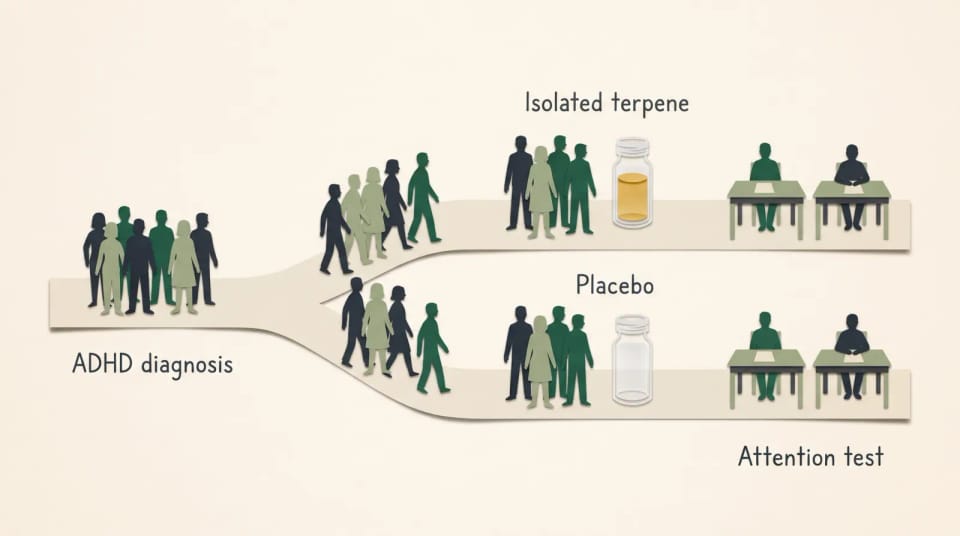
The missing study. No published trial in our searches has run these four steps for any single cannabis terpene.
What can a terpene label tell you?
A terpene percentage tells you what is in the product, not what it will do for your attention. Our guide on how to read a terpene profile explains what the numbers on a lab report mean. The High IQ app can scan a label and keep notes on how a product felt for you, and those notes stay a personal record, not a measure of ADHD symptoms.
The same caution applies to strain families. High Families group products by their terpene profile. They describe a product, not a clinical outcome, and no family is an ADHD treatment.
When should you talk to a clinician?
Talk to a clinician if attention, restlessness or impulsivity is affecting your work, school, relationships or safety, or before you add cannabis or any supplement alongside ADHD medication. Diagnosis and treatment belong with a professional. Standard ADHD care includes medication and psychosocial approaches such as cognitive behavioral therapy, parent training and school support. National Institute of Mental Health
Cannabis itself is not an approved ADHD treatment. The FDA states it “has not approved a marketing application for cannabis for the treatment of any disease or condition.” FDA The only randomized trial of a cannabinoid medicine in adult ADHD we found, a 30-person pilot of a THC and CBD mouth spray, missed its primary outcome. Cooper et al., European Neuropsychopharmacology, 2017 Cannabis can also impair attention and reaction time, so see how long to wait before driving.
Key takeaways
- Our October 2026 searches found no trial of an isolated terpene in people with ADHD.
- Limonene lowered an attention brain signal in its one direct human test.
- Pinene did nothing alone in healthy adults and tended to worsen rat attention at a high dose.
- The only ADHD terpene survey links trans-β-farnesene to heavier use, not to lower ADHD scores.
- ADHD diagnosis and treatment belong with a clinician.
FAQ
What terpenes are good for ADHD?
No terpene has been shown to be good for ADHD. Our searches found no randomized trial of a single terpene in people with ADHD. The popular picks, such as limonene, pinene and linalool, rest on animal work or small studies in healthy adults, and some of those point the wrong way.
Do terpenes work without THC?
Terpenes have measurable effects without THC in some studies, but not reliably helpful ones for attention. Pinene alone did nothing in healthy adults, and pure myrcene worsened divided attention in a ten-person pilot. Limonene alone lowered an attention signal in 19 students.
Is trans-β-farnesene good for ADHD?
There is no evidence that it is. Its only appearance in ADHD research is a 2020 survey where the heavier-using patients took in more of it. The terpene was not linked to lower ADHD scores, and the authors drew no causal conclusions.
Can cannabis replace ADHD medication?
No evidence supports replacing ADHD medication with cannabis or terpenes. The one randomized trial of a cannabinoid medicine in adult ADHD missed its primary outcome, and the FDA has not approved cannabis for any condition. Never stop or change ADHD medication without talking to the clinician who prescribes it.
Sources
- Hergenrather JY, Aviram J, Vysotski Y, Campisi-Pinto S, Lewitus GM, Meiri D. “Cannabinoid and Terpenoid Doses are Associated with Adult ADHD Status of Medical Cannabis Patients.” Rambam Maimonides Medical Journal, 2020. doi:10.5041/RMMJ.10384
- Tamura K, Nishimura T, Ohno Y, Yoshimura S, Tonoike M. “Limonene Selectively Modulates Visual Attention Through P300 Suppression: A Comparative Event-Related Potential Study With Lemon Essential Oil.” Brain and Behavior, 2025. doi:10.1002/brb3.71012
- Kumar L, Spindle TR, Zamarripa CA, et al. “The Individual and Interactive Effects of Alpha-Pinene and Delta-9-Tetrahydrocannabinol in Healthy Adults.” Medical Cannabis and Cannabinoids, 2025. doi:10.1159/000547014
- Moore CF, Wilberger TJ, Jenkins BW, Vandrey R, Weerts EM. “The monoterpenes alpha-pinene and limonene augment or mitigate THC-induced impairments in sustained attention in rats.” Psychopharmacology, 2026. doi:10.1007/s00213-026-07158-w
- Williams MN, Patel NT, Fleischel EJ, Wimmer ME, Ward SJ, Parikh V. “β-caryophyllene, a CB2-selective phytocannabinoid, differentially modulates attention and inhibitory control in low- and high-performing young and aged mice.” Psychopharmacology, 2026. doi:10.1007/s00213-026-07093-w
- Johnson MB, McKnight S, Taylor EP, Mechtler L, Ralyea CC Jr. “The Effects of beta-myrcene on Simulated Driving and Divided Attention: A Double-Blind, Placebo-Controlled, Crossover Pilot Study.” Cannabis, 2023. doi:10.26828/cannabis/2023.01.002
- Moss M, Cook J, Wesnes K, Duckett P. “Aromas of rosemary and lavender essential oils differentially affect cognition and mood in healthy adults.” International Journal of Neuroscience, 2003. doi:10.1080/00207450390161903
- Shimizu K, Gyokusen M, Kitamura S, et al. “Essential oil of lavender inhibited the decreased attention during a long-term task in humans.” Bioscience, Biotechnology, and Biochemistry, 2008. doi:10.1271/bbb.70835
- Heuberger E, Ilmberger J. “The influence of essential oils on human vigilance.” Natural Product Communications, 2010. PMID 20923005
- Ilmberger J, Heuberger E, Mahrhofer C, et al. “The influence of essential oils on human attention. I: alertness.” Chemical Senses, 2001. doi:10.1093/chemse/26.3.239
- Moss M, Oliver L. “Plasma 1,8-cineole correlates with cognitive performance following exposure to rosemary essential oil aroma.” Therapeutic Advances in Psychopharmacology, 2012. doi:10.1177/2045125312436573
- Weston-Green K, Clunas H, Jimenez Naranjo C. “A Review of the Potential Use of Pinene and Linalool as Terpene-Based Medicines for Brain Health.” Frontiers in Psychiatry, 2021. doi:10.3389/fpsyt.2021.583211
- Zoobi G, Marco M, Foraida KJ, Tandon S, Zhornitsky S. “Do consumer-facing ‘Indica,’ ‘Sativa,’ and ‘Hybrid’ labels predict cannabis composition or effects? A systematic review.” Journal of Cannabis Research, 2026. doi:10.1186/s42238-026-00528-3
- Cooper RE, Williams E, Seegobin S, Tye C, Kuntsi J, Asherson P. “Cannabinoids in attention-deficit/hyperactivity disorder: A randomised-controlled trial.” European Neuropsychopharmacology, 2017. doi:10.1016/j.euroneuro.2017.05.005
- ClinicalTrials.gov. NCT06542445 and NCT07586761, records accessed October 29, 2026.
- National Institute of Mental Health. “Attention-Deficit/Hyperactivity Disorder (ADHD).” Accessed October 29, 2026.
- U.S. Food and Drug Administration. “FDA and Cannabis: Research and Drug Approval Process.” Accessed October 29, 2026.



