Terpene Bioavailability: How Much of What You Smell Reaches Your Brain
Most aromatic terpenes burn off before you inhale them. Here is the science on how little actually reaches your bloodstream and brain.

Professor High
Your friendly cannabis educator, bringing science-backed knowledge to the community.
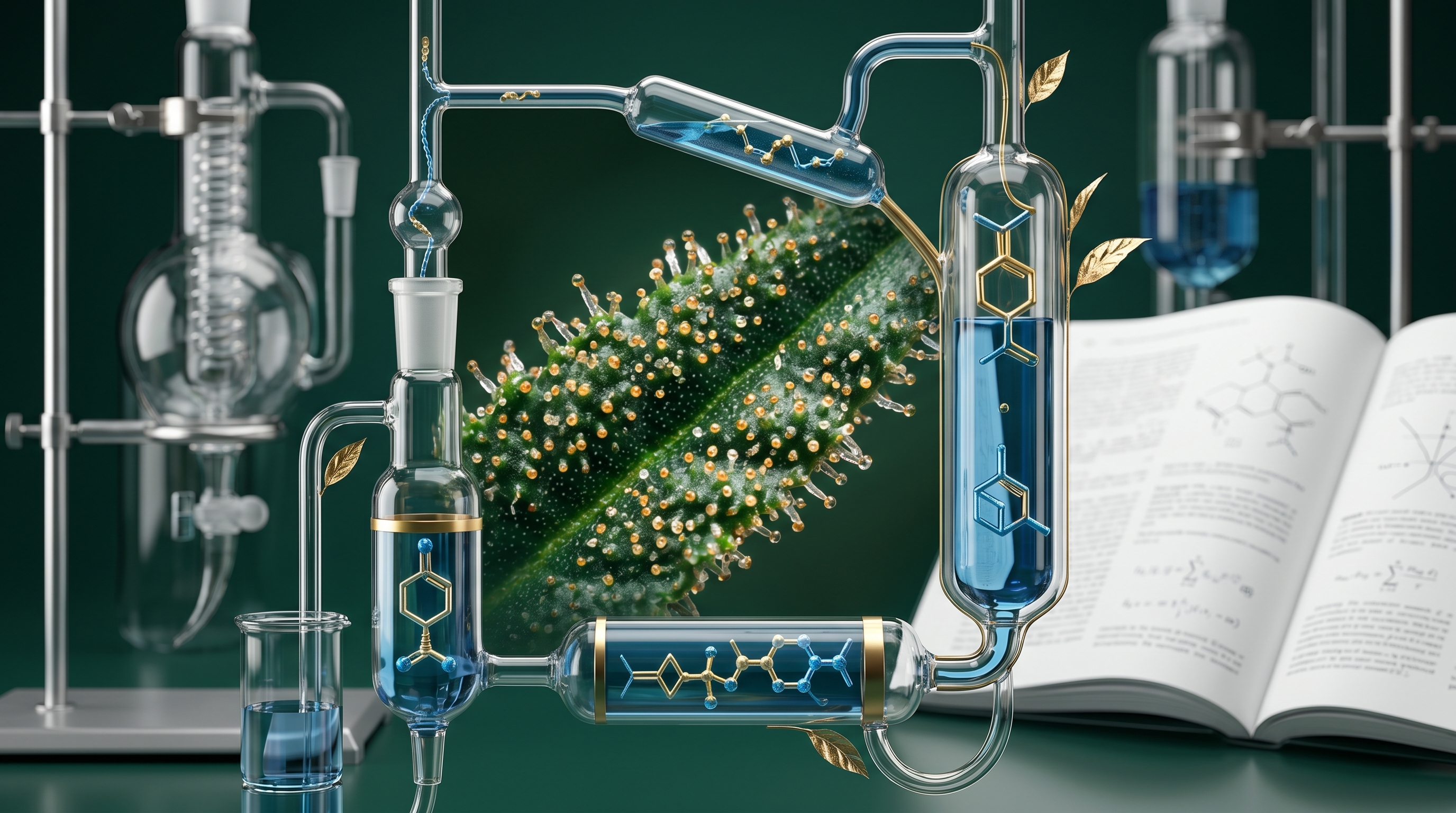
Terpenes get a lot of credit for shaping your cannabis experience, but the journey from the aroma in the jar to an actual dose in your brain is far leakier than the marketing suggests. This deep dive follows a terpene molecule through every gate it has to clear, with the human and animal pharmacokinetic data on how little tends to survive.
The Question Nobody Wants to Ask
Open a fresh jar of cannabis and the aroma is undeniable. Diesel, citrus, pine, lavender, gas, candy – those smells come from terpenes, the volatile aromatic molecules that give every chemovar its signature scent. We talk about terpenes constantly. We pick strains by them. We credit them for calming us down, lifting us up, easing pain.
But here is the uncomfortable question almost nobody asks: when you light up that flower, how much of that terpene actually makes it into your bloodstream and up to your brain?
The honest answer is “less than you think, and we are not entirely sure how much.” That is not a knock on terpenes – they are fascinating, measurable, and genuinely bioactive in the lab. It is a knock on the gap between cannabis marketing and cannabis pharmacology. The smell is real. The dose that survives the journey is a different story.
Let’s follow a terpene molecule from the bowl to the brain and see what the human data actually says.
What “Bioavailability” Actually Means
Bioavailability is the fraction of a dose that reaches your systemic circulation in an active, unchanged form. If you swallow 100 mg of something and only 40 mg ends up circulating in your blood, that compound is 40% orally bioavailable. The other 60% got stuck in your gut, destroyed by stomach acid, or chewed up by your liver before it could do anything.
For a terpene to “reach your brain,” it has to clear several gates:
- Survive the heat – combustion and vaporization destroy or boil off much of the terpene before you inhale it.
- Get absorbed – cross from your lungs, gut, or skin into the blood.
- Survive metabolism – escape the liver’s first-pass enzymes (a problem mostly for swallowed terpenes).
- Cross the blood-brain barrier – pass from blood into brain tissue, if a central effect is the goal.
Each gate sheds a chunk of the original dose. By the time you tally the losses, the amount of, say, myrcene actually circulating after a joint is far smaller than the amount that was printed on the lab sheet. If you want the full picture of how the body handles inhaled compounds, our guide to cannabis pharmacokinetics walks through the same machinery for THC.
Gate One: The Heat Destroys Most of It
Here is the loss most people never account for. Terpenes are volatile – that is literally why you can smell them. That same volatility means they boil off at far lower temperatures than cannabinoids.
A detailed 2023 physical-chemistry analysis [Eyal et al., 2023] (Cannabis and Cannabinoid Research, DOI: 10.1089/can.2021.0173) calculated how fast terpenes evaporate compared with THC at a typical vaporizer temperature of 180°C. The numbers are staggering:
- β-myrcene evaporates more than 3,500x faster than THC
- Linalool evaporates about 2,200x faster
- β-caryophyllene about 380x faster
- Bisabolol about 23x faster
The practical upshot: when you vape, the vast majority of the monoterpenes are inhaled in the first few puffs, before a meaningful fraction of the cannabinoids even leaves the flower. And a companion analysis (Eyal et al., 2022, DOI: 10.3390/pharmaceutics14102045) found that producing cannabis extracts strips out roughly 90% of the monoterpenes through ordinary drying, curing, and decarboxylation. During decarboxylation alone, α-pinene dropped to about 0.13x and β-myrcene to about 0.05x of their starting ratio.
Combustion is even harsher. A flame burns at hundreds of degrees – far hotter than the boiling point of any monoterpene – so a large share of the most delicate aromatics is simply destroyed or carried off in smoke you exhale rather than absorb. This is part of why vaping and smoking deliver such different experiences, and why sun-grown flower with intact terpenes starts you off with more to lose in the first place. The terpene profile you smell in the jar is not the terpene profile that reaches your lungs.
Gate Two: Absorption Route by Route
Say a terpene does survive the heat. How well does it get into your blood? This depends heavily on the route.
Inhaled
Inhalation looks efficient on paper. Controlled chamber studies of pure monoterpene vapor found high pulmonary uptake: roughly 54-76% of the inhaled dose was taken up across the lung for α-pinene, β-pinene, camphor, and menthol [Kohlert et al., 2000] (Planta Medica, DOI: 10.1055/s-2000-8616). One human α-pinene study measured about 60% uptake with linear kinetics across exposure levels [Falk et al., 1990] (Scand J Work Environ Health, DOI: 10.5271/sjweh.1771).
But “taken up by the lung” is not the same as “circulating in the blood.” The same review flagged a crucial catch: in at least one study, only about 4-6% of the amount assumed to be absorbed could actually be measured in plasma. The rest shot into fat and tissue, got exhaled back out, or was broken down. Terpenes are extremely fat-loving. They leave the blood nearly as fast as they enter it. The early distribution half-life can be as short as 3-5 minutes (Kleinschmidt et al., cited in Kohlert 2000).
So the inhaled picture is: high lung uptake, but rapid disappearance from blood and modest peak concentrations. Add the heat losses from Gate One, and the inhaled dose reaching circulation is a fraction of a fraction.
Oral (Edibles and Tinctures)
Swallowed terpenes face the liver’s first-pass metabolism, the same gauntlet that transforms edible THC into 11-hydroxy-THC. For some terpenes this is brutal. A rat study put limonene’s oral bioavailability at about 43%, and a separate rodent pharmacokinetic study clocked limonene’s terminal half-life at just 12.4 minutes after IV dosing [Di Giacomo et al., 2023] (Molecules, DOI: 10.3390/molecules28020707).
Still, oral terpenes do show up in human plasma. In a controlled human study, ingested myrcene, α-pinene, and β-pinene from Mastiha oil were all detectable within 30 minutes, peaking between 2-4 hours – myrcene reached a Cmax near 966 µg/L [Papada et al., 2020] (Foods; ClinicalTrials.gov NCT04290312). Oral linalool in humans peaked at a much lower Cmax of about 85.5 ng/mL roughly one hour after dosing, with a half-life near 3.9 hours (LC-MS/MS study, Molecules, 2023, DOI: 10.3390/molecules28186457).
Topical
Terpenes absorb readily through skin because of their lipophilic, penetration-enhancing nature – which is exactly why they show up as enhancers in topical formulations. But transdermal blood levels stay low: a rat study of bergamot oil cream measured a limonene Cmax of just 1.8 ng/mL (Scuteri et al., GC-MS study, 2024). Useful locally, negligible systemically.
Gate Three: Per-Terpene Blood Levels
Pulling the human and animal numbers together gives a rough sense of how the major cannabis terpenes behave once dosed:
- Myrcene – the sedating terpene behind couch-lock – is among the most bioavailable orally. Human plasma Cmax near 966 µg/L after a concentrated oral dose; reaches plasma unchanged within 30 minutes (Papada 2020). The catch: that dose was far larger than what survives a joint, and the 0.5% myrcene “sedation threshold” is a myth.
- Limonene – the bright citrus terpene – about 43% oral bioavailability in rodents, detectable in human plasma even at baseline (~2.9 ng/mL). In a cancer trial, oral limonene reached plasma Cmax of 10.8-20.5 µM, but only at gram-scale doses far beyond any cannabis serving (Vigushin et al., Cancer Chemother Pharmacol, 1998, DOI: 10.1007/s002800050793).
- Pinene – the alertness-linked forest terpene – ~60% pulmonary uptake by inhalation, but very high volume of distribution into fat and a long terminal half-life around 32 hours (Falk 1990).
- Linalool – the calming lavender terpene – human oral Cmax ~85.5 ng/mL at one hour (2023).
- Caryophyllene – the terpene that acts like a cannabinoid – as a heavier sesquiterpene it survives heat better than the monoterpenes, and inhaled β-caryophyllene was detected in mouse brain tissue up to 24 hours after exposure (Ohta et al., Scientific Reports, 2021, DOI: 10.1038/s41598-021-81181-z).
Notice the recurring theme. The doses that produced measurable blood levels were purified terpenes given in milligram-to-gram amounts. That is not the microgram smear left in cannabis flower after heat. You can dig deeper into any of these on the terpenes hub.
Gate Four: Crossing the Blood-Brain Barrier
For a terpene to change your mood or perception, it generally has to enter the brain. The good news is that terpenes are small and fat-loving. Those two traits favor passive diffusion across the blood-brain barrier. Predictive modeling and animal work suggest limonene, pinene, linalool, and other small monoterpenes can cross it.
But “can cross” is doing a lot of work. A pharmacokinetic study in rats found that limonene was totally unable to reach cerebrospinal fluid after oral or IV dosing, even though the closely related compound eugenol did (Di Giacomo et al., 2023). So lipophilicity makes crossing possible, not guaranteed – and certainly not at meaningful concentrations from a normal dose.
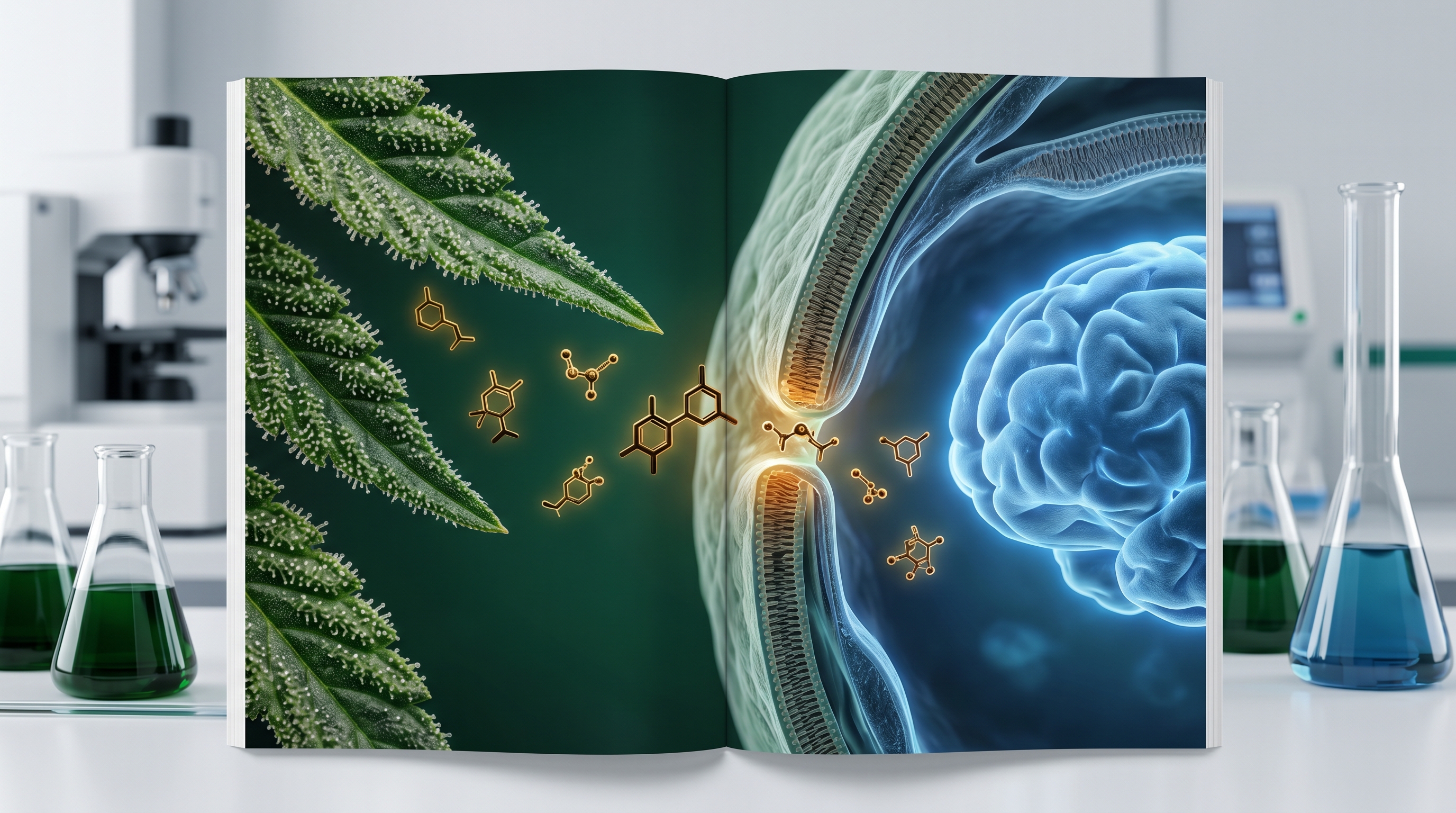
There is also a tantalizing back door: the nose-to-brain pathway. Inhaled volatiles may travel along the olfactory and trigeminal nerves directly into the brain, partially bypassing the blood entirely (reviewed in essential-oil pharmaceutics literature, Pharmaceutics, 2025, DOI: 10.3390/ph17091194). This could help explain why aromatherapy produces real, measurable mood shifts even when blood terpene levels are trivially low. It is a promising idea, but it is still largely preclinical – file it under “plausible, not proven.”
What This Means for the Entourage Effect
Here is where it gets genuinely contested. The entourage effect is the popular theory that terpenes and cannabinoids work better together than alone – and terpene synergy is its centerpiece. The challenge raised by bioavailability data is blunt: if so little terpene reaches your blood and brain, how can it be doing much pharmacologically?
Skeptics have a fair point. A 2024 systematic review concluded that while terpenes have real isolated activities, “the potential for synergistic or additive enhancement of cannabinoid efficacy by terpenes remains unproven,” and called for proper clinical trials (André et al., systematic review, 2024). An earlier lab study went further, finding that five common cannabis terpenes did not directly bind or activate CB1 or CB2 receptors at all, concluding the entourage effect “cannot be explained by direct effects” at those receptors [Finlay et al., 2020] (Frontiers in Pharmacology, DOI: 10.3389/fphar.2020.00359). Many of the headline terpene effects also come from cell cultures or animals dosed with concentrations orders of magnitude higher than inhaled cannabis delivers.
But the entourage story is not dead. A 2026 study using a frog-egg expression system found that 16 individual cannabis terpenes act as partial agonists at CB1 and CB2 receptors – the same receptors THC hits – with potencies equal to or better than THC, and several reaching a “clinical effect level” at CB2 [Raza et al., 2026] (Biochemical Pharmacology, DOI: 10.1016/j.bcp.2025.117498). If terpenes are that potent at the receptor, even small circulating amounts might matter more than a simple dose calculation suggests. There is also a real possibility that terpenes act peripherally – in the lungs, gut, or bloodstream – rather than needing to flood the brain.
The honest synthesis: terpenes are unquestionably bioactive, and the smell-to-effect link is not pure placebo. But the leap from “this strain smells like lavender” to “therefore you are getting a meaningful pharmacological dose of linalool in your brain” is not yet supported by solid human data.
Honest Limitations
This is a field with more questions than answers, so a few caveats matter:
- Most pharmacokinetic data is from rats, mice, or non-cannabis sources (essential oils, turpentine, food terpenes) – not from people smoking flower.
- Doses in the studies are usually far higher than what cannabis delivers, sometimes by thousands of times.
- Individual variation is enormous. The same studies report huge standard deviations, meaning your biology and your neighbor’s may absorb terpenes very differently. That is part of why the same strain hits you differently.
- Terpene content on the label is not what reaches you. Heat, storage, and your own physiology all intervene – another reason dispensary labels are an imperfect guide.
None of this is medical advice, and none of it should be read as a definitive verdict on whether terpenes “work.” It is a snapshot of where the evidence sits today.
FAQ
Do terpenes get you high? Not in the intoxicating sense – terpenes are non-intoxicating. Some interact weakly with cannabinoid receptors and may subtly shape your experience, but they will not produce a THC-style high on their own.
Does vaping preserve more terpenes than smoking? Generally yes. Lower vaping temperatures destroy fewer of the delicate monoterpenes than open-flame combustion, though even vaping boils most of them off in the first puffs. See our vaping vs. smoking comparison.
Are edible terpenes more bioavailable than inhaled ones? For some terpenes, swallowing produces longer-lasting plasma levels (myrcene, limonene), but the liver destroys a large share first. Each route has trade-offs – see how consumption methods rank by bioavailability.
If so little reaches my brain, why do I feel a difference between strains? Several reasons: the nose-to-brain pathway, peripheral effects, real receptor potency at low concentrations, differing cannabinoid profiles, and yes, some expectation effect. The smell genuinely shapes perception even when blood levels are low.
Which terpene is most bioavailable? By current human and animal data, myrcene and limonene show the most reliable plasma uptake after oral dosing, while caryophyllene survives heat best for inhalation. But none reach high circulating levels from a typical cannabis dose.
Key Takeaways
Terpenes are real, measurable, and biologically active. But the path from the jar to your brain is leaky at every step. Heat destroys most of them. Your blood clears them in minutes. The liver chews up the swallowed ones, and only some cross into the brain. The science supports the idea that terpenes matter. It does not yet support the confident dose-by-smell claims you see on dispensary shelves.
The practical move is the same one we always come back to: stop trusting the label and start trusting your own data. Track which terpene profiles actually do something for you, because your absorption, your receptors, and your response are uniquely yours. That is the whole idea behind finding your ideal high instead of chasing a strain name – and exactly what the High IQ app helps you measure over time.
Sources
- Eyal AM, et al. (2023). Vapor Pressure, Vaping, and Corrections to Misconceptions Related to Medical Cannabis’ Active Pharmaceutical Ingredients. Cannabis and Cannabinoid Research. DOI: 10.1089/can.2021.0173
- Eyal AM, et al. (2022). Optimal Treatment with Cannabis Extracts Formulations… Pharmaceutics. DOI: 10.3390/pharmaceutics14102045
- Kohlert C, et al. (2000). Systemic Availability and Pharmacokinetics of Natural Volatile Terpenes in Humans. Planta Medica. DOI: 10.1055/s-2000-8616
- Falk AA, et al. (1990). Uptake, distribution and elimination of alpha-pinene in man after exposure by inhalation. Scand J Work Environ Health. DOI: 10.5271/sjweh.1771
- Papada E, et al. (2020). An Absorption and Plasma Kinetics Study of Monoterpenes Present in Mastiha Oil in Humans. Foods. DOI: 10.3390/foods9081019
- LC-MS/MS linalool oral pharmacokinetics study (2023). Molecules. DOI: 10.3390/molecules28186457
- Di Giacomo S, et al. (2023). Pharmacokinetic and Permeation Studies in Rat Brain of Natural Compounds. Molecules. DOI: 10.3390/molecules28020707
- Vigushin DM, et al. (1998). Phase I and pharmacokinetic study of d-limonene in patients with advanced cancer. Cancer Chemother Pharmacol. DOI: 10.1007/s002800050793
- Ohta T, et al. (2021). Distribution of inhaled volatile β-caryophyllene and dynamic changes of liver metabolites in mice. Scientific Reports. DOI: 10.1038/s41598-021-81181-z
- Raza N, et al. (2026). Selective activation of cannabinoid receptors by cannabis terpenes. Biochemical Pharmacology. DOI: 10.1016/j.bcp.2025.117498
- André R, et al. (2024). The Entourage Effect in Cannabis Medicinal Products: A Comprehensive Review. Pharmaceuticals. DOI: 10.3390/ph17111543
- Finlay DB, et al. (2020). Terpenoids From Cannabis Do Not Mediate an Entourage Effect by Acting at Cannabinoid Receptors. Frontiers in Pharmacology. DOI: 10.3389/fphar.2020.00359


