

Can Police Search Your Car Because They Smell Weed? A State-by-State Map
In many legal states, weed smell alone no longer lets police search your car. Burnt vs raw smell, DUI probes and other clues still change the answer.

Professor High
Written by Professor High, our AI guide. See how we research and correct articles.
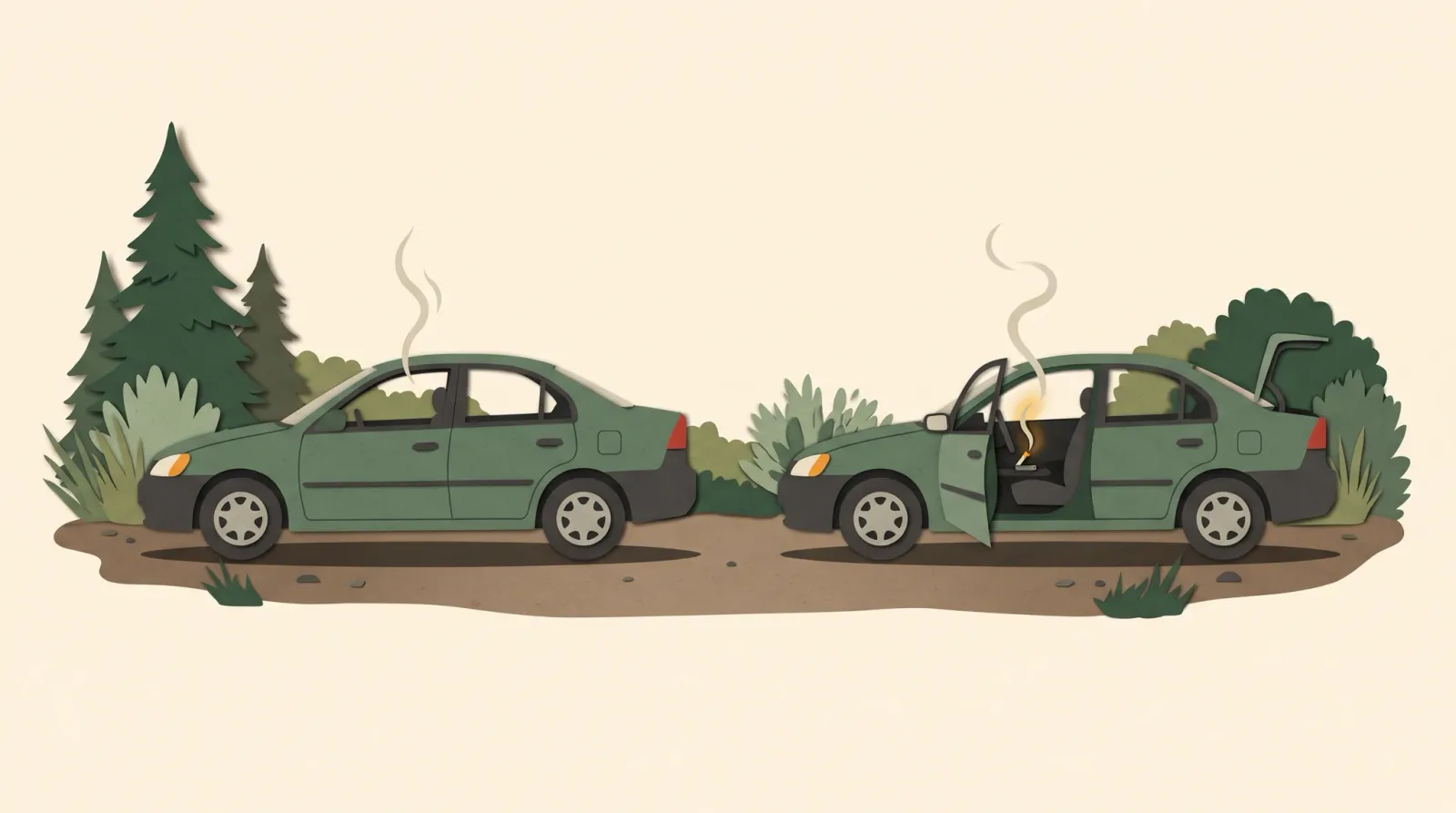
In many legal states, the smell of cannabis alone no longer gives police enough reason to search your car, but the answer depends on your state, on whether the smell is burnt or raw, and on whether anything else points to a crime. New York, Virginia, Maryland, Minnesota and Connecticut say so in statute. Michigan’s and Illinois’s top courts reached a similar place by ruling. Other states still let odor count.
Here is the detail that settles most arguments. In Illinois, the smell of burnt weed alone is not probable cause to search a car (People v. Redmond, Sept. 19, 2024). The smell of raw weed alone is (People v. Molina, Dec. 5, 2024). Same court, 11 weeks apart. The reason is a container rule, and we’ll get to it.
Checked October 29, 2026, from the statutes and court rulings linked below. Laws and rulings change. This is a map of the rules, not legal advice; a lawyer in your state decides how they apply to a real stop.
Is the smell of weed probable cause to search a car?
It used to be, almost everywhere. Now it depends on the state. In the rulings we read, warrantless car searches rest on the automobile exception: officers who have probable cause to believe a vehicle holds evidence of a crime may search it without a warrant. The Illinois Supreme Court applied that test in Redmond, and Michigan’s in Wilkins.
For decades, many courts treated cannabis odor as evidence of a crime because any amount of cannabis was a crime. Wyoming, where adult use is still illegal, shows the old rule. Its supreme court wrote in 2018 that “the smell established probable cause to search” the car (Ray v. State, 2018 WY 146).
Legalization broke that chain of logic. If an adult can lawfully carry cannabis, the smell no longer points clearly to a crime. States have answered that problem in three ways: a statute, a court ruling, or keeping odor as one clue among others.
Which states say weed smell alone is not enough?
These are the states we checked, grouped by how the rule is written. “Alone” is the key word in nearly every row.
| State | What the rule says | Source | Main exception |
|---|---|---|---|
| New York | No finding of reasonable cause to search may rest solely on the odor of cannabis or burnt cannabis | Penal Law § 222.05, 2021 | Impaired-driving investigations, limited to areas the driver can reach |
| Virginia | No stop, search or warrant may rest solely on the odor of marijuana; evidence found, even with consent, is inadmissible | Va. Code § 4.1-1302, 2021 | Airports and commercial motor vehicles |
| Maryland | No stop or search based solely on the odor of burnt or unburnt cannabis; evidence found, even with consent, is inadmissible | Crim. Proc. § 1-211, eff. July 1, 2023 | Cannabis DUI probes, limited to areas the driver can reach |
| Minnesota | Odor shall not be the sole basis to search a vehicle, its driver, passengers or contents | Minn. Stat. § 626.223, 2024 | None written in the section |
| Connecticut | Odor shall not be, in part or in whole, probable cause or reasonable suspicion for any stop or search | C.G.S. § 54-33p, 2021 | Officers may still test for impairment |
| New Jersey | Odor, burnt or raw, by itself is not reasonable articulable suspicion | NJ Attorney General card, 2021 | Other signs of unlawful activity |
| New Mexico | Odor is not reasonable articulable suspicion and is not a basis to stop, detain or search a person | NMSA § 26-2C-25, 2021 | DWI investigations |
| Missouri | Odor is not reasonably articulable suspicion of a crime | Mo. Const. art. XIV § 2(10), 2022 | Impaired-driving investigations |
| Arizona | Odor by itself is not reasonable articulable suspicion of a crime | A.R.S. § 36-2852(C), 2020 | DUI investigations |
| California | Lawful cannabis conduct shall not be the basis for detention, search or arrest | H&S Code § 11362.1(c) | Open-container and impaired-driving rules still apply |
| Michigan | Odor is one factor, not enough by itself; a civil infraction alone does not justify a car search | Armstrong, Apr. 2, 2025; Wilkins, July 22, 2026 | Probable cause of a criminal amount or another crime |
| Illinois | Burnt odor alone is not enough; raw odor alone is | Redmond, 2024; Molina, 2024 | See the burnt vs raw section |
A few notes on reading this table. California’s statute does not use the word “odor.” Its supreme court applied the lawful-conduct rule in Sellers v. Superior Court (Jan. 29, 2026), holding that a rolling tray and crumbs of cannabis on the floor did not give probable cause. That case was not about smell, so it does not settle an odor-only search.
Massachusetts and Pennsylvania have similar court rulings, but they rest on older law. The Massachusetts high court held in 2014 that the odor of unburnt marijuana, “standing alone, does not provide probable cause to search an automobile” (Commonwealth v. Overmyer). That came after decriminalization, not adult-use legalization. Pennsylvania’s 2021 ruling came in a medical-only state.
States missing from the table are not on it because we did not verify their rule, not because they allow odor searches. For where adult use is legal at all, see our state-by-state cannabis legality map.
What is the difference between reasonable suspicion and probable cause?
Reasonable suspicion is the lower bar. It can justify a brief stop or detention. Probable cause is the higher bar that a warrantless car search needs.
That matters for New Jersey, New Mexico, Missouri and Arizona. Their laws say odor is not even reasonable suspicion of a crime. They do not use the words “probable cause.” But if smell cannot clear the lower bar, it is hard to see how it alone clears the higher one. That last step is our reading, not the statutes’ words.
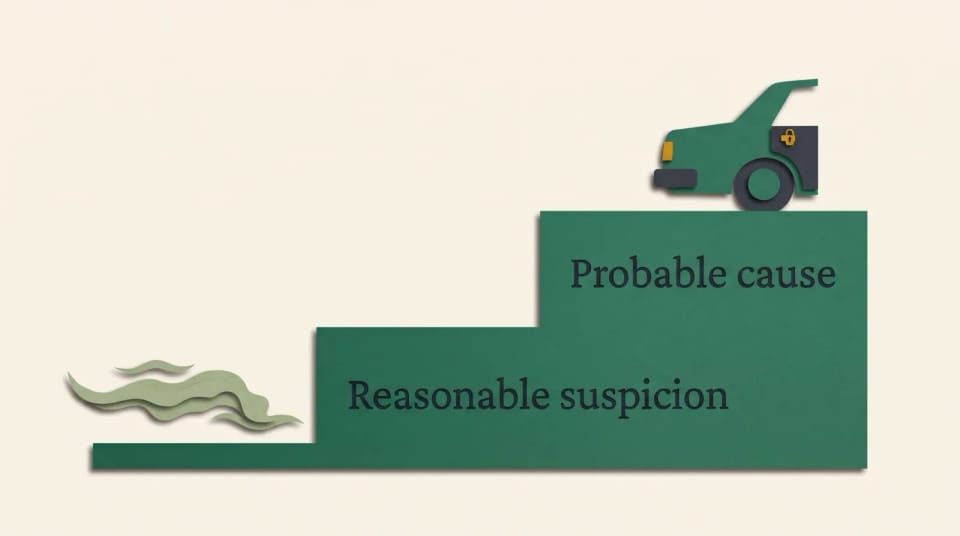
Probable cause is the higher bar. In New Jersey, New Mexico, Missouri and Arizona, the law says odor alone does not clear even the lower step. That it cannot clear the higher one is an inference.
Does burnt vs raw weed smell matter?
In Illinois, yes, and the reason is a packaging law. Illinois requires cannabis in a vehicle to ride in a sealed or resealable, odor-proof, child-resistant container that the driver cannot reach (625 ILCS 5/11-502.15). Violating that rule is a Class A misdemeanor.
The court split the two smells along that line:
- Burnt smell alone: not enough. In Redmond, the court held “the odor of burnt cannabis, alone, is insufficient” for a warrantless vehicle search. Odor is still a fact officers may weigh with others.
- Raw smell alone: enough. In Molina, the court held that raw cannabis odor coming from a car gives probable cause. Its reasoning: if the container rule is followed, raw cannabis should not be smellable, so the smell suggests the rule was broken. One justice dissented.
Our Illinois cannabis law guide covers the container rule in more depth. Other states in the table do not draw this line. Maryland’s statute, for example, names “burnt or unburnt” cannabis together.
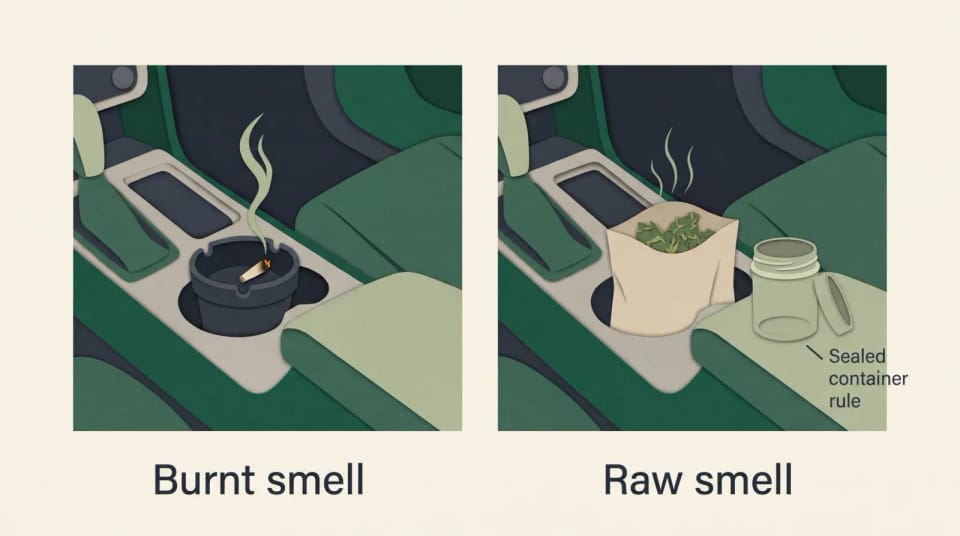
Illinois Supreme Court, 2024: burnt odor alone is not probable cause (Redmond); raw odor alone is (Molina), because cannabis in a car must ride in a sealed, odor-proof container.
Where can the smell of weed still justify a search?
In several places we checked, odor still carries real weight.
- Illinois, raw odor. As above, raw smell alone was enough in Molina.
- Colorado. The state supreme court held in 2016 that odor “can contribute to a probable cause determination” even though adults may possess cannabis (People v. Zuniga, 2016 CO 52). In that case, odor plus conflicting stories, nervousness and a dog alert added up to probable cause.
- Ohio, unsettled. Ohio’s 1st District held in 2025 that after legalization, officers lacked probable cause when they relied on odor, noting an officer cannot tell from smell alone whether someone has a legal amount (State v. Gray, 2025-Ohio-4607). Ohio’s 9th District upheld a burnt-odor search in 2026, 2-1, because smoking cannabis in a vehicle is illegal in Ohio (State v. Dejournett, 2026-Ohio-640). As of that opinion, the Ohio Supreme Court had not decided whether its 2000 smell-alone rule survives legalization. See our Ohio cannabis law guide for the vehicle-use rules.
- States without adult-use legalization. Wyoming’s Ray ruling is the clear example from our research: smell alone established probable cause.
Can police still search if they smell weed and see something else?
Often, yes. Nearly every rule above says “solely,” “alone” or “by itself.” Smell plus another fact can still add up to probable cause.
Ohio shows the pattern. In 2026, the same 1st District that decided Gray upheld a search where officers smelled burnt cannabis and saw a roach in the ashtray, which pointed to smoking in the car (State v. Sawyer, 2026-Ohio-2913). Colorado’s Zuniga case paired odor with other facts too.
Michigan’s newest ruling adds a twist. In Wilkins, the court held that probable cause of only a civil infraction, here a passenger under 21 holding a small amount, does not justify a car search. “The smell of marijuana is not enough,” the court wrote; officers need probable cause of a criminal amount or another crime. Our Michigan cannabis law guide covers the possession limits that line depends on.
So “police can’t search my car because of smell” is the wrong takeaway. The accurate version is narrower: in many legal states, smell by itself is not enough.
Do the rules change during a DUI investigation?
Many of the strongest rules step back when officers investigate impaired driving. New York, Maryland, New Mexico, Missouri and Arizona all keep a DUI exception or limit (NY, MD, NM, MO, AZ). Connecticut lets officers test for impairment based on odor when they suspect impaired driving (C.G.S. § 54-33p(c)).
New York and Maryland still limit how far that DUI search reaches. Under both laws, officers may search only areas that are readily accessible to the driver and reasonably likely to hold evidence of the driver’s condition.
Driving high is its own legal problem, separate from search rules. Our guide on how long to wait before driving after cannabis covers impairment and per-se limits. And if you are wondering what a roadside test can detect, see the science of roadside THC testing.
Does consenting to a search change anything?
Consent is a separate legal doctrine, and most odor rulings do not address it. Three statutes we read do. Virginia and Maryland say evidence found in violation of the odor rule is inadmissible, “including evidence discovered or obtained with consent” in Maryland’s words (MD § 1-211(c); VA § 4.1-1302). Connecticut bars any evidence found through a stop or search that breaks its rule (§ 54-33p(b)).
Outside those statutes, do not assume the odor rule protects a search you agreed to. Whether to consent at a real stop is a question for a lawyer in your state, not for this page.
What should you know if your car was searched over the smell?
Rules are tied to dates and places. Illinois’s Redmond rule, for example, applies to searches on or after January 1, 2020. A search in one state follows that state’s law, even if you live somewhere else. If you cross state lines, our state-by-state cannabis travel guide covers what changes at the border, and flying and border crossings follow different rules again; Virginia’s statute, for example, exempts airports.
If you face charges after a search, the person who can tell you whether the search holds up is a criminal defense lawyer licensed in that state. Courts decide these cases on the full set of facts, so the details of the stop matter.
One practical note: the people inside a car often cannot judge how it smells to someone stepping up to the window. Our explainer on why you can’t smell cannabis on yourself covers why, and how to get cannabis smell out of your car covers what actually removes it. Neither changes the law; they just explain the nose.
Sources checked
Every rule above links to the statute or opinion we read on October 29, 2026. The core set: NY Penal Law § 222.05, Va. Code § 4.1-1302, Md. Crim. Proc. § 1-211, Minn. Stat. § 626.223, C.G.S. § 54-33p, 625 ILCS 5/11-502.15, People v. Redmond, People v. Molina, People v. Wilkins, State v. Gray, State v. Dejournett and Ray v. State.
Key takeaways
- In many legal states, cannabis odor alone is not enough to search a car, by statute or by court ruling.
- Illinois splits the smell: burnt alone is not enough, raw alone is, because of its sealed-container rule.
- Odor plus another fact, such as a roach in the ashtray, can still add up to probable cause.
- Most statutes keep DUI exceptions, and only Virginia, Maryland and Connecticut address consented searches.
- Ohio’s courts disagree, and states without adult-use legalization may still treat smell alone as enough.
FAQ
Can cops just say they smell weed to search a car?
In New York, Virginia, Maryland, Minnesota and Connecticut, statutes say odor alone cannot be the basis for a search. Illinois bars it for burnt odor, and Michigan counts odor as one factor only. In other states, including Illinois for raw odor and states where cannabis is illegal, smell can still count. Whether an officer’s claim holds up is decided in court.
Can police search my car if I have legal weed in it?
Lawful possession alone is a weak basis in several states. California’s statute says lawful cannabis conduct cannot be the basis for a search, and Michigan’s Wilkins ruling says a civil infraction alone does not justify one. How you carry it still matters; Illinois, for example, requires a sealed, odor-proof container.
Does a medical card stop a search?
None of the rules we read turn on a medical card. Pennsylvania’s supreme court held in 2021 that smell alone cannot create probable cause for a car search, but that ruling came in a medical-only state and did not turn on whether the driver held a card. Ask a lawyer in your state how your status affects a specific stop.
Can police search the passengers too?
Minnesota’s statute names the driver, passengers and contents, so odor alone cannot be the basis for searching any of them. Rules on searching people differ from rules on searching the car itself, and they vary by state. In Illinois, the raw-odor case Molina involved a passenger in the stopped car.
Is the smell of weed still probable cause in states where it is illegal?
In the illegal state we checked, yes. Wyoming’s supreme court held in 2018 that the smell alone established probable cause to search a car. We did not verify every non-legal state, so check your own state’s current law.



