Cannabis Laws in Illinois 2026: The Midwest Blueprint
Illinois cannabis laws in 2026: possession limits, who can grow at home, the THC-based tax, record expungement, and the social-equity licensing story.


If you live in Illinois, here’s the short version. As of 2026, cannabis is legal for adults 21 and older. You can buy it at a licensed dispensary, carry up to an ounce of flower, and consume it in private. What you can’t do, somewhat surprisingly, is grow your own — unless you hold a medical card.
That mix is what makes Illinois worth studying. It was the first state to legalize recreational sales entirely through the legislature rather than a ballot measure. And it wrote one of the most ambitious social-equity and record-clearing frameworks in the country directly into the statute. Other states have spent the years since either copying it or learning from its stumbles.
Let me walk you through where things stand under the Cannabis Regulation and Tax Act. What you can do, what you still can’t, and why people keep calling Illinois the Midwest blueprint.

The Quick Answer
Illinois passed House Bill 1438, the Cannabis Regulation and Tax Act (410 ILCS 705), in May 2019. Governor J.B. Pritzker signed it, and it took effect January 1, 2020. That’s the date legal sales began. No ballot initiative, no constitutional amendment — Illinois did it the hard way, through the General Assembly.
Here’s the table to keep in your pocket.
| Topic | Illinois Rule (2026) |
|---|---|
| Legal age | 21 and older |
| Resident flower | Up to 30 grams (about 1 ounce) |
| Resident concentrate | Up to 5 grams |
| Resident edibles | Up to 500 mg THC in infused products |
| Non-resident limits | Exactly half of all the above |
| Home grow | Medical patients only, up to 5 plants |
| Where to buy | Licensed dispensaries only |
| Retail tax | THC-tiered excise (10–25%) plus sales tax |
| Public use | Prohibited |
| Driving | Cannabis DUI laws apply (5 ng/mL THC limit) |
If you’re brand new to all this, our first-time cannabis users guide and the cannabis quantities visual guide pair well with this one. For the bigger picture, see the cannabis legalization in the United States 2026 overview and the state-by-state cannabis laws 2026 breakdown.
Possession & Purchase: What You Can Carry
The Cannabis Regulation and Tax Act splits its possession limits into two tiers, and which one applies to you depends on where you live.
If you’re an Illinois resident, you can possess:
- 30 grams of cannabis flower (roughly one ounce)
- 5 grams of cannabis concentrate
- 500 milligrams of THC in a cannabis-infused product (edibles, tinctures, beverages)
If you’re a non-resident — just visiting from Indiana, Wisconsin, or anywhere else — your limits are cut exactly in half:
- 15 grams of flower (about half an ounce)
- 2.5 grams of concentrate
- 250 milligrams of THC in infused products
That non-resident rule trips people up. The dispensary will sell to any adult 21 or older with a valid ID, resident or not. But your legal carry limit is smaller if you can’t prove Illinois residency. To count as a resident, you generally need to show you’ve lived in the state — a lease, utility bill, or in-state ID does the trick.
Illinois dispensaries carry the full range: flower, pre-rolls, vape cartridges, concentrates, edibles, tinctures, and topicals. Not sure where to start? Our guide on how to choose between flower, edibles, and concentrates breaks down what each form does and how fast it kicks in. And before your first trip, how to choose the right dispensary is worth a read.
One thing people get wrong at the counter: the big THC percentage on the label is a poor predictor of how a product will actually feel. We dug into why in THC percentage is a terrible way to choose cannabis and why your dispensary labels are mostly wrong. The terpene profile tells you far more than the potency number does — more on that later.
Home Grow: The One Big Catch
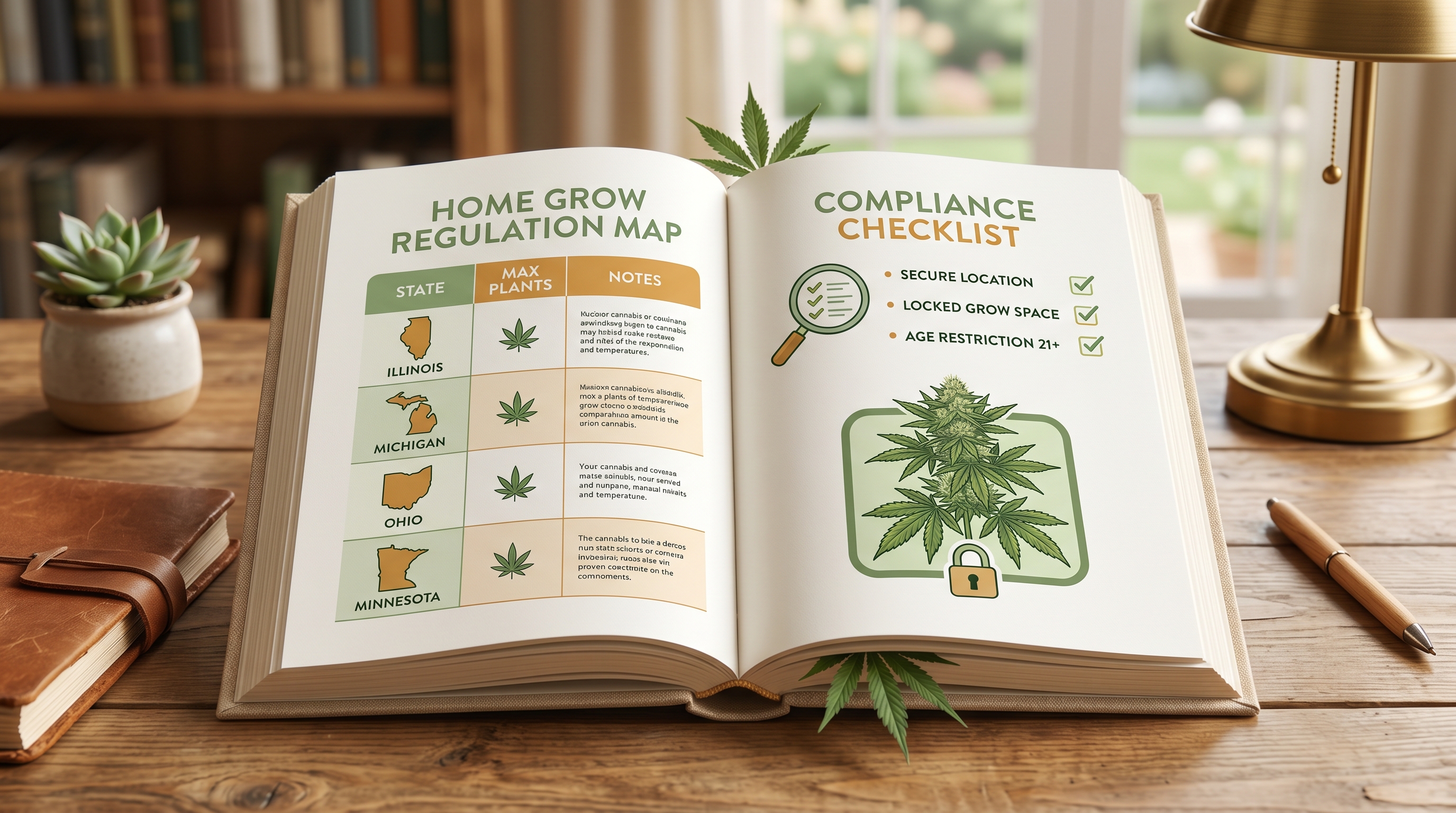
Here’s where Illinois departs from its Midwest neighbors. Recreational home cultivation is not legal.
Under the Cannabis Regulation and Tax Act, only Registered Qualifying Medical Cannabis Patients may grow at home, and even then the cap is five plants per household. Those plants have to be kept in an enclosed, locked space, out of public view, inside the patient’s residence.
So if you’re an adult who just wants to grow a couple of plants for personal use, Illinois says no. That’s a real contrast with Missouri, where any adult can grow with a cheap registration, or Minnesota, which lets adults grow up to eight plants without a card. Ohio also allows adult home grows. Illinois remains the Midwest outlier on this point.
Growing more than five plants — or growing at all without being a registered patient — is a separate offense under the Act. So if you’re a medical patient curious about cultivation, start with our how to grow cannabis at home beginner’s guide and the cannabis growing stages seed to harvest timeline. And renters, read can your landlord ban cannabis first — a lease can restrict cultivation even where the state allows it.
The Tax: Built Around THC
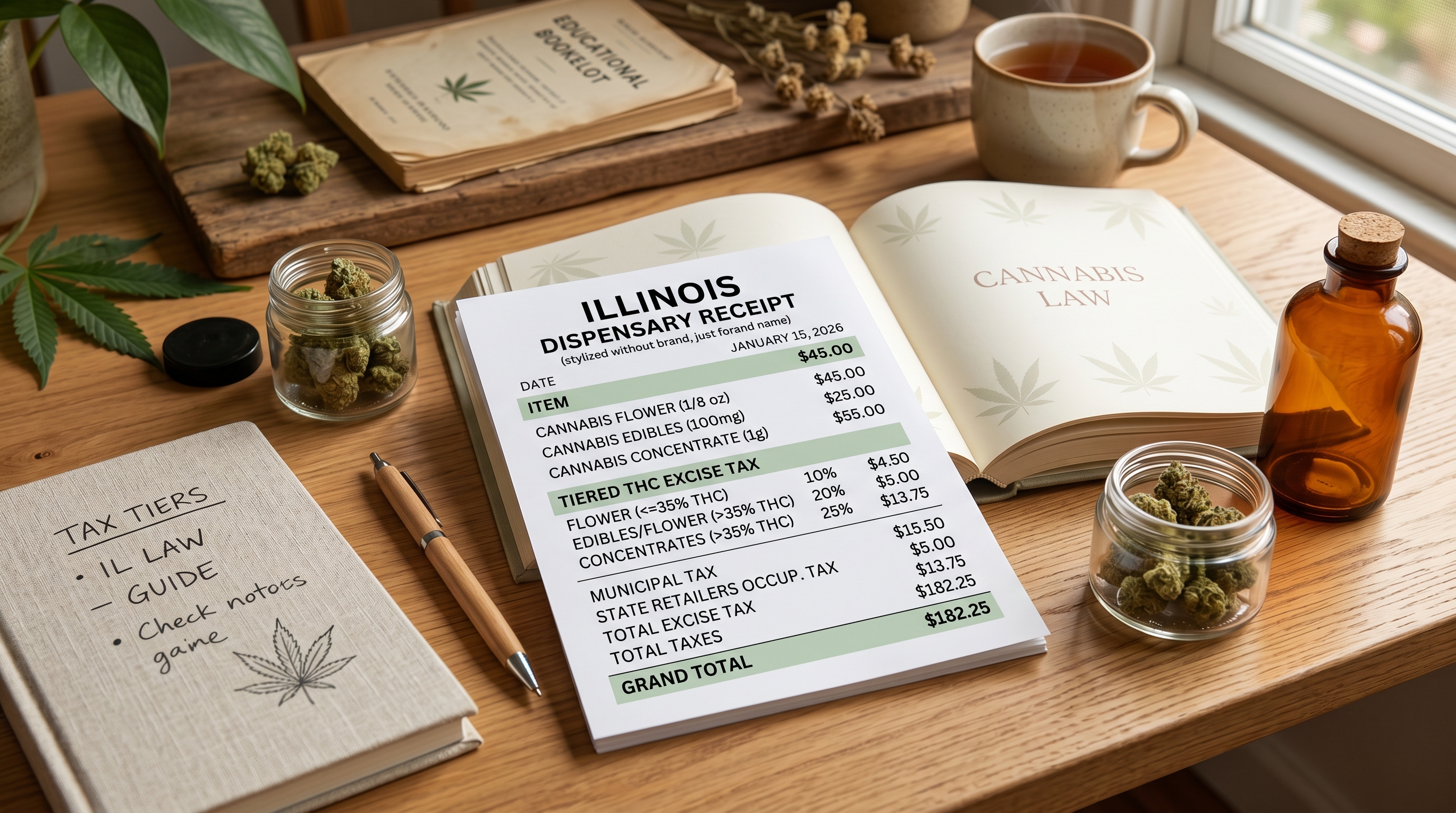
Illinois does taxes differently from most legal states, and it’s worth understanding before you’re surprised at checkout. Instead of one flat rate, the state ties the excise tax to potency. The more THC, the more you pay.
The cannabis purchaser excise tax breaks down like this:
- 10% of the purchase price for cannabis flower and other non-infused products with an adjusted THC level at or below 35%
- 25% for non-infused products above 35% THC
- 20% for any cannabis-infused product (edibles, beverages, tinctures), regardless of potency
On top of that excise tax, you’ll pay the state’s standard 6.25% sales tax, plus local taxes that can run up to roughly 3.5% depending on your city and county. Stack it all together and your total at the register can land anywhere from about 20% to nearly 35% of the sticker price. Cultivators also pay a separate 7% tax on their first sale into the supply chain.
It’s one of the heavier tax structures in the country, and that’s by design. Illinois built legalization partly as a revenue engine, and the money goes somewhere specific — which brings us to the part that made Illinois famous.
Where the Money Goes: The R3 Program
After covering the cost of running the program, Illinois directs cannabis tax revenue by formula. The largest single slice — 25% — funds the Restore, Reinvest, and Renew (R3) Program, which sends grants into the communities hit hardest by the war on drugs. Another large portion goes to the state’s general fund, with smaller shares directed to mental health and substance-use services (20%), local government, public education, and law enforcement.
That R3 commitment is unusual. Plenty of states tax cannabis. Far fewer write a community-reinvestment mandate directly into the statute and fund it from day one. It’s the financial engine behind the social-equity ambitions we’ll get to in a moment.
If you want the history of why those communities were disproportionately harmed in the first place, our pieces on the war on drugs and the Reagan era and the 1970 Controlled Substances Act trace exactly how we got here.
Expungement: Hundreds of Thousands of Records
This is where Illinois earned national attention. The Cannabis Regulation and Tax Act didn’t just legalize weed going forward — it reached backward to clear the records left behind.
The law set up two tracks. For minor offenses (possession of 30 grams or less that didn’t result in a conviction), the state pursued automatic expungement — no petition, no lawyer, no fee. For larger amounts (30 to 500 grams), people could petition the courts to vacate and expunge.
The numbers are striking. Under Governor Pritzker, Illinois pardoned more than 20,000 low-level cannabis convictions. Count both pardons and expungements together, and the state has cleared well past 700,000 cannabis records. Hundreds of thousands of minor, non-conviction records were wiped automatically.
It hasn’t been frictionless — the volume is enormous, and clearing decades of old paper files takes time. But the design is the headline. Build the cleanup into the legalization law itself, fund it from cannabis revenue, and don’t make people who were already harmed do the paperwork. That’s the template reform advocates in other states keep pointing to.
Social Equity: The Ambition and the Reality
Illinois tried to do something genuinely hard. It wanted the people most harmed by prohibition to get a real shot at owning the new legal businesses. So the Act created a social equity applicant category. Qualifying for it opened the door to lower fees, bonus points on applications, and low-interest loans and grants from the Cannabis Business Development Fund.
You can qualify as a social equity applicant through several pathways, including:
- Owning 51% or more of a business while having lived at least 5 of the past 10 years in a Disproportionately Impacted Area (a community defined by high poverty and heavy past cannabis enforcement)
- Having a cannabis arrest or conviction eligible for expungement, or being the parent, child, or spouse of someone who does
- Running a business where a majority of employees meet those residency or conviction criteria
The intent was clear: tie legalization to repair, not just revenue. The execution has been harder. Lawsuits over the licensing lotteries delayed the first equity-focused dispensaries by years. Many winners struggled to raise money and find real estate. In June 2025, the state paused new retail licensing. The goal was to ease the pressure on equity applicants who held licenses they couldn’t yet use. The process is expected to resume in 2026. The 500-license cap still has well over a hundred slots open.
Six years in, the honest assessment is mixed. The legal scaffolding is among the most ambitious in the nation. The on-the-ground results — how many equity entrepreneurs actually opened profitable doors — have lagged the promise. That gap is exactly why Illinois is studied: it shows both what’s possible to write into law and how much harder it is to deliver.
Public Use, Driving & Crossing Borders
A few rules people break without realizing it.
Public consumption is illegal. The Act does not let you smoke, vape, or eat cannabis in any public place. That includes streets, parks, sidewalks, and vehicles. Consumption is meant to happen in a private residence (with exceptions — landlords and condo boards can prohibit it) or at a small number of specially licensed venues. Brush up on cannabis etiquette so you don’t become that person at the cookout.
Driving under the influence is banned. Legalization covered possession, not impaired driving. Illinois sets a per se limit of 5 nanograms of THC per milliliter of whole blood (or 10 ng in other bodily substances) within two hours of driving. The tricky part is that THC can linger in your body long after the high fades, so timing matters more than most people assume. We covered the science in cannabis and driving: how long to wait and how long THC stays in your system.
Crossing state lines is still illegal. Cannabis remains federally controlled. You cannot legally carry Illinois-bought product into Indiana, Wisconsin, Iowa, Kentucky, or Missouri — not even into another legal state. See how to travel with cannabis and interstate cannabis commerce for the full why. And because cannabis is federally illegal, gun ownership gets complicated for users — read can cannabis users own a gun if that affects you.
Frequently Asked Questions
Do I need a medical card to buy cannabis in Illinois? No. Any adult 21 or older can buy from a licensed dispensary with a valid ID. A medical card still has perks — most notably, it’s the only way to legally grow at home. If you want one, our medical marijuana card state-by-state guide explains the steps.
How much can I legally possess? Residents: 30 grams of flower, 5 grams of concentrate, and 500 mg of THC in infused products. Non-residents get exactly half of each.
Can I grow my own at home? Only if you’re a registered medical cannabis patient, and then up to five plants in a locked, private space. Recreational home grow is not legal in Illinois.
Were old convictions really cleared? Yes. Illinois pardoned more than 20,000 low-level cannabis convictions and cleared well over 700,000 cannabis-related records, much of it automatically.
Can I use cannabis in public? No. Public consumption is prohibited. Use is limited to private residences (where allowed) and a small number of licensed venues.
Why is my dispensary bill so high? Illinois layers a THC-tiered excise tax (10–25%) on top of the 6.25% state sales tax and local taxes, so the total can approach 35%.
How to Actually Choose What Works for You
Legal access is the starting line, not the finish. The harder question is which products do what you want — and that has almost nothing to do with the indica/sativa labels on the menu. We unpack why in indica vs sativa: the myth and what science actually says in 2026. Then we offer a better framework in understanding High Families.
The real predictor of your experience isn’t the strain name — it’s how your body responds to a terpene and cannabinoid profile. A strain rich in myrcene tends toward the heavy, couch-locked end of the Relaxing High family, the kind of profile you’ll find in classics like Granddaddy Purple or Northern Lights. Bright, citrusy limonene leans toward the mood-lifting Uplift High — think Super Lemon Haze or Tangie. If pinene and terpinolene dominate, you’re more in Energetic High territory, like Jack Herer or Durban Poison. And caryophyllene-forward strains such as GSC sit closer to the Relieving High family for pain relief. Beginners often do best with balanced profiles — the Balancing High family and a gentle hybrid like Blue Dream — while the full-spectrum Entourage High shows what happens when many compounds work together.
That’s what tools like the High IQ app help you track. Log what you try, note how it actually felt, and let your own patterns guide the next dispensary trip. As I always say, the goal isn’t to memorize a strain — it’s to know exactly why you’re high.
Key Takeaways
- Cannabis is legal in Illinois for adults 21 and older under the Cannabis Regulation and Tax Act (410 ILCS 705), effective January 1, 2020.
- Residents can hold 30 g of flower, 5 g of concentrate, and 500 mg of THC in edibles; non-residents get half of each.
- Home grow is limited to registered medical patients (5 plants) — there is no recreational home cultivation.
- The tax is tiered by THC potency (10–25% excise) on top of sales and local taxes.
- Illinois cleared over 700,000 cannabis records and built one of the nation’s most ambitious social-equity programs — with real results on expungement and a rockier road on equity ownership.
- Public use and impaired driving remain illegal, and you can’t carry product across state lines.
Sources
- Illinois Cannabis Regulation Oversight Office — Frequently Asked Questions
- Illinois General Assembly — 410 ILCS 705, Cannabis Regulation and Tax Act
- Illinois Department of Revenue — Cannabis Taxes
- Marijuana Policy Project — Overview of the Illinois Cannabis Regulation and Tax Act
- Illinois Office of the Governor — Expungement and pardon announcements
- The Chicago Reporter — Six years in, has Illinois’ cannabis equity law delivered?
This article is for educational purposes only and is not legal advice. Cannabis laws change frequently and enforcement varies by county and municipality. Always verify current rules with the Illinois Cannabis Regulation Oversight Office or a licensed attorney before acting.


