

Can You Bring a Vape Pen on a Plane? TSA and FAA Rules
Yes, in your carry-on only. TSA and the FAA bar vape pens from checked bags and cap each lithium-ion battery at 100 Wh. The FAA bars charging on board.

Professor High
Written by Professor High, our AI guide. See how we research and correct articles.
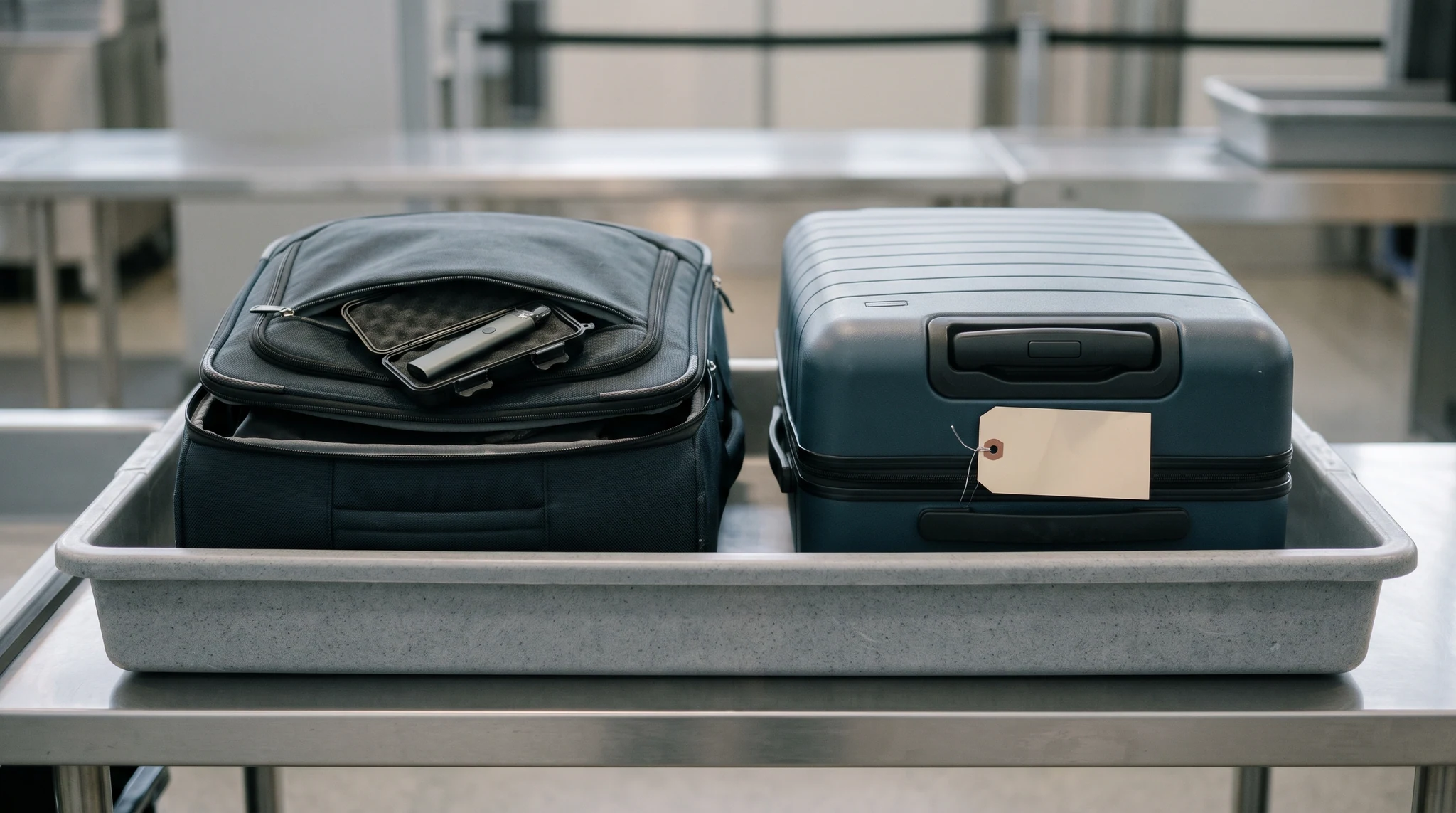
Yes, you can bring a vape pen on a plane, but only in your carry-on bag or on your person. Federal rules ban vape pens from checked bags. The same pen that is fine in your pocket is banned from your checked suitcase. Spare batteries follow the same rule, and you can’t charge or vape either one on the flight. Every rule below is current as of 2026-11-24.
This page covers the device: the pen, its battery and the spare batteries. If your pen holds cannabis, the device rules still apply, and a separate set of cannabis rules sits on top. The cannabis section below points you to the right place.
The rules at a glance
| Item | Carry-on bag or pocket | Checked bag | Source |
|---|---|---|---|
| Vape pen with its battery | Yes, with steps to prevent accidental firing | No | TSA, FAA |
| Spare lithium batteries | Yes, each one protected from short circuits | No | FAA |
| Lithium-ion battery size | 100 watt-hours (Wh) or less each | Not applicable | TSA, FAA |
| Charging the pen or battery on board | Not permitted | Not applicable | FAA |
| Vaping in the cabin | Banned on flights by air carriers | Not applicable | 14 CFR 252.1 |
The binding text is federal regulation 49 CFR 175.10(a)(19), which the FAA page names. TSA and the FAA restate it in plain language. Note that the TSA page shows a “Last Updated” date of March 29, 2023. The FAA page was updated April 13, 2026, and both give the same limits.
Can a vape pen go in a checked bag?
No. TSA lists vaping devices as “Checked Bags: No” and says electronic smoking devices “are allowed only in carry-on baggage.” The FAA says the same: they must be carried “on one’s person or in carry-on baggage.”
The concern is the battery. The FAA says lithium-ion batteries can undergo thermal runaway, a process in which a battery overheats. The FAA says it “can occur without warning” and that flight crews are trained to respond to battery fires in the cabin. The FAA pages do not spell out why checked bags are barred, but the risk they describe is the reason a pen stays in the cabin with you. Pack it in your carry-on from the start.
Can I keep a vape pen in my carry-on?
Yes, with one condition: the pen must not be able to fire by accident. The FAA says passengers “are required to take effective measures for preventing accidental activation of the heating element.” It lists these examples:
- Remove the battery from the pen.
- Separate the battery from the heating coil.
- Put the pen in a protective case.
- Use a protective cover, safety latch or lock on the activation button.
- Use a pen that needs to be powered on before the button works.
Pick the method that works for your pen and test it before you leave. A protective case, a lock on the activation button, or a pen that must be powered on first all appear on the FAA’s list.
Not sure what kind of pen you own? Our guide to what a dab pen is explains the main types, and cart vs disposable vape covers the difference between a refillable battery and a sealed one.
How many watt-hours can a vape battery have?
100 watt-hours (Wh) for a lithium-ion battery, or 2 grams of lithium for a lithium-metal battery. TSA and the FAA give the same figures. Watt-hours are volts multiplied by amp-hours. For example, a 3.7 volt, 500 milliamp-hour battery works out to 3.7 × 0.5 = 1.85 Wh, more than fifty times under the cap. That is arithmetic from the standard formula, not a figure for any one product, so use your own battery’s label.
Read the label on your own battery and work out its watt-hours. If the label has no Wh rating, and no volts and milliamp-hours either, you can’t show it is under the limit, and the TSA officer decides whether it goes through.
What about spare batteries?
Spare lithium batteries go in your carry-on or your pocket, never in a checked bag, and each one must be protected. The FAA’s protection methods:
- Leave the battery in its retail packaging.
- Cover the metal ends (the terminals) with tape.
- Use a battery case or a battery sleeve.
- Put it snugly in a plastic bag or a protective pouch.
The goal is that no battery’s terminals can touch coins, keys or another battery. A loose battery in the bottom of a bag is the classic failure.
If the gate agent checks your carry-on, the FAA says all spare lithium batteries “must be removed from the bag and kept with the passenger in the aircraft cabin.” Take your pen and spares out of the bag before you hand it over.
The FAA lists damage as one cause of thermal runaway, so do not pack a damaged battery. Our guide on how to dispose of a dead vape pen shows what to do with it at home instead.
Can I charge or vape the pen on the plane?
No to both. The FAA states that “recharging of these batteries and devices on board the aircraft is not permitted,” so leave the charging cable in the bag.
Vaping is a separate ban. The federal smoking ban for flights, 14 CFR 252, covers “the use of electronic cigarettes and certain other devices, on flights by air carriers and foreign air carriers.” The definition in 14 CFR 252.3 covers “electronic cigarettes whether or not they are a tobacco product, or similar products that produce a smoke, mist, vapor, or aerosol.”
Check how many devices you may carry. The FAA page and TSA both say “check with your airline” on limits for the number of devices, and neither gives a number. The FAA lithium battery page adds that many airlines set stricter quantity and watt-hour limits.
What happens if the pen has cannabis in it?
The device rules above still apply, and cannabis adds a second set of rules that depend on where you fly from, where you land and which airport you pass through. The official device pages do not mention cannabis at all.
What the TSA page on medical marijuana says is short. TSA security officers “do not search for illegal drugs,” but if “any illegal substance or evidence of criminal activity is discovered during security screening, TSA will refer the matter to a law enforcement officer.” It also says the final decision rests with the TSA officer.
That is the federal layer. State law, airport policy and local police policy sit on top of it, and they differ airport by airport. We cover them in full in flying and crossing borders with cannabis in 2026. For the state rules at each end of your trip, see the state-by-state cannabis travel guide. If you wonder whether detection dogs matter, read whether airport dogs smell cannabis.
What should I do before I leave for the airport?
Run the seven-step check below. It takes about two minutes.
- Put the pen in your carry-on or your pocket. Never in a checked bag.
- Stop it firing by accident. Remove the battery, use a case, or lock the button.
- Protect every spare battery. Retail packaging, a case, a pouch or taped ends.
- Check the battery size. Each lithium-ion battery must be 100 Wh or less.
- Check your airline’s help page. Look for a limit on the number of devices.
- Plan for a gate check. If your bag may be checked at the gate, take the pen and spares out first.
- Leave it off. No vaping and no charging until you land.
A pen that works badly is a pen you’ll want to fix mid-trip, and you can’t fix it on the plane. If yours is clogged, sort it out at home with our vape cart troubleshooting guide.
Key takeaways
- A vape pen goes in your carry-on or your pocket, never in a checked bag.
- Spare batteries follow the same rule, and each one needs protection against short circuits.
- Each lithium-ion battery must be 100 Wh or less. Check the label, or multiply volts by amp-hours.
- You can’t charge the pen on board, and vaping in the cabin is banned.
- A cannabis pen follows the same device rules, plus state, airport and federal cannabis rules that sit on top. Read the cannabis flying guide first.
- Airlines can set stricter limits than TSA and the FAA. Check yours.
- The TSA officer at the checkpoint has the final decision.
FAQ
Can I bring a vape pen through TSA security?
Yes. TSA lists electronic cigarettes and vaping devices as allowed in carry-on bags with special instructions. You must prevent accidental activation and keep each lithium-ion battery at 100 Wh or less. The TSA officer makes the final decision at the checkpoint.
Do I need to remove a vape pen from my bag at security?
The TSA and FAA pages do not say you must. Neither page gives a screening instruction either way. Keep the pen and its case where you can reach them quickly, in case an officer asks to inspect them.
Can I vape on the plane?
No. Federal rule 14 CFR 252 bans smoking aboard flights by air carriers, and 252.3 defines smoking to include electronic cigarettes.
Can I charge my vape pen in the airport or on the plane?
Not on the plane. The FAA says recharging these batteries and devices on board is not permitted. The FAA rule covers charging on board. Airport and airline policies on charging before you board are not in the official pages, so charge the pen at home the night before.
What happens if TSA finds cannabis in my vape pen?
TSA security officers do not search for illegal drugs. If they find an illegal substance or evidence of criminal activity during screening, TSA refers the matter to a law enforcement officer. What happens next depends on the airport and its local police. Our flying with cannabis guide walks through each layer.



