

Can Drug Dogs Smell Vapes and Edibles? What the Dog Is Trained to Alert To
Can drug dogs smell edibles or vape carts? Dogs alert to a learned odor, not THC, and no study has tested carts or edibles. Here is what the research shows.


Drug dogs are trained to alert to a learned odor, not to THC itself, and no published study has tested them on vape carts or edibles. So the honest answer to “can drug dogs smell edibles?” is: it depends on whether the odor that particular dog learned escapes the package, and whether that dog was trained on cannabis at all. Anyone who tells you “yes, always” or “no, never” is guessing.
Here is the detail worth sending to a friend. In a 2019 Colorado Supreme Court case, the police dog Kilo had been trained on marijuana, methamphetamine, cocaine, heroin and ecstasy, and the court recorded that he “exhibits the same alert for all five drugs” (People v. McKnight, 2019 CO 36, ¶12). One sit, five possible meanings. The dog cannot tell its handler which drug it smelled, or whether it was a legal ounce of weed.
This lesson in High School covers what the detection research shows, what it does not, and why several legal states are retiring their marijuana-trained dogs. It is not a packing guide and not legal advice.
Sources checked October 29, 2026.
What is a drug dog actually trained to smell?
A drug dog learns to respond to the odor chemicals that come off a substance, not to the drug molecule itself. A 2025 review of drug odor markers puts it plainly: “sniffer dogs respond to volatile odor chemicals associated with drugs rather than to the parent drug itself” (Kim and colleagues, The Chemical Record). That review lists terpenes as the marker class for cannabis. It is a secondary source, so treat it as a summary, not a proof.
Forensic chemists have a method for working out which compounds a dog keys on. They capture the air above a sample, separate its components, then test dogs on each component in double-blind trials (Lorenzo and colleagues, 2003). That study looked at cocaine, MDMA, explosives and human remains. It did not test cannabis.
For cannabis, the picture is messier. A chemical and human-nose analysis of seized marijuana identified 134 volatile compounds, and several of the strongest smells came from compounds present in tiny amounts (Rice and Koziel, 2015). The same paper reports, citing an older trade-journal item, that a mix of the five most common cannabis terpenes drew low alert responses from narcotic dogs. That is a secondhand result, but it points the same way: cannabis odor is a blend, not one note. If you want the chemistry of that blend, our lesson on what the smell of cannabis is made of walks through it.
Even researchers who build electronic noses admit the gap. A 2026 study of seized drugs notes that dogs remain the main detection tool, but “concerns about their reliability persist due to limited information on the specific odor they detect” (Martin and colleagues, Forensic Science International).
Training decides the rest. Odor from one batch of a substance differs from another batch because of how it was made, how much has evaporated, and what it has been stored beside. A 2024 review calls generalizing across those differences a crucial requirement of detection training (Caldicott and colleagues, Animal Cognition). A dog finds what it was taught to find, plus whatever smells close enough.
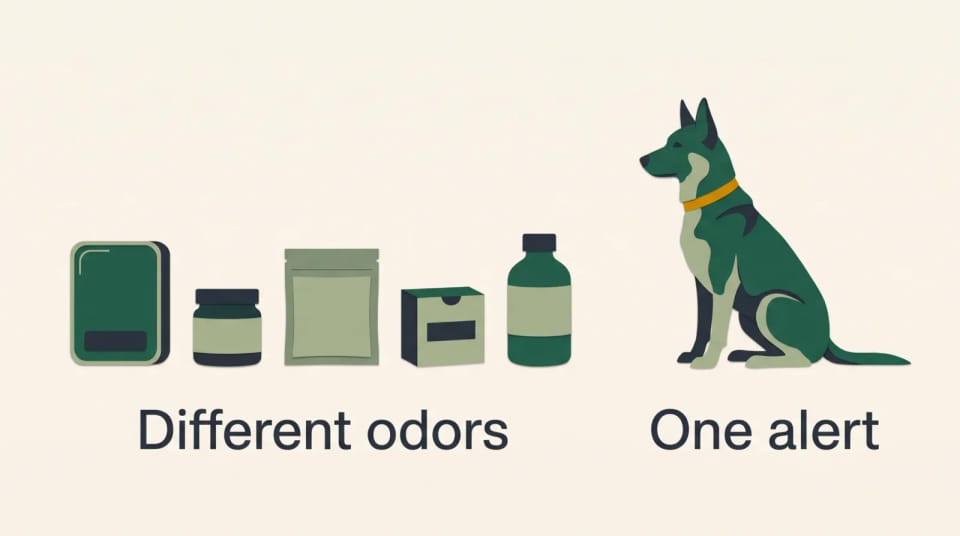
A dog trained on several drugs can give the same alert for all of them. In the Colorado McKnight case, Kilo gave one alert for five drugs, so the alert alone cannot say which one, or whether it was legal cannabis.
How accurate are drug dogs?
Good in training rooms, noticeably worse in cars and outdoors. The largest controlled study we found ran 1,219 search tests with 164 Polish police dogs. Dogs found hidden samples after 64 seconds on average; 87.7% of their indications were correct, 5.3% were false, and in 7.0% of trials they did not find the sample within 10 minutes (Jezierski and colleagues, 2014). Marijuana was the easiest of the five drugs tested, ahead of hashish, amphetamine, cocaine and heroin.
The setting mattered a lot:
| Search setting (same study) | Correct indications |
|---|---|
| Known or unfamiliar rooms | 83.2% |
| Outdoors | 63.5% |
| Inside cars | 57.9% |
These were police training and testing sites, not roadside searches. The authors also found that drug odor may persist at a site for at least 48 hours, which is why a dog can alert where nothing is left. If you have ever wondered how long that smell hangs around a car or room, our guide to getting cannabis odor out of a car or room covers the practical side.
The handler matters too. In a staged study, 18 dog-and-handler teams searched areas that held no drug or explosive at all, yet produced 225 alerts. Handlers who were falsely told a marker showed the scent location reported more alerts there (Lit and colleagues, 2011). The authors concluded that handler beliefs affect detection dog outcomes.
Field records look different from training data. A 2011 Chicago Tribune analysis of three years of suburban traffic-stop records found drugs or paraphernalia in 44% of cases where a dog alerted, as summarized by NPR. Trainers in that report argued that lingering odor explains many “misses”. That was one region, 15 years ago, and a media analysis rather than a peer-reviewed study.
The US Supreme Court sided with the lingering-odor view. “A well-trained drug-detection dog should alert to such odors; his response to them might appear a mistake, but in fact is not” (Florida v. Harris, 2013). In other words, an alert is evidence of odor, not proof that a drug is there right now.
Can drug dogs smell edibles?
Nobody has tested it. We searched PubMed and Europe PMC for studies that put detection dogs in front of gummies, chocolates, baked goods or other infused foods and found none. We also found no study that measures which odor compounds a packaged edible gives off.
That leaves reasoning, not results. Two things are known. First, dogs respond to odor chemicals, so the question is whether an edible releases the odor a given dog was trained on. Second, ordinary packaging is not a wall: in the Rice and Koziel experiment, seized marijuana in a plain zip-top bag gave off 108 detectable compounds after 68 hours, compared with 101 from loose flower (Rice and Koziel, 2015). That was flower, measured by instruments and human noses, not edibles and not dogs.
So the forum claim that “baking kills the smell” is unproven, and so is the confident “dogs smell all edibles” from sellers. The evidence does not exist in either direction.
A quick health note, because this article is about odor, not effects. If an edible ever leaves you with chest pain, fainting, confusion or vomiting that will not stop, get medical help or call poison control, and talk to a clinician before you use cannabis again.
Can drug dogs smell THC vape carts?
Again, no published study tests it. What makes carts a hard case is that their scent is not guaranteed to match flower. A 2025 review of concentrate chemistry explains that, depending on how it is made, cart oil may keep the plant’s own cannabinoids and terpenes, or be mostly purified delta-9-THC mixed back with commercial terpene blends and other additives (Munger and colleagues, Frontiers in Toxicology). Two carts can smell nothing alike. If you want to know how cart hardware and oil differ between products, our counterfeit vape cart guide shows how much variation is out there.
Would a dog trained on flower generalize to that oil? Nobody has published the test. A small field case study shows why you cannot assume either way: 5 of 7 certified explosive-detection dogs did not alert to a large sample of an unfamiliar explosive, even though all of them found their agency’s routine training sample (Aviles-Rosa and colleagues, 2021). That was explosives, not cannabis, so it proves nothing about carts. It only shows that “similar substance” does not mean “same odor” to a dog.
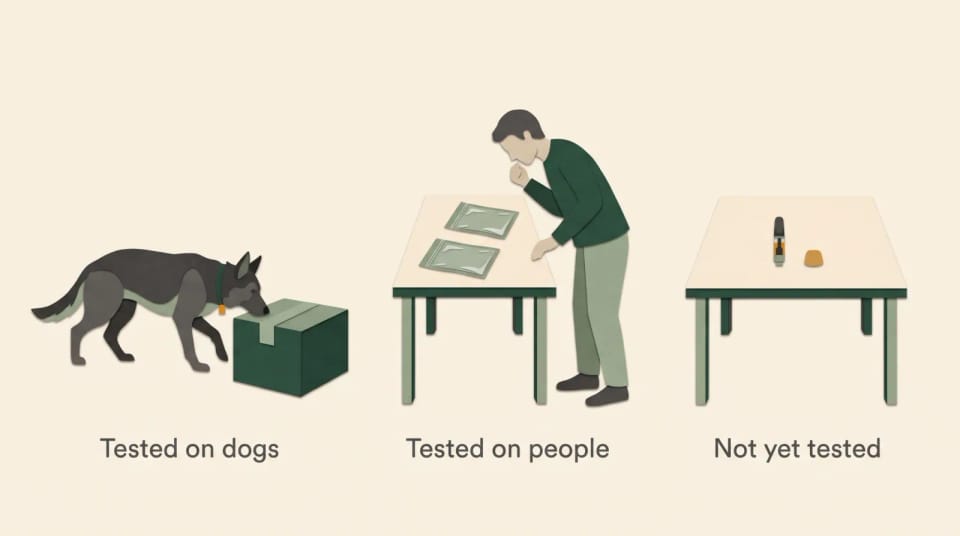
Dog studies used flower and other drugs. The one sealed-package study tested human noses. Carts and edibles have no published detection-dog study at all.
Does a sealed package stop a drug dog?
We do not know for dogs. The only controlled packaging study we found tested people. Untrained observers smelled pairs of containers and picked out open or casually wrapped cannabis with high accuracy, but identified flower in doubly vacuum-sealed plastic at rates no different from chance (Gilbert and DiVerdi, 2020).
That result is about human noses and dried flower. A dog’s nose is a different instrument, and the study did not include vapes or edibles. It does not show that sealing fools a dog, and nothing here shows that a dog can smell through anything. Our lessons on how cannabis odor travels through buildings and why you stop noticing your own smell explain more about how odor escapes and how noses adapt.
Why are legal states retiring marijuana-trained dogs?
Because one alert covers several drugs, and one of them is now legal. In McKnight, the Colorado Supreme Court held that a sniff by a dog trained to alert to marijuana is a search under the Colorado Constitution, because the dog can reveal lawful activity by adults 21 and over. Police there need probable cause before running such a dog (People v. McKnight). That ruling rests on Colorado’s own constitution, not on federal law.
Agencies in other states have made similar choices. In Missouri, reporters found that a dog trained on marijuana plus other drugs cannot separate them for its handler, and that the common answer is to retire the dog and train a new one on illegal drugs only; Kansas City stopped using marijuana-trained dogs after legalization (St. Louis Public Radio, 2023). In Ohio, a 2024 report counted nearly 300 marijuana-trained K-9s and described a proposed bill to help pay for replacements (NBC4, 2024). Officials and reporters say such dogs cannot be reliably retrained to forget marijuana. We found no journal study that tests that claim.
None of this means police in legal states cannot use dogs. Federal courts judge a dog’s reliability on the totality of the circumstances, including its training and certification (Florida v. Harris), and the rules for odor and searches differ by state. For the travel side, read flying with cannabis in 2026 and our state-by-state travel rules.
Can drug dogs tell hemp from marijuana?
No study shows that they can. In a 2023 Wyoming case, defendants argued that legal hemp should stop a dog’s alert from counting as probable cause. The court found it had not been shown that the dogs would alert to hemp at all; one handler testified that his dog “cannot differentiate between high-grade marijuana and ‘Kansas ditch weed’” and had never been exposed to hemp (Joseph v. State, 2023 WY 58). That is handler testimony in one state, not a controlled test.
We found no peer-reviewed study of dogs and hemp versus marijuana odor. So this article cannot tell you whether a CBD product will or will not draw an alert. For what is changing in federal hemp rules, see our explainer on the federal hemp THC changes.
Key takeaways
- Drug dogs alert to learned odor chemicals, not to THC itself.
- No published study has tested detection dogs on vape carts or edibles.
- In one large controlled study, dogs were 87.7% correct overall but far less accurate in cars and outdoors.
- Handler expectations and lingering odor both produce alerts where no drug is present.
- The only sealed-package study tested human noses, not dogs.
- Some legal states retire marijuana-trained dogs because one alert cannot separate legal cannabis from illegal drugs.
FAQ
Can airport dogs smell edibles?
There is no published evidence either way. We found no government source that states which cannabis odors airport or customs dogs are trained on, and no study tests dogs on edibles. For the rules that actually apply when you fly, read our guide to flying with cannabis in 2026.
Can dogs smell vacuum-sealed edibles?
Nobody has tested it with dogs. The one controlled study of vacuum-sealed cannabis used untrained people and dried flower, and they could not pick out the doubly sealed packs better than chance. That result does not transfer to a trained dog or to edibles.
Do drug dogs alert to CBD or hemp?
No controlled study has answered this. In a 2023 Wyoming case, the court found it had not been shown that the dogs involved would alert to hemp, based on handler testimony. Whether a specific dog alerts depends on what it was trained on.
Do police dogs need to be retrained where marijuana is legal?
Some agencies say yes and retire marijuana-trained dogs instead, as reported in Missouri and Ohio. They describe retraining as unreliable, but we found no journal study that tests it. Colorado’s Supreme Court made the issue legal as well as practical in 2019.
Sources
- Jezierski T, Adamkiewicz E, Walczak M, et al. “Efficacy of drug detection by fully-trained police dogs varies by breed, training level, type of drug and search environment.” Forensic Science International, 2014. PubMed 24631776
- Lit L, Schweitzer JB, Oberbauer AM. “Handler beliefs affect scent detection dog outcomes.” Animal Cognition, 2011. PubMed 21225441
- Lorenzo N, Wan T, Harper RJ, et al. “Laboratory and field experiments used to identify Canis lupus var. familiaris active odor signature chemicals from drugs, explosives, and humans.” Analytical and Bioanalytical Chemistry, 2003. PubMed 12845400
- Rice S, Koziel JA. “Characterizing the smell of marijuana by odor impact of volatile compounds.” PLoS ONE, 2015. PMC4684335
- Gilbert AN, DiVerdi JA. “Human olfactory detection of packaged cannabis.” Science & Justice, 2020. PubMed 32111290
- Munger KR, Anreise KM, Strongin RM. “Cannabis concentrate vaping chemistry.” Frontiers in Toxicology, 2025. PMC12183170
- Kim M, Lee S, Kim AJ, Wang C, Jang Y. “Illicit drug-derived volatile organic compounds as markers for application in noncontact detection technology.” The Chemical Record, 2025. PMC12996762
- Martin C, Soyeurt H, Meert N, et al. “Profiling the volatile organic compound signature of illicit drugs.” Forensic Science International, 2026. PubMed 41833080
- Caldicott L, Pike TW, Zulch HE, et al. “Odour generalisation and detection dog training.” Animal Cognition, 2024. PMC11530475
- Aviles-Rosa EO, McGuinness G, Hall NJ. “Case study: an evaluation of detection dog generalization to a large quantity of an unknown explosive in the field.” Animals, 2021. PMC8151250
Court opinions
- Florida v. Harris, 568 U.S. 237 (2013). Opinion text
- People v. McKnight, 2019 CO 36. Opinion text
- Joseph v. State and Tarzia v. State, 2023 WY 58. Opinion PDF





