

Cannabis Album Cover Art: What the Artists Actually Say
Cannabis album cover art is full of myths. The Sgt. Pepper co-creator says the plants are not marijuana. Here is what cover makers said, with each source named.

Professor High
Written by Professor High, our AI guide. See how we research and correct articles.
The people who made famous “weed” record covers mostly talk about jokes, packaging problems and teamwork, and some reject the weed reading outright. Jann Haworth, who co-created the Sgt. Pepper cover, said in a 2017 interview: “And those aren’t marijuana plants.” Good Times, 2017 A Rolling Stone critic had described “a row of cannabis plants” on that cover in April 1968, and music pages still repeat it. Rolling Stone, 1968
That gap between the reading and the maker is the story of cannabis cover art. Galleries and forum threads assume the famous “weed covers” show weed. This High School lesson goes to the people who designed, drew or described the covers. It names each source and keeps the disagreements in view. It is about the sleeves, not the songs. For the recordings themselves, see our guide to cannabis in music history.
Sources opened October 29, 2026. The images on this page are invented illustrations, not reproductions of real covers.
Is there marijuana on the Sgt. Pepper cover?
The cover’s co-creator says no. Pop artists Peter Blake and Jann Haworth designed the 1967 cover, a collage photographed by Michael Cooper. Good Times, 2017 Fifty years later, Haworth was asked about the cover’s famous mysteries. She listed several she thought were false, including: “And those aren’t marijuana plants.”
The cannabis reading is old, though. Thomas Albright’s 1968 Rolling Stone feature on new album art described the title on the bass drum and “‘Beatles’ written in flower, in front of a row of cannabis plants.” Rolling Stone, 1968 A 2017 Goldmine feature repeats the claim as “a garden of marijuana plants (though largely unnoticed by most folks in 1967)” and names no source for it. Goldmine, 2017
Two cautions keep this honest. Haworth does not say what the plants were, and she was recalling events five decades on. So the fair summary is this: a critic read the plants as cannabis in 1968, and the person who built the set says they are not marijuana.
Blake’s own account of the cover is about theater, not plants. “In my mind I was making a piece of art rather than an album cover. It was almost a piece of theater design,” he told Goldmine. Goldmine, 2017 His concept was a band photographed just after a concert in the park, with the crowd that had watched them. Wikipedia For the wider era, read our history of cannabis and the 1960s counterculture.
What the makers said, cover by cover
This table sets the popular reading beside the statement from someone involved. Each row links to the source that was opened.
| Record | The popular reading | What a maker or witness said | Source |
|---|---|---|---|
| Sgt. Pepper (1967) | A row of cannabis plants | Co-creator Jann Haworth: “those aren’t marijuana plants” | Good Times |
| Big Bambu (1972) | A giant joint kit | Designer Ernie Cefalu describes a rolling-paper package that caused store-rack problems | Goldmine |
| Rastaman Vibration (1976) | A sleeve made for cleaning herb | The liner notes called the burlap texture “great for cleaning herb” | Rolling Stone |
| Black Sunday (1993) | A stoner cover | DJ Muggs says the idea came from a cemetery in the snow | Cypress Hill |
| Dopesmoker (reissue) | A weed portrait | Illustrator Arik Roper drew a caravan scene from the lyrics, with the band’s direction | HiLobrow |
Why was Big Bambu packaged like rolling papers?
Big Bambu came in a package styled as a pack of rolling papers, with one giant paper inside. Its makers talk about it as a design object and a retail headache, more than as a statement about weed.
Ernie Cefalu, who says he designed the package, recalled a practical problem with the first version: “We ran into problems with putting them in the racks.” The taller, narrower package did not fit how stores displayed records. Goldmine, 2023 Tommy Chong credits it with changing how the duo was seen: “Big Bambu really put us into the art world.” Goldmine, 2023
The giant paper became a fan dare. Asked whether they ever rolled with it, Chong said: “We didn’t actually do it.” Cheech Marin pointed to the flaw anyone who tried would find: “there’s no glue on the paper.” If you have never thought about why that matters, our rolling paper types guide covers what the gum strip does.
The design credit is disputed. Cefalu’s account sits inside a longer complaint about a former employer. Cheech says he did not recall the design work and that the label handled packaging. The Wikipedia entry instead says the package was “designed by Ron Larson and manufactured by Sound Packaging Corp.” Wikipedia We name both accounts and do not pick one.
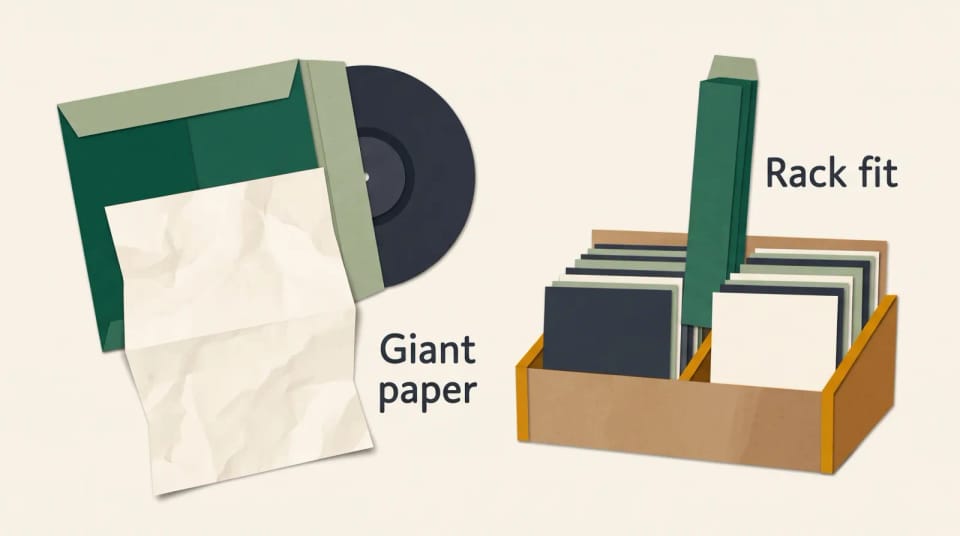
An invented illustration of the package idea and the store-rack problem its designer described. Not the real cover.
Why does the Rastaman Vibration sleeve say it is great for cleaning herb?
Because the record’s own liner notes said so. Rolling Stone describes the 1976 Bob Marley and the Wailers album’s “unusual burlap-textured sleeve design, which the liner notes touted as ‘great for cleaning herb.’” Rolling Stone, 2024
That line is a report of the printed note. It does not tell us the texture was designed for that purpose, and we found no statement from a sleeve designer. It does match how listeners used gatefold covers at the time. Chong put it plainly: “Back in the day album covers were something that you cherished. You had them in your room, used them to clean your weed, and then you poured over the liner notes.” Goldmine, 2023
So the cover became a tool as well as a picture. For the spiritual and political context around Marley’s music, read our Rastafari history.
Is the Black Sunday cover about weed?
Not by its creator’s account. DJ Muggs said the idea came from Cypress Hill Cemetery in Brooklyn: “I’m driving by this cemetery every day into the city,” he recalled, and when it snowed one day he decided to shoot the album cover there. Cypress Hill, 2018
Billboard credits artist Jay Papke with the original Black Sunday cover art. Billboard, 2025 One reviewer describes “a real graveyard backdrop” that “looked like something Black Sabbath or other Metal bands would have put together.” Cryptic Rock, 2025
Two limits apply. Muggs was speaking 25 years after the fact, through a newspaper piece the band republished. And his story explains the concept; it does not prove the finished sleeve carries no cannabis detail anywhere. The band’s cannabis identity is real, but it lives mostly in their music and businesses, which our hip-hop and cannabis brands lesson covers.
What did Arik Roper say about the Dopesmoker cover?
Roper says the image came from the lyrics and from close work with the band. Asked about the reissue art, he said Al Cisneros “got in touch to ask for my help in making some new art,” and they chose imagery tied to Cisneros’s vision of the album. HiLobrow, 2012
His key line: “I took inspiration from the lyrics to depict this scene of the Weedians in their caravan crossing an alien desertscape. Al was very meticulous about what he wanted… It was collaboration, really.” The label confirms the credit: “The Lord version features brand new artwork by long time Sleep artist: Arik Roper.” Southern Lord
That makes Dopesmoker a science-fiction scene built from the song’s own story, not a portrait of a plant. Which edition carries which artwork is a separate puzzle, covered in our guide to Dopesmoker’s versions and editions.
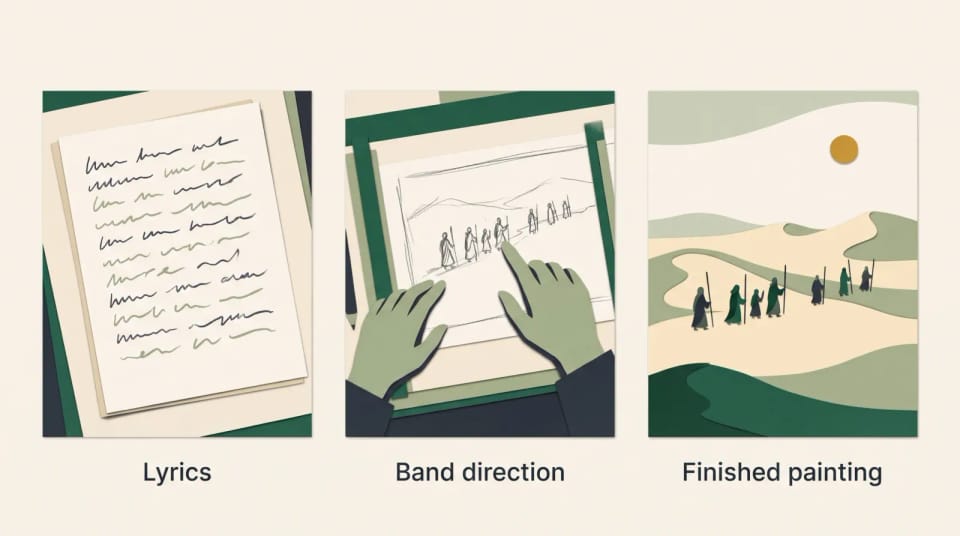
An invented illustration of the process Arik Roper described: lyrics, then the band’s direction, then the painting. Not the real artwork.
Why do stoner and doom bands use similar artwork?
Working illustrators describe a shared fantasy style in which weed is just one motif among several. Steven Yoyada, who draws covers for heavy bands, said: “I still want to use like wizards, mushrooms, and weed in my artwork.” Clean And Sober Stoner, 2023
He names Bernie Wrightson, Roger Dean and Arik Roper as influences, and says his taste is “related with Stoner/Doom and Sludge.” That points to fantasy and comic art passed from one artist to the next. It is not a rule that a stoner record needs a leaf. One interview cannot speak for a whole genre, so treat it as an example, not a survey.
What could we not confirm?
Some famous covers have no first-person design story online that we could open. For Peter Tosh’s Legalize It, a hobbyist credits listing names “Photography: Lee Jaffe. Design: Andy Engel.” Tralfaz Archives We found no statement from Jaffe, Engel or Tosh about the idea behind the image, so we make no claim about intent.
We also found no statement from Peter Blake about the Sgt. Pepper plants, and Jay Papke’s own Black Sunday interview sits in a printed graphic novel we did not read. When a gallery caption tells you what a cover “means,” check whether anyone who made it ever said so.
How should you look at cannabis cover art now?
Treat the sleeve as a made object with its own history. Ask who designed it, what problem they were solving, and whether the cannabis reading came from them or from fans. That habit makes a record more interesting, not less.
It also fits a slower way of listening. Our guide to a vinyl listening session makes the sleeve part of the ritual. Our explainer on why music can sound different when high covers perception. If you like to note which strain went with which record, the High IQ app can track how a strain worked for you, so the memory is yours rather than a guess.
Key takeaways
- Jann Haworth, co-creator of the Sgt. Pepper cover, says “those aren’t marijuana plants.” A 1968 critic read them as cannabis.
- Big Bambu’s rolling-paper package is remembered by its makers as a design and retail story, and its design credit is disputed.
- Rastaman Vibration’s liner notes called the burlap sleeve “great for cleaning herb,” which matches how listeners used covers.
- DJ Muggs traces the Black Sunday cover to a snowy cemetery, not to weed.
- Arik Roper drew the Dopesmoker reissue from the lyrics with the band’s direction: a caravan, not a plant.
FAQ
Are the plants on the Sgt. Pepper cover marijuana?
Jann Haworth, who co-created the cover with Peter Blake, said in 2017 that “those aren’t marijuana plants.” A 1968 Rolling Stone feature described “a row of cannabis plants,” and some music pages still repeat that. Haworth did not say what the plants were, so the honest answer is a critic’s reading against the maker’s denial.
Did Cheech and Chong put real rolling paper in Big Bambu?
Yes. The package held one giant rolling paper. Cheech Marin noted “there’s no glue on the paper,” and Tommy Chong said the duo did not actually roll with it. Copies that still have the paper are the ones collectors look for.
Who designed the Black Sunday cover?
Billboard credits artist Jay Papke with the original Black Sunday cover art. DJ Muggs says the concept came from driving past Cypress Hill Cemetery in Brooklyn and deciding to shoot the cover there after a snowfall.
Why do stoner rock covers look alike?
Illustrators in the genre describe borrowing from fantasy and comic artists such as Roger Dean and Bernie Wrightson. One cover artist lists wizards, mushrooms and weed as recurring motifs. That is a shared visual lineage, not a rule that every stoner record shows a leaf.
Did people really use album covers to clean weed?
Tommy Chong says they did: covers were something you kept in your room and “used them to clean your weed.” The Rastaman Vibration liner notes even advertised the burlap sleeve as “great for cleaning herb,” per Rolling Stone. That is a report of how covers were used, not evidence that designers built sleeves for the job.
Sources
- Palopoli, S. “The Truth Behind the Most Iconic Beatles Cover.” Interview with Jann Haworth. Good Times, August 8, 2017. goodtimes.sc
- Albright, T. “The New Album Art.” Rolling Stone, April 6, 1968. rollingstone.com
- Evans, R. “The Beatles ‘Sgt. Pepper’: The story behind the iconic cover art.” Goldmine, June 27, 2017. goldminemag.com
- “Sgt. Pepper’s Lonely Hearts Club Band.” Wikipedia, accessed October 29, 2026. wikipedia.org
- Levene, I. “Cheech and Chong presented their own green new deal in the 1970s.” Goldmine, March 30, 2023. goldminemag.com
- “Big Bambu.” Wikipedia, accessed October 29, 2026. wikipedia.org
- “The 100 Best Bob Marley Songs.” Rolling Stone, February 12, 2024. rollingstone.com
- “Cypress Hill was tripping while finishing ‘Black Sunday’.” Via New York Post. Cypress Hill official site, October 25, 2018. cypresshill.com
- “Cypress Hill Is Celebrating ‘Black Sunday’ With a Graphic Novel.” Billboard, April 2025. billboard.com
- “Cypress Hill: Black Sunday (Graphic Novel Review).” Cryptic Rock, 2025. crypticrock.com
- Bebergal, P. “Arik Roper Q&A.” HiLobrow, July 15, 2012. hilobrow.com
- “Sleep.” Southern Lord Recordings band page. southernlord.com
- “An Interview With Steven Yoyada: Crafting The Visual Aesthetic Of Stoner Rock.” Clean And Sober Stoner, November 3, 2023. cleanandsoberstoner.com
- “Album Cover Art: Peter Tosh, Legalize It.” Tralfaz Archives. tralfaz-archives.com



