Cannabis and the Counterculture: From Beatniks to Woodstock
From smoky jazz clubs and Beat poets to the Summer of Love and Woodstock, trace how cannabis became the counterculture's symbol of peace and rebellion.

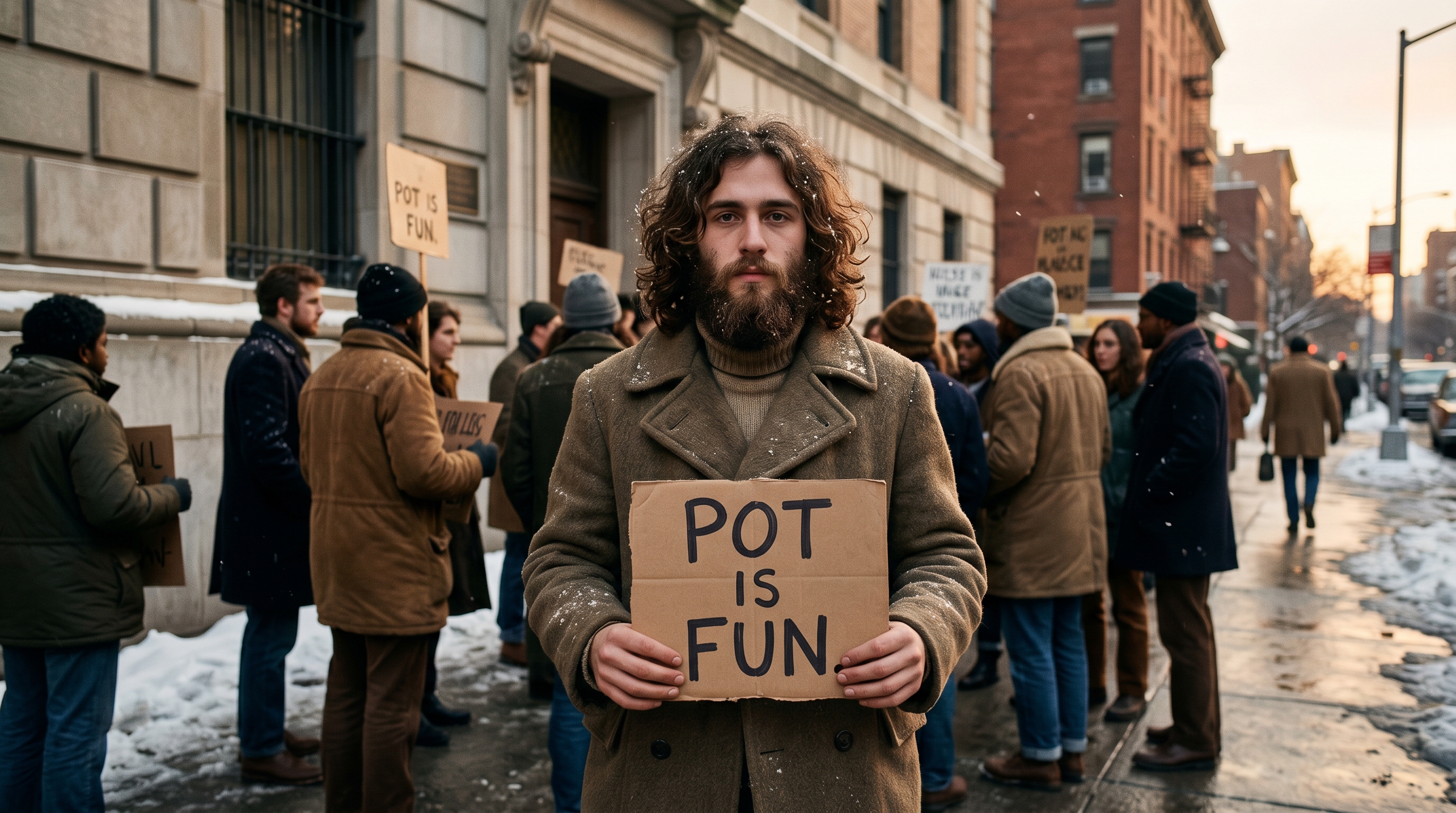
Picture a cold New York sidewalk in the winter of 1964. A bearded poet stands outside a women’s jail holding a hand-lettered sign that reads “POT IS FUN.” Snowflakes catch in his beard. A dozen people chant beside him. To passersby, it looked like a stunt. In hindsight, it was the opening scene of a cultural revolution.
That poet was Allen Ginsberg. Over the next decade, cannabis moved from the edges of American life to the center of a cultural earthquake. It traveled from smoky jazz clubs to Beat paperbacks. Then to the Summer of Love and the muddy fields of Woodstock. Along the way, it became something no plant had been before in modern America. It became a symbol. Of peace. Of rebellion. Of a generation that stopped believing what its government told it.
This is the story of how that happened, and why it still shapes the way we talk about cannabis today.
Beat Roots: Jazz Clubs, “Tea,” and the First American Pot Poets
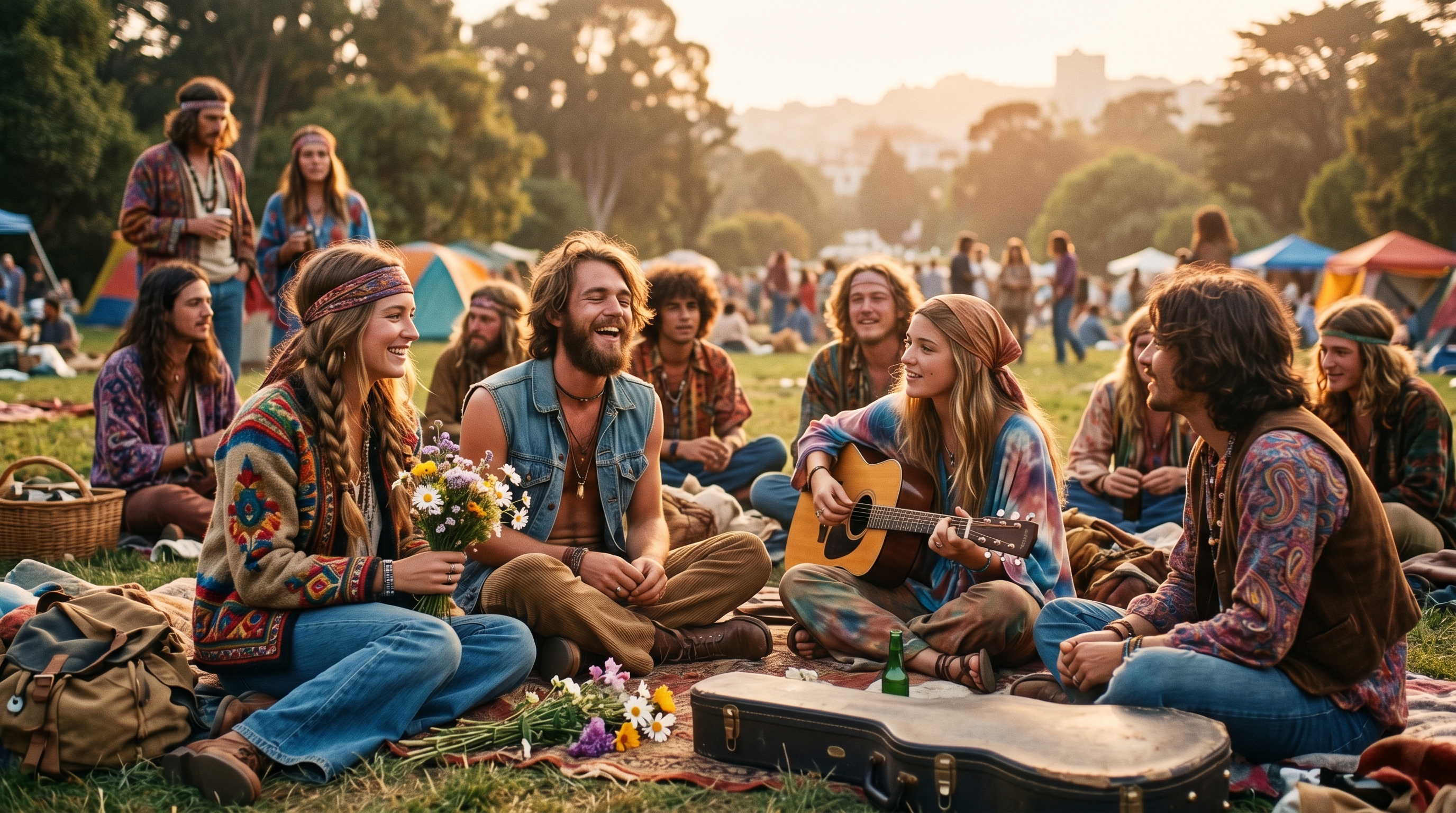
Cannabis did not arrive with the hippies. By the 1940s and ’50s, it was already woven through American jazz culture. Black musicians, Mexican-American communities, and bohemian crowds had kept it alive for decades. Louis Armstrong was a lifelong smoker. The clarinetist Mezz Mezzrow grew so famous as a supplier that “mezz” became slang for top-grade grass. As Mezzrow put it, “Tea puts a musician in a real masterly sphere… you hear everything at once and you hear it right.” That bond between cannabis and sound never went away. Our look at cannabis in music from jazz clubs to hip-hop traces it in full.
The Beat writers absorbed that jazz world directly. Jack Kerouac, Allen Ginsberg, and William S. Burroughs met around Columbia University in the mid-1940s. Together they built a literary movement. It was rooted in restless travel, Eastern faith, and a flat refusal of postwar conformity. Cannabis sat at the center of it. In On the Road (1957), Kerouac wove “tea” through the story, using the same jazz slang the musicians used. Burroughs wrote about “tea heads” in Junky. Ginsberg’s landmark poem Howl (1956) named cannabis openly.
The line of transmission was almost literal. Armstrong and Mezzrow helped turn on Ginsberg and the Beats. From the Beats, the habit spread to the hippies and the anti-war movement. The Beats did not invent American cannabis use. What they did was make it literary. They put it in the hands of serious writers who refused to apologize. When Howl survived its 1957 obscenity trial, a judge ruled it had “redeeming social importance.” Its frank drug references became protected speech. The government tried to bury a poem and made it famous instead.
The Hippies and the Summer of Love
The Beats were a small, urban crowd dressed in black. The hippies who followed in the 1960s were a much larger youth movement dressed in tie-dye. As historian W.J. Rorabaugh put it, the Beats “wrote the philosophical script that the hippies would later perform on a much larger stage.” Neal Cassady even drove the literal bridge between the eras. He was the driver of Ken Kesey’s psychedelic bus.
The turning point came in San Francisco’s Haight-Ashbury district. On January 14, 1967, an estimated 20,000 to 30,000 people gathered in Golden Gate Park for the Human Be-In. Ginsberg, Timothy Leary, and poet Gary Snyder spoke. Cannabis smoke hung over the whole crowd. At a similar moment, Leary coined the era’s most famous slogan: “Turn on, tune in, drop out.”
That winter gathering set the stage for the Summer of Love. In 1967, roughly 100,000 young people streamed into Haight-Ashbury. Time magazine said the movement was “blooming in every major U.S. city,” reaching some 300,000 people nationwide. Here is the detail that mattered most. For the first time, marijuana was not just for jazz musicians, poets, or border communities. It was used openly, in daylight, by middle-class white college students. That shift mattered more than any legal argument. It put a sympathetic, mainstream face on a banned plant. If the era grabs you, our history of how cannabis culture differs around the world shows how those American roots traveled.
Woodstock and the Birth of Festival Culture
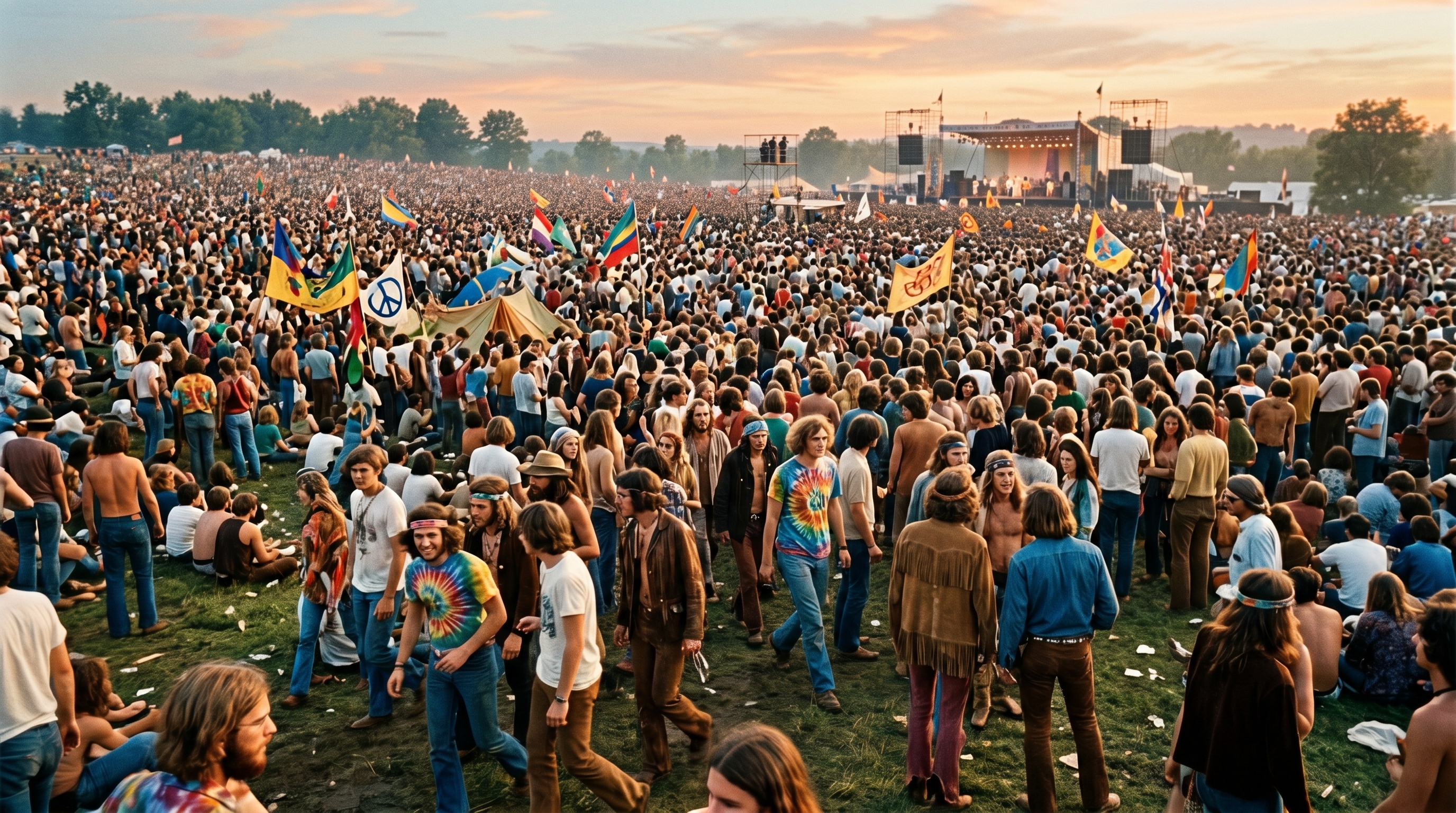
If the Summer of Love made cannabis visible, Woodstock made it legendary. Held August 15-18, 1969, on Max Yasgur’s dairy farm in Bethel, New York, the festival was billed as “An Aquarian Exposition: 3 Days of Peace & Music.” Organizers expected perhaps 50,000 people. More than 400,000 showed up.
Joan Baez, the Grateful Dead, Jimi Hendrix, Janis Joplin, Jefferson Airplane, The Who, and Crosby, Stills, Nash & Young played through overcast skies and rain. The New York Times ran an editorial titled “Nightmare in the Catskills.” It sneered at “the dreams of marijuana and rock music that drew 300,000 fans.” But coverage softened fast. Parents heard from their kids by phone and reported that the chaos was peaceful. Half a million strangers shared a muddy field for three days, and almost no one fought. Cannabis was part of the glue.
Woodstock more or less invented the modern music festival. It made an annual ritual where the herb and the music are inseparable. Want to carry that tradition forward? Our cannabis music festival survival guide and the science of why music sounds better high pick up where the 1960s left off. The dream did not last. Four months later, the Altamont festival ended in violence. By the early 1970s, the “love generation” had hit a harder reality.
Music, Marijuana, and the Sound of a Generation
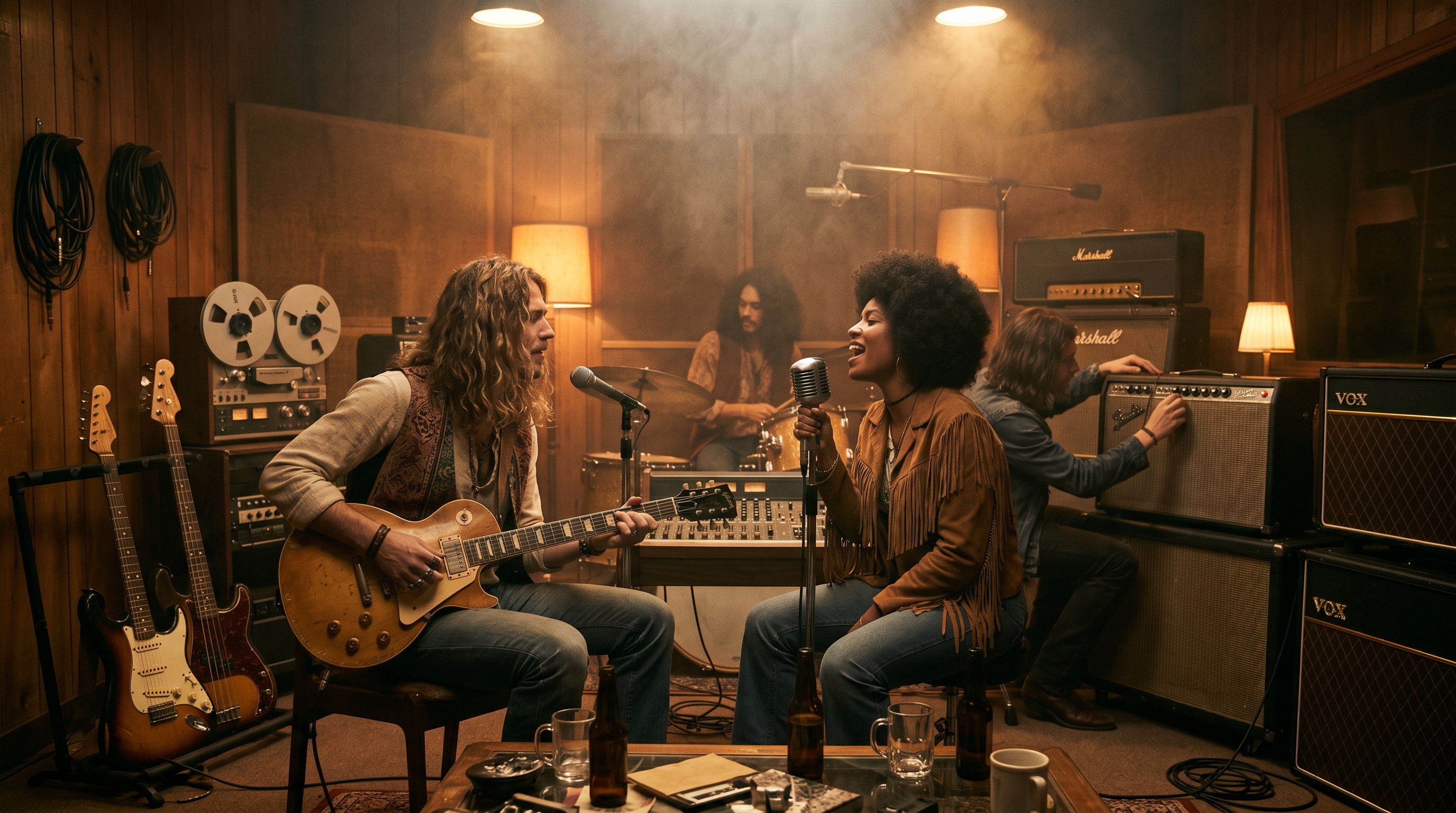
You cannot separate 1960s cannabis from 1960s music. The connection ran so deep that one of rock’s most consequential drug moments happened in a hotel room.
On August 28, 1964, Bob Dylan introduced The Beatles to marijuana at the Delmonico Hotel in New York. Dylan assumed they already smoked. He had misheard the line in “I Want to Hold Your Hand” as “I get high.” (The real lyric is “I can’t hide.”) The Beatles admitted they had never really smoked. Dylan rolled the first joint. By Paul McCartney’s account, Ringo Starr was the “royal taster.” Within a year, the band was, in John Lennon’s words, “smoking marijuana for breakfast.” Their music began its turn toward Rubber Soul and Sgt. Pepper’s. Dylan, in turn, soon went electric. As one writer put it, after that meeting “the Beatles’ words got grittier and Bob invented folk-rock.”
Meanwhile in San Francisco, the Grateful Dead lived communally at 710 Ashbury Street and made cannabis part of their identity. When police raided the house in 1967, the band held a press conference on the same front steps the next day. The message was not contrition but defiance: the laws were wrong, and everyone knew it. We dig deeper into that bond in how cannabis fuels musical creativity and our ultimate strain-and-music pairing guide.
Cannabis as a Symbol of Peace and Rebellion
By the late 1960s, lighting a joint was more than a way to get high. It was a statement. Marijuana use exploded on fast-growing college campuses. The simple act of using a banned plant in secret created shared identity. It also created shared distrust of authority.
The writer Jeremy Narby describes cannabis as carrying “an aura of cool rebelliousness.” Its users seemed harmless next to real criminals. In the UK, a judge sentenced Rolling Stone Keith Richards to a year in prison in 1967. The crime was a tiny amount of cannabis. Richards later admitted the judge “managed to turn me into some folk hero overnight.” The crackdowns were making the very martyrs the establishment feared.
In the United States, cannabis fused with the big currents of the age. Those included the Vietnam War protests, civil rights, free love, and a deep suspicion of government. The hippie movement peaked as the war escalated and faded as it wound down. To smoke was to signal which side you were on. Our look at how weed went mainstream in fashion shows how those symbols outlived the era.
Planting the Seeds of Legalization: LeMar and NORML
Out of that ferment came the first real push to change the law. In 1964, Allen Ginsberg co-founded LeMar (short for “Legalize Marijuana”) in New York City. His partners were poet Ed Sanders and activist Randy Wicker. It was one of the very first organized cannabis-legalization groups in American history. It predated the modern movement by years.
LeMar’s tactics were small but pointed. On a cold January day in 1965, Ginsberg led about a dozen demonstrators. They marched outside the New York Women’s House of Detention, a jail that held people on low-level drug charges. That march produced the famous “Pot Is Fun” photograph. The goal, Sanders said, was “to get people who use marijuana to stand up and agitate for its legalization.” LeMar framed cannabis prohibition as a civil-rights issue. That framing would echo for decades.
LeMar later fed into a West Coast group called Amorphia. In 1970, a young attorney named Keith Stroup founded NORML, the National Organization for the Reform of Marijuana Laws, in Washington, D.C. Stroup ran it as a single-issue consumer group, “a Nader’s Raiders for reefer smokers.” The amateur poets on a snowy sidewalk had become a professional lobby. For the longer arc, see the history of cannabis from ancient medicine to modern science and how 4/20 became cannabis culture.
Collision: Nixon, the Controlled Substances Act, and the Shafer Commission
The counterculture’s victory was also its weak spot. The movement tied cannabis to radical politics, anti-war protest, and challenges to authority. That gave prohibition’s defenders an easy target. Richard Nixon saw it at once.
On October 27, 1970, Congress passed the Controlled Substances Act. It was part of the Comprehensive Drug Abuse Prevention and Control Act. The law created the five-schedule system that still governs federal drug policy. It placed marijuana in Schedule I: “no currently accepted medical use” and “high potential for abuse.” The placement was meant to be temporary. It waited on a commission Nixon himself would appoint. (We cover the law in depth in the 1970 Controlled Substances Act, which followed the earlier 1937 Marihuana Tax Act.)
That commission was chaired by Republican former Pennsylvania Governor Raymond Shafer. It studied the question seriously. Its 1972 report, Marihuana: A Signal of Misunderstanding, found that “neither the marihuana user nor the drug itself can be said to constitute a danger to public safety.” It recommended decriminalizing personal possession. White House tapes later showed Nixon had told Shafer to “keep your commission in line.” He had privately raged about legalization advocates. When the report crossed him, Nixon refused to even read it. The “temporary” Schedule I status became permanent. It stayed that way for over half a century. Our histories of the War on Drugs in the Reagan era and how reefer madness gave way to The Dude in cinema trace what came next.
The deeper irony, as journalist Martin A. Lee observed, is that prohibition “had little to do with the actual effects of the herb and everything to do with who was using it.” Nixon’s drug war was a tool. It stigmatized youth protest, anti-war feeling, and dissent itself. The plant was a stand-in for a culture war.
The Legacy: Why the 1960s Still Matter
The counterculture lost the legal battle but won something bigger. Millions of young people tried marijuana. They found that the government’s “reefer madness” warnings were absurd. They concluded, correctly, that they had been lied to. That credibility gap poisoned public trust in drug education for generations. It also planted the seeds of every reform movement since. The slow march toward cannabis legalization in the United States and the recent rescheduling to Schedule III traces straight back to that snowy 1964 sidewalk.
The cultural DNA is everywhere today. You see it in festival culture. You see it in the bond between cannabis and music. You see it in the very idea that the plant is a matter of personal freedom, not criminal danger. The hippies framed cannabis as natural, communal, and freeing. They were not all right, and they were not all wrong. What they sensed, and what science is now catching up to, is that cannabis is deeply personal. The Beats found their “kick.” The hippies found their peace. Woodstock found its connection. All from the same plant working differently in different bodies.
That insight is exactly why we built High IQ. The 1960s gave cannabis its symbolism. Our era can give it precision. Instead of chasing the same strain everyone swears by, you can track what truly works for you. The terpene profiles. The High Families. The effects that match your goals. Half a century after a poet picketed for the right to a kick, the most radical act might just be paying attention to your own experience.
Key Takeaways
- Cannabis did not start with the hippies. Jazz musicians and the Beat writers carried it for decades first.
- The Beats made cannabis literary. The hippies made it mass, moving it onto college campuses and into the open.
- Woodstock (1969) turned the music festival into a lasting ritual, with cannabis at its core.
- Bob Dylan turned The Beatles on to pot in 1964, and rock’s psychedelic turn followed.
- Allen Ginsberg’s LeMar (1964) launched organized legalization activism, which led to NORML in 1970.
- Nixon’s 1970 Controlled Substances Act made cannabis Schedule I, then he buried his own commission’s call to decriminalize.
- The era’s lasting lesson is that cannabis is personal, which is exactly what modern tracking lets you measure.
Frequently Asked Questions
Did the hippies invent cannabis use in America? No. By the time the hippies arrived, jazz musicians, Mexican-American communities, and the Beat writers had sustained American cannabis culture for decades. What the counterculture did was make it mass, mainstream, and political, moving it out of underground clubs and onto college campuses.
Who introduced The Beatles to marijuana? Bob Dylan, at the Delmonico Hotel in New York City on August 28, 1964. The meeting is widely credited with influencing the psychedelic turn in The Beatles’ music over the following years.
What was LeMar? LeMar (Legalize Marijuana) was one of the first organized cannabis-legalization groups in the United States, co-founded by Beat poet Allen Ginsberg in 1964. Its civil-rights framing of prohibition influenced NORML, founded in 1970.
Why did Nixon make marijuana a Schedule I drug? The Controlled Substances Act (1970) placed marijuana in Schedule I pending study. Nixon’s own Shafer Commission recommended decriminalization in 1972, but he rejected it, in large part to stigmatize the anti-war counterculture associated with the drug.
Was cannabis really a symbol of rebellion? Yes. Because it was banned and associated with youth, anti-war protest, and civil rights, the simple act of smoking became a political statement, an identity marker that signaled opposition to mainstream authority.
Sources
- HistoryOfCannabis.org, “Beat Generation Cannabis and the 1960s Revolution”
- HistoryOfCannabis.org, “Nixon and Marijuana: CSA 1970 and Shafer Commission”
- Los Angeles Review of Books, “The Mighty Mezz, Marijuana, and the Beat Generation”
- The Emerald Magazine, “Cannabis in American Literature: From Fitz Hugh Ludlow to the Beats”
- History.com, “How the Vietnam War Empowered the Hippie Movement”
- Wikipedia, “Summer of Love” and “Woodstock”
- NORML, Keith Stroup, “A Founder Looks at 50: From LeMar to Amorphia to NORML”
- The Nation, Martin A. Lee, “Let a Thousand Flowers Bloom: The Populist Politics of Cannabis Reform”
- Congressional Research Service, “The Evolution of Marijuana as a Controlled Substance”
- Americans for Safe Access, “History of Cannabis Scheduling in the United States”
- The Beatles Bible, “28 August 1964: Bob Dylan turns The Beatles on to cannabis”


