Cannabis and Organ Transplants: What Patients Must Know
Cannabis can affect organ transplant eligibility. The history, state protection laws, real infection and drug-interaction risks, and what to ask.


Imagine you are waiting for a new heart, kidney, liver, or lung. One line on an intake form can feel like it carries your whole future: Do you use marijuana? For years, answering “yes” to that question could push a patient down a transplant list. Sometimes it pushed them off it entirely — even when a doctor had recommended the cannabis. This is one of the most important, least-discussed corners of cannabis and medicine. It deserves a careful, honest look.
This is a high-stakes topic. So let me say the most important thing first and loudest: nothing here is medical advice, and nothing here should override your transplant team. These decisions are deeply personal. They turn on your specific organ, your medications, and the rules of your specific center. The goal here is simple. It is to help you walk into those talks informed — not to make the choice for you.

Why this matters: the stakes of the transplant list
Organ transplantation is one of medicine’s great rationing problems. There are always far more people who need organs than there are organs to give. Because of that scarcity, transplant centers screen candidates closely. They try to predict who will do well with a precious, irreplaceable organ. Anything thought to raise the risk of complications, infection, or graft failure becomes part of that math.
That is the frame cannabis falls into. The question teams ask is not “is cannabis good or bad?” It is “does this person’s cannabis use change the odds that this organ and this patient survive?” For a long time, many programs answered with caution that bordered on exclusion. Some of that was grounded in real clinical risk. Some of it, in hindsight, looks more like reflex than evidence.
The history: when cannabis users were turned away
To understand today’s landscape, look at where it came from. In the past, transplant programs often treated any controlled-substance use as a contraindication. Medical cannabis got lumped in with “drug abuse.” Cannabis remains federally Schedule I. So transplant societies have listed substance use as a risk factor, but offered no clear, separate guidance on physician-recommended cannabis. That gap left each center to write its own rules. The rules varied wildly.
Real patients paid the price. In 2010, Garry Godfrey, a Maine man with Alport syndrome facing kidney failure, was removed from a transplant waiting list. His medical marijuana use was cited among the reasons. His case helped spark a Maine bill to bar denials based solely on medical cannabis. Clinicians have described other patients too. One Ohio medical cannabis patient was denied a transplant and later died. The details of many such cases never became public.
Physicians at the time captured the cruelty in one phrase: the “Catch-22.” A patient might use cannabis because it was the only thing controlling pain, nausea, or appetite loss from the very illness destroying their organ. Then they were told that the medicine helping them survive made them ineligible for the transplant that could save them. Some patients learned during their workup that they had other conditions needing medications that also counted against them. The path to the list could feel rigged from both ends.
The state laws protecting medical cannabis patients
The patient stories triggered a wave of legislation. Over the past decade and a half, a growing number of states have acted. By most counts that is more than a dozen, and arguably close to twenty depending on how you read the statutes. These laws bar transplant centers from disqualifying a candidate solely because they are a registered medical cannabis patient.
States with explicit transplant or medical-care anti-discrimination provisions include Arizona, California, Delaware, Illinois, Minnesota, New Hampshire, Washington, Ohio, New Jersey, New Mexico, New York, Utah, Rhode Island, Oklahoma, Alabama, North Dakota, and others. The exact wording differs, but the common thread is the word solely: cannabis use cannot be the lone reason for denial.

That word matters enormously. These laws are shields, not blank checks. Nearly all of them carve out an exception when a patient’s cannabis use is medically significant to the transplant. In plain terms: if a physician documents a real clinical reason the cannabis raises risk, the protection can give way. That reason might be an active infection concern, a dangerous drug interaction, or evidence of a use disorder affecting adherence. And because cannabis is still federally illegal, there is no federal protection at all. If you live in a state without one of these laws, a center is generally free to set its own policy. The patchwork is real. Your zip code can shape your access.
The genuine clinical concerns — and they are genuine
Here is where honesty matters most. It would be easy to frame every past denial as pure stigma. But for transplant patients, some of the clinical worries are real and well-documented. Pretending otherwise would do readers a disservice. There are two concerns worth understanding in depth.
1. Aspergillus and mold: a real infection danger for the immunosuppressed
After a transplant, you take immunosuppressant drugs for life. They stop your body from rejecting the new organ. That suppressed immune system is the whole point. It is also a vulnerability. It leaves you far more exposed to infections that a healthy immune system would shrug off.
Cannabis flower, like any dried plant material, can harbor fungal contaminants — most notably Aspergillus and Penicillium species. In a healthy person, inhaling a few mold spores is usually harmless. In a profoundly immunosuppressed transplant recipient, those same spores can seed invasive aspergillosis. That is a lung-and-bloodstream infection that is frequently lethal in this group. Case series in transplant recipients have reported mortality as high as 90% [Mahmoudi et al., 2022]. The medical literature documents real cases. One renal transplant recipient developed invasive pulmonary aspergillosis linked to smoking marijuana [Marks et al., 1996]. A bone-marrow transplant patient died of aspergillosis traced to Aspergillus fumigatus that matched the organism cultured from his cannabis [Hamadeh et al., 1988].
It gets worse. Cannabis smoke itself may impair the alveolar macrophages — the immune cells in the lungs that would otherwise clear inhaled pathogens. So smoked cannabis can do two harmful things at once. It can introduce the spores and weaken the local defense against them. This is the single most defensible clinical reason teams worry about cannabis. It is also why so much guidance focuses on the act of smoking, not on cannabis as a molecule. For the underlying biology, see our deep dives on cannabis and the immune system and whether secondhand cannabis smoke is actually harmful. If you inhale, the broader picture of cannabis and lung health is worth a read.
2. Drug interactions with immunosuppressants (tacrolimus and CYP3A4)
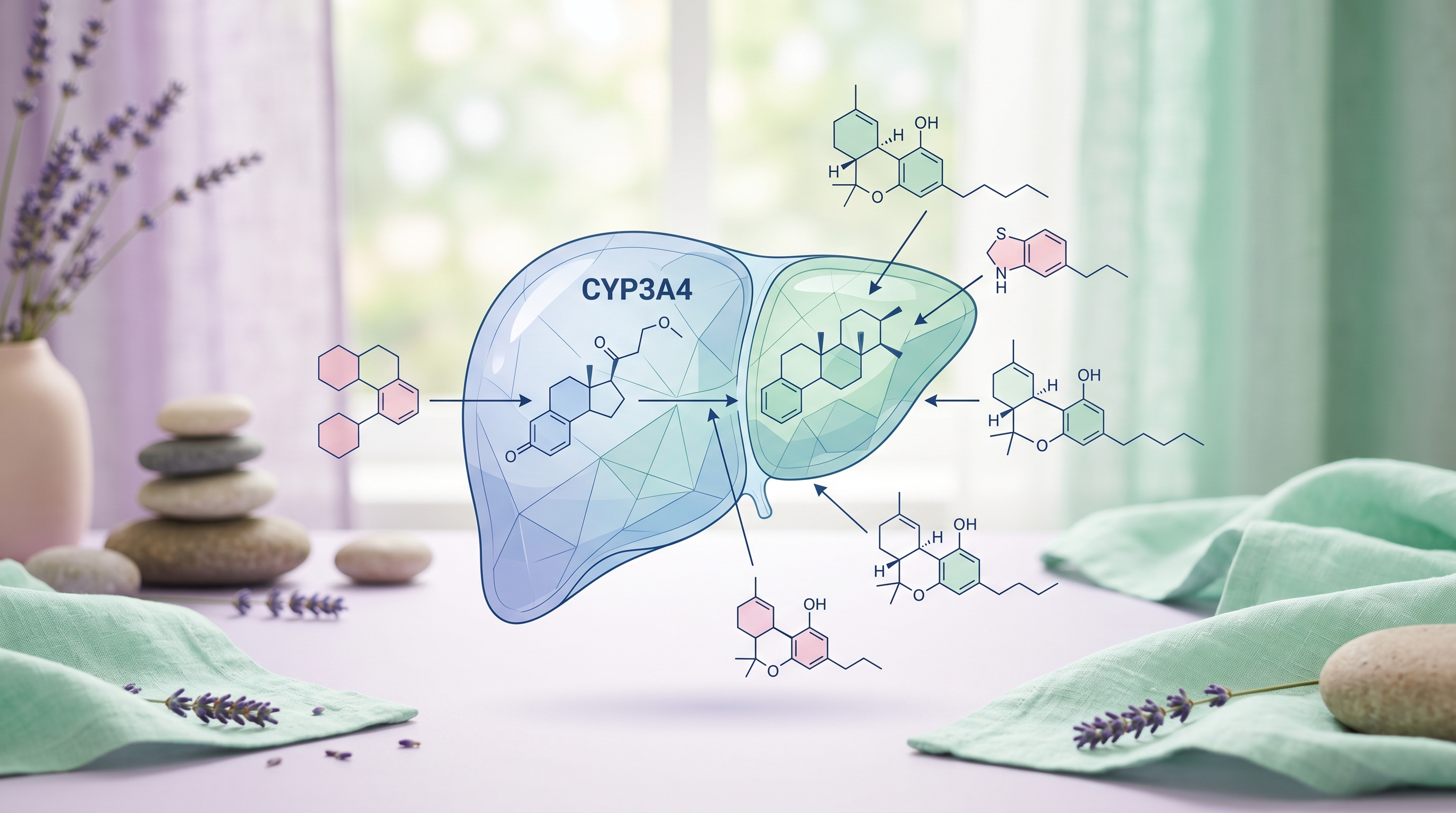
The second real concern is about drugs. Many transplant patients take tacrolimus, a workhorse immunosuppressant. It has a famously narrow therapeutic window. Too little and the organ rejects. Too much and the drug becomes toxic to the kidneys and nervous system. The liver enzyme CYP3A4 does most of the work breaking it down.
Cannabis compounds can interfere with that pathway. CBD in particular can inhibit CYP3A4 and P-glycoprotein. That can cause tacrolimus to build up to higher-than-expected blood levels. Clinicians have published case reports of tacrolimus toxicity — including altered mental status — after cannabis edible use in transplant recipients [Mahmoudi et al., 2022]. THC and CBD can also inhibit CYP2C9. That is why they can raise INR in patients on the blood thinner warfarin. These are not hypothetical. They are the kind of interactions transplant pharmacists watch for closely.
The practical takeaway is not that cannabis and transplant medication can never mix. It is simpler. If you use cannabis around immunosuppressants, your team needs to know, and your drug levels need monitoring. Our guides to cannabis and medication interactions your doctor may not mention and cannabis and blood thinners like warfarin go deeper on the CYP enzyme story. Neither replaces a talk with the pharmacist managing your regimen.
Smoking versus edibles and cleaner routes
Connect the two big concerns above and a theme jumps out. The route of use matters as much as the substance itself. The Aspergillus risk is mostly tied to inhaling burned or vaporized plant material. Swallowing a lab-tested edible or capsule sidesteps the mold-in-the-lungs problem almost entirely.
But that does not make edibles “safe” for transplant patients. It trades one risk for another. Oral cannabis is absorbed slowly and unpredictably. It peaks late and produces a more potent liver metabolite. That is exactly why the tacrolimus interaction can be sharper with edibles. Several of the documented tacrolimus-toxicity case reports involved edibles, not smoke. So the cleanest route for infection can be the riskiest for drug interactions.
There is also a quality-control layer transplant patients cannot ignore. Mold and contaminant testing in the legal market is inconsistent at best, as we cover in why lab-testing standards are failing cannabis consumers. For an immunosuppressed person, a contaminated product is not a bad night. It is a potential medical emergency. Say you and your team decide cannabis stays in the picture. Then it helps to understand vaping versus smoking, how consumption methods rank by bioavailability, and flower versus oil. Capsules and other measured oral formats at least make dosing predictable. That matters when interactions are on the table.
Candidate versus post-transplant: two different conversations
It helps to separate the timeline into two phases, because the considerations differ.
Before transplant (as a candidate): This is where eligibility and the state laws come into play. Screening practices are inconsistent across programs. Surveys have found that some centers screen every candidate, some screen based on the organ, and some do not routinely screen at all. Only a minority have a formal policy on recreational use. Reassuringly, the outcomes research has not borne out the worst fears. Large analyses of heart, lung, and liver transplants have generally found no significant difference in survival or major complications between cannabis-using and non-using recipients. A UNOS analysis of more than 23,000 heart transplants found substance-use history was not tied to lower survival [Mahmoudi et al., 2022]. This is part of why many experts now argue for individualized screening — for example, using a validated tool like the CUDIT-R to spot a genuine cannabis use disorder that might affect adherence — rather than a blanket “yes/no marijuana” rule.
After transplant (as a recipient): Now the immune-suppression and drug-interaction concerns move front and center. You are living on tacrolimus or similar drugs, and your defenses are down. The data here is more mixed. At least one kidney-transplant study linked a diagnosis of cannabis dependence or abuse in the first post-transplant year with roughly a two-fold rise in graft failure. Another found higher pneumonia rates in cannabis-using recipients. That does not mean every recipient who uses cannabis will have problems. But it does mean the post-transplant period calls for the most caution. Smoking, in particular, carries the steepest downside here.
Maybe your transplant relates to a condition where cannabis was helping with symptoms. If so, our coverage of cannabis for cancer-related symptoms, cannabis for chronic kidney disease, cannabis and HIV/AIDS, and cannabis for surgery recovery may add useful context for the trade-offs you are weighing.
Talk to your transplant team — first, honestly, and early
I cannot stress this enough. The single most protective thing you can do is be honest with your transplant team, as early as possible. Many patients want to hide cannabis use out of fear it will cost them a place on the list. That instinct is exactly what leads to dangerous, unmonitored drug levels and hidden risks. A team that knows can do real work for you. It can monitor your tacrolimus levels. It can steer you toward tested products and away from smoking. And it can document the medical picture in a way that supports your candidacy under the “solely” protections instead of undermining it.
Bring specifics. Know your state’s law, or know that it lacks one. Ask your center directly what its written cannabis policy is. Ask whether the worry is the route, the dose, the interaction, or a use-disorder question. Each one has a different solution. And remember that older patients make up a large share of transplant recipients. They have their own overlapping considerations, worth reviewing in our guide for cannabis and seniors.
Say you keep using cannabis through some phase of this process. Then track it precisely. Note the product, route, dose, lab batch, and how you respond. That turns vague self-reporting into real data you can hand your care team. That kind of pattern-tracking is exactly what the High IQ app is built for. In a situation this high-stakes, precise records are not a nice-to-have. They are part of staying safe.
Frequently asked questions
Can a transplant center legally deny me a transplant for using medical cannabis? It depends on your state. In states with anti-discrimination laws, a center cannot deny you solely for being a registered medical cannabis patient. It can deny you if there is a documented, medically significant reason. In states without such a law, and at the federal level, there is no protection. Always confirm your center’s written policy.
Is the Aspergillus risk overblown? For a healthy person, mostly yes. For a deeply immunosuppressed transplant recipient, no. Invasive aspergillosis is rare but frequently fatal in this group. Smoked cannabis is a documented route of exposure. This is the concern with the strongest evidence behind it.
Are edibles a safe workaround? They remove the inhaled-mold risk. But they can intensify the interaction with immunosuppressants like tacrolimus, because of how the liver handles oral cannabis. “Safer in one way, riskier in another” is the honest framing. Discuss it with your team.
Will using cannabis hurt my chances even before transplant? Outcomes data on cannabis-using recipients is largely reassuring for survival and major complications. The real candidacy risk is an untreated cannabis use disorder that affects medication adherence. That is treatable, and very different from occasional medical use.
Should I just quit before my transplant? That is a decision for you and your transplant team. It weighs your symptom needs against the post-transplant risks. Do not stop or change any medical regimen based on a blog post. Raise it with your physicians.
Key takeaways
Cannabis and organ transplantation sit at a genuine crossroads of stigma and real science. Some historical denials reflected reflexive prejudice that states have rightly moved to curb. But some of the underlying concerns are real, evidence-based, and worth taking seriously. Here is the short version to carry into your next appointment:
- State law may protect you, but only “solely.” More than a dozen states bar denying a transplant solely for medical cannabis use. There is no federal protection, and a documented medical reason can still override the shield.
- The mold risk is real for the immunosuppressed. Smoked or vaped cannabis can carry Aspergillus spores that are dangerous after transplant. This is the best-evidenced concern.
- Edibles trade one risk for another. They avoid the lung-infection problem but can sharpen the tacrolimus interaction through the liver. Neither route is automatically “safe.”
- Tested products and monitoring matter. If cannabis stays in the picture, lab-tested products and regular drug-level checks are not optional.
- Honesty is protective, not risky. A team that knows can monitor, advise, and document in ways that support your candidacy.
The path through is not secrecy or defiance. It is transparency, route awareness, tested products, drug-level monitoring, and an early, honest partnership with the team that holds your life in their hands.
This article is educational and is not medical or legal advice. Cannabis affects transplant eligibility and post-transplant safety in ways that are highly individual. Always consult your transplant team, transplant pharmacist, and a qualified attorney about your specific situation before making any decision.
Sources
- Mahmoudi et al., 2022. “Cannabis Use and Heart Transplantation: Disparities and Opportunities to Improve Outcomes.” PMC (PMC9772032). https://pmc.ncbi.nlm.nih.gov/articles/PMC9772032/
- Marks et al., 1996. “Successfully treated invasive pulmonary aspergillosis associated with smoking marijuana in a renal transplant recipient.” PubMed (PMID 8685958). https://pubmed.ncbi.nlm.nih.gov/8685958/
- Hamadeh et al., 1988. “Fatal aspergillosis associated with smoking contaminated marijuana, in a marrow transplant recipient.” CHEST. https://journal.chestnet.org/article/S0012-3692(16)33484-5/abstract
- Marijuana Policy Project. “Medical Cannabis Laws and Anti-Discrimination Provisions.” https://www.mpp.org/issues/medical-marijuana/medical-marijuana-laws-anti-discrimination-provisions/
- Petrie-Flom Center, Harvard Law School. “Organ Transplant Candidates Who Use Medical Cannabis Face Discrimination” (2023). https://petrieflom.law.harvard.edu/2023/10/20/organ-transplant-candidates-who-use-medical-cannabis-face-discrimination/
- Network for Public Health Law. “State Laws Addressing Discrimination Against Medical Cannabis Patients.” https://www.networkforphl.org/wp-content/uploads/2021/04/Issue-Brief-State-Laws-Addressing-Discrimination-Against-Medical-Cannabis-Patients-1.pdf


