

Cannabis Daily Light Integral: The Math and What Trials Tested
Cannabis daily light integral is PPFD x hours x 0.0036, in mol per square meter per day. See the math, and why trials found no clear DLI ceiling.

Professor High
Written by Professor High, our AI guide. See how we research and correct articles.
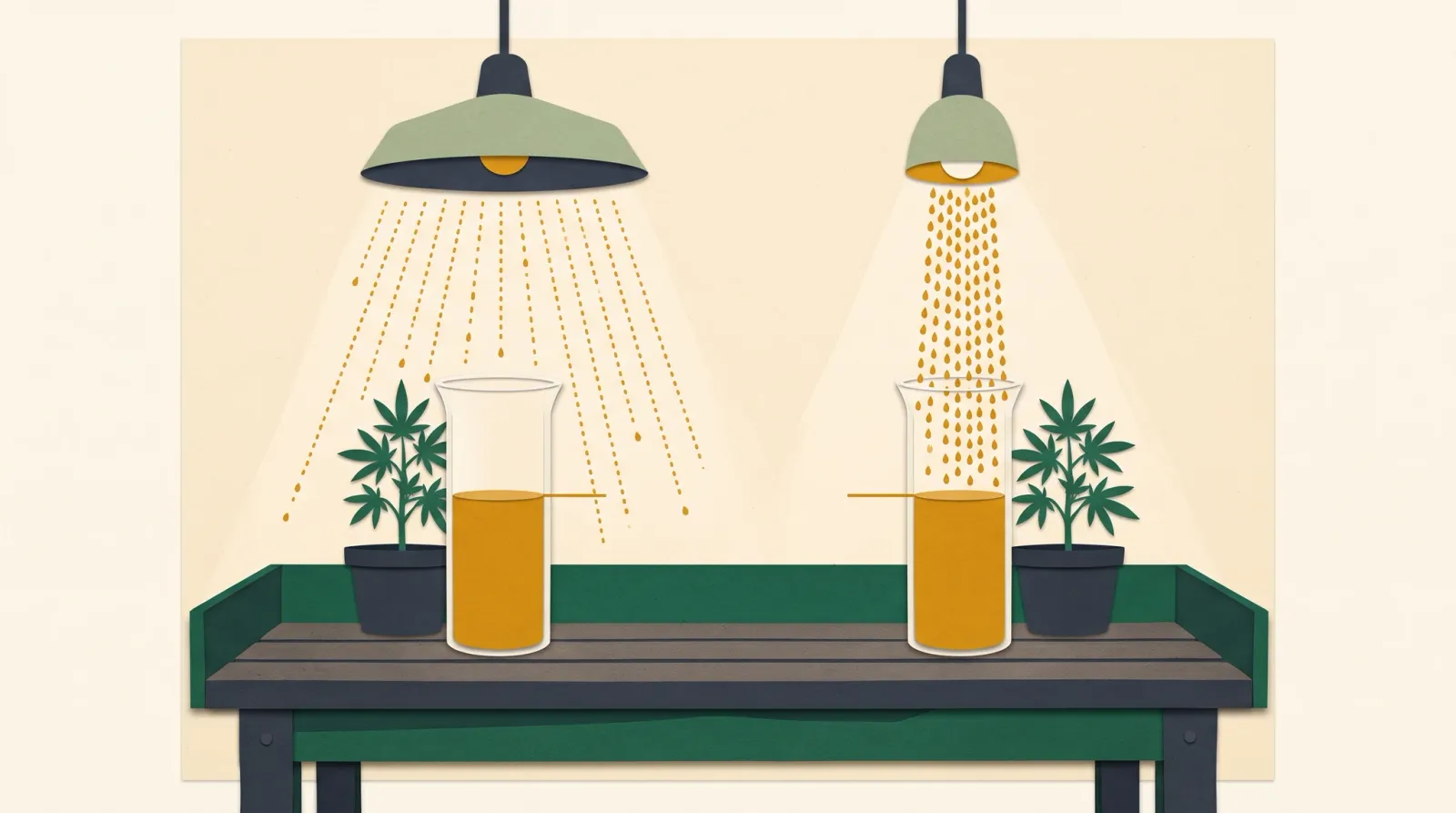
Cannabis daily light integral (DLI) is the total amount of usable light that lands on your canopy in one day, and you calculate it as PPFD × hours of light × 0.0036. The answer is in moles of photons per square meter per day (mol/m²/day). In the indoor cannabis trials we found, flower yield kept rising across a DLI range of about 5 to 78, so no study has pinned down one “right” number. Your real limits are power, heat and cost.
Here is the line worth sending to your grow chat: 600 PPFD for 18 hours and 900 PPFD for 12 hours are the same 38.9 mol of light per day. A PPFD reading is a speed. DLI is the distance traveled. Your plants respond to the total photons they get, not to the number on the meter at one moment.
This lesson here in High School covers what DLI is, how to work it out, and what controlled trials actually tested. Popular DLI charts online often disagree by about twofold for the same growth stage, and most cite no study. We will show you which numbers come from trials and which are convention.
What is daily light integral?
DLI is the number of photosynthetically active photons, in the 400 to 700 nm range, that reach one square meter in one day. Virginia Tech Extension defines it in mol/m²/day and gives the conversion from PPFD (Virginia Tech Extension, SPES-720NP).
Michigan State University Extension compares it to a rain gauge. A rain gauge collects all the rain that falls in a day, whether it came as a drizzle or a downpour. DLI does the same for light (MSU Extension).
A mole is a huge count of photons. MSU calls 1 mol/m²/day “a very low DLI for plant growth.” For scale, the sun gives a maximum of about 60 mol/m²/day on a cloudless summer day, and it can fall below 5 on a dark winter day in the northern US or Canada (MSU Extension).
PPFD (photosynthetic photon flux density) is the instant rate, in micromoles per square meter per second. Our guide to choosing an LED and reading a PPFD map covers how fixtures deliver it. DLI adds the missing piece: time.
How do you calculate DLI from PPFD?
Multiply the canopy PPFD by the hours of light, then by 0.0036. The full form is PPFD × 3,600 seconds × hours ÷ 1,000,000. The 3,600 converts hours to seconds, and dividing by a million turns micromoles into moles. Virginia Tech’s worked example: 200 PPFD for 16 hours gives 11.5 mol/m²/day (Virginia Tech Extension).
- Measure PPFD at the canopy. Take readings at the top of the plants, not at the fixture, at several spots across the area.
- Average the readings. Edges are usually dimmer than the center, so one center reading overstates the whole canopy.
- Multiply by hours of light. Use the hours the light is on each day.
- Multiply by 0.0036. The result is DLI in mol/m²/day.
| Canopy PPFD (µmol/m²/s) | Hours of light | DLI (mol/m²/day) |
|---|---|---|
| 200 | 16 | 11.5 |
| 425 | 18 | 27.5 |
| 600 | 12 | 25.9 |
| 600 | 18 | 38.9 |
| 900 | 12 | 38.9 |
| 1,800 | 12 | 77.8 |
The last two pairs show why DLI matters. Flowering usually runs on a 12-hour day, so a flowering plant needs a higher PPFD than a vegetative plant to collect the same daily total. If you are setting up a grow tent, measure where the plant tops will be, because PPFD changes with distance from the fixture.
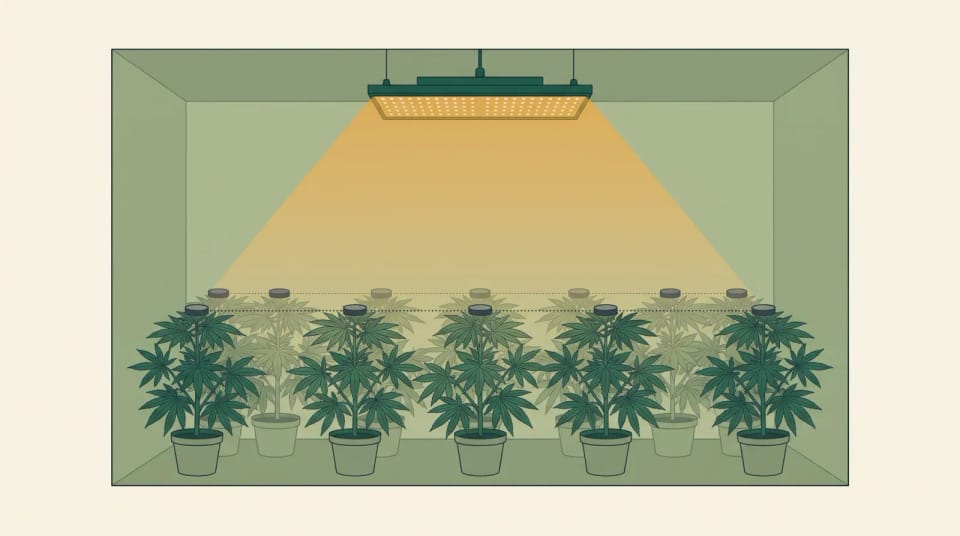
Measure PPFD where the leaves are, at several spots, then average. A single reading under the center of the lamp overstates the daily light most of the canopy gets.
How much DLI did cannabis trials actually test?
No controlled trial we found names one best DLI for cannabis. Each one tested a range and measured what changed. In every trial below, flower or plant mass rose as DLI rose, up to the highest level tested.
| Stage and setting | Study | DLI tested (mol/m²/day) | What happened as DLI rose |
|---|---|---|---|
| Flower, indoor LED, 12 h, ambient CO2 | Rodriguez-Morrison et al., 2021 | About 5 to 78 | Dry flower yield rose in a straight line; cannabinoid concentration did not change |
| Flower, indoor LED, 12 h, no added CO2 | Llewellyn et al., 2022 | 25.9 to 43.2 | Dry flower weight 1.6 times higher at the top level; concentration unchanged |
| Flower, greenhouse plus LED, hemp | Collado and Hernandez, 2025 | About 15 to 41 | Flower yield rose in a straight line |
| Flower, indoor LED, 12 h, hemp | Hahm et al., 2025 | About 9 to 26 (our calculation) | Flower mass rose; CBD and THCA concentration also rose |
| Vegetative, greenhouse plus LED, hemp | Collado et al., 2024 | 17.9 to 51.8 | Biomass, leaf area and branching rose; no response saturated at 52 |
| Vegetative, indoor LED, hemp | Grover et al., 2025 | 29.4 versus 21.2 | The lower vegetative DLI cut later flower biomass by about 22% |
The biggest study range is worth a closer look. In the Guelph trial, one drug-type cultivar flowered for 12 weeks under canopy PPFD from 120 to 1,800. Yield climbed in a straight line the whole way, with no plateau, even at ambient CO2 (Rodriguez-Morrison et al., 2021). That top level is above what the summer sun delivers.
Keep the limits in view. Most of these trials used one cultivar, one facility and short runs. Cultivar matters: a factorial study of four varieties found that each variety responded differently to the same light intensity (Vanhove et al., 2011). The trend is consistent, but the numbers belong to their setups.
Does more light always mean more yield?
In the trials, yes, up to the highest DLI each one tested. That is not the same as “more light is always worth it.” Two points matter.
First, a leaf curve does not predict a whole plant. A single-leaf study found photosynthesis peaked at about 1,500 PPFD at 25 to 30 °C and fell above that at 30 °C (Chandra et al., 2008). Yet whole plants in the Guelph trial kept adding flower at 1,800, and the authors note that the leaf light curve did not predict whole-plant yield (Rodriguez-Morrison et al., 2021). So do not treat 1,500 PPFD as a plant limit.
Second, the return per unit of electricity falls. In an older study with HPS lamps, yield per watt dropped as irradiance went up, from 1.6 g/W at the lowest level to 0.9 g/W at the highest (Potter and Duncombe, 2012). The Guelph authors also say the best light level is an economic decision, not a biological ceiling.
More light also brings more heat and higher water demand. Once you raise DLI, check your humidity, temperature and CO2 targets and your vapour pressure deficit. A single-leaf test found that raising CO2 to 750 ppm increased leaf photosynthesis by 50% compared with ambient air (Chandra et al., 2008). That is a leaf result, not a yield promise.
Does more light raise THC?
Not reliably. In the two indoor drug-type trials, cannabinoid concentration stayed the same across light levels (Rodriguez-Morrison et al., 2021; Llewellyn et al., 2022). The older HPS study also found no change in flower THC potency with irradiance (Potter and Duncombe, 2012).
Other results point different ways. One short hemp trial at a low DLI range found CBD and THCA concentration rose with light (Hahm et al., 2025). A Utah State master’s thesis, which is not peer reviewed, reported that CBD concentration fell in one cultivar at very high light (Nielson, 2024).
What does rise is total cannabinoid mass per square meter, because there is more flower. In the Guelph trial, cannabinoid yield per square meter rose 4.5 times from the lowest to the highest light level, while concentration stayed flat (Rodriguez-Morrison et al., 2021).
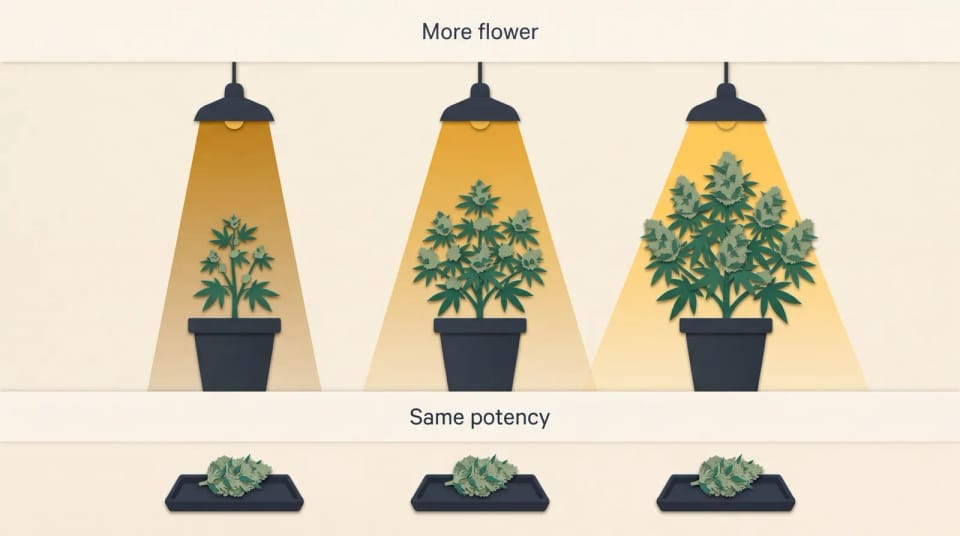
In two indoor drug-type trials, more light meant more flower per square meter, while cannabinoid concentration stayed the same. One hemp trial found concentration rising, so treat this as the common result, not a rule.
What DLI do seedlings, clones and autoflowers need?
We found no controlled cannabis trial of seedling or clone DLI in a grow room, and none of autoflower DLI. The stage ranges you see online for these are grower convention. Two popular guides, for example, give flowering ranges of 35 to 50 and 20 to 40 mol/m²/day, and the seedling ranges we saw cite no cannabis seedling trial.
The only low-light cannabis data we found came from plantlets grown in sealed lab vessels, which is a different setting from a seedling tray. If you start plants under gentle light and raise it as they establish, that is a reasonable habit, but it is a habit, not a tested target. Our growing stages timeline explains what each stage needs in general.
Autoflowering plants usually run on one light schedule from start to finish. The DLI math is the same: canopy PPFD × hours × 0.0036. A longer daily schedule raises DLI at the same PPFD.
Is the same DLI always the same result?
Not necessarily. The hours half of the formula can matter on its own. In a trial with two high-THC cultivars, a 13-hour day instead of a 12-hour day raised DLI by about 8%, from 23.8 to 25.7. Flower yield rose by 35% in one cultivar and 50% in the other (Ahrens et al., 2024).
That gain is far bigger than the DLI change, so DLI alone does not explain it. The study was small (three chambers per treatment, one lab) and one cultivar started flowering about 1.5 days later. Treat it as a research result, not as a reason to change your flowering schedule.
Timing matters too. In a winter greenhouse hemp trial, plants that got more of their light during flowering made up to 10.4% more flower than plants given the same total light spread evenly (Collado and Hernandez, 2025).
How does a greenhouse or the sun compare?
The sun peaks at about 60 mol/m²/day in summer, and US greenhouses average 5 to 30 across the year, according to MSU’s general crop figures (MSU Extension). In the winter greenhouse trial above, the sun supplied only 7.5 mol/m²/day at the canopy, which is why the researchers added LEDs (Collado and Hernandez, 2025).
So an indoor flowering room at 900 PPFD for 12 hours (38.9) delivers less daily light than a clear summer day, while the top Guelph treatment (about 78) delivered more. For the bigger trade-offs, see indoor versus outdoor growing and greenhouse versus indoor. If you are new to all this, start with our guide to growing cannabis at home, which also covers checking your local law.
Sources
- Stallknecht E. “Calculating and Using Daily Light Integral (DLI): An Introductory Guide.” Virginia Tech Extension, SPES-720NP, 2025. pubs.ext.vt.edu
- Runkle E. “Daily light integral defined.” Michigan State University Extension, 2006. canr.msu.edu
- Rodriguez-Morrison V, Llewellyn D, Zheng Y. “Cannabis Yield, Potency, and Leaf Photosynthesis Respond Differently to Increasing Light Levels in an Indoor Environment.” Frontiers in Plant Science. 2021;12:646020. DOI: 10.3389/fpls.2021.646020
- Llewellyn D, Golem S, Foley E, et al. “Indoor grown cannabis yield increased proportionally with light intensity, but ultraviolet radiation did not affect yield or cannabinoid content.” Frontiers in Plant Science. 2022;13:974018. DOI: 10.3389/fpls.2022.974018
- Ahrens A, Llewellyn D, Zheng Y. “Longer Photoperiod Substantially Increases Indoor-Grown Cannabis’ Yield and Quality: A Study of Two High-THC Cultivars Grown under 12 h vs. 13 h Days.” Plants. 2024;13(3):433. DOI: 10.3390/plants13030433
- Grover EF, Haiden SR, Berkowitz GA. “Examining the ‘Night Break’ Method in Cannabis sativa Horticulture: Vegetative Daily Light Integral Affects Yield of Extractable Biomass in C. sativa.” Plants. 2025;14(19):3095. DOI: 10.3390/plants14193095
- Collado CE, Hwang SJ, Hernandez R. “Supplemental greenhouse lighting increased the water use efficiency, crop growth, and cutting production in Cannabis sativa.” Frontiers in Plant Science. 2024;15:1371702. DOI: 10.3389/fpls.2024.1371702
- Collado CE, Hernandez R. “Vegetative and reproductive stage lighting interactions on flower yield, water use efficiency, terpenes, and cannabinoids of Cannabis sativa.” Scientific Reports. 2025;15:43641. DOI: 10.1038/s41598-025-27437-4
- Hahm S, Bok G, Kim S, et al. “High light intensity enhances cannabinoid biosynthesis through concerted gene expression in hemp (Cannabis sativa) flowers.” Frontiers in Plant Science. 2025;16:1687794. DOI: 10.3389/fpls.2025.1687794
- Westmoreland FM, Kusuma P, Bugbee B. “Cannabis lighting: Decreasing blue photon fraction increases yield but efficacy is more important for cost effective production of cannabinoids.” PLOS ONE. 2021;16(3):e0248988. DOI: 10.1371/journal.pone.0248988
- Chandra S, Lata H, Khan IA, ElSohly MA. “Photosynthetic response of Cannabis sativa L. to variations in photosynthetic photon flux densities, temperature and CO2 conditions.” Physiology and Molecular Biology of Plants. 2008;14(4):299-306. PMID: 23572895
- Potter DJ, Duncombe P. “The effect of electrical lighting power and irradiance on indoor-grown cannabis potency and yield.” Journal of Forensic Sciences. 2012;57(3):618-622. PMID: 22211717
- Vanhove W, Van Damme P, Meert N. “Factors determining yield and quality of illicit indoor cannabis (Cannabis spp.) production.” Forensic Science International. 2011;212(1-3):158-163. PMID: 21737218
- Nielson JD. “Responses of Medical Cannabis to Daily Light Integrals Higher Than Summer Sunlight: Yield, Morphology, And Quality.” Master’s thesis, Utah State University, 2024. digitalcommons.usu.edu
Key takeaways
- DLI is the daily total of usable light at the canopy: PPFD × hours × 0.0036, in mol/m²/day.
- 600 PPFD for 18 hours and 900 PPFD for 12 hours both give 38.9 mol/m²/day.
- In the trials we found, yield kept rising up to the highest DLI tested, as high as about 78.
- More light gave more flower, but cannabinoid concentration mostly did not change.
- No trial we found tested seedling, clone or autoflower DLI; those charts are convention.
- Cost, heat and electricity set the practical limit, not a proven plant ceiling.
FAQ
What is a good DLI for cannabis?
No trial has identified a single best DLI. Indoor flowering trials found yield rising across about 5 to 78 mol/m²/day in their setups. The practical choice depends on what light, cooling and electricity you can afford and control.
Is DLI more important than PPFD?
They measure different things, and you need both. PPFD is the rate at one moment; DLI is that rate added up over the day. Two rooms with the same PPFD but different hours give plants different daily totals.
Can you give cannabis too much light?
The trials we found did not reach a DLI where yield fell, but they controlled heat, water and airflow. A single-leaf study found photosynthesis dropped above about 1,500 PPFD at 30 °C. High light adds heat, so keep temperature and humidity in range when you raise intensity.
Can you estimate yield from DLI?
Not reliably. Yield depends on cultivar, climate, CO2 and how long the plants grow. One series of hemp trials reported about 0.22 to 0.36 g of dry flower per mole of light, but that figure belongs to those setups and is not a general conversion (Westmoreland et al., 2021).
Do I need a PAR meter to know my DLI?
You need a canopy PPFD value to calculate DLI accurately. A quantum or PAR meter measures it at the plant tops. A manufacturer PPFD map gives a starting estimate, but your height, reflectors and walls change the real number.



