Greenhouse vs Indoor Flower: Is Sun-Assist Better?
Greenhouse vs indoor cannabis: we compare cost, energy, terpenes, potency, consistency, and price to find out if sun-assisted flower really wins.

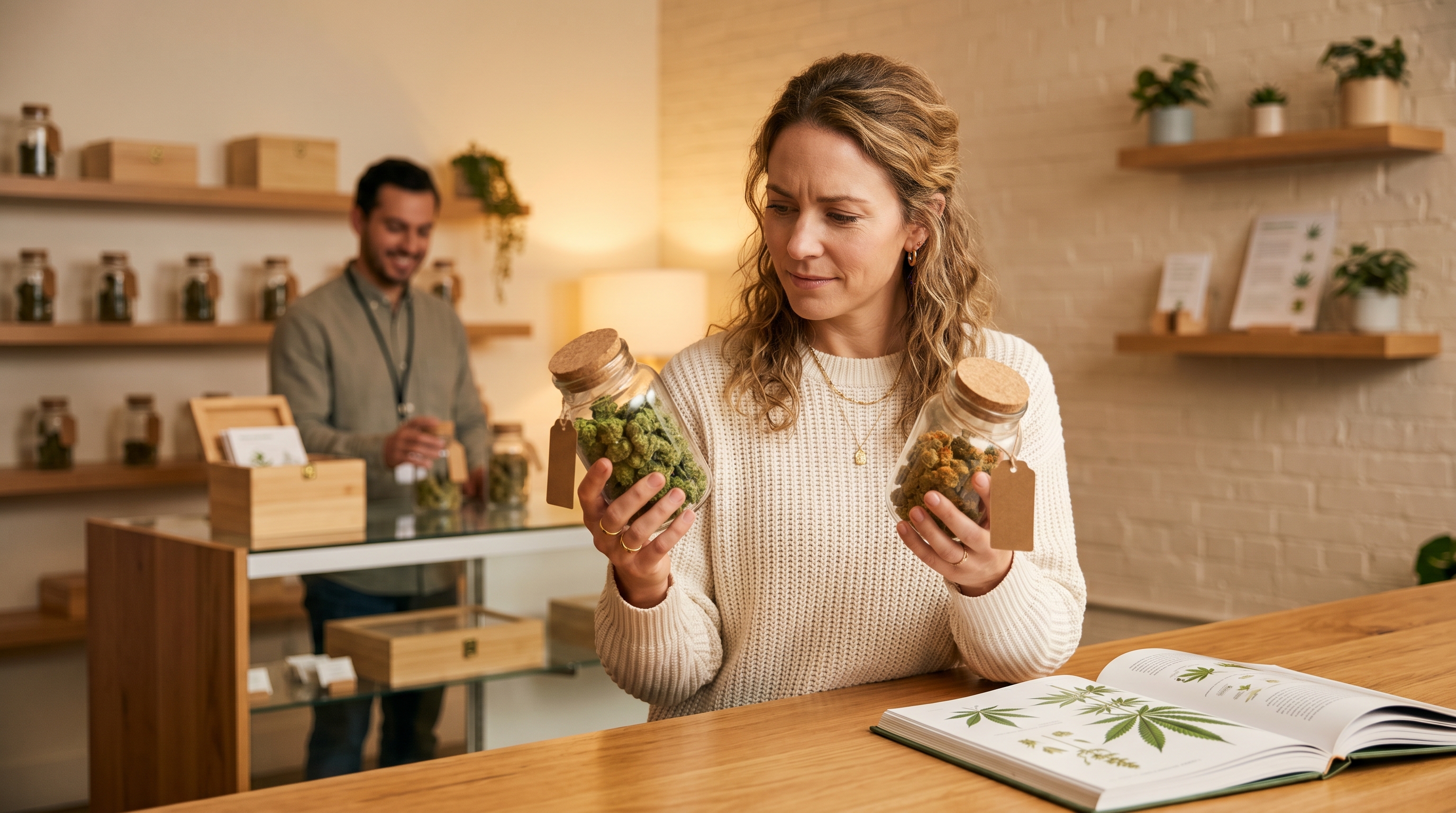
You’re standing at the dispensary counter and the budtender points to two jars. One says “premium indoor.” The other says “greenhouse” or “sun-grown,” and it costs noticeably less. Your brain does the lazy math: cheaper must mean worse, right?
Not so fast. That price gap has little to do with how the flower will actually feel. It has a lot to do with electricity bills, marketing, and decades of habit. Let me walk you through what’s really going on between these two growing styles, so you can stop overpaying for a label.
How We’re Judging This
Before we crown a winner, we need fair criteria. “Better” is doing a lot of work in that headline, so here’s how I’ll break it down:
- Cost and energy to produce a pound
- Terpene and cannabinoid expression (the stuff that shapes your experience)
- Consistency batch to batch
- Environmental footprint
- Price to you at the register
Spoiler: no single method sweeps every category. The “best” flower depends on what you value. If you’re still learning how to evaluate flower at all, our guide on why THC percentage is a terrible way to choose cannabis is a great companion read.
Greenhouse and Mixed-Light: The Sun-Assist Approach
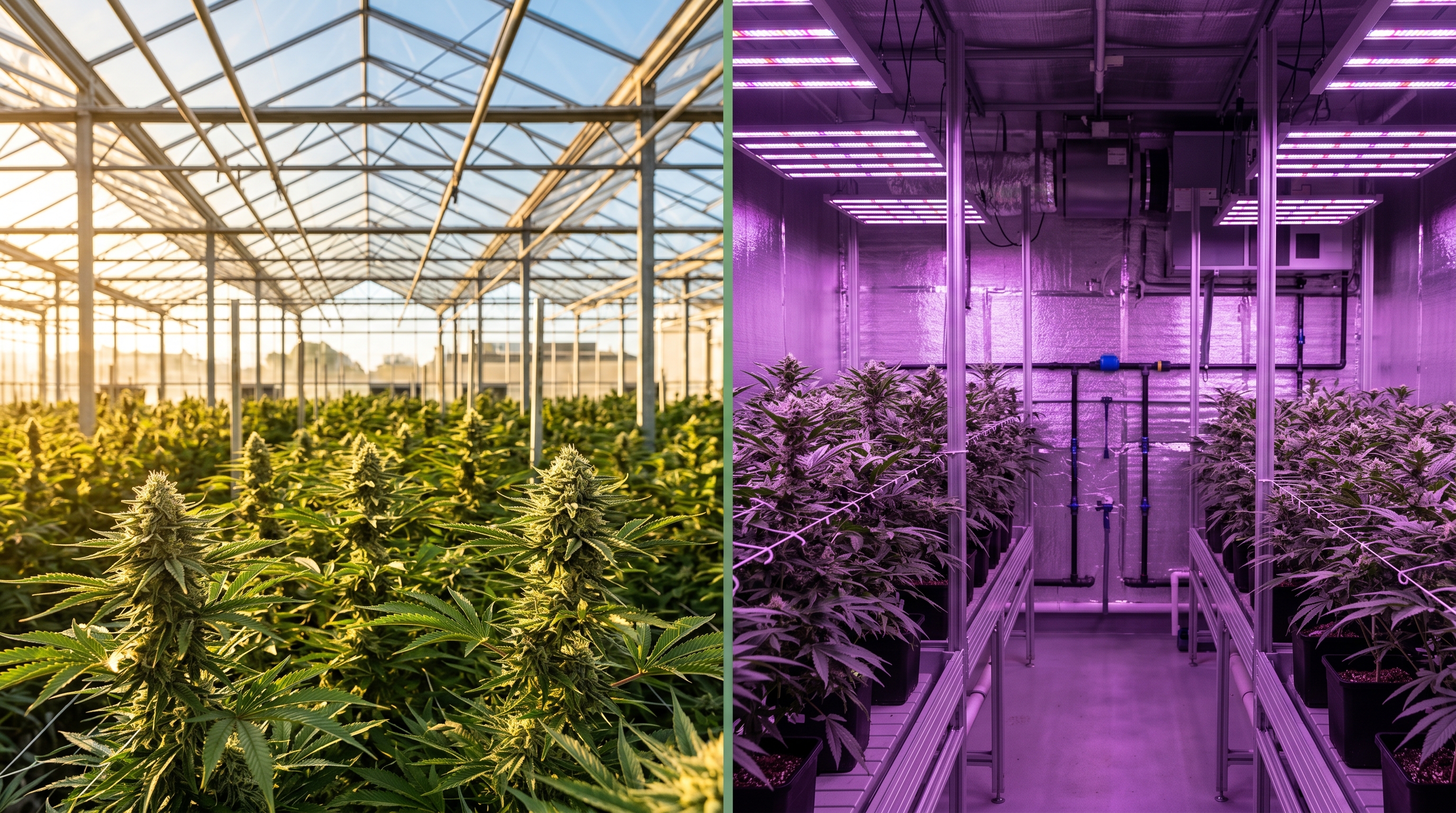
A greenhouse is the middle path. An indoor room fights the sun. A greenhouse uses it. It harnesses free sunlight and adds extra light only when needed. The most common trick is light deprivation, or “light dep.” Growers pull blackout tarps to control the light cycle and trigger flowering on demand. That lets a greenhouse harvest several times a year while still riding the sun for most of the plant’s energy.
The economics are the headline. Sunlight does the heavy lifting, so greenhouse operations use far less electricity than sealed indoor rooms. Industry estimates put greenhouse and outdoor production around $200 to $500 per pound. Fully indoor flower runs $500 to $1,200+ per pound, with electricity alone adding $200 to $400 per pound.
That efficiency is also a sustainability story. Greenhouses lean on natural light and natural temperature swings, so their carbon and energy load is a fraction of indoor’s. For the bigger picture on growing’s footprint, see our deep dive on cannabis and sustainability.
The trade-off is control. A greenhouse grower is partly at the mercy of weather, seasonal light, and humidity. Modern operations fight back with automated venting, supplemental LEDs, and dehumidifiers. Still, they never get the absolute lock on conditions that a sealed room offers. Want to see the dials growers adjust all day? Our VPD guide and the grow room humidity, temperature, and CO2 guide show just how many variables are in play.
Full Indoor: Total Control, Premium Price
Indoor cultivation is the opposite idea: shut out nature and engineer a perfect climate. Growers tune the light spectrum with LED grow lights, pump in CO2, and hold temperature and humidity in a narrow band around the clock. The plant never sees a cloud, a cold snap, or a pest it didn’t invite.
That control delivers real, tangible benefits:
- Consistency. Batch after batch comes out looking nearly identical. Tight, frosty nugs with vivid colors and that “Instagram-ready” sparkle are easier to hit indoors.
- Year-round production. No waiting for a season. A room can run continuous cycles regardless of what’s happening outside.
- Higher peak potency on the label. Top-shelf indoor strains often test in the 25 to 30% THC range, while greenhouse flower commonly lands around 20 to 26%.
This is why indoor has owned the “premium” tier for so long. In big markets like California, indoor reportedly makes up most legal flower sales. Dense, manicured, high-testing bud became shorthand for quality. Dispensaries price it that way.
But look at what really drives that premium: looks, label numbers, and the cost of the electricity. None of that is the same as how the flower makes you feel. And as I always say, THC percentage is a terrible way to choose cannabis in the first place.
The Quality Debate: Marketing vs Reality
Here’s where it gets interesting. Is indoor actually better, or have we just been trained to believe it?
The honest answer: it’s complicated, and a lot of the “indoor is king” narrative is marketing inertia. Two threads matter.
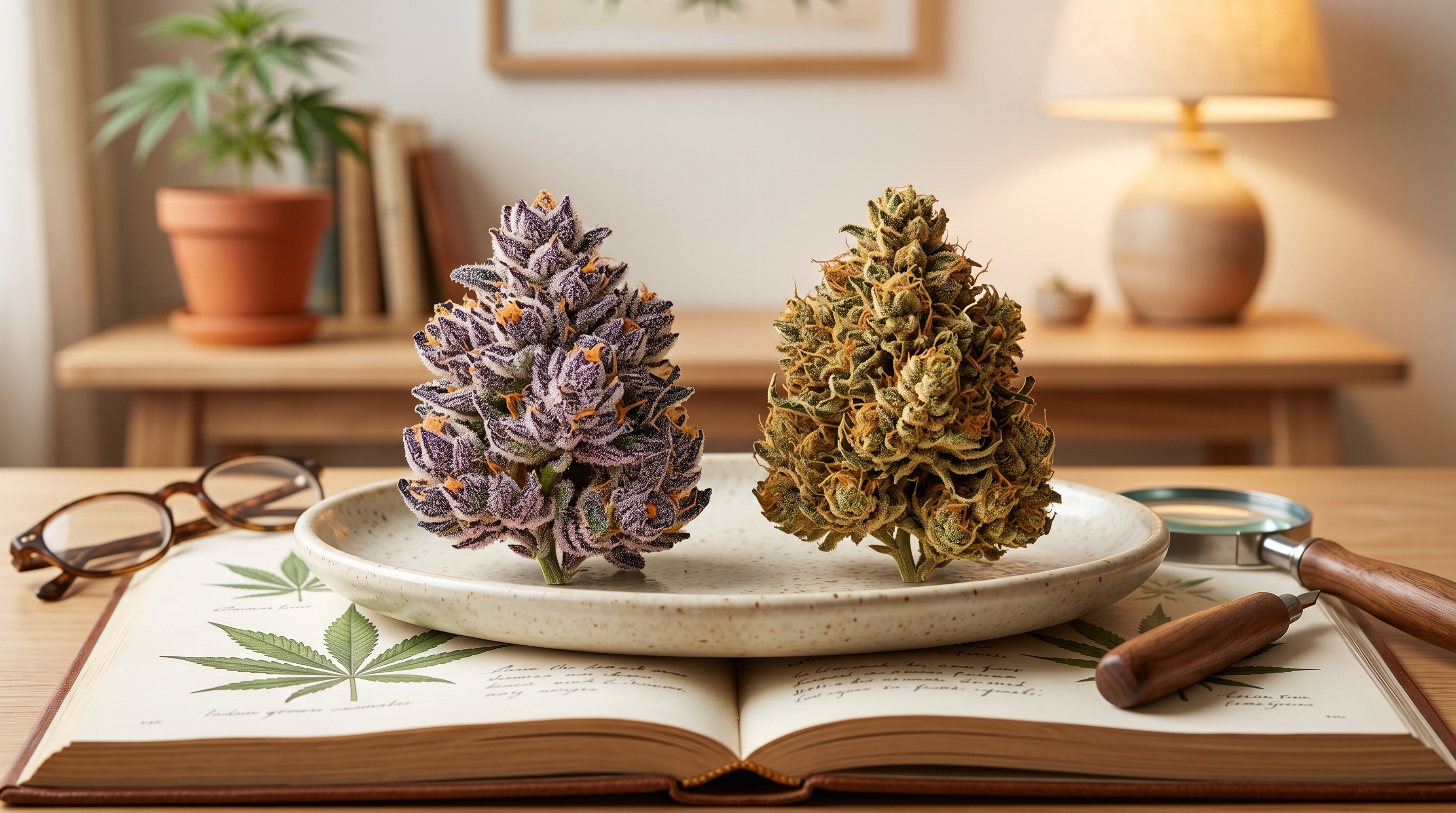
Terpenes may favor the sun. Terpenes are the aromatic compounds that shape a strain’s smell, flavor, and much of its character. Some cultivators and consumers report that natural sunlight brings out richer terpenes, maybe thanks to its full spectrum and natural UV. The effect shows up most in the heavier sesquiterpenes. Our piece on whether sun-grown cannabis has better terpenes digs into the science and the limits of those claims. The research is far from settled. But it does undercut the assumption that indoor always tastes better.
Potency on a label is not the whole experience. A bud testing 28% THC is not automatically better than one at 22%. The effect you feel comes from cannabinoids and terpenes working together. Scientists call this the entourage effect. A greenhouse bud at 22% THC with a rich terpene profile can easily beat a sterile 29% indoor flower. That is why we built the High Families system. It sorts flower by its terpene-driven effect, not by a single number.
The most important truth in the whole debate? Grower skill matters more than growing method. A master cultivator working a greenhouse will smoke a mediocre indoor operation every time, and vice versa. Method sets the ceiling; the grower decides how close you get to it.
The Energy and Carbon Footprint
This is the category where greenhouse wins cleanly, and it isn’t close.
Indoor cannabis is shockingly energy-hungry. A single pound can take 2,000 to 3,000 kWh of electricity to grow indoors. That’s like driving an electric car several thousand miles. In some legal states, indoor growing may eat up 1 to 2% of total state electricity.
A widely cited 2021 Colorado State University analysis [Summers, 2021], published in Nature Sustainability, found indoor cannabis emits roughly 2,300 to 5,200 kg of CO2-equivalent per kilogram of dried flower, depending on location. The biggest drivers were HVAC for climate control and CO2 supplementation, followed by lighting. An earlier study [Mills, 2012] flagged the same problem more than a decade ago.
A greenhouse sidesteps most of that. It uses the sun as the main light source and natural conditions for much of its climate. That slashes the energy and emissions per pound. If sustainability matters to you at all, sun-assisted flower is the responsible pick. Our sustainability deep dive explains why the gap is so big.
Price to the Consumer
All that energy cost flows downstream to you. Because indoor production runs 20 to 40% more expensive than greenhouse or outdoor at retail, you’re often paying a premium that reflects an electricity bill, not a better experience.
Greenhouse flower is often the sweet spot: near-indoor quality at a much lower price. If you consume regularly, that gap adds up fast. It’s the same logic behind why so many cannabis regulars choose consistency and value over the priciest jar on the shelf.
So Which Is Actually Better?
The nuanced truth: it depends on what you’re optimizing for.
- Want the most pristine, uniform, highest-testing bud and don’t mind paying for it? Premium indoor is hard to beat on appearance and label potency.
- Want excellent flower, rich terpenes, a lighter environmental footprint, and a better price? Greenhouse / sun-assist is very likely your best value, and the quality gap has narrowed to the point of being negligible for most people.
What doesn’t hold up is the lazy assumption that indoor is automatically superior. For a fuller breakdown of the broader cultivation trade-offs, see our companion guide on indoor vs outdoor cannabis growing: pros, cons, and yields.
The smartest move isn’t picking a camp. It’s learning your own response. The growing method, the strain name, even the THC number are all just proxies. The real predictor is the terpene-driven High Family and how your body responds to it. Track a few greenhouse and a few indoor batches in High IQ. Note the effects. You’ll quickly see your real preference has nothing to do with the jar’s marketing.
The Verdict
Greenhouse and indoor are two valid roads to great cannabis. Indoor buys you control, consistency, and showroom looks, but at a steep energy and dollar cost. Greenhouse buys you sun-charged terpenes, a fraction of the footprint, and a better price. In skilled hands, its quality now rivals indoor.
For most consumers, sun-assist isn’t just “good enough.” It’s the smarter buy. So judge flower by how it actually performs for you, not by the label on the jar.
Key Takeaways
- Indoor wins on looks, consistency, and label potency, but at a steep energy and dollar cost.
- Greenhouse (sun-assist) costs far less, uses far less energy, and may favor richer terpenes.
- Indoor production can run 20 to 40% more expensive at retail than greenhouse flower.
- Grower skill matters more than the growing method.
- The real predictor of a great experience is the terpene-driven High Family, not where the plant was grown.
Frequently Asked Questions
Is greenhouse weed lower quality than indoor? Not inherently. Greenhouse flower may test slightly lower in THC and look a touch less uniform, but it often carries richer terpene profiles and can deliver an equal or better experience. Grower skill matters more than the method.
Why is indoor cannabis more expensive? Mostly electricity. Indoor rooms run lights, HVAC, and CO2 around the clock, which can add hundreds of dollars per pound in energy costs. That premium is passed to you and reflects production cost more than guaranteed quality.
Does sunlight really improve terpenes? Some cultivators and consumers report fuller, more complex terpene expression in sun-grown flower, possibly tied to natural UV and full-spectrum light. The science isn’t conclusive, but it challenges the idea that indoor always tastes better. See our sun-grown terpenes article for details.
What is light deprivation (light dep)? It’s a greenhouse technique where growers use blackout tarps to shorten the light cycle and trigger flowering on schedule. It lets sun-assisted operations harvest multiple times per year while still relying mainly on natural light.
Is greenhouse cannabis more eco-friendly? Yes. By using the sun as the primary light source, greenhouses use far less electricity and emit far less CO2 per pound than sealed indoor rooms. See our sustainability guide for the full footprint comparison.
Sources
- Summers, H.M., Quinn, J.C., & Reardon, E.J. (2021). “The greenhouse gas emissions of indoor cannabis production in the United States.” Nature Sustainability. https://www.nature.com/articles/s41893-021-00691-w
- Fresh Bros (2025). “Indoor vs Outdoor Cannabis: Quality, Potency & Price Comparison 2025.” https://freshbros.com/indoor-vs-outdoor-cannabis-comparison-2025/
- Doobie Nights. “Indoor vs Greenhouse Weed: What’s the Difference and Which Is Better?” https://www.doobienights.com/indoor-vs-greenhouse-weed
- Mills, E. (2012). “The carbon footprint of indoor Cannabis production.” Energy Policy. https://www.sciencedirect.com/science/article/abs/pii/S0301421511008007


