From-Scratch Cannabis Brownies (Better Than the Box)
Make fudgy from-scratch cannabis brownies with cannabutter, learn why 350F baking is fine, and nail per-square dosing so every piece is honest.

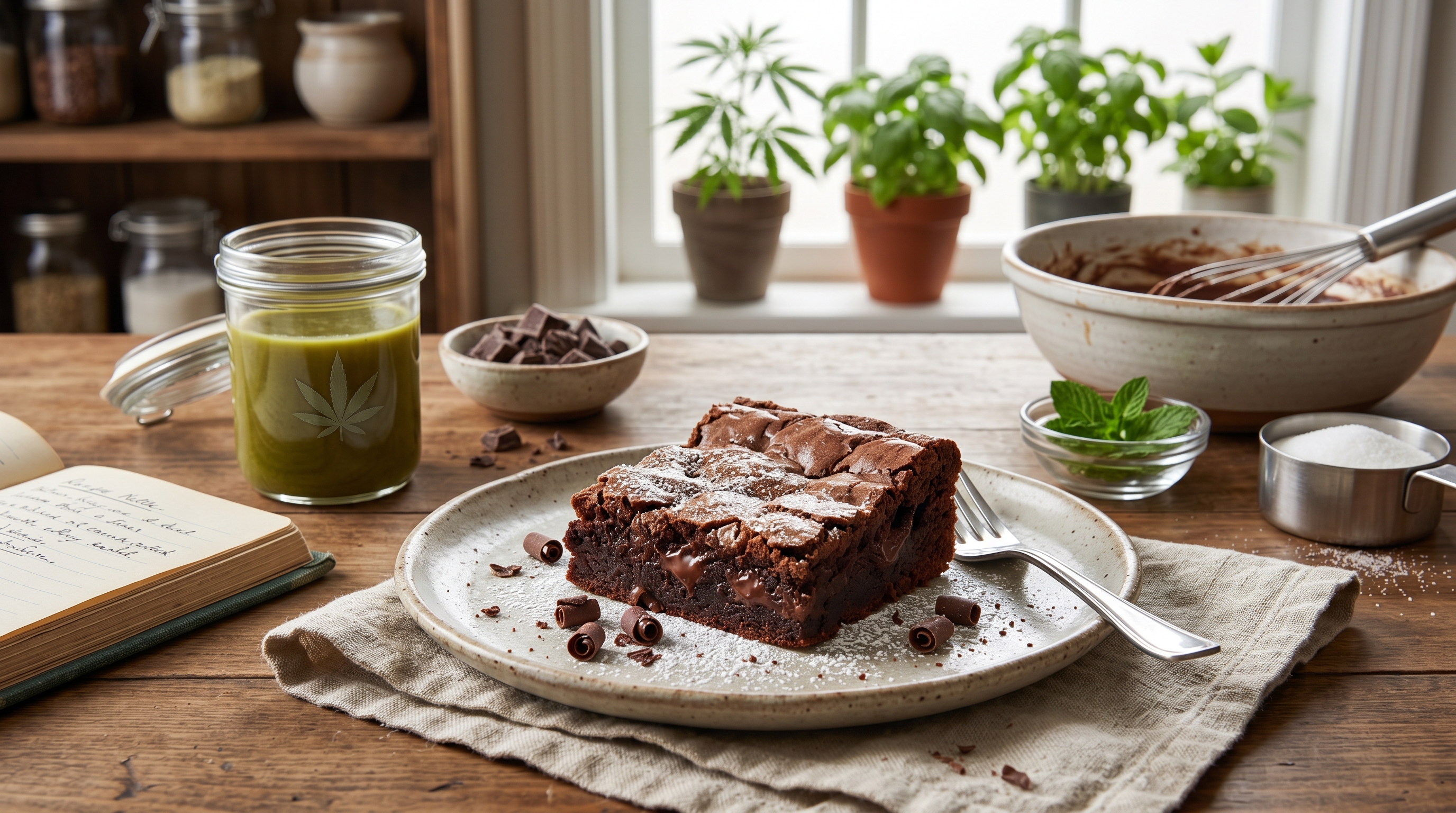
The box mix is fine. It is also a missed opportunity. A boxed brownie gives you no control over the one variable that matters most in an edible — the fat — and the fat is where every milligram of THC lives. When you bake from scratch, you decide exactly how much cannabutter goes in, you control the texture, and you can do the dosing math honestly instead of guessing.
This guide walks through the whole thing: why cannabutter beats oil for a fudgy brownie, why a 350°F oven will not “burn off” your high, the exact ingredients and steps, and — the part most recipes skip — how to portion the pan so a single square is a known, repeatable dose. Grab a whisk. Let’s bake something better than the box.
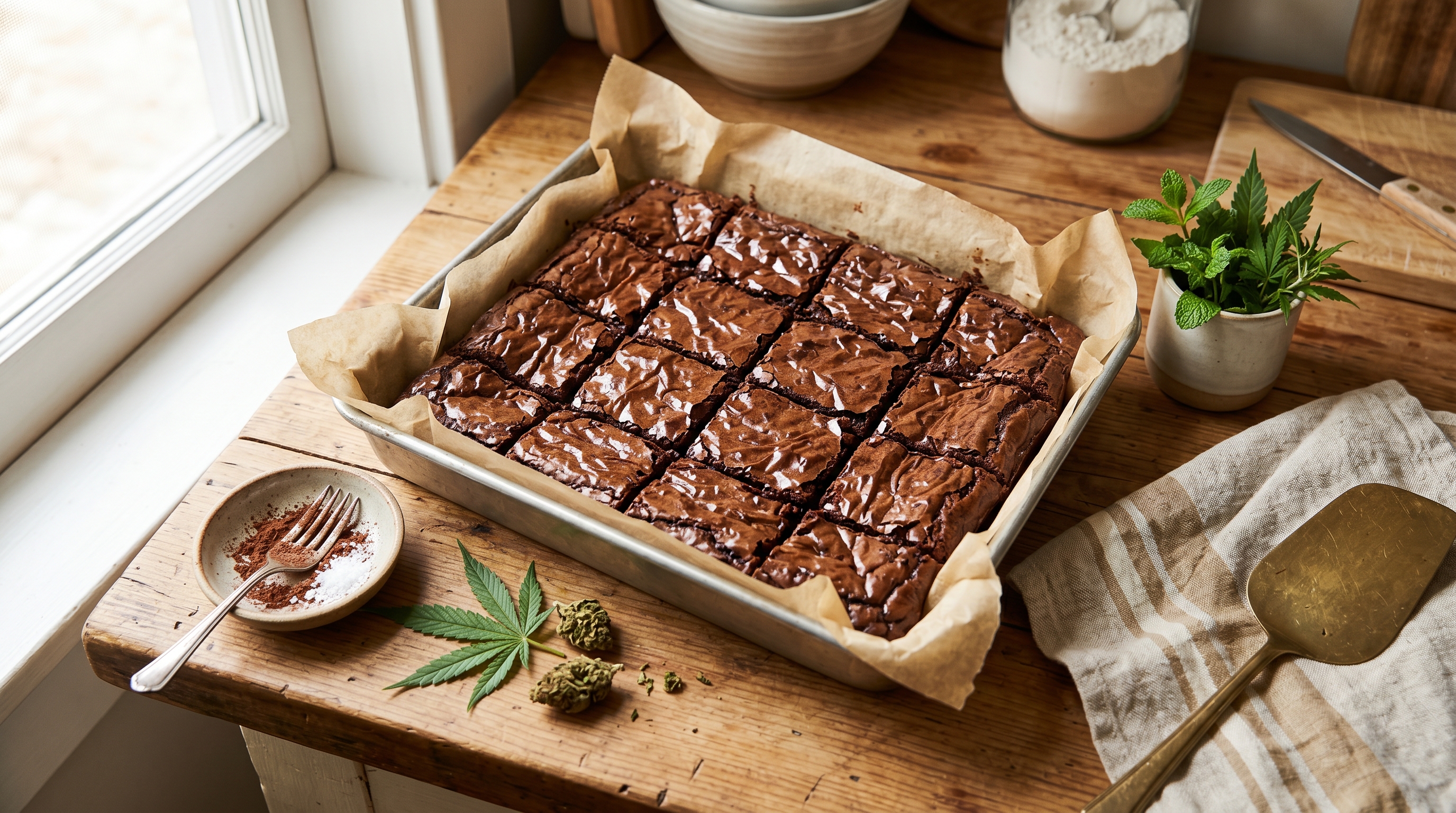
Why Cannabutter Is the Whole Game
Here is the science that the box hides from you. THC and CBD are lipophilic — fat-loving and water-hating. They dissolve into fats, not into watery liquids. That is why you infuse butter or oil rather than mixing ground flower straight into batter, and it is why the fat in a brownie is doing double duty: it carries the flavor and it carries the cannabinoids into your body.
So your first decision is the fat itself. You can infuse butter (cannabutter) or a neutral oil (canna-oil), and for brownies the choice actually shapes the texture as much as the dose. Bakers have measured this. According to King Arthur Baking, fudgy brownies lean on melted butter or oil with a low flour ratio, while cakier brownies use more flour and more egg. More fat, less flour, melted not creamed — that is the fudgy formula. Cannabutter slots right into it because you are melting it anyway.
The non-negotiable part is what comes before the butter: decarboxylation. Raw cannabis contains THCA, which is not psychoactive. Heat removes a carboxyl group and converts THCA into THC. Skip this step and your brownies will taste weedy and do absolutely nothing. The widely cited home protocol is roughly 240°F for 30–40 minutes, which converts most of the THCA while sparing the terpenes; one industry write-up puts that conversion in the 85–95% range [Green Rush, 2026]. Then you infuse: gently warm the decarbed flower in butter at a low temperature for an hour or more. Keep the butter below about 190°F — if it is bubbling hard or sizzling, the heat is too high and you are wasting cannabinoids.
If you want the full breakdown of which fat extracts best and tastes cleanest, our guide to choosing the right fat for cannabis infusions goes deeper, and if you have never infused anything before, start with cannabis cooking 101. The reason this matters so much for an edible specifically: oral cannabis gets converted in your liver into 11-hydroxy-THC, a more potent metabolite, which is exactly why edibles hit harder than the same dose smoked.
The Fudgy-Texture Science (Less Flour, More Fat)
A brownie sits on a sliding scale from gooey-fudgy to dry-cakey, and you control where it lands with a handful of ratios. A chemistry professor interviewed by Popular Science put it simply: each ingredient has a job, and the proportions decide the outcome.
- Flour builds structure. Its proteins form gluten, and its starch swells and sets in the oven. More flour and more mixing means a stronger network and a cakier, lighter crumb. Less flour, mixed gently, keeps the brownie dense and fudgy.
- Fat brings the gooey. Butter is about 82% fat; melted chocolate adds more. More fat means a richer, fudgier, denser bite. Melt the butter rather than creaming it — melted butter encourages fudginess.
- Cocoa powder vs. melted chocolate. Cocoa powder has less fat and gives a lighter, drier crumb; melted chocolate adds cocoa butter that sets firm and fudgy as it cools. A from-scratch recipe lets you choose.
- Sugar and chew. Brown sugar carries more molasses than white, which adds chew and moisture. Lean brown if you like a chewier square.
The fudgy formula, then: melted butter (your cannabutter), a modest amount of flour, mostly cocoa, eggs for emulsion, and minimal mixing. Overmixing develops gluten and drags you toward cake. There is even a chef’s trick worth stealing — after baking, tap the pan on the counter a couple of times to deflate the brownies slightly, which collapses big air pockets and boosts that chewy-fudgy density.
Why does any of this matter for a cannabis brownie beyond taste? Because texture and dose are linked. A fudgy brownie made with more fat is a more efficient carrier, and an evenly mixed batter is the only way to get an even dose across the pan. A dry, crumbly, overbaked brownie is harder to portion cleanly — and uneven portions are uneven doses.
Why 350°F Will Not Burn Off Your High
This is the fear that sends people to the box mix: “If I bake at 350°F, won’t the heat destroy the THC?” The short answer is no, and the reason is genuinely reassuring once you understand it.
First, the activation already happened. Your cannabinoids were decarbed during the decarb step and locked into the butter during infusion. The brownie bake is not trying to activate anything — it is just baking a brownie that happens to contain already-active THC.
Second, and this is the key fact: the inside of your brownie never actually reaches 350°F. Because the batter is full of water, its internal temperature stays at or near the boiling point of water — around 212°F — until it is fully set. The oven air is 350°F and the surface can get hot, but the moist interior stays far cooler. Meanwhile, THC only begins to degrade meaningfully above roughly 315°F (157°C), well above what the interior of a baking brownie ever sees. One cooking-science write-up estimates total THC loss for standard baking at 325–375°F in the range of just 10–15% — and conservative dosing already accounts for that [Green Rush, 2026].
Lab kinetics back up the general picture: THC is heat-sensitive over time and converts toward CBN (a mildly sedative breakdown product) at sustained high temperatures [Moreno et al., 2021], but a brief 20–30 minute bake where the interior stays near 212°F is not that scenario. The real danger zone is the opposite of baking — leaving infused fat over direct, high, prolonged heat. So the rule for infused fats: never use them for anything that pushes the fat itself well past 350°F — no hard-crack candy, no broiling, no deep-frying. A normal brownie bake is comfortably safe.
A practical note: many bakers actually prefer 325°F for fudgy brownies anyway, because the gentler heat gives a more even, gooier set. Either 325°F or 350°F is fine for potency. Use an oven thermometer — home ovens are routinely off by 25°F or more, and accuracy matters more here than in a normal kitchen.
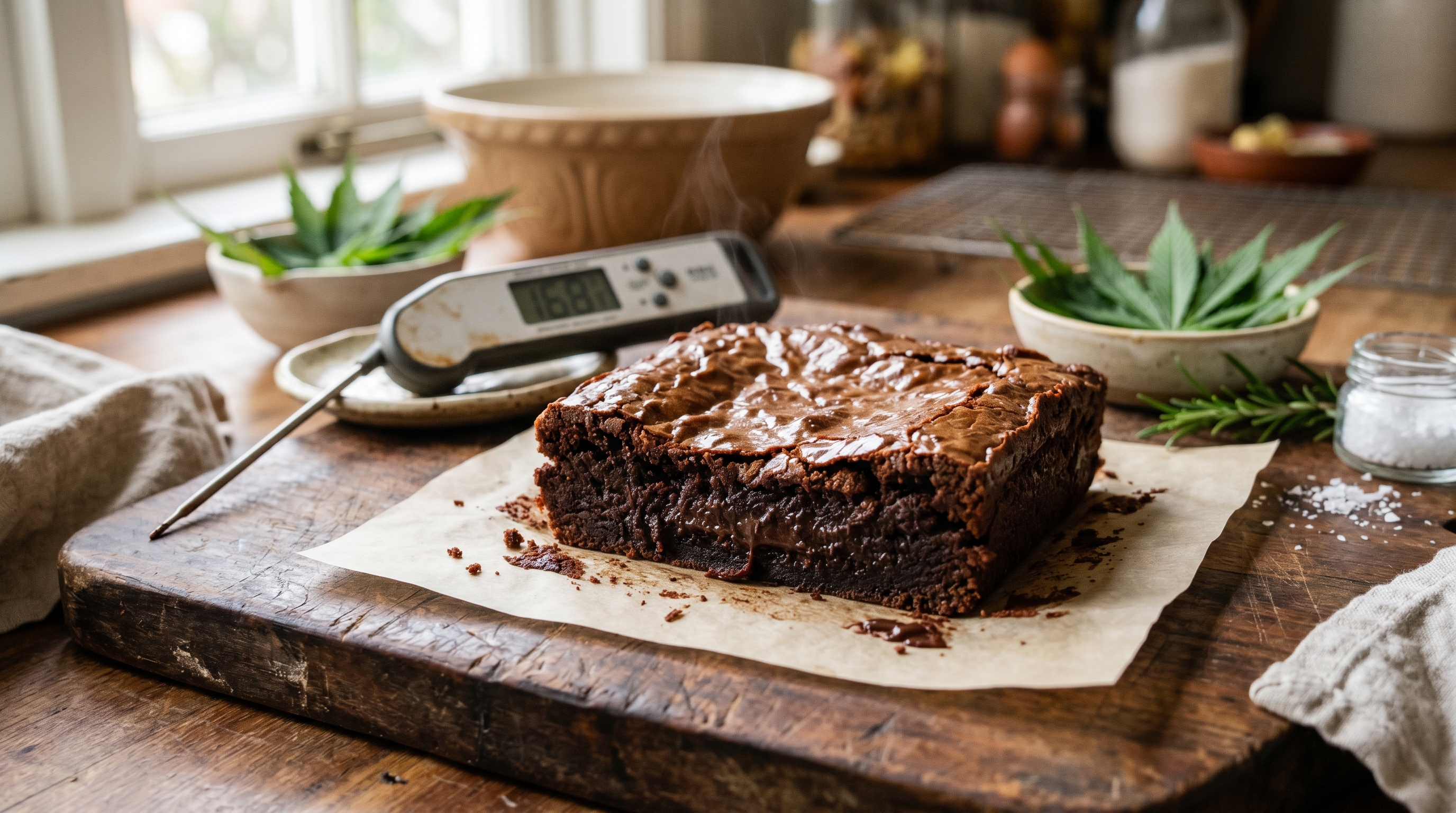
What You’ll Need
This recipe makes 16 brownies in an 8x8-inch pan — a size chosen on purpose, because a square pan cut into a clean 4x4 grid gives you 16 nearly identical pieces, which is the foundation of honest dosing.
Ingredients:
- 1/2 cup (1 stick / 113 g) cannabutter, melted (see dosing math before you decide how much is infused)
- 1 cup (200 g) granulated sugar (or swap up to half for brown sugar for extra chew)
- 2 large eggs, room temperature
- 1 teaspoon vanilla extract
- 1/2 cup (43 g) unsweetened cocoa powder (Dutch-process for a deeper color)
- 1/2 cup (60 g) all-purpose flour
- 1/4 teaspoon fine salt
- Optional: 1/2 cup chocolate chips or chopped nuts
Equipment:
- 8x8-inch metal baking pan
- Parchment paper
- Whisk and a rubber spatula
- Mixing bowls
- A kitchen scale (precision matters more than usual here)
- An oven thermometer
- A ruler or bench scraper for cutting even squares
A note on the butter: the amount of cannabutter you use is set by your dosing target, not by the recipe. If your infused butter is very strong, you can use part cannabutter and part regular butter to hit the same total fat with a lower, safer dose. We will do that math next. New to portioned dosing? Skim edible dosing for beginners and the beginner’s dosing chart first.
Step-by-Step
Step 1: Prep the pan and oven
Preheat to 350°F (or 325°F for extra-fudgy) and verify with your oven thermometer. Line the 8x8 pan with parchment, leaving an overhang on two sides so you can lift the whole slab out and cut it on a flat surface — much easier than cutting in the pan.
Step 2: Melt the cannabutter gently
Melt your measured cannabutter over low heat or in short microwave bursts. Stop the moment it is liquid. Do not let it sizzle — you already protected these cannabinoids through decarb and infusion, so there is no reason to cook them again now.
Step 3: Whisk butter and sugar thoroughly
In a large bowl, whisk the melted cannabutter and sugar until the mixture looks smooth and glossy. This step is doing double duty: it builds the crackly top and it begins distributing the infused fat evenly through the batter. Spend a full minute here. Even distribution starts in the bowl.
Step 4: Add eggs and vanilla
Whisk in the eggs one at a time, then the vanilla, until the batter is glossy and slightly lightened. The eggs are your emulsifier — their lecithin keeps the fat from splitting out, which is what lets a fudgy brownie hold that much butter without weeping grease.
Step 5: Fold in the dry ingredients
Sift the cocoa, flour, and salt over the wet mixture. Fold gently with a spatula just until no dry streaks remain. Stop there. Overmixing develops gluten and pushes you toward cake — and, just as important, more folding does not spread the dose any better once the butter is already emulsified. Fold in chips or nuts now if using.
Step 6: Spread evenly and bake
Scrape the batter into the pan and smooth it into a level, even layer with your spatula — an even thickness bakes evenly and, again, keeps the dose consistent corner to corner. Bake 20–28 minutes, until the top is set and a toothpick in the center comes out with a few moist crumbs (not wet batter). For fudgy, pull it on the earlier side.
Step 7: Tap, cool, then cut
Tap the pan on the counter a couple of times to deflate slightly for that chewy-fudgy crumb. Let it cool completely — at least an hour — before cutting. Warm brownies tear; cool ones cut into clean, equal squares. Lift the slab out by the parchment and cut a precise 4x4 grid with a ruler.
Even Distribution and the Per-Square Dosing Math
This is the part that separates a responsible from-scratch baker from someone who is rolling dice. Two things have to be true for a square to be a known dose: the butter has to be spread evenly, and you have to do the arithmetic.
Even distribution comes from technique, not luck. You earned it in Steps 3 and 6 — whisking the butter and sugar thoroughly so the cannabinoids are dispersed before the dry ingredients lock the structure, then spreading the batter in a flat, even layer so every square has the same thickness. Pour carelessly into a warped pan and one corner gets a double dose while another gets almost none.
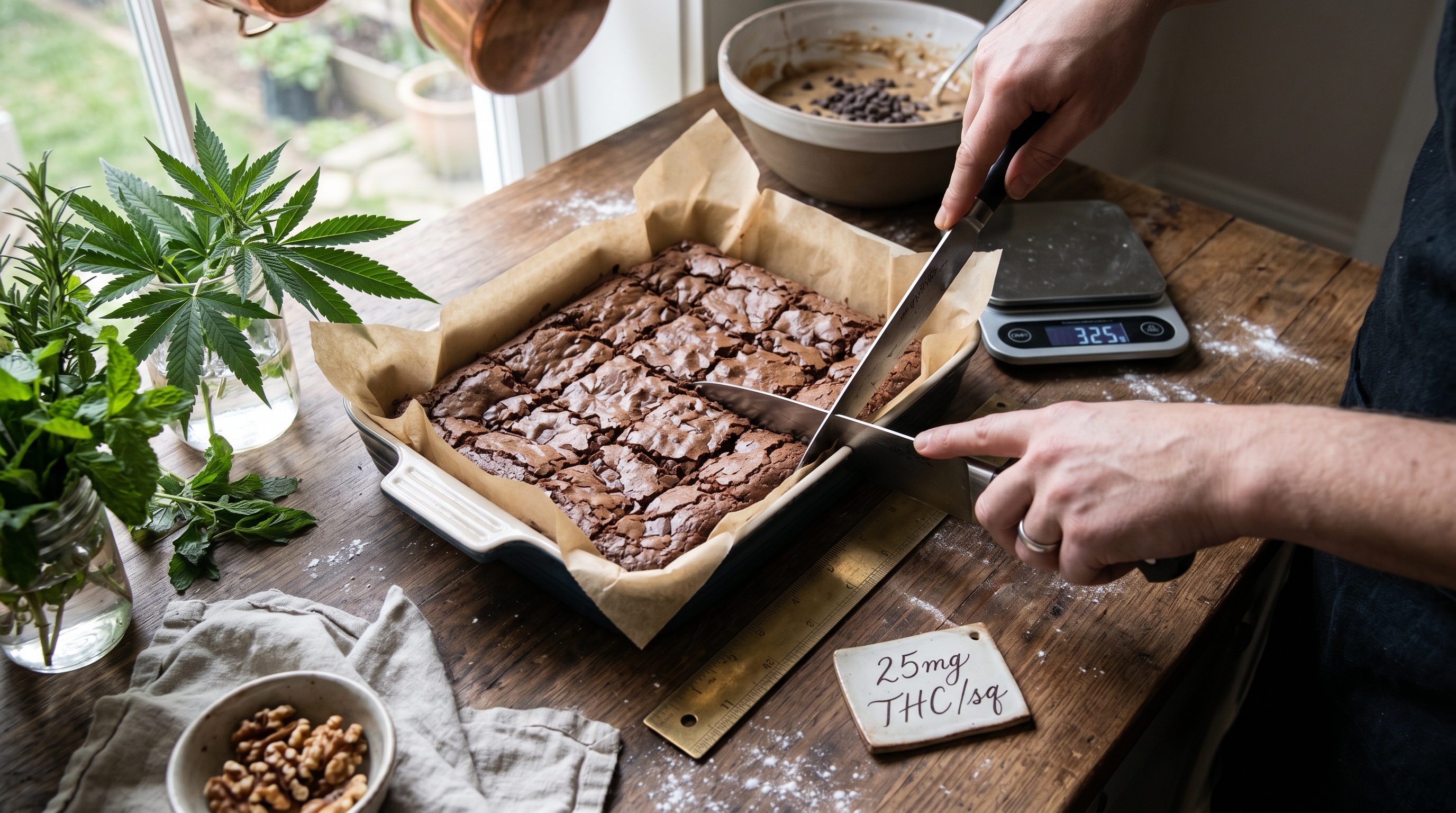
Now the math. Three numbers:
- Total THC in your butter. Start from the flower. Weight in grams x (THC % as a decimal) x 1000 = milligrams. Example: 1 gram of 20% THC flower = 1 x 0.20 x 1000 = 200 mg of THC. Home decarb and infusion are not perfectly efficient, so multiply by a realistic yield — using 70% gives about 140 mg that actually ends up in the butter. (This is an estimate; homemade butter is never lab-precise.)
- How much of that butter goes in the pan. If you infused that whole batch into the 1/2 cup of butter this recipe uses, the entire pan carries about 140 mg.
- Divide by the number of squares. 140 mg ÷ 16 squares = roughly 8–9 mg per square. That is a sensible single-serving range for many people.
Want every square at a gentle 5 mg? Aim for ~80 mg in the pan — so infuse less flower, or cut the cannabutter with plain butter and keep the same total fat. The full worked examples live in our edible dosing math for home cooks guide, and if you want to verify your real-world potency rather than estimate it, here is how to test homemade edible potency at home.
Whatever the number, start with one square and wait the full two hours before eating more. Oral cannabis is slow, and that delay is exactly why the 2-hour rule saves sessions. If you are unsure where you land, our high-dose vs. microdose edibles explainer sets expectations.
Common Mistakes (and How to Dodge Them)
- Skipping or rushing decarb. No decarb, no high. Don’t expect the bake to do it for you — the batter’s brief, water-cooled bake is too short and too cool to reliably activate raw THCA, which is the whole point of pre-decarbing.
- Cooking the butter too hot. Sizzling, hard-boiling, or browning your infused butter degrades cannabinoids. Keep infusion below ~190°F and melt gently.
- Uneven distribution. Lazy whisking and a sloppy, uneven batter layer mean some squares are strong and some are duds. Whisk the fat in fully; spread flat.
- Overbaking. A dry brownie is not just sad — it crumbles, which makes clean, equal squares (and equal doses) harder to cut. Pull it with moist crumbs on the toothpick.
- Eyeballing the dose. “It’s about 10 mg” is how people get blindsided. Do the three-number math and cut a precise grid.
- Cutting warm. Warm brownies tear into uneven chunks. Cool completely, then cut with a ruler.
Storage
Cool completely before storing or the trapped steam will turn them gummy. Keep brownies in an airtight container at room temperature for up to a few days, in the fridge for about a week, or freeze well-wrapped for longer. Cold and dark slow cannabinoid breakdown — the villains are heat, light, and oxygen — so an opaque container in the fridge or freezer keeps potency more stable over time. For the full breakdown, see our cannabis edibles shelf-life and storage guide. One more reason to label: write the per-square dose and the date on the container, especially if anyone else might find them.
FAQ
Will baking at 350°F destroy the THC in my brownies? No. The cannabinoids are already activated in the butter, the brownie’s moist interior stays near 212°F (well below THC’s ~315°F degradation point), and total loss for standard baking is estimated around 10–15% — already covered by conservative dosing.
Should I use 325°F or 350°F? Both preserve potency fine. Many bakers prefer 325°F for an extra-fudgy, even set; 350°F is the classic. Use an oven thermometer either way.
Cannabutter or oil for brownies? Both work. Butter gives the classic flavor and a fudgy melt; a neutral oil makes brownies even moister. The cannabinoids ride in either fat — pick by taste and texture. See choosing the right fat.
Can I just mix decarbed flower straight into the batter? You can, but you shouldn’t. Without infusing into fat first, extraction is poor, the texture turns gritty, and the flavor goes weedy. Infuse the butter — and if the weedy taste is your worry, here is how to make edibles without it.
How long until I feel them? Edibles are slow — often 30 minutes to 2 hours. Eat one square, wait the full two hours, and resist the urge to “top up” early. That’s the 2-hour rule.
I made the whole pan strong by accident. Now what? Cut smaller squares (an 8x8 cut into a 6x6 grid gives 36 mini-squares) and treat each as a fraction of a dose. Recalculate per-piece milligrams and start low.
A note from Professor High: edibles are a learning curve, not a guessing game. The math is the safety net — do it once, write it on the lid, and you can bake the same trustworthy pan every time. Cannabis affects everyone differently, and nothing here is medical advice; start low, go slow, and keep these away from kids and pets.
Key Takeaways
- From-scratch wins because you control the fat — and the fat is where the dose lives.
- Decarb first (≈240°F, 30–40 min), then infuse gently (keep butter below ~190°F).
- 350°F baking is fine: cannabinoids are already activated, the moist interior stays near 212°F, and THC only degrades above ~315°F. Expect ~10–15% loss.
- Fudgy = melted butter, less flour, cocoa powder, minimal mixing, slight underbake.
- Bake in an 8x8 pan, cut a clean 4x4 grid (16 squares), and divide total milligrams by 16 for a per-square dose.
- Eat one square, wait the full two hours, and label the container with the dose and date.
Sources
- King Arthur Baking — Types of brownies: fudgy, chewy, and cakey explained (baker’s percentages and texture ratios). https://www.kingarthurbaking.com/blog/2025/05/21/types-of-brownies
- Popular Science — The best brownie recipe, according to science (Dr. Lesa Tran, Rice University, on flour, fat, and texture). https://www.popsci.com/science/best-brownie-recipe/
- FoodCrumbles — Cakey vs. Gooey Brownies: The Science Behind a Brownie’s Texture (fat content, eggs as emulsifier, pan size and bake time). https://foodcrumbles.com/chemistry-brownie-science-recipe/
- Green Rush — Cooking With Cannabis: The Complete Science of Decarboxylation, Infusion, and Dosing (THC degrades above ~315°F; interior stays near 212°F; 10–15% baking loss; infusion 160–200°F). https://greenrushnews.com/articles/cannabis-cooking-recipes-basics/
- MunchMakers — Cannabis Decarboxylation Guide (240°F for 30–40 min; why baking alone doesn’t reliably decarb). https://guides.munchmakers.com/guide/cannabis-decarboxylation-guide/
- tCheck — Decarbing Defined (material temperature, THC boiling point ~311°F, slow THC-to-CBN conversion). https://tcheck.me/blogs/cannabis-tips/decarbing-defined-the-what-why-and-how-of-decarboxylation
- Moreno, Dyer & Tallon — Cannabinoid Decarboxylation: A Comparative Kinetic Study (first-order kinetics; THC loss at sustained high temperatures). https://wolnekonopie.org/wp-content/uploads/2021/02/Cannabinoid-Decarboxylation-A-Comparative-Kinetic-Study.pdf


