Is Weed Legal in Massachusetts? 2026 Cannabis Laws Explained
Is weed legal in Massachusetts? Yes, for adults 21 and older: up to 2 ounces outside the home and 10 ounces at home. The 2026 rules, in plain words.

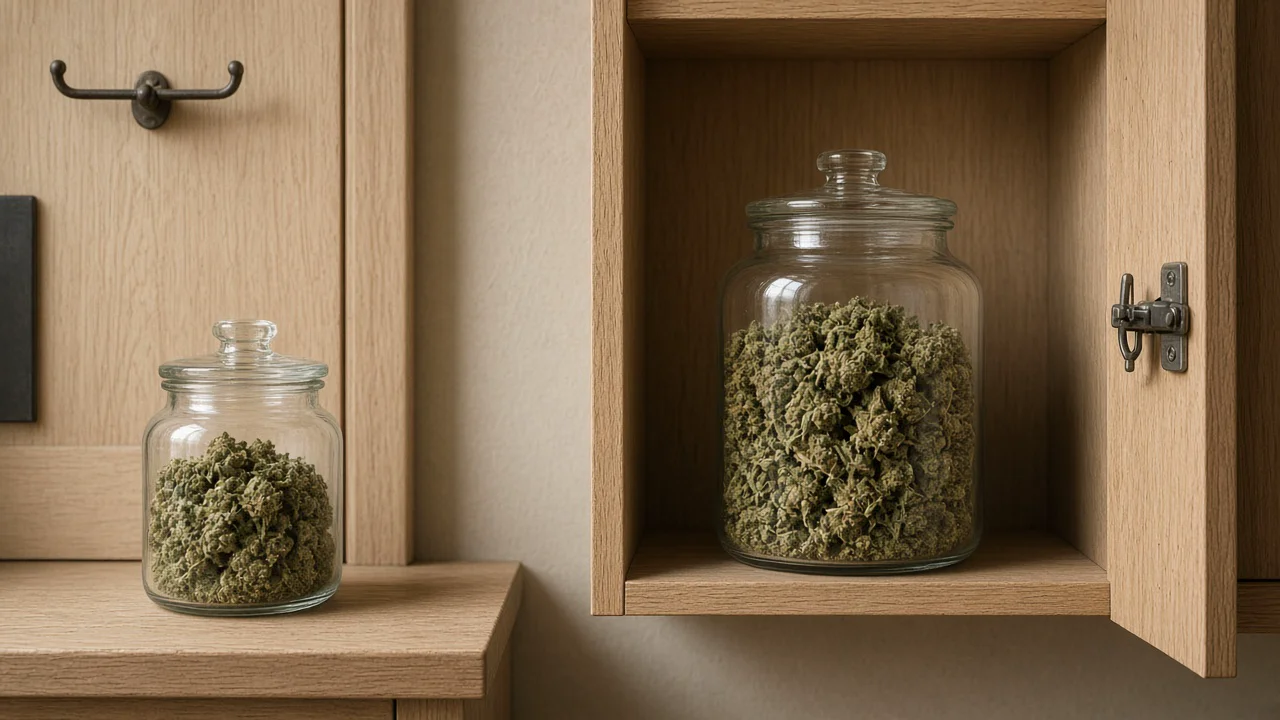
Yes. If you are 21 or older, Massachusetts lets you keep up to 10 ounces of marijuana at home and only 2 ounces outside your home.
That split is the current personal-use rule. It took effect on April 19, 2026. Before that date, the amount outside the home was 1 ounce. The home amount stayed at 10 ounces. Marijuana produced by plants grown on the premises is extra. It sits on top of the 10 ounces. It is not a blank check to sell what you grow.
Last checked: October 8, 2026, including Question 8 on the Secretary of the Commonwealth’s ballot page and in the 2026 Information for Voters. This is a High School guide for adults. It is not legal advice. A city, a landlord, or a job can add a rule the statute does not.
The national map is in where weed is legal, state by state. Connecticut and New York use different numbers. Read those guides before you assume a Massachusetts ounce is legal next door.
How much weed can you possess in Massachusetts?
Chapter 94G, section 7 is the possession statute. The text in force now is the version amended by Chapter 65 of the Acts of 2026. The official page prints both the old clause and the new one. Use the clause marked effective April 19, 2026.
Outside your primary residence, an adult may possess, use, purchase, process, or manufacture 2 ounces or less. The commission sets the equivalent amount of marijuana products. Inside the primary residence, the same adult may possess up to 10 ounces, plus any marijuana produced by plants cultivated on the premises.
| Place | What adults 21+ may have | The next line in the statute |
|---|---|---|
| Outside the home | 2 ounces or less, or the product equivalent the commission sets | More than 2 ounces and not more than 3 ounces is a civil penalty of not more than $100, plus forfeiture, while federal law still bars import and export |
| At the primary residence | Up to 10 ounces, plus marijuana from plants grown on the premises | More than 2 ounces at home must be secured by a lock |
| A gift to another adult | Up to 2 ounces, or the commission’s product equivalent, with no payment | The transfer cannot be advertised or promoted to the public |
| Home plants | Not more than 6 plants for personal use, and not more than 12 plants on the premises at once | Plants must be locked up and kept out of public view |
The Trial Court law library states the same home-and-outside split. Its page was last updated June 4, 2026.
Go past 2 ounces and not past 3 ounces outside the home, and section 13 sets a civil penalty of not more than $100 and forfeiture. That civil-only band applies while federal law still prohibits bringing marijuana into or out of Massachusetts. The same subsection does not state the penalty for more than 3 ounces. This guide will not invent one.
The lock rule is separate. Section 13 says no person shall possess more than 2 ounces at home unless the marijuana is secured by a lock. The official sentence says “2 ounce.” The meaning is more than 2 ounces. The civil penalty is not more than $100, plus forfeiture. Two ounces or less at home is under that lock line. Plants have their own lock rule, covered below.
You may give away up to 2 ounces, or the commission’s equivalent in products, to someone who is 21 or older. There is no payment. You cannot advertise the gift or promote it to the public.
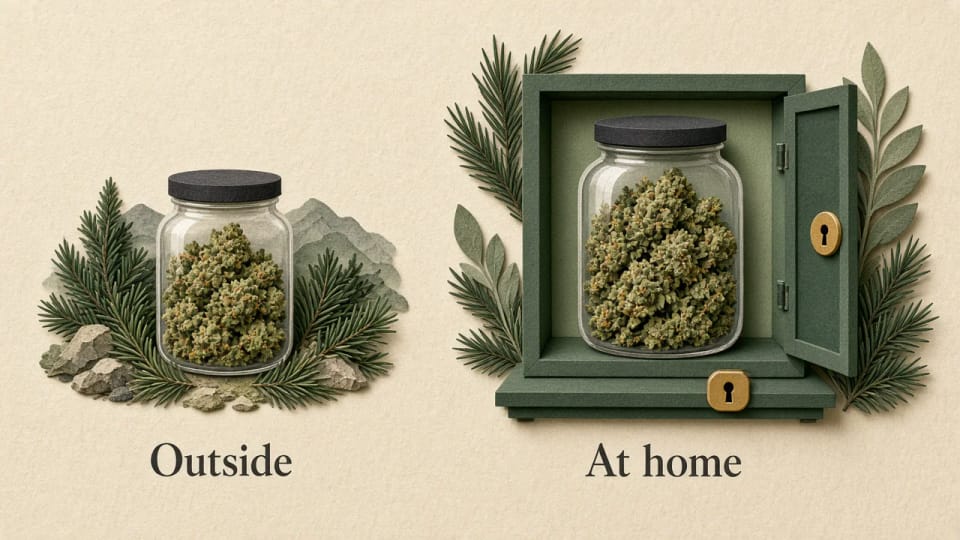
The labels name the two places in the possession rule. They are not weights. Neither jar is a reason to drive, and the picture does not show public use.
Can you grow weed in Massachusetts?
An adult who is 21 or older may possess, cultivate, or process not more than 6 marijuana plants for personal use. Not more than 12 plants may be cultivated on the premises at one time. Two adults at 6 plants each can reach that 12-plant ceiling and still sit inside section 7. One adult who grows 7 to 12 plants is in a different band. Section 13 calls that a civil penalty of not more than $100 and forfeiture, and not another criminal punishment solely for that conduct, while federal import and export remain prohibited. The statute does not spell out the penalty for more than 12 plants in that subsection.
The plants cannot be visible from a public place without binoculars, aircraft, or other optical aids. They have to be in an area with a lock or other security device. Break either rule and the civil penalty is not more than $300, plus forfeiture of the marijuana.
Section 13 still points at section 8 for those cultivation penalties. Section 8 is the accessories section. The grow right itself is in section 7.
Home manufacture is a separate limit. Unless you hold a product-manufacturer license, chapter 94G does not let you manufacture marijuana or hemp with any liquid or gas, other than alcohol, that has a flashpoint below 100 degrees Fahrenheit.
If you are new to the garden, start with how to grow cannabis at home. That piece is about the plant. The plant count on this page is the Massachusetts count. Connecticut’s rules and New York’s rules are different documents.
How much can you buy at a Massachusetts dispensary?
A licensed retailer may not knowingly sell more than two ounces of marijuana, or the combined dry-weight equivalent in concentrate or edibles, to a retail customer per day. The same two-ounce cap applies per transaction. Delivery orders follow the same two-ounce ceiling. These lines are in 935 CMR 500.140, in the commission’s posted compilation effective September 11, 2026. That PDF is marked unofficial. The official booklet is sold at the state bookstore. This guide uses the commission’s posted text.
The equivalent is active THC, not the weight of the whole package.
- One ounce of flower equals five grams of active THC in concentrate, including tinctures.
- One ounce of flower equals 500 milligrams of active THC in edibles.
- Two ounces of flower therefore line up with 10 grams of active THC in concentrate, or 1,000 milligrams of active THC in edibles.
- Topicals and ointments are not subject to a daily sales cap.
A retailer must check identification at the door and again at the register. You are not admitted unless the shop has verified that you are 21 or older. The shop must refuse the sale if you cannot produce valid government-issued identification. The regulation does not say the card has to come from Massachusetts. It also does not promise that every out-of-state card will pass the check. Bring a current government photo ID.
A shop entrance may not be closer than 500 feet from the nearest school entrance, unless the city or town adopts an ordinance or bylaw that reduces that distance. The 500 feet is a straight line from the center of one entrance to the center of the other, unless an impassable barrier forces the measure along the shortest public walking path. That buffer is a siting rule for the business. It is not a possession rule for you.
A familiar flower such as Blue Dream sits in our Relaxing High family. That label is a product classification. It is not a prediction of how the flower will feel, and it does not change the two-ounce purchase cap.
Can you use cannabis in public in Massachusetts?
No person shall consume marijuana in a public place. No person shall smoke marijuana where smoking tobacco is prohibited. The civil penalty is not more than $100.
That ban has a narrow exception. It does not apply to a person who consumes marijuana in a designated area of a marijuana establishment, in a city or town that has voted to allow consumption on the premises where the marijuana is sold. The same subsection does not limit medical use.
The commission has written three social-consumption license classes: Supplemental On-site Consumption, Hospitality On-site Consumption, and Marijuana Event Organizer. A license class on paper is not the same thing as an open cafe. This guide does not confirm that any social-consumption venue is operating.
Some places are closed to possession and consumption even if you are 21. Chapter 94G does not authorize marijuana on the grounds of a public or private school where children attend preschool, kindergarten, or grades 1 through 12. The same bar covers a school bus, a youth center, a correctional facility, and a detoxification facility.
Can you drive with cannabis in Massachusetts?
Leave the car parked. Chapter 94G does not change the penalties for operating a vehicle while impaired by marijuana, or for consuming marijuana while you operate one. The list covers a motor vehicle, train, aircraft, motorboat, or other motorized transport or machinery.
The opening penalty in chapter 90, section 24 covers operating under the influence of marijuana. It is a fine of not less than $500 and not more than $5,000, or imprisonment for not more than two and one-half years, or both the fine and the imprisonment. Later paragraphs raise the penalty after prior offenses. This guide does not recite license-suspension days, because those lines were not the part read for this page. There is no safe wait time here.
An open container in the passenger area is its own civil penalty of not more than $500. An open container means the seal is broken, or some of the contents have been removed or consumed. The passenger area is the space designed to seat the driver and passengers, plus any area they can reach while seated. It does not include the trunk, a locked glove compartment, or the living quarters of a house coach or house trailer. If the vehicle has no trunk, the area behind the last upright seat is also outside the passenger area.
Do not carry cannabis across a state line. Section 7 gives a broader personal-use protection only if federal law does not prohibit import or export. This guide does not treat that condition as met. How to travel with cannabis explains why each state line is a new rule. What Schedule III means is the federal piece. Neither page is permission to drive after you use cannabis.
Researchers are still designing ways to detect cannabis-impaired driving in real time. A 2026 paper is a protocol for a planned closed-track pilot with 45 healthy recreational cannabis users. It is a study plan. It is not a result, and it does not name a time when driving is fine. Deuber et al., 2026.
Can your job ban cannabis in Massachusetts?
Yes. Chapter 94G does not require an employer to permit or accommodate adult-use conduct at work. It also leaves in place the employer’s authority to restrict consumption by employees. A lawful purchase on Saturday does not become a workplace right on Monday.
The employment detail, including how medical use is discussed in court, lives in can you be fired for legal cannabis. This page stays with the sentence in section 2.
A lease has a narrower rule. The lease shall not prohibit a tenant from consuming marijuana by means other than smoking in the residence, unless allowing that use would make the landlord violate federal law. Smoking can still be banned. This guide does not say public housing must allow cannabis.
How does the medical cannabis program differ?
Medical use is a separate statute, chapter 94I. A “sixty-day supply” is the amount a registered qualifying patient would reasonably be expected to need over 60 days, up to 10 ounces, or as the commission otherwise defines it.
The Cannabis Control Commission tells law enforcement that a 60-day supply is 10 ounces, or the equivalent in other forms. For concentrate and resin, multiply the weight by 6.7 to get the dry-weight equivalent. The commission’s table shows 1.5 ounces of concentrate times 6.7 as 10 ounces of plant material. Do not mix that medical math with the adult-use purchase rule. Adult-use concentrate is counted by active THC, at five grams of active THC per ounce of flower.
Patients, caregivers, and treatment-center agents must carry a Massachusetts medical registration card while they possess marijuana for medical use. The card is valid for one year.
A hardship cultivation registration can let a patient, or the patient’s personal caregiver, grow at home for that patient’s own use. The plants are a limited number, enough to maintain a 60-day supply. They must be in an enclosed, locked area. They cannot be visible from the street or other public areas. They may be grown only at the location the commission approved.
People under 21 are outside the adult-use right. Chapter 94G does not allow them to possess, use, buy, or grow marijuana. A qualifying patient with a valid registration card is carved out of some of the under-21 purchase and cultivation penalties in section 13.
Chapter 94C, section 32L is the civil rule for possession by people under 21. As of April 19, 2026, possession of 3 ounces or less is only a civil offense. An offender who is 18 through 21 faces a civil penalty of $100 and forfeiture. An offender under 18 faces the same forfeiture and civil penalty if they complete a drug awareness program. If that younger person does not finish both the program and the required community service within one year, the civil penalty may rise to $1,000. Civil is not the same word as legal. The adult-use chapter still does not allow possession under 21.
Furnishing marijuana to a person under 21 is a different offense. The penalty is a fine of not more than $2,000, or imprisonment for not more than one year, or both. The statute’s definition of “furnish” excludes the children and grandchildren of the person charged, for possession on premises that person owns or controls. That definition is not permission to give cannabis to a minor. It is not advice. Read it with a lawyer before you rely on it. The furnishing penalty does not apply to medical marijuana furnished under chapter 94I.
Chapter 64N, the marijuana excise, does not apply to a sale by a medical marijuana establishment to a qualifying patient or personal caregiver. That exemption is the excise chapter. It is not a statement that the 6.25 percent sales tax is waived.
What did the 2026 reform bill change?
Governor Maura Healey signed the bill on April 19, 2026. The press release is the short official list. The possession limit went up. The Cannabis Control Commission went from five members to three, appointed by the governor. The number of retail licenses one owner can hold went from 3 to 6. The law adds license categories for on-site consumption, event-based use, and research. It removes the requirement that many medical businesses grow and process what they sell. It calls for studies of use patterns, the current excise rates, and future regulation of hemp-derived cannabinoid products.
That is the summary. The commission structure, the license caps, and the rest of the bill are in what the 2026 Massachusetts cannabis reform bill actually changes. This page does not repeat that article.
What would Question 8 change?
Question 8 is on the November 3, 2026 ballot as “Prohibit Retail Sale of Adult Recreational Use Marijuana.” A yes vote would, on January 1, 2028, prohibit legalization, regulation, and taxation of retail adult recreational sales and change possession penalties. A no vote would make no change, so the current 2 ounces outside the home and 10 ounces at home would stay. This page does not recommend a vote.
The proposed law would continue the medical program and repeal chapters 94G and 64N, the chapters that govern non-medical possession, use, distribution, cultivation, and taxation. The repeal would remove today’s 2-ounce and 10-ounce amounts and the non-medical caps of 6 plants per adult and 12 on the premises. Adults 21 and older could possess 1 ounce or less, including no more than 5 grams of concentrate, with no civil or criminal penalty, and could give that amount to another person 21 or older with no payment and no public advertising. More than 1 ounce, up to 2 ounces, would be a $100 civil penalty and forfeiture.
Read October 8, 2026, in the Secretary’s ballot text and the Information for Voters. See what Massachusetts Question 8 would do.
What about hemp?
An adult who is 21 or older is protected from arrest, prosecution, penalty, and asset forfeiture for possessing, producing, processing, manufacturing, purchasing, obtaining, selling, or otherwise transferring hemp. That protection is section 7 of chapter 94G. It is not a milligram chart. This guide does not state a hemp THC percentage or a hemp milligram cap, because those figures were not taken from the statute read for this page.
The 2026 act ordered a study of how hemp-derived cannabinoid products should be regulated later. “Ordered a study” means the rule is still ahead. The wider hemp picture is in hemp versus cannabis regulations.
One record rule is already on the books, and it is narrow. The Trial Court law library says misdemeanor marijuana possession convictions from before March 13, 2024 have been pardoned by Governor Maura Healey. That sentence does not list every record that can be sealed or expunged. The steps are in how to expunge a cannabis conviction.
Key takeaways
- Adults 21 and older may keep 2 ounces or less outside the home, and up to 10 ounces at home, plus marijuana produced by plants grown on the premises.
- The outside amount was 1 ounce until April 19, 2026. The current statute is the one to use.
- More than 2 ounces at home must be locked. Plants must be locked and kept out of public view. The home plant cap is 6 per adult and 12 on the premises.
- A retailer may sell up to 2 ounces per day and per transaction. Concentrate and edibles are measured by active THC. Topicals have no daily sales cap.
- Public consumption is a civil penalty of not more than $100, aside from a designated area in a city or town that voted to allow on-premises consumption.
- Driving under the influence of marijuana remains a crime. Do not drive after use, and do not carry cannabis across a state line.
- Employers may still restrict cannabis at work. A lease may still ban smoking.
- Medical patients follow chapter 94I, a registration card, and a 60-day supply the commission describes as 10 ounces or the equivalent.
- Question 8 is on the November 3, 2026 ballot. A yes vote would take effect on January 1, 2028, repeal chapter 94G, and replace the current 2-ounce and 10-ounce personal-use amounts, while the medical program would continue. A no vote would leave those rules in place.
FAQ
Can you gift weed in Massachusetts?
Yes, within a limit. An adult who is 21 or older may give up to 2 ounces of marijuana, or the equivalent amount of products the commission sets, to another person who is 21 or older. There is no payment. The gift cannot be advertised or promoted to the public. The same chapter does not permit a transfer to anyone under 21.
Do you have to lock cannabis at home?
You must lock it when the amount at home is more than 2 ounces. The civil penalty for breaking that rule is not more than $100, plus forfeiture. Plants have a separate rule. They must sit in an area with a lock or other security device, even when the plant count is inside the legal cap.
Is cannabis taxed in Massachusetts?
Adult-use sales carry three possible charges, and they are written separately. The state sales tax is 6.25 percent. The state marijuana excise is 10.75 percent of the sales price, and it sits on top of the sales tax. A city or town that accepts the local option may add a tax not greater than 3 percent. Not every town has accepted it. The Department of Revenue table that lists these rates was updated December 30, 2025.
Can tourists buy cannabis in Massachusetts?
A buyer has to be 21 or older. The retailer must refuse the sale without valid government-issued identification. The posted rule does not require a Massachusetts ID, and it does not guarantee that every out-of-state license will be accepted. What you buy is still Massachusetts cannabis. It does not become legal in the next state when you drive home.
Does home-grown cannabis count toward the 10-ounce limit?
Marijuana produced by plants cultivated on the premises is in addition to the 10 ounces you may possess at home. The statute says “any marijuana produced by” those plants. That phrase is not a license to sell the harvest, and it does not raise the 2-ounce limit outside the home.
What would happen if Question 8 passes?
Not on election night. The proposed law would take effect on January 1, 2028, and only if voters approve it. The ballot question says the Senate and the House took no vote on it before May 6, 2026. A yes vote would repeal chapter 94G, which holds the current 2 ounces outside the home, 10 ounces at home, and the non-medical home-grow caps. It would also prohibit legalization, regulation, and taxation of retail adult recreational sales. Adults 21 and older could then possess 1 ounce or less, including no more than 5 grams of concentrate. Above 1 ounce, through 2 ounces, the penalty would be $100 and forfeiture. The medical program would continue. The Attorney General’s summary would keep the Cannabis Control Commission for the medical market only. A chapter 94G licensee could apply on an expedited path for a medical-program license and sell existing supplies to a medical marijuana treatment center. A no vote would leave the April 19, 2026 rules in place. This answer does not recommend a vote. The full text is in what Massachusetts Question 8 would do.
Sources
- Massachusetts General Court, General Laws chapter 94G, section 7, personal use of marijuana, clause in force effective April 19, 2026. https://malegislature.gov/Laws/GeneralLaws/PartI/TitleXV/Chapter94G/Section7
- Massachusetts General Court, General Laws chapter 94G, section 13, penalties, text in force effective April 19, 2026. https://malegislature.gov/Laws/GeneralLaws/PartI/TitleXV/Chapter94G/Section13
- Massachusetts General Court, General Laws chapter 94G, section 2, limitations, including driving, people under 21, home manufacture, property, schools, and employment. https://malegislature.gov/Laws/GeneralLaws/PartI/TitleXV/Chapter94G/Section2
- Massachusetts General Court, Acts of 2026, chapter 65, an act modernizing the commonwealth’s cannabis laws. https://malegislature.gov/Laws/SessionLaws/Acts/2026/Chapter65
- Office of Governor Maura Healey, press release, Governor Healey signs cannabis reform legislation, April 19, 2026. https://www.mass.gov/news/governor-healey-signs-cannabis-reform-legislation
- Trial Court Law Libraries, Massachusetts law about recreational marijuana, last updated June 4, 2026. https://www.mass.gov/info-details/massachusetts-law-about-recreational-marijuana
- Massachusetts Cannabis Control Commission, 935 CMR 500.000, Adult use of marijuana, posted compilation effective September 11, 2026, including sections 500.050, 500.110, and 500.140. The file is marked unofficial. https://masscannabiscontrol.com/wp-content/uploads/2026/09/20260911-935-CMR-500.000.pdf
- Massachusetts General Court, General Laws chapter 94C, section 32L, possession of 3 ounces or less of marihuana, text effective April 19, 2026. https://malegislature.gov/Laws/GeneralLaws/PartI/TitleXV/Chapter94C/Section32L
- Massachusetts General Court, General Laws chapter 90, section 24, operating under the influence, opening penalty paragraph. https://www.mass.gov/info-details/mass-general-laws-c90-ss-24
- Massachusetts Department of Revenue, tax rates, sales tax and marijuana row, updated December 30, 2025. https://www.mass.gov/info-details/massachusetts-tax-rates
- Massachusetts General Court, General Laws chapter 64N, sections 2, 3, and 4, excise rate, local option, and medical exemption. https://malegislature.gov/Laws/GeneralLaws/PartI/TitleIX/Chapter64N/Section2
- Massachusetts General Court, General Laws chapter 94I, section 1, definition of a sixty-day supply. https://malegislature.gov/Laws/GeneralLaws/PartI/TitleXV/Chapter94I/Section1
- Massachusetts Cannabis Control Commission, law enforcement guide for the medical use of marijuana, 60-day supply, concentrate table, hardship cultivation, and registration cards. https://masscannabiscontrol.com/law-enforcement-for-medical-use-of-marijuana/
- Deuber R, Bechny M, Heck C, Brügger J, Pfäffli M, Jovanova M, Fleisch E, Wortmann F, Weinmann W (2026). Protocol for the REVELIO test-track pilot study: a randomised, controlled, single-centre trial in healthy recreational cannabis users investigating real-time in-vehicle detection of cannabis-impaired driving. PLOS One. https://doi.org/10.1371/journal.pone.0349328 and https://pubmed.ncbi.nlm.nih.gov/42821661/
- Secretary of the Commonwealth, 2026 State Election Ballot Questions, Question 8, Prohibit Retail Sale of Adult Recreational Use Marijuana, the summary as it will appear on the ballot, and the yes and no statements. https://www.sec.state.ma.us/divisions/elections/research-and-statistics/2026-ballot-questions.htm
- Secretary of the Commonwealth, Information for Voters for the November 3, 2026 state election, English PDF, Question 8 summary and the full text of An Act to restore a sensible marijuana policy, including the purpose clause and sections 3, 4, 6, 8, and 10. https://www.sec.state.ma.us/divisions/elections/download/information-for-voters/archive/IFV_2026%20English.pdf