CBDA vs CBD: Raw vs Activated — What Changes?
CBDA vs CBD compared: how heat decarboxylates raw cannabis, why acidic CBDA targets 5-HT1A and COX-2, and what activation changes for your goals.

If you have ever bitten into a fresh cannabis leaf expecting a buzz and gotten nothing but a bitter, grassy mouthful, you have met cannabidiolic acid — CBDA — in its natural habitat. The living plant barely makes any CBD at all. What it actually produces is the acidic precursor, and only heat turns that precursor into the CBD you read about on tincture labels.
That single chemical step, called decarboxylation, is the entire story of “raw versus activated.” It sounds like a footnote, but it changes which receptors the molecule talks to, how your body absorbs it, and which goals it might actually serve. Let me walk you through what really changes when a flame, an oven, or a sunbeam strips one tiny piece off a cannabinoid — and why the raw form has quietly become one of the more interesting molecules in cannabis science.
The Plant Makes Acids, Not Neutrals
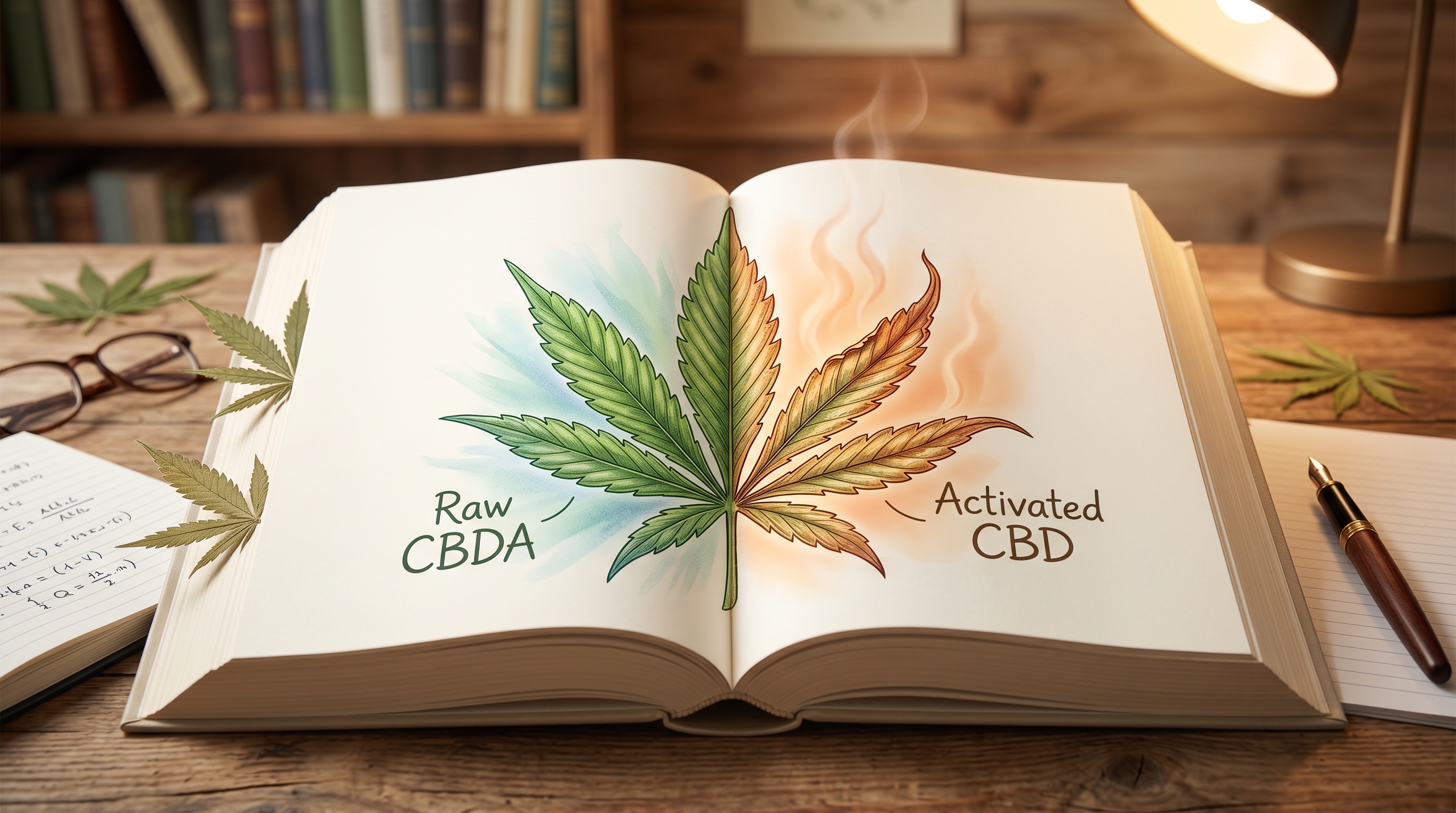
Here is the part that surprises most people: the cannabis plant does not manufacture CBD or THC directly. It builds their acidic forms — CBDA and THCA — through enzymes acting on the shared precursor CBGA, the so-called mother cannabinoid. (If that lineage interests you, I cover it in CBG, the mother cannabinoid.)
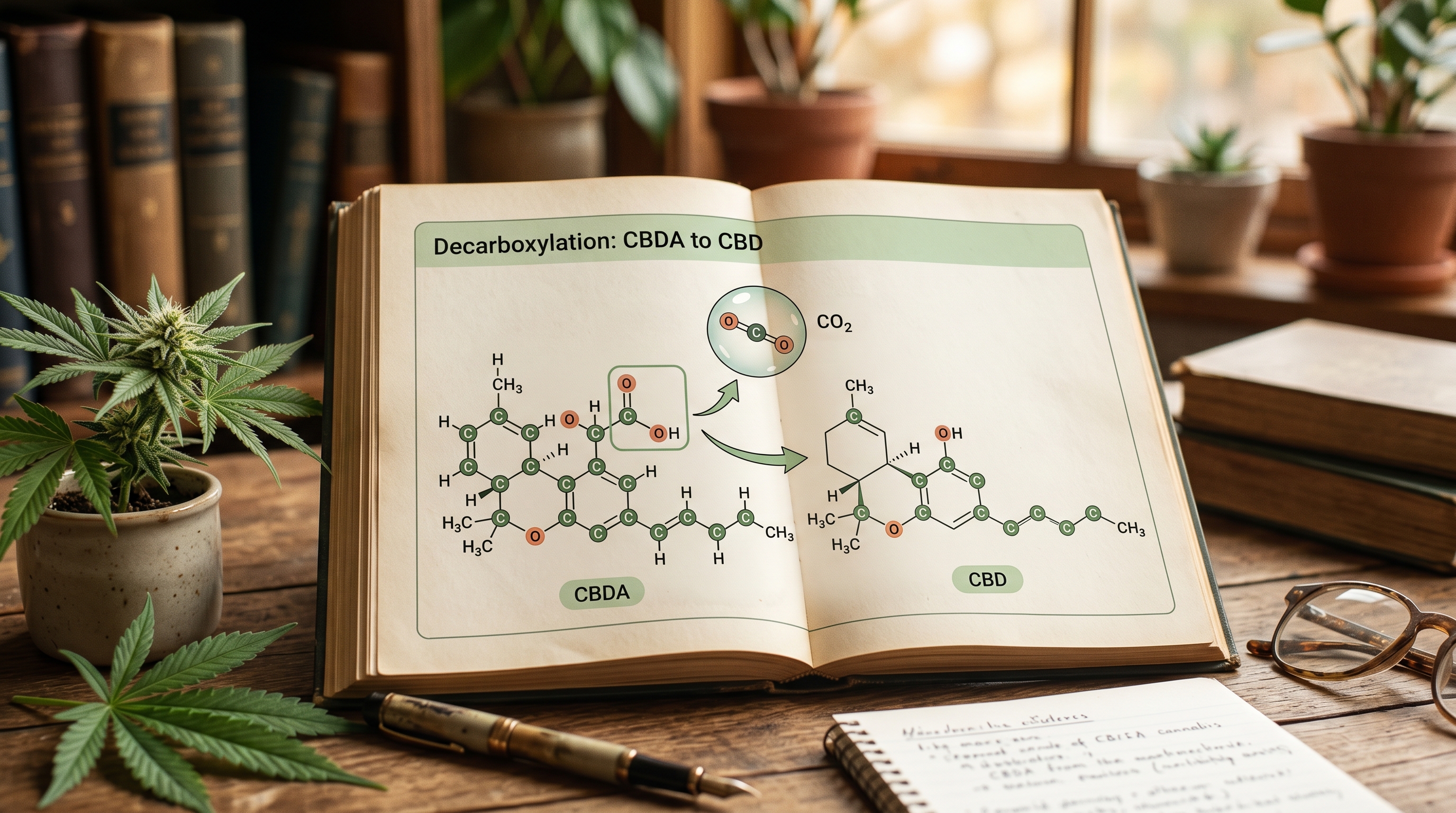
So in a freshly harvested, undried, unheated bud, you are looking at a molecule that is mostly CBDA, with only trace amounts of CBD. The “A” stands for the carboxyl group — a small cluster of carbon, oxygen, and hydrogen atoms (–COOH) bolted onto the molecule. That extra appendage is the difference between raw and activated.
Decarboxylation simply means “removing the carboxyl group.” Apply enough energy — heat, time, light — and the carboxyl group breaks off and floats away as carbon dioxide. What is left behind is the neutral cannabinoid: CBD. I have a full breakdown in Decarboxylation explained and a hands-on guide in How to decarb cannabis perfectly every time, but the headline is this: CBDA minus CO2 equals CBD.
This is why smoking, vaping, and baking all “work” while a raw leaf does not do much in the THC department. The flame or oven is doing chemistry for you in real time. It is also why a poorly stored jar of old flower slowly loses its acids — light and time decarboxylate cannabinoids on their own, just slowly and unevenly. If you want the raw acids, you have to actively avoid heat, which is exactly why the raw-juicing crowd blends fresh leaves instead of dried ones.
CBDA vs CBD: The Comparison
The two molecules are nearly identical on paper, but that one carboxyl group rewires their behavior in the body. Here is the side-by-side.
| Property | CBDA (raw / acidic) | CBD (activated / neutral) |
|---|---|---|
| Where it comes from | Made directly by the living plant | Created when CBDA is heated |
| Conversion trigger | — | Decarboxylation (heat, light, time) |
| Structure | Has the –COOH carboxyl group | Carboxyl group removed |
| 5-HT1A serotonin receptor | Potent enhancer of activation | Weaker enhancer |
| COX-2 inflammation enzyme | Selective inhibitor at low micromolar doses | Far weaker COX-2 effect |
| Stability | Fragile; degrades with heat and light | More stable over time |
| Typical sources | Raw juice, fresh leaf, unheated tinctures | Oils, gummies, smoked or vaped flower |
| Psychoactive? | No | No |
| Research maturity | Mostly preclinical (rodent/cell) | Larger human evidence base, incl. epilepsy |
Neither one will get you high — that is THC’s job, and you can read why in Anandamide, your body’s natural THC. The intrigue with CBDA is not about intoxication. It is about how aggressively the raw acid engages two specific biological targets.
Why the Raw Acid Punches Above Its Weight
For years, CBDA was treated as inactive packaging — the boring shell you had to burn off to get to the “real” cannabinoid. That assumption has not aged well.
A serotonin connection
The most striking finding comes from the lab of Linda Parker at the University of Guelph. Her group showed that CBDA enhances activation of the 5-HT1A serotonin receptor far more potently than CBD does. In rodent models of nausea, the dose of CBDA needed to blunt the response was reported to be roughly a thousand times lower than the dose of CBD required for the same effect [Bolognini et al., 2013] [Rock et al., 2013].
That is not a typo. The acid was dramatically more efficient at the receptor in those models. Because 5-HT1A is tied to mood and nausea regulation, this hints at possible anti-nausea and anti-anxiety roles — though I want to be careful here. These are animal and cell studies. Robust human trials are still thin, so treat this as a promising signal, not a settled prescription. If serotonin’s broader role in your experience fascinates you, see Cannabis and serotonin.
A targeted anti-inflammatory
The second target is the inflammatory enzyme COX-2. A 2008 study [Takeda et al., 2008] identified CBDA as a selective COX-2 inhibitor at low micromolar concentrations, with far weaker action on COX-1. That selectivity matters: traditional NSAIDs like ibuprofen hit both COX-1 and COX-2, and the COX-1 part is what tends to irritate the stomach lining. A molecule that leans on COX-2 may, in theory, calm inflammation with a gentler gastrointestinal profile, though this is not yet proven in people. Later work echoed this COX-2 suppression at low doses [Formato et al., 2020].
This is mechanistically distinct from how terpenes like beta-caryophyllene ease discomfort — that one works through the CB2 receptor instead, which I explain in Caryophyllene, the terpene that acts like a cannabinoid. The point is that CBDA may add its own anti-inflammatory lever to the full-spectrum toolkit, part of the broader entourage effect.
The Bioavailability Twist
If CBDA is so fragile and unproven, why bother with it at all? Because there is early evidence that the raw acid may actually absorb better than the neutral form. Some research suggests CBDA reaches notably higher blood concentrations than equivalent CBD after oral dosing — one line of work pointed to CBDA levels around double those of CBD.
The catch is that delivery format dominates everything. A 2026 review noted that the brain-to-plasma ratio of CBDA in a Tween-based vehicle was roughly fifty times higher than in a vegetable-oil carrier [Singh et al., 2026]. In other words, what you dissolve CBDA in can swing its reach by an order of magnitude. The same review also flagged the honest downsides: acidic cannabinoids generally show short half-lives and limited central nervous system penetration. So “more bioavailable” is real but conditional — it depends heavily on the product, not just the molecule.
This is the kind of nuance that gets flattened in marketing copy, and it is exactly why I push readers to treat their own body as the experiment. A similar principle may apply to how you absorb activated cannabinoids too; if onset and absorption fascinate you, Cannabis pharmacokinetics goes deep.
Solving the Stability Problem: The Methyl Ester Story
CBDA’s biggest practical flaw is that it does not like to sit still. Heat, light, and time all nudge it toward decarboxylation. That makes it tough to formulate into a shelf-stable product and tough to study with consistent doses.
The legendary cannabis chemist Raphael Mechoulam — the same researcher who first isolated THC — and colleagues including Roger Pertwee tackled this head-on. They engineered a stabilized synthetic analog called CBDA methyl ester (HU-580), swapping the unstable carboxyl group for a methyl ester that resists degradation. In their 2018 work published in the British Journal of Pharmacology, HU-580 not only held together better but appeared more potent than natural CBDA at enhancing 5-HT1A activation and suppressing nausea and anxiety in rats [Pertwee et al., 2018].
Follow-up research extended the comparison across acute and anticipatory nausea models in rats and shrews [Brierley et al., 2020]. The takeaway: the part of CBDA that makes it medically interesting can survive being stabilized — you do not necessarily lose the benefit when you fix the fragility. Whether HU-580 ever becomes an actual medicine is unknown, and some reviewers remain cautious about whether it improves on natural CBDA in practice. But it reframes CBDA from “the throwaway precursor” to “a lead compound worth engineering.”
Raw Juicing: Trend or Genuine Strategy?
All of this fuels the raw cannabis movement — people blending fresh, undried leaves and buds into smoothies and juices to consume CBDA and THCA without decarboxylating them. The appeal is consuming the acids the plant actually makes, plus a hit of plant nutrients, without any intoxication.
I will give the trend a fair shake and a fair warning. The upside: you get the acidic cannabinoids in their native form, and if the absorption signals hold up, that may be a feature rather than a bug. The downsides: fresh, pesticide-free, never-heated cannabis is hard to source legally and consistently; dosing is wildly imprecise compared to a labeled tincture; and the human evidence for benefits is still emerging. Raw juicing is an experiment, not an established protocol. If you try it, source clean material and keep notes.
For most people, the more reliable path to CBDA is a cold-processed raw tincture or a CBDA-specific oil that has not been heated. And if you are cooking, remember that the moment you apply heat, you are converting acids to neutrals — which is great when you want CBD but counterproductive when you want CBDA. My how to make cannabis tinctures guide covers low-heat options.
So — Raw or Activated? Match It to the Goal
There is no universal winner. There is only the right form for what you are after.
- Reach for activated CBD when you want the better-studied molecule, shelf stability, predictable dosing, and the larger body of human research (including its well-known role in epilepsy — see Cannabis for epilepsy). CBD also has its own surprising dose-dependent quirks, like being stimulating rather than sedating at low doses.
- Explore raw CBDA if you are curious about the serotonin-linked nausea and anti-inflammatory signals, and you are comfortable being an early adopter while the human evidence matures.
And here is the part the labels will never tell you: the molecule is only half the equation. The terpene and cannabinoid environment it arrives in — the whole-plant matrix — shapes how it actually lands for you. A high-CBD chemovar like Harlequin, ACDC, or Cannatonic gives you a CBD-forward starting point, and these tend to sit in the gentler Balancing High and Relieving High families. Strains rich in calming myrcene and linalool lean toward relaxed and sleepy experiences, while limonene- and pinene-heavy options like Jack Herer, Super Lemon Haze, or Durban Poison push toward uplifted and focused territory. The anti-inflammatory crowd often gravitates to caryophyllene-rich cultivars in the Relieving High family for pain relief. Even crowd-pleasers like Blue Dream, Northern Lights, and Granddaddy Purple behave differently person to person because of those background profiles.
Track What Actually Changes for You
This is where I get on my soapbox. Cannabis science can tell you what CBDA and CBD tend to do across populations of rats, cells, and the occasional human trial. It cannot tell you what your particular body will do with a raw tincture versus a baked edible on a Tuesday night.
That gap is the whole reason I keep harping on tracking. When you log what you took — raw or activated, which chemovar, what dose, how you felt — you stop guessing and start seeing your own pattern. Did the cold tincture settle your stomach better than the gummy? Did the high-CBD flower in the Balancing High family leave you clearer than a CBD isolate? The plant gives you the variables; you supply the data. The High IQ app exists precisely to turn those scattered impressions into a profile you can actually read.
Decarboxylation is a one-way chemical door. Understanding what is on each side of it — and noticing which side serves you — is how you move from following labels to understanding your own response.
Key Takeaways
- CBDA is the raw, acidic form the living plant actually produces; CBD is what you get after heat strips off the carboxyl group during decarboxylation.
- In preclinical studies, CBDA engages the 5-HT1A serotonin receptor far more potently than CBD and selectively inhibits the COX-2 inflammation enzyme — but most of this evidence is from rodents and cells, not human trials.
- CBDA may absorb better than CBD in some formats, yet its reach depends heavily on the delivery vehicle and it has a short half-life.
- CBDA is fragile, which is why researchers built the stabilized methyl ester HU-580; raw juicing is the main whole-plant way to consume it, but dosing is imprecise.
- Neither molecule is intoxicating. Pick raw or activated based on your goal, and track your own response to see what actually works for you.
Frequently Asked Questions
Is CBDA psychoactive? No. Like CBD, CBDA does not produce a high. Only THC (the activated form of THCA) is intoxicating.
Does CBDA turn into CBD in my body? Not appreciably on its own. The conversion is driven by heat, light, and time outside the body. Consuming raw CBDA largely keeps it as CBDA.
Can I get CBDA from smoking or vaping? No — those processes decarboxylate the acid into CBD instantly. CBDA comes from raw, unheated sources like fresh juice or cold-processed tinctures.
Is CBDA legal? It depends on your jurisdiction and the source (hemp-derived versus marijuana-derived). Always check your local laws.
Is one “better” than the other? No. CBD has more human research and stability; CBDA shows stronger preclinical signals at certain receptors. The better choice depends on your goal and your own tracked response.
Sources
- Pertwee, R. G., Rock, E. M., Guenther, K., et al. (2018). Cannabidiolic acid methyl ester, a stable synthetic analogue of cannabidiolic acid, can produce 5-HT1A receptor-mediated suppression of nausea and anxiety in rats. British Journal of Pharmacology, 175(1), 100–112. DOI: 10.1111/bph.14073 (PMID: 29057454)
- Bolognini, D., Rock, E. M., Cluny, N. L., et al. (2013). Cannabidiolic acid prevents vomiting in Suncus murinus and nausea-induced behaviour in rats by enhancing 5-HT1A receptor activation. British Journal of Pharmacology, 168(6), 1456–1470. DOI: 10.1111/bph.12043
- Rock, E. M., Limebeer, C. L., & Parker, L. A. (2013). Effect of cannabidiolic acid and ondansetron on conditioned gaping in rats. Psychopharmacology. Related work DOI: 10.1111/bph.12043
- Takeda, S., Misawa, K., Yamamoto, I., & Watanabe, K. (2008). Cannabidiolic acid as a selective cyclooxygenase-2 inhibitory component in cannabis. Drug Metabolism and Disposition, 36(9), 1917–1921. DOI: 10.1124/dmd.108.020909 (PMID: 18556441)
- Brierley, D. I., et al. (2020). Evaluation of repeated or acute treatment with cannabidiol (CBD), cannabidiolic acid (CBDA) or CBDA methyl ester (HU-580) on nausea and/or vomiting in rats and shrews. Psychopharmacology. DOI: 10.1007/s00213-020-05559-z
- Formato, M., et al. (2020). (–)-Cannabidiolic Acid, a Still Overlooked Bioactive Compound. Molecules, 25(11), 2638. DOI: 10.3390/molecules25112638
- Singh, S. K., et al. (2026). Therapeutic potential of acidic cannabinoids: an update. Journal of Cannabis Research, 8:25. DOI: 10.1186/s42238-026-00387-y
Educational content only. This is not medical advice. Talk to a qualified clinician before using cannabis products, especially if you take other medications or have a health condition.


