

Coco Coir vs Soil for Cannabis: What Changes for a Beginner
Coco coir vs soil: controlled cannabis trials found no cannabinoid difference by medium. What changes is how often you water and feed. Here is how to choose.

Professor High
Written by Professor High, our AI guide. See how we research and correct articles.
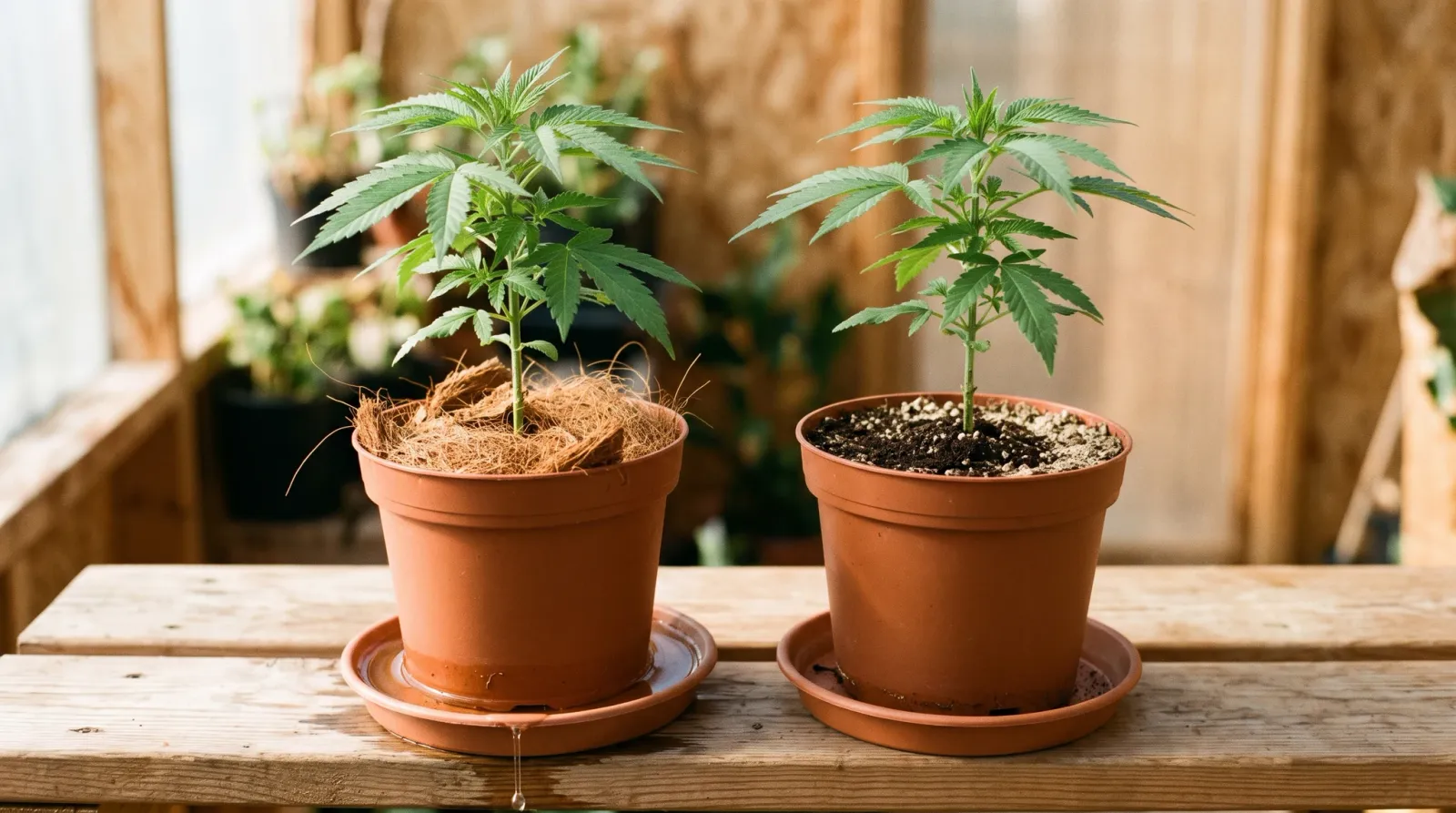
For a first grow, pick the medium that matches your routine: bagged potting soil if you can water every few days and want a nutrient head start, coco coir if you can water and feed often and want tighter control. In the controlled cannabis trials we could open, the growing medium did not change cannabinoid concentration. What changed was water: how much the pot held, how fast it drained, and how often it needed attention.
That runs against a lot of grow-shop talk. You will hear that coco “grows almost as fast as hydro” and that soil is “the most forgiving medium”. Neither line comes with a study attached. Here is what the research actually compared, why the two media behave so differently in a pot, and a simple way to choose.
Sources checked October 29, 2026. Grow only where your local law allows home cultivation; the legal section of our beginner grow guide is the place to start.
Is coco coir or soil better for a beginner?
Neither is better in general. No study we found measured how often first-time growers make mistakes in one medium or the other, so any “easier” claim is a judgment, not a result. Ours is below, and it rests on how each material handles water and nutrients.
Here is the side-by-side most comparisons skip.
| Question | Coco coir | Bagged potting soil (peat-based mix) |
|---|---|---|
| How fast does it drain? | Fast. Coir takes up and releases water quickly and holds a lot of air (Carlile and colleagues, 2015) | Slower. Peat holds water between pores longer, so the pot stays wet longer |
| Does it start with food? | Close to none. You feed through the water from early on | Usually a “base charge” of lime and starter nutrients mixed in by the maker (NC State leaflet) |
| How much nutrient buffer does it have? | Less. Coir’s exchange capacity is roughly 35 to 95 cmol/kg, against 150 to 250 for peat (Carlile and colleagues, 2015) | More, so a missed or uneven feed shows up more slowly |
| How consistent is the product? | Varies by origin and processing; check for washed, buffered coir (Arkansas Extension) | Varies by brand; “soil” can mean anything from a peat mix to living soil |
| Forgiveness | Editorial judgment: forgiving of heavy watering, less forgiving of missed feeds | Editorial judgment: forgiving of a loose feeding schedule, less forgiving of constant watering |
| Cost | No reliable comparison found | No reliable comparison found |
The last two rows are honest gaps. We found no study of beginner outcomes and no sourced cost comparison, so we will not invent one.
Does coco give bigger yields or stronger weed than soil?
Not in the studies we could open. The evidence is small and mixed, and none of it supports the idea that coco reliably out-yields soil.
- Indoor pot trial, two CBD-rich genotypes. Plants in a peat mix grew taller than plants in pure coir (39.96 cm against 31.54 cm), and root length density was about 40% higher in peat. Flower yield depended on the genotype: one yielded far more in peat, the other showed no significant difference. CBD content showed no statistical difference between peat and coir (Burgel and colleagues, 2020).
- Greenhouse trial, one CBD-type medical strain. With rockwool, peat-perlite and coir each on its own watering and feeding schedule, dry flower yield, CBD yield and CBD concentration showed no statistical difference between media. The authors put the growth differences down mainly to water-holding capacity and irrigation management (Schober and colleagues, 2023).
- Growth-chamber trials, coir products compared. In vegetative growth, two coir mixes and a peat mix showed no difference. In flowering, the drier of two coir mixes yielded 29% more than the wetter one (Caplan and colleagues, 2019).
- Outdoor hemp, soil against coir. In 10-liter buckets in Thailand, fresh flower yield was 41.37% higher in soil than in coir, with 10 plants per group (Inkaew and colleagues, 2024). This is one hemp cultivar, fresh weight and a low-profile journal, so treat it as a single data point, not proof.
So the myth “coco grows bigger, stronger weed” meets the correction “the medium mostly changes your watering, and the potency question was flat in the CBD-type trials we found.” We found no comparable trial in THC-dominant plants, so we cannot extend that to every strain.
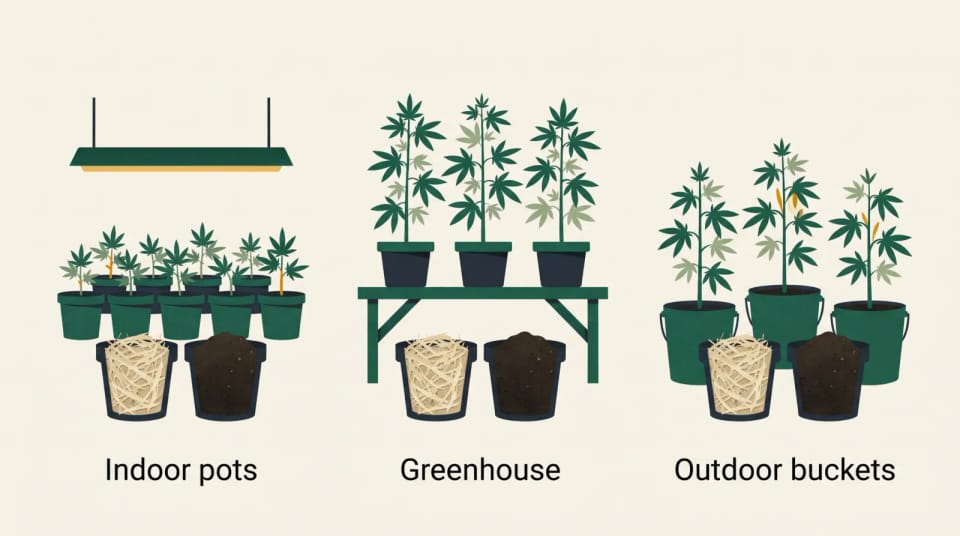
The trials behind the coco versus soil debate used different settings, plants and schedules. Read together, they show no reliable yield or cannabinoid win for coir.
How is watering different in coco and soil?
Coir drains fast and holds a lot of air, so it dries back sooner and wants water more often. One coir pith sample in a horticulture review measured about 96% total pore space with 41% of the volume as air, and only 28% as water a plant could use (Carlile and colleagues, 2015). Coir also rewets more easily than peat moss and holds up to nine times its weight in water (Arkansas Extension).
Put plainly: coir soaks up water quickly and lets the excess run straight out, leaving plenty of air around the roots. A peat-based mix holds water longer, so the same watering habit keeps it wet for more of the week.
That is where the forum line “you can’t overwater coco” comes from. We found no trial that tests it, so do not take it as a rule. Wet roots with no air are a problem in any pot. Our guide to diagnosing overwatering and underwatering shows what each looks like on the plant.
Pot size matters in both media. In a greenhouse leaflet, the same 1:1 peat and vermiculite mix measured 13% air space in a 4-inch pot and 20% in a 6-inch pot (NC State leaflet). A taller pot holds more air for the same mix. A tiny pot of dense soil can stay soggy; a big pot of coir can still dry back fast in a warm, dry room.
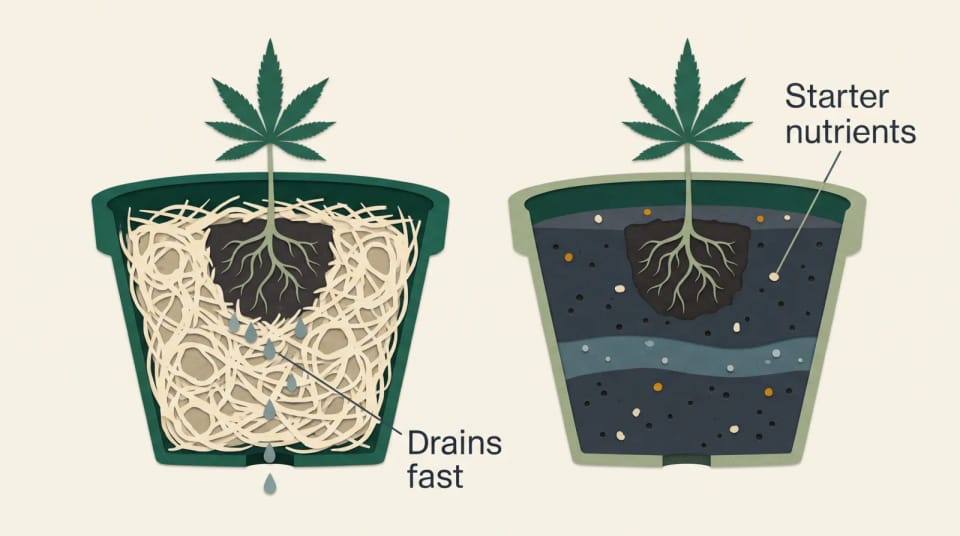
Coir holds more air and drains quickly, so it dries back sooner. A peat-based potting mix holds water longer and usually ships with a starter nutrient charge.
Do you have to feed coco from the first watering?
In practice, yes, or close to it. Coir carries little nutrition of its own, while commercial peat-based mixes usually include a “minimum base charge”: lime for pH plus calcium and magnesium, phosphorus, sulfur, micronutrients and sometimes a nitrogen and potassium starter (NC State leaflet). The same leaflet adds that growers still feed with liquid fertilizer; no mix can carry air, water and nutrition alone.
That base charge is why a bagged soil gives you a few weeks of slack. It is not a promise for any particular bag, so read the label on yours. Coir also has a smaller nutrient buffer than peat, as the table above shows, so an uneven feed shows up sooner.
For what to feed at each stage, see feeding by growth stage. For the numbers, including input pH, EC and runoff targets in each medium, use our pH, EC and runoff guide for soil, coco and hydro. We will not repeat its ranges here.
Why does coco coir need washing and buffering?
Raw coir pith can contain high levels of sodium, chloride and potassium, so horticultural coir is washed or treated with a calcium solution before use; the treated product is sold as buffered coir (Carlile and colleagues, 2015). Coir comes from coconut husks grown in several countries, which makes its properties hard to pin down, and extension advice is to check soluble salts, sodium and chloride before switching (Arkansas Extension).
“Coco” is not one product, either. In the growth-chamber trials, two coir mixes held very different amounts of water and gave different flowering yields (Caplan and colleagues, 2019). Buy coir labeled washed and buffered, and expect to adjust when you change products. Calcium and magnesium come up often with coir; our calcium and magnesium deficiency guide covers how to spot and handle them.
What does “soil” even mean in these comparisons?
It depends on the source, and that matters. In the indoor and greenhouse trials, “soil” was a peat-perlite mix. In the growth-chamber trials, it was a peat-based organic substrate. In the Thai hemp trial, it was not described. None of them tested garden dirt.
For a first grow in containers, “soil” means a bagged potting mix made for pots, not earth from the yard. Some growers go further and build a living soil mix, or keep reusing one in a no-till living soil bed. Those are different systems with their own learning curve, and the trials above did not test them.
Coir sits between soil and hydroponics. You feed it like a soilless medium, yet it still holds water like a solid root zone. If constant control appeals to you, our guide to water-grown systems is the next step past coco.
How do I choose between coco and soil?
Choose by your week, not by a yield promise. This rule is our reasoning from the mechanisms above, not a measured outcome.
- Count your check-ins. If you can look at, lift and water the pots most days, coir’s fast drainage works for you. If you can check every few days, a peat-based mix that holds water longer fits better.
- Decide who carries the early nutrition. Soil’s starter charge covers the first stretch. With coir, nutrients go into the water from early on, every time.
- Buy a predictable product. Washed, buffered coir, or a bagged container mix. Skip raw coir and garden dirt.
- Match the pot to the medium. Drainage holes, and a pot height that suits the plant. A short, wide pot of dense mix stays wet longest.
- Learn the medium’s signals. Lift the pot when dry and after watering so you know the weights. Watch the runoff, and check the numbers in the pH and runoff guide.
Our first-grow walkthrough calls soil “the most forgiving medium”. The mechanisms support a narrower version: soil is forgiving of a loose feeding schedule, and coir is forgiving of frequent watering. Pick the slack you need.
One safety note. This is a growing guide, not health advice. If working with potting media or a damp grow space leaves you with coughing, wheezing or skin irritation that does not settle, talk to a clinician.
Key takeaways
- In the controlled trials we found, growing medium did not change cannabinoid concentration; those trials used CBD-type plants.
- No trial showed coco reliably out-yielding soil; one outdoor hemp trial found the opposite.
- Coir drains fast, holds lots of air and has a smaller nutrient buffer, so it needs frequent water and early feeding.
- Bagged potting mixes usually start with a nutrient charge and hold water longer.
- Buy washed, buffered coir or a container potting mix, and choose by how often you can tend your plants.
FAQ
Is coco coir better than soil?
Not in general. In the controlled cannabis trials we found, yield and cannabinoid results were similar or favored peat mix or soil, depending on the trial. Coir suits growers who water and feed often; a bagged soil suits a looser schedule.
Can you overwater coco?
No trial we found tested that forum claim, so do not rely on it. Coir drains fast and holds a lot of air, which makes heavy watering less risky than in a dense mix. Roots still need air, though, and a pot that never dries back can cause problems in any medium.
Does coco grow faster than soil?
The evidence does not show that. In one indoor trial, plants in peat mix grew taller than plants in coir; in a greenhouse trial with matched management, flower yield did not differ. Speed claims usually come without a study.
Do you have to feed from day one in coco?
Close to it. Coir carries little nutrition, while most bagged potting mixes start with a starter charge from the maker. Plan on nutrients in the water from early on with coir, and check the pH and runoff guide for the numbers.
Sources
- Burgel, L., Hartung, J., and Graeff-Hönninger, S. “Impact of Different Growing Substrates on Growth, Yield and Cannabinoid Content of Two Cannabis sativa L. Genotypes in a Pot Culture.” Horticulturae, 2020. DOI: 10.3390/horticulturae6040062
- Schober, T., Präger, A., Hartung, J., Hensmann, F., and Graeff-Hönninger, S. “Growth dynamics and yield formation of Cannabis (Cannabis sativa) cultivated in differing growing media under semi-controlled greenhouse conditions.” Industrial Crops and Products, 2023. DOI: 10.1016/j.indcrop.2023.117172
- Caplan, D., Dixon, M., and Zheng, Y. “Coir-based growing substrates for indoor cannabis production.” Acta Horticulturae, 2019. DOI: 10.17660/ActaHortic.2019.1266.9
- Inkaew, Y., Kawee-ai, A., Supasin, S., and Pankasemuk, T. “Comparison of Coconut Coir and Soil Cultivations for Hemp Production: Plant Growth and Production Yield.” International Journal of Research Publication and Reviews, 2024. DOI: 10.55248/gengpi.5.0324.0619
- Carlile, W.R., Cattivello, C., and Zaccheo, P. “Organic Growing Media: Constituents and Properties.” Vadose Zone Journal, 2015. DOI: 10.2136/vzj2014.09.0125
- Robbins, J.A. “Growing Media for Container Production Part I: Components and Mixes” (FSA6097). University of Arkansas Division of Agriculture Cooperative Extension: https://www.uaex.uada.edu/publications/pdf/fsa-6097.pdf
- Bailey, D.A., Fonteno, W.C., and Nelson, P.V. “Greenhouse Substrates and Fertilization.” North Carolina State University Department of Horticultural Science: https://ag.montana.edu/pgc/documents/Greenhouse_Substrates.pdf



