No-Till Cannabis: The Recycled Organic Living Soil Method
Learn how no-till cannabis and recycled organic living soil (ROLS) build a perpetual, self-feeding ecosystem that gets better and cheaper every cycle.

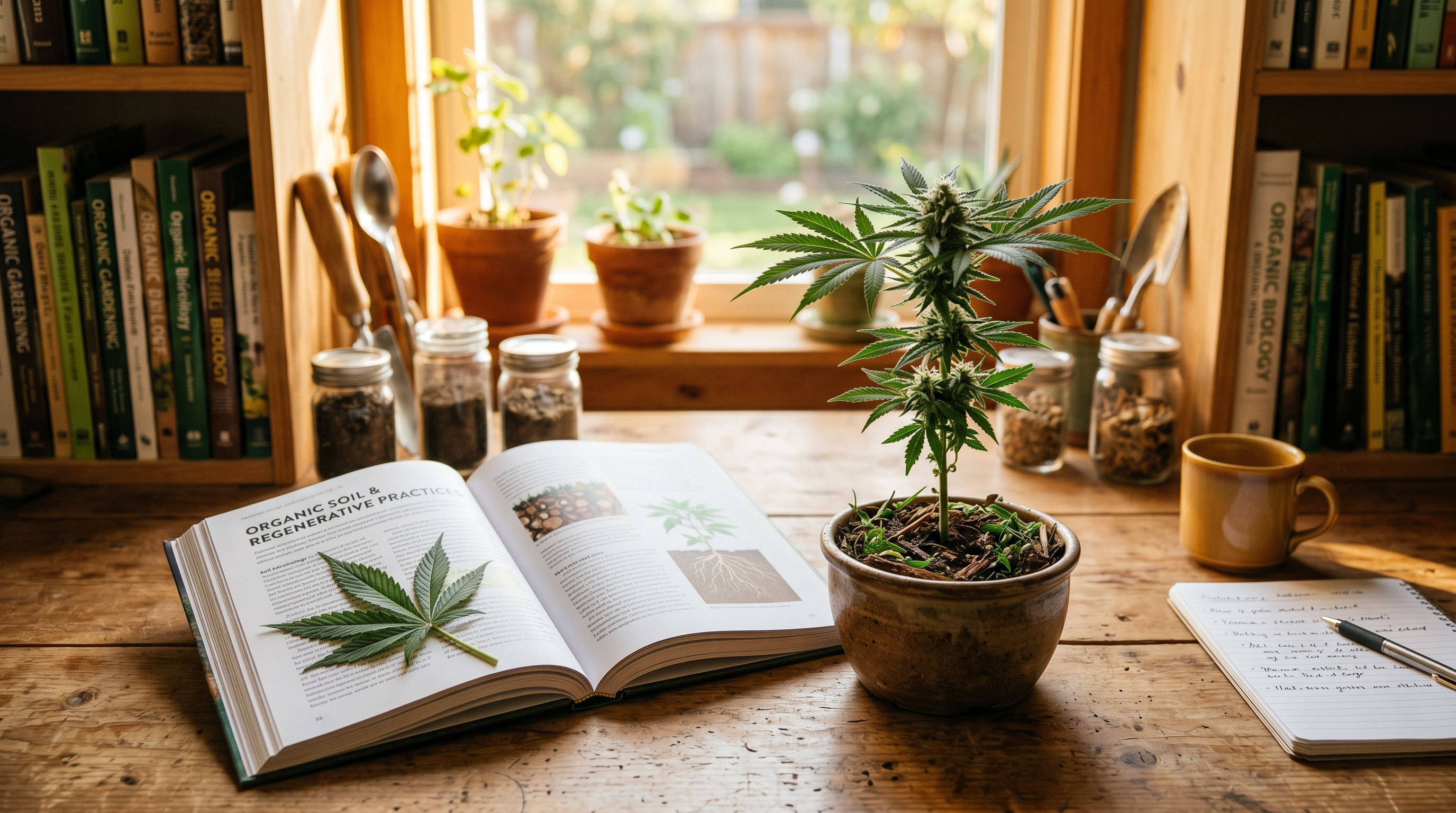
Most growing advice handles soil like a battery: you buy it full, run it through a single harvest, and toss it in the trash. No-till cannabis flips that logic on its head. Instead of replacing your medium every cycle, you keep the same living soil alive for years, feeding the soil rather than the plant and letting an underground ecosystem do the heavy lifting. It is slower to start, dramatically cheaper over time, and many growers swear it produces the most flavorful flower they have ever smoked.
This is the world of recycled organic living soil, usually shortened to ROLS. If you have ever wanted to garden the way nature actually works, this is the method that gets you there. Let me walk you through it.
What No-Till and ROLS Actually Mean
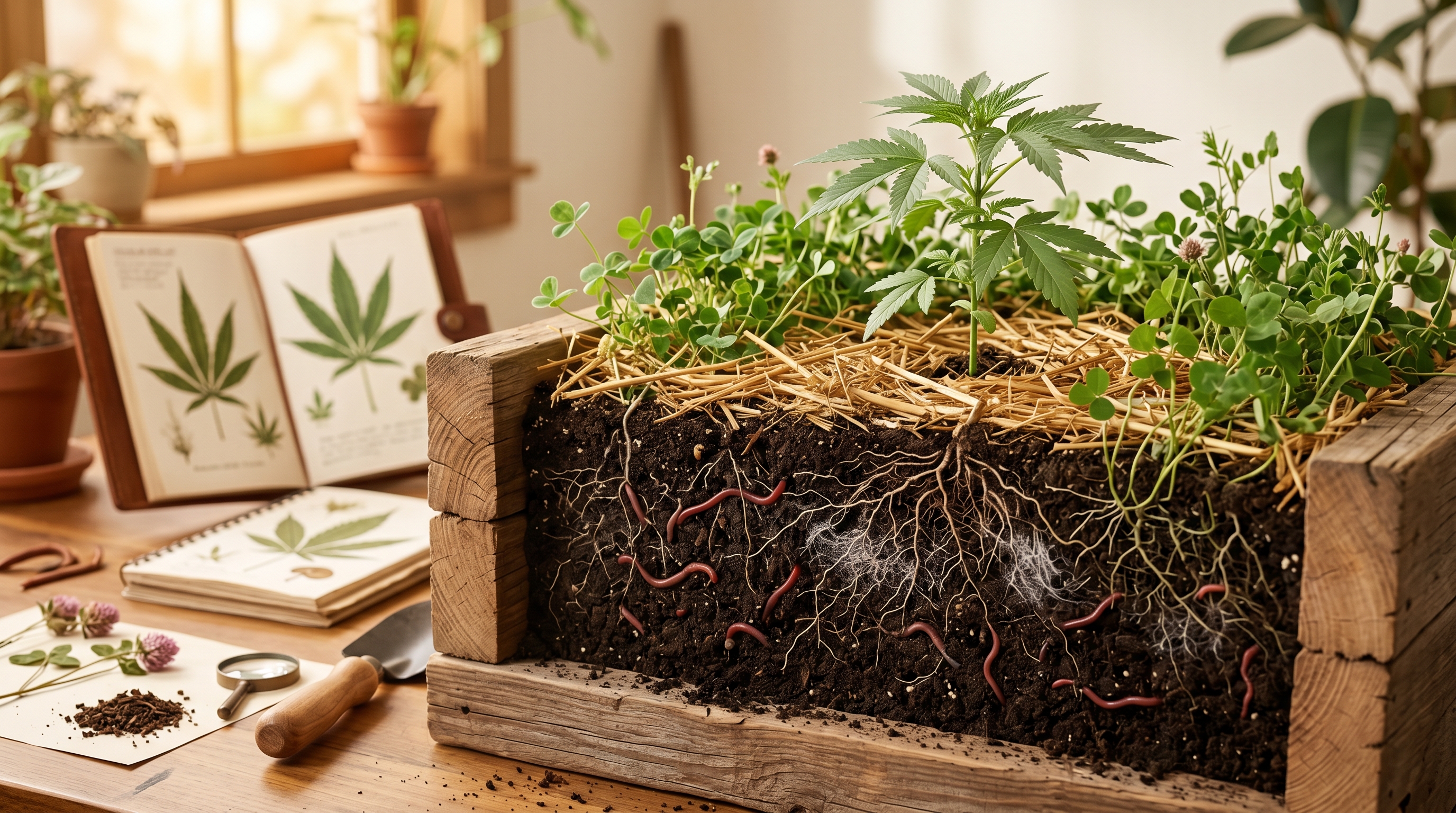
No-till means exactly what it says: no digging. You do not turn the soil over, you do not repot into fresh medium, and you do not rebuild your mix between harvests. After you chop a plant down, you cut the stalk off at the soil line, leave the roots in the ground to decompose, top off the surface with compost, and plant again into the same bed.
ROLS is the broader philosophy that no-till lives inside. It breaks down into three principles:
- Recycled — You convert “waste” like grass clippings, kitchen scraps, fallen leaves, and old root balls into food for the soil.
- Organic — No synthetic fertilizers, pesticides, or fungicides, because those chemicals damage the very microbes you are trying to cultivate.
- Living soil — A thriving population of bacteria, fungi, protozoa, nematodes, and worms that cycle nutrients on demand.
The result is a self-sustaining system that improves with age. A first-cycle bed is decent. A bed in its third or fourth run, with kilometers of fungal threads per gram of soil, can carry plants from seed to harvest on water alone. That is the payoff that keeps growers patient.
The Soil Food Web: Why You Stop Digging
Here is the core idea, and once it clicks, everything else makes sense. In conventional growing, you feed the plant directly with soluble, bottled nutrients. In living soil, you feed the microbes, and the microbes feed the plant. This is called indirect nutrition, and it runs on a predator-prey loop scientists call the nutrient mineralization cycle.
It works like this. Bacteria and fungi decompose organic matter and lock those nutrients into their own bodies. Then protozoa and nematodes eat the bacteria and fungi, and when they digest their meal, they excrete the surplus nutrients in plant-available, ionic form, right at the root zone — the predator-prey nutrient loop that soil microbiologist Dr. Elaine Ingham mapped in her foundational Soil Food Web research [Ingham, 2004]. The plant is not a passive bystander either: its roots leak sugars and amino acids that recruit the exact microbes it wants. It is, quite literally, ordering takeout.
Mycorrhizal fungi are the standout players. They form symbiotic networks with roots, trading phosphorus and water for plant sugars, and they weave hyphal threads through the soil that take weeks or months to establish — a partnership detailed at length in the living-soil classic Teaming with Microbes [Lowenfels, 2010]. Worms aerate the medium and turn decaying matter into nutrient-rich castings.
Now here is why you stop digging. The moment you till, you sever those fungal networks, collapse the soil structure, and force the microbial community to restart from scratch. That is the whole argument in one sentence. A multi-year no-till bed develops a fungal complexity that a tray of fresh coco re-mixed every run can never reach. If you want to understand the underground partnership in more depth, our piece on cannabis and the soil food web through nutrient cycling goes deeper on how plants actually absorb what they need.

No-Till vs. Super Soil: Battery vs. Perpetual Engine
People constantly mix these two up, and the confusion matters because they ask different things of you.
Super soil is a front-loaded, “hot” mix. You blend compost, worm castings, and dry amendments like bone meal, kelp, and guano, then let it “cook” for several weeks so the harsh ingredients mellow. Once it is cooked, you plant into it and just add water for one full cycle. It is essentially a battery: charged up, used once, and conventionally discarded or heavily re-amended afterward. If that approach appeals to you, our super soil recipe and living soil build guide walks through it step by step.
No-till is a perpetual engine. The same soil is good from seedling to maturity and stays good for years. Following a base like the popular Coot’s Mix, you avoid hot ingredients entirely, so there is little burn risk and far less cooking required. Crucially, no-till is meant to be reused, and it gets better the more you use it. Super soil degrades; no-till compounds.
| Factor | No-Till / ROLS | Super Soil |
|---|---|---|
| Reuse | Perpetual, years on end | Usually one cycle, then re-amend |
| Trajectory | Improves with every run | Front-loaded, then declines |
| Cooking | Minimal — no hot inputs | Several weeks before planting |
| Worms required | Yes — they run the system | Optional |
| Disturbance | None | Re-mixed between grows |
Honestly, the line blurs. A super soil that you commit to reusing and re-amending without dumping basically becomes a living soil bed over time. The terms describe a spectrum more than a hard wall.
Setting Up Your First No-Till Bed
The single most important decision is container size, and most beginners get it wrong by going too small.
No-till needs volume. A bigger ecosystem buffers moisture. It holds a more diverse microbe population. And it provides enough nutrients to cycle. KIS Organics recommends a minimum of 7 gallons for a full-cycle plant, with 10 to 20 gallons producing noticeably better growth. Many no-till veterans push to 25 to 30 gallons per plant, and the most successful growers use raised beds where roots roam freely. As one living-soil supplier bluntly puts it, small pots under roughly 20 to 30 liters are a “critical zone” — too little buffer for a stable cycle. Fabric pots and raised beds beat plastic for airflow.
A widely used base mix looks like this:
- 25–35% compost — well-aged and biologically active; the microbial engine
- 20–30% aeration — perlite, pumice, or rice hulls to keep air in the root zone
- 20–30% topsoil or peat/coco — the mineral and water-holding base
- 10–15% worm castings — bioavailable nutrients plus a microbe starter
- 2–5% dry amendments — kelp, neem cake, crustacean meal, rock dust, biochar
Inoculate with mycorrhizae at planting, then add worms. This part is not optional. As the Grow Weed Easy guide flatly states, “if you do not have worms, it’s not really a no-till grow.” Keep the soil evenly moist even before plants go in, so your worms and microbes stay alive. If you are brand new to cultivation, pair this with our complete beginner’s guide to growing cannabis at home to cover the basics like lighting, watering, and timing, and our cannabis growing stages timeline so you know what each phase should look like. Indoor no-till growers will also want a solid grow tent setup and the right LED grow lights to power the canopy above all that biology.
Mulch and Cover Crops: Protecting the Surface
Bare soil is dead soil waiting to happen. The top layer dries out, the surface microbes die, and you lose the habitat that beneficial insects need. Mulch and cover crops solve this.
Mulch is a layer of dead organic material — straw, shredded leaves, or grass clippings — laid over the surface. It is not just dressing. Mulch slows evaporation, moderates soil temperature, shelters surface biology from drying light, and slowly breaks down into a steady nutrient source. Hay and barley straw are ideal for containers because they are light, breathable, and biodegradable.
Cover crops are living plants you grow alongside your cannabis — clover, hairy vetch, phacelia, fenugreek, or oats. They are sometimes called living mulch. Their roots leak exudates that keep soil biology active, legumes like crimson clover fix nitrogen from the air, and the canopy shades and cools the surface. Just keep them trimmed so they do not steal light from your cannabis.
A word of caution from the experts, though: a cover crop is an active player, not a free bonus. It competes for water, nutrients, and root space. In smaller containers, running both heavy mulch and an aggressive cover crop at once can suffocate the soil, invite fungus gnats, and cause nutrient lockouts. The cleanest technique for most growers is “chop and drop”: let the cover crop grow, cut it at the base when your plant hits pre-flower, and leave the biomass on the surface as instant mulch. The roots stay in the ground to feed the web. Full mulch-plus-cover-crop systems shine only in large beds with mature biology.
Top-Dressing and the Reamendment Cycle
Since you never replace the soil, how do you put nutrients back? You feed from the top.
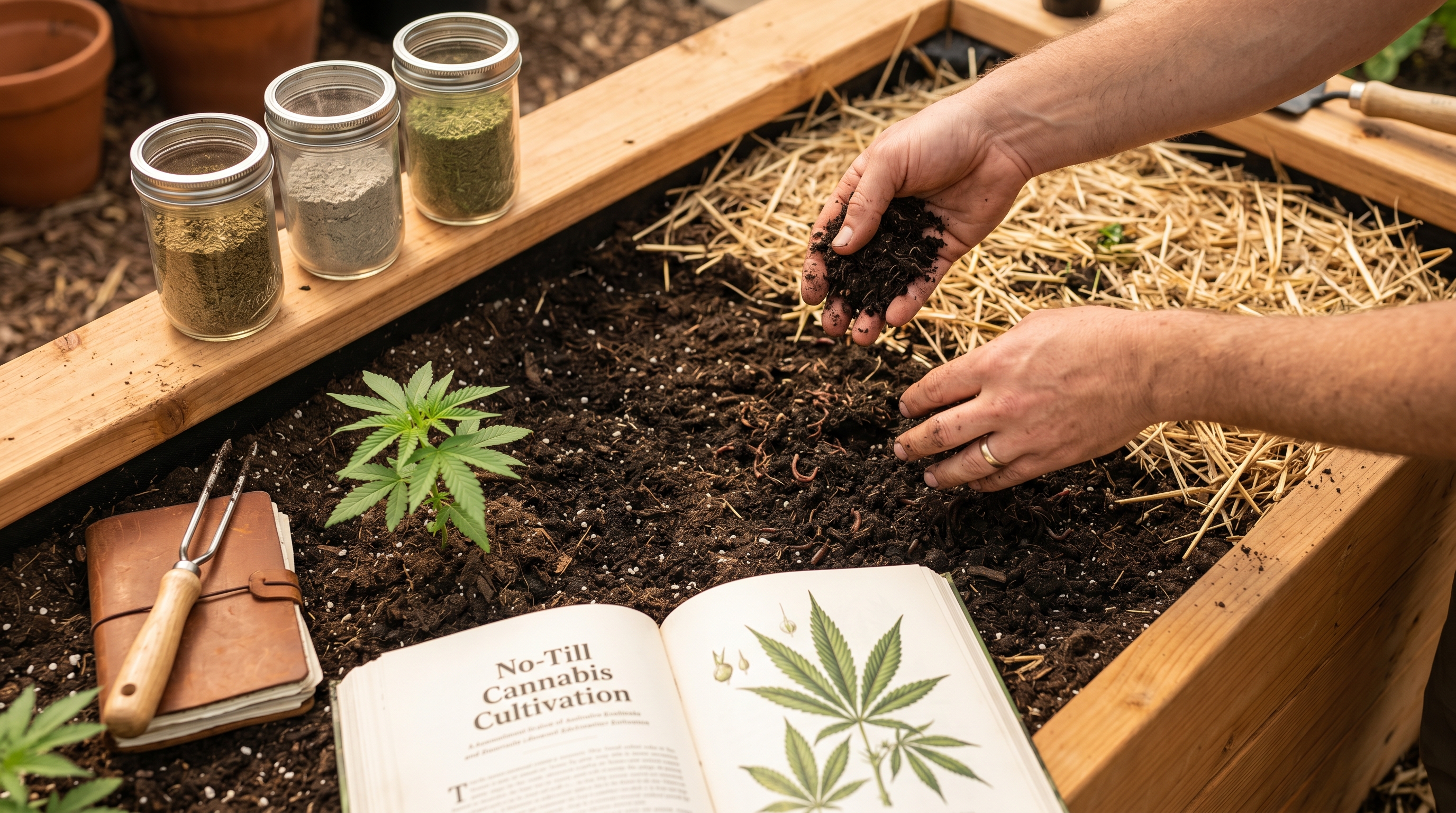
Top-dressing means spreading amendments on the soil surface. Worms and microbes then carry them down — no digging required. A typical move is a thin 1 to 2 cm layer of worm castings and compost right after harvest, then a light mulch over it. For minerals, growers add dry amendments like kelp, neem cake, and rock dust roughly every three to four cycles as a top-dress. Compost tea — compost or castings aerated in water with a spoon of molasses for 24 to 36 hours — is brewed not for NPK but to inoculate a microbial boom into the soil.
Here is the full perpetual cycle:
- Harvest. Cut the stalk at the soil line. Leave the roots — they become worm food and decompose into channels for water and air.
- Top-dress. Spread 1 to 2 cm of worm castings and compost over the surface. Re-mulch with straw or leaves.
- Rest. Water lightly and let the bed sit 2 to 4 weeks. Microbes process the new organic matter and fungal networks reconnect.
- Replant. Transplant into the existing soil, disturbing only the small planting hole. No repotting, ever.
- Re-mineralize periodically. Every few cycles, add dry mineral amendments as a top-dress. A soil test every three grows keeps you honest.
The economics are the quiet superpower here. KIS Organics reports that a raised bed re-amended this way works for up to five years, dropping the nutrient cost to under $50 per cubic yard of soil. Compare that to buying fresh bagged medium and bottled nutrients every single run.
Worms and Microbes: Your Unpaid Workforce
I want to linger on this because it is what makes no-till feel different from any other method. You are not running a grow op so much as tending a tiny wilderness.
Worms eat decomposing roots and organic matter. Then they excrete castings packed with bioavailable nutrients, beneficial microbes, and plant growth hormones. They tunnel constantly. That aerates the soil and keeps it from compacting into a root-choking brick. Bacteria and fungi do the molecular demolition, breaking complex organic matter into building blocks. Protozoa and nematodes graze on them and release the nutrients. Above it all, mycorrhizal fungi extend the root system’s reach by orders of magnitude.
Your job is to keep this workforce alive: maintain even moisture (microbes die when soil dries out), never apply synthetic chemicals (they are poison to biology), and keep feeding organic matter from the top. Do that, and the system largely runs itself. Avoiding chemical inputs is also why no-till sits at the heart of sustainable, low-impact cannabis cultivation, since you eliminate fertilizer runoff and single-use medium waste in one move.
The Honest Pros and Cons
The upsides:
- It compounds. Soil quality, yield potential, and resilience all improve cycle over cycle.
- It is cheap long-term. After the initial build, you reuse soil for years on free and low-cost inputs.
- Flavor and aroma. Many growers report richer terpene and cannabinoid expression from microbially active soil. (See why sun-grown and organic flower often tastes better, and our guide to cannabis terpenes for what those compounds actually do.)
- Sustainable. Near-zero waste, no salt buildup, no end-of-grow flush needed.
- Forgiving. With no hot inputs, there is almost no risk of nutrient burn.
The trade-offs:
- Slow start. The system needs roughly 12 to 18 months — two or three cycles — to fully mature. Water-only growing is rarely achievable in cycle one.
- Slightly lower early yields. Expect modestly smaller harvests than a dialed-in coco-and-bottles setup until the biology matures.
- Higher upfront cost and space. Big beds and quality compost cost more on day one.
- It is a system, not a shortcut. Pest and disease pressure require proactive management.
And one genuinely contrarian note worth respecting: not every expert agrees no-till is strictly best indoors. KIS Organics has run trials suggesting that lightly working amendments into the top few inches of an indoor bed — without ever using a rototiller or going deep — can outperform a strict no-till approach with identical inputs, because it gets immobile nutrients like phosphorus into the root zone faster. The takeaway is not “no-till is wrong.” It is that the deep enemy is the rototiller and full soil inversion, not a gentle surface scratch. As always, the move is to run your own comparison and measure what works in your room. If problems do crop up, our guide to common cannabis growing problems and how to fix them can help you troubleshoot.
Where No-Till Fits Your Grow
No-till rewards patience and punishes impatience. If you want grams-per-watt right now in a tiny tent, coco and mineral nutrients are more efficient. But if you want a garden that gets better, cheaper, and more flavorful every year — and you have the space for real beds — living soil is hard to beat.
It also works in plenty of setups. You can run no-till in raised beds, large fabric containers, indoors under LEDs, or outdoors in the ground. The principles do not change with the venue; only the scale does. Outdoor and greenhouse growers get a bonus, since soil biology accumulates across seasons in permanent beds — if that is your path, our outdoor growing season starter guide will help you time it. If you are weighing your environment, our breakdown of indoor versus outdoor cannabis growing lays out the trade-offs, and our grow room humidity, temperature, and CO2 guide plus our vapor pressure deficit (VPD) guide will help you keep that indoor ecosystem stable.
Knowing when and how to harvest matters even more in no-till, since you cut at the soil line and leave roots behind. And once your harvest is in, the work is not done — drying and curing is where all that microbial flavor either survives or gets lost.
FAQ
How big does my container need to be for no-till? Aim for a minimum of 7 gallons per plant, 10 to 20 gallons for better results, and ideally a raised bed. Containers under about 20 to 30 liters lack the buffer for a stable, self-cycling ecosystem.
How long until I can grow with water only? Usually two to three full cycles. By the third run in an undisturbed bed, the fungal networks and nutrient cycling are mature enough that most well-chosen genetics finish on water alone. Plan to supplement with compost teas and light top-dresses early on.
Do I really need worms? Yes. Worms are central to a true no-till system — they aerate the soil, decompose old roots, and produce castings that feed your plants. Without them, you have reused soil, not living soil.
Will no-till produce better flower? Many growers report more expressive terpene and cannabinoid profiles from biologically active soil, and you skip the chemical “flush” entirely. Early yields run slightly lower than synthetic setups, but quality is the draw.
Is no-till the same as super soil? No. Super soil is front-loaded for a single cycle, like a battery. No-till is a perpetual system designed for reuse that improves over years. A continuously reused, re-amended super soil effectively becomes living soil over time.
Can I do no-till indoors in a tent? Yes, as long as your space is well-ventilated and clean. Use large containers or a bed and keep the soil evenly moist. Just note that some growers find lightly scratching amendments into the top inches indoors outperforms a strict no-till approach.
Key Takeaways
- No-till means no digging. You reuse the same living soil for years, cutting plants at the soil line and leaving roots to feed the web.
- You feed the soil, not the plant. Microbes convert organic matter into nutrients on demand through the soil food web.
- Tilling is the enemy. Disturbing the soil severs fungal networks and resets the ecosystem; a gentle surface scratch is a different thing entirely.
- Go big on volume. Aim for 7 gallons minimum, ideally raised beds, and add worms — without them it is not really no-till.
- It compounds. Slow to start (two to three cycles to mature), but cheaper, more sustainable, and more flavorful over time.
Cannabis is a journey, not a checklist — the same goes for the soil it grows in. Whether you build a perpetual living bed or just want to understand your flower better, knowing why you respond to a given plant matters more than any label — which is the whole reason your ideal high is not a strain name. The same instinct that makes a good no-till gardener — observe, record, adjust — makes a good consumer. Keeping a cannabis journal and noticing how aroma predicts your experience both pay off. The High IQ app helps you track what actually works for you, strain by strain and session by session. Grow patient, garden smart, and stay curious. — Professor High
Sources
- Ingham, E. (2004) — The Soil Biology Primer / Soil Food Web, USDA Natural Resources Conservation Service. NRCS Soil Food Web
- Lowenfels, J. & Lewis, W. (2010) — Teaming with Microbes: The Organic Gardener’s Guide to the Soil Food Web, Timber Press.
- Royal Queen Seeds — How Recycled Organic Living Soil (ROLS) Creates Great Weed
- KIS Organics — FAQ: Container Size, Reusing Soil, and Reamendment Economics
- KIS Organics — Is “No Till” Really the Best Way to Grow Plants?
- Grow Weed Easy — No-Till Soil Cannabis Grow Guide by WeedyPests
- Zamnesia — What Is Recycled Organic Living Soil (ROLS)?
- The Cannigma — How to Prepare Organic Living Soil for Cannabis: Compost, Soil Food Web, and Companion Plants
- Alchimia — Cover Crops, Green Manure & Mulch for Cannabis
- Atami — Living Soil vs. Super Soil: What to Choose for Better Growth


