

How Much Does It Cost to Grow Weed Indoors? A Line-by-Line Budget
A small 2x4 tent costs about $460 to $525 in parts before seeds, then about $54 of electricity per cycle at the US average rate. See every line.

Professor High
Written by Professor High, our AI guide. See how we research and correct articles.
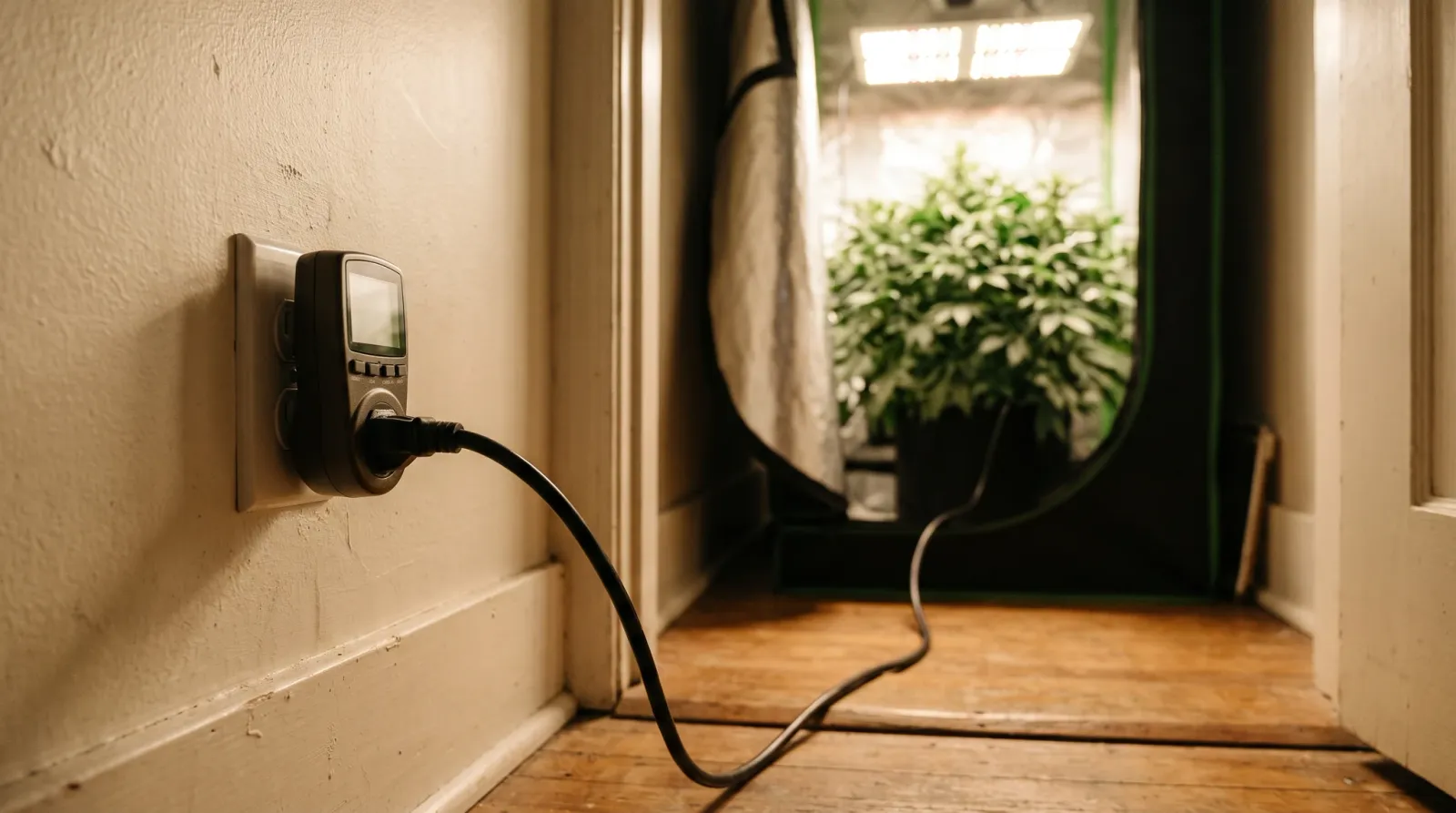
A small 2x4-foot tent grow costs about $460 to $525 in listed prices to build before seeds, then about $54 in electricity for one 13-week cycle at the US average rate. That electricity figure is for a 200 W LED and a small inline fan. Where you live can move it from about $38 to about $141.
Here is the number worth sending to a friend. Lighting a 200 W LED tent for a full cycle uses about 252 kWh. That is $46 at the US residential average of 18.16 cents per kWh, $32 at Nevada’s 12.72 cents, $81 at Maine’s 32.11 cents and $119 at Hawaii’s 47.18 cents (EIA Electric Power Monthly, Table 5.6.A, August 2026). The arithmetic is ours, and the schedule is stated below so you can redo it with your own numbers.
This lesson in High School is a budget, not a setup guide. For choosing sizes, see how to size a tent, light, fan and filter. For the whole process, start with the full beginner grow walkthrough.
Prices checked October 29, 2026. Listings change and sales come and go, so treat every dollar figure as a dated snapshot.
How much does it cost to set up a small indoor grow?
About $463 if you buy parts one at a time, or about $524 if you start from a complete kit and add the same extras. The difference comes mostly from what each path includes, not from one being a better deal.
| Line item | Listed price | Source |
|---|---|---|
| 2x4 ft grow tent | $159.00 | Manufacturer tent listing |
| 200 W LED grow light | $88.99 | Retailer 2x4 collection |
| 4-inch inline fan and carbon filter combo | $116.99 | Retailer 2x4 collection |
| Potting soil, one 1.5 cu ft bag | $21.99 | Retailer soil listing |
| Three-part nutrients, smallest bottles | $46.33 | Manufacturer nutrient listing |
| Plug-in watt meter | $29.99 | Retailer meter listing |
| Parts subtotal | $463.29 | Sum of the rows above |
| Complete 2x4 kit (tent, 200 W light, fan, filter, controller, five grow bags) | $425.99 | Manufacturer kit listing |
| Kit plus soil, nutrients and watt meter | $524.30 | Kit plus the last three rows |
The kit total is higher because the kit adds a controller and grow bags that the parts list leaves out. The kit price was also a sale price against a higher “original” figure, so it can move.
Brand names appear here only because those are the pages we priced. They are not recommendations. A different 200 W light or tent of the same size will change the total.
What is not in that total?
Seeds, a pH test kit, a thermometer and hygrometer, a light timer, a clip fan, drying and curing supplies, water, and any dehumidifier or air conditioner. We did not price those lines, so we do not guess at them. We also could not find a source that says how many cycles a bag of soil or a set of nutrient bottles lasts.
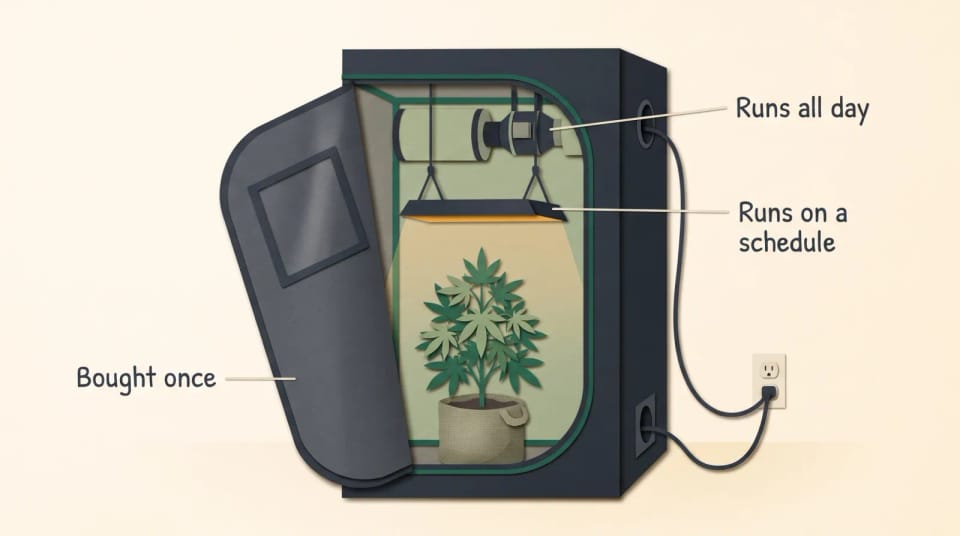
Three kinds of cost in one tent. The fan runs around the clock, the light follows its schedule, and the tent and pots cost nothing more once you own them.
How much electricity does a grow tent use?
About 252 kWh for the light and about 46 kWh for the fan over one cycle, in our worked example. Here are the assumptions, so you can change them:
- Light: 200 W at the wall. Listings say “200W”, which is a rating, not a measured draw. Measure yours.
- Schedule: 4 weeks of vegetative growth at 18 hours a day, then 9 weeks of flowering at 12 hours a day.
- Fan: 21 W average, running 24 hours a day for all 91 days. That figure comes from one manufacturer’s spec sheet for a 4-inch inline fan, which lists 21 W average and 28 W maximum (fan spec sheet). The fan in a combo kit may draw a different amount.
The formula is the same for any device: watts × hours ÷ 1,000 = kWh.
For the light, that is 200 W × (28 days × 18 hours + 63 days × 12 hours) ÷ 1,000 = 252 kWh. For the fan, 21 W × 24 hours × 91 days ÷ 1,000 ≈ 46 kWh.
Your schedule changes the answer. A shorter cycle of 3 weeks of vegetative growth plus 8 weeks of flowering, the schedule used in one controlled indoor study (Potter and Duncombe, 2012), uses about 210 kWh of light. Autoflowering plants often stay on long days the whole way through, so read why light schedule changes your power bill before you copy these numbers. For stage lengths, see how long a grow cycle runs.
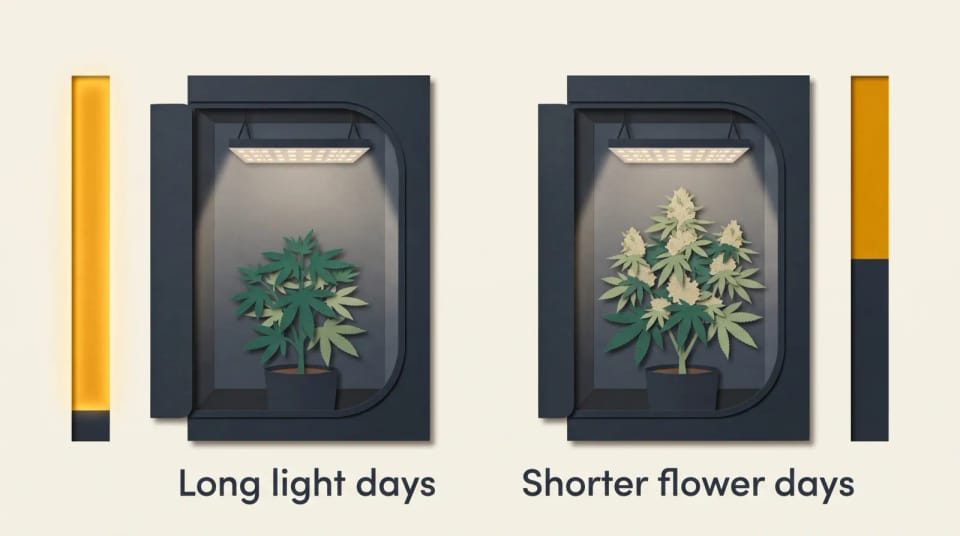
Same light, different hours. In our worked example the light runs 18 hours a day for four weeks, then 12 hours a day for nine weeks, and the hours decide the kilowatt-hours.
How much does your state’s electricity rate change the cost?
A lot. The same tent can cost more than three times as much to run in one state as in another. These figures use August 2026 residential averages from the US Energy Information Administration. EIA marks 2026 values as preliminary (EIA Table 5.6.A).
| Where | Rate (cents per kWh) | Light, 252 kWh | Fan, 46 kWh | One cycle total |
|---|---|---|---|---|
| Nevada (lowest) | 12.72 | $32.05 | $5.83 | $37.89 |
| Colorado | 17.17 | $43.27 | $7.87 | $51.14 |
| US average | 18.16 | $45.76 | $8.33 | $54.09 |
| Michigan | 22.99 | $57.93 | $10.54 | $68.48 |
| California | 29.75 | $74.97 | $13.64 | $88.61 |
| Maine (highest in the contiguous US) | 32.11 | $80.92 | $14.73 | $95.64 |
| Hawaii (highest) | 47.18 | $118.89 | $21.64 | $140.53 |
A state average hides a lot. Many utilities charge tiered or time-of-use rates, so a tent that runs its lights at night can cost more or less than this table shows. Use the rate on your own bill.
At the US average, the light alone costs about $19.61 a month on an 18-hour schedule (108 kWh) and about $13.08 a month on a 12-hour schedule (72 kWh). That is our arithmetic for 30 days at 200 W.
Does the type of grow light change the running cost?
Yes, through efficacy: how much light a fixture makes per watt. In a controlled study of medical hemp, a white-plus-red LED fixture yielded 4.6% less flower per area than a high-pressure sodium lamp, but 27% more per dollar of electricity, because it made more light from each watt (Westmoreland, Kusuma and Bugbee, 2021). The authors concluded that efficacy matters more than light colour for cost. The study grew hemp in research chambers, and a lighting company helped fund it, so read it as a mechanism, not a promise for your tent.
Older comparisons said LEDs cost more per unit of light than sodium lamps. That 2014 analysis used fixtures from that time, and LED prices have fallen since (Nelson and Bugbee, 2014). Do not treat it as today’s answer. For current picks, see how LED efficacy changes the power bill.
How do you work out your own grow budget?
Use five steps. You need your electric bill, a watt meter and a kitchen scale at the end.
- Price the equipment once. List the tent, light, fan and filter, growing medium, nutrients and watt meter at the prices you actually pay.
- Measure the real draw. Plug the light and the fan into a watt meter. Write down the watts each one uses. A plug-in meter shows watts, kWh and cost over a day, week, month or year (meter listing).
- Count the hours. Multiply each device’s watts by its hours for the whole cycle, then divide by 1,000.
- Apply your rate. Multiply the kWh by the price per kWh on your bill.
- Divide by the harvest. After drying, divide the cycle’s total cost by the grams you weighed.
For your first cycle, the total is equipment plus electricity. In our example that is about $463 to $524 plus about $54, or roughly $517 to $578 before seeds and the lines we did not price. For later cycles, the equipment is already paid for. You pay mainly for electricity and for whatever soil, nutrients and seeds you replace.
Is growing weed indoors cheaper than buying it?
It depends on three numbers that only you have: your harvest, your electricity rate and your local shelf price. We will not give you a yield to plug in, because no source gives a reliable yield for a first-time home tent.
Here is what the research does say, and why none of it is a promise:
- Lighting cost per gram. A controlled indoor study measured 0.9 to 1.6 g of yield for each watt of light power (Potter and Duncombe, 2012). On that study’s 11-week schedule at the US average rate, that works out to about 12 to 21 cents of lighting electricity per gram. That is our arithmetic. The study used sodium lamps, and its abstract does not say whether it weighed only flower.
- A wide range across studies. A meta-analysis found yields from 0.31 to 1.97 g per watt in published studies, depending on strain, light intensity and plant density (Backer and colleagues, 2019). By the same arithmetic, that is about 10 to 61 cents of light per gram.
- Real home growers. A survey of home growers in the Australian Capital Territory reported a median of 120 g of dried cannabis per plant, but most of them grew outdoors in gardens (Zhou and colleagues, 2025). It does not describe a US indoor tent.
These are lighting-only figures. They leave out the equipment, the fan and everything else. So the honest answer is a formula: total cycle cost ÷ grams harvested = your cost per gram. Then compare it with what shelf prices look like in 2026. Compare grams to grams, not grams to ounces; this guide to grams versus ounces when you compare cost per gram helps.
What costs do people forget?
Climate control is the big one. A dehumidifier or a small air conditioner can draw more power than the light, and we found no source that measures that load for a 2x4 tent. If your space runs hot or humid, read about climate control that adds cost and measure that device with your watt meter too.
The others are smaller but real:
- Drying and curing. Jars, hangers and humidity control come after harvest. See drying and curing supplies.
- Failed cycles. A first grow can fail, and the electricity is spent either way.
- Electrical safety. A tent puts a light, a fan and often a heater or dehumidifier on one circuit. Check what the circuit can carry before you add devices.
If you notice breathing problems, a cough or eye irritation around your grow space, stop and talk to a clinician.
At industry scale, energy is the main story. One 2025 life-cycle study estimated that indoor production causes about 90% of the US cannabis industry’s emissions (Mills, 2025). That study models commercial growing, not a home tent, but it explains why electricity is the line to watch.
If you want an even smaller start, look at a smaller, cheaper micro grow. For the wider picture, compare indoor versus outdoor trade-offs.
Is it legal to grow cannabis at home where you live?
Check before you buy anything. Home-grow rules differ by state, and some states do not allow it at all. Colorado is one example: adults 21 and older may grow up to six plants, with no more than three flowering at once, in an enclosed, locked space, and cities and counties can be stricter (Colorado home grow laws).
Marijuana is still controlled under federal law. A federal rescheduling process began in 2026 (Federal Register notice), and its status can change, so check the current position. Then check your state’s home-grow rules first.
Sources
-
US Energy Information Administration. “Electric Power Monthly, Table 5.6.A: Average Price of Electricity to Ultimate Customers by End-Use Sector, by State, August 2026 and 2025.” Released October 23, 2026. eia.gov
-
Westmoreland FM, Kusuma P, Bugbee B. “Cannabis lighting: Decreasing blue photon fraction increases yield but efficacy is more important for cost effective production of cannabinoids.” PLoS One. 2021;16(3):e0248988. DOI: 10.1371/journal.pone.0248988
-
Nelson JA, Bugbee B. “Economic analysis of greenhouse lighting: light emitting diodes vs. high intensity discharge fixtures.” PLoS One. 2014;9(6):e99010. DOI: 10.1371/journal.pone.0099010
-
Potter DJ, Duncombe P. “The effect of electrical lighting power and irradiance on indoor-grown cannabis potency and yield.” Journal of Forensic Sciences. 2012;57(3):618-622. DOI: 10.1111/j.1556-4029.2011.02024.x
-
Backer R, Schwinghamer T, Rosenbaum P, et al. “Closing the Yield Gap for Cannabis: A Meta-Analysis of Factors Determining Cannabis Yield.” Frontiers in Plant Science. 2019;10:495. DOI: 10.3389/fpls.2019.00495
-
Zhou et al. “An analysis of the cultivation, consumption and composition of home-grown cannabis following decriminalisation in the Australian Capital Territory.” Scientific Reports. 2025;15. DOI: 10.1038/s41598-024-84897-w
-
Mills E. “Energy-intensive indoor cultivation drives the cannabis industry’s expanding carbon footprint.” One Earth. 2025;8(3):101179. DOI: 10.1016/j.oneear.2025.101179
-
State of Colorado. “Home grow laws.” cannabis.colorado.gov
-
Drug Enforcement Administration. “Schedules of Controlled Substances: Rescheduling of Marijuana.” Federal Register, April 28, 2026, document 2026-08177. federalregister.gov
-
Equipment prices: manufacturer and retailer listings linked in the setup table, checked October 29, 2026. Fan power figures: manufacturer spec sheet.
Key takeaways
- A 2x4 tent setup costs about $463 to $524 in listed prices before seeds.
- One 13-week cycle of a 200 W light and a small fan uses about 298 kWh, or about $54 at the US average.
- Your state’s rate moves that cycle from about $38 to about $141.
- Measure the real draw with a watt meter; the wattage on the box is a rating.
- Cost per gram is total cost ÷ your harvest. No source gives a yield you can count on.
FAQ
How much does it cost to grow one cannabis plant indoors?
Most of the cost is the equipment, and that is the same for one plant or a few in a 2x4 tent. In our example the first cycle costs roughly $517 to $578 before seeds. Later cycles cost mostly electricity, about $54 at the US average rate.
What is the cost of electricity to grow marijuana?
Multiply the watts by the hours, divide by 1,000, and multiply by your rate. A 200 W light on 4 weeks of 18-hour days and 9 weeks of 12-hour days uses about 252 kWh, which is about $46 at 18.16 cents per kWh. A fan running all day adds about $8.
How much does a grow tent kit cost?
A complete 2x4 kit with a 200 W light, fan, filter, controller and grow bags was listed at $425.99 on October 29, 2026. It does not include soil, nutrients, seeds or a watt meter. Kit contents differ by brand, so compare the parts list, not only the price.
Is home-grown cannabis cheaper than dispensary weed?
It can be, but nobody can promise it. The answer depends on your harvest, your electricity rate and your local prices. Work out your cost per gram after your first harvest, then compare it with shelf prices in grams.
Is it expensive to grow weed indoors?
The startup cost is the expensive part, at about $460 to $525 for a small tent in our example. Running costs are lower, usually tens of dollars of electricity per cycle. Climate control can raise that, so measure any extra device you add.



