Micro-Growing Cannabis: Maximum Yield from Minimum Space
Grow top-shelf cannabis in a cabinet, PC case, or tiny tent. Strain choice, LST, SCROG, LED, odor control, and realistic yields for micro grows.

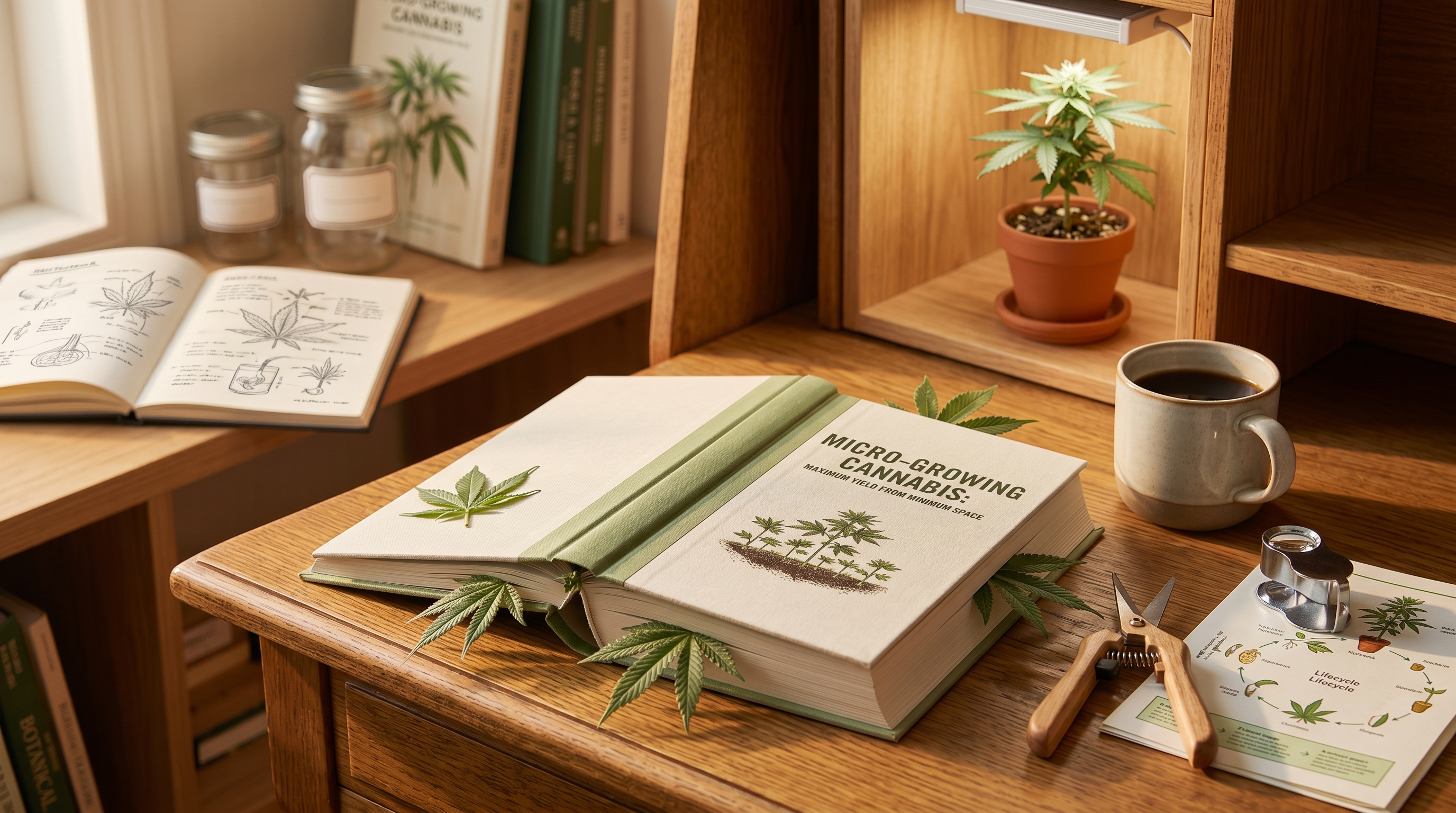
Most “grow your own” advice assumes you have a spare closet, a garage corner, or a basement nobody uses. A lot of people don’t. They have a studio apartment, a roommate situation, a landlord who reads leases out loud, or simply a strong preference that the bedroom not smell like a dispensary loading dock. That’s where micro-growing comes in: producing genuinely top-shelf flower in a footprint smaller than a nightstand.
Let me be clear about what micro-growing is and isn’t. It is not “growing bad weed because you cut corners.” It’s regular indoor cultivation, scaled down and engineered for tight tolerances. A well-run micro grow in a cabinet, a converted PC tower, or a sub-60 cm tent can absolutely deliver dense, aromatic, potent buds. The trade-off isn’t quality — it’s quantity per cycle and the discipline required to manage a small environment. Everything is amplified when your grow space is the size of a microwave. A little heat becomes a lot of heat. A slightly-too-tall plant becomes a plant pressed against a hot light.
This guide walks you through the whole system: picking the right space, choosing genetics that actually stay small, training a single plant to fill its box, lighting it without cooking it, and keeping the smell where it belongs. If you’ve read our beginner’s complete guide to growing cannabis at home, think of this as the “but I have almost no room” expansion pack.
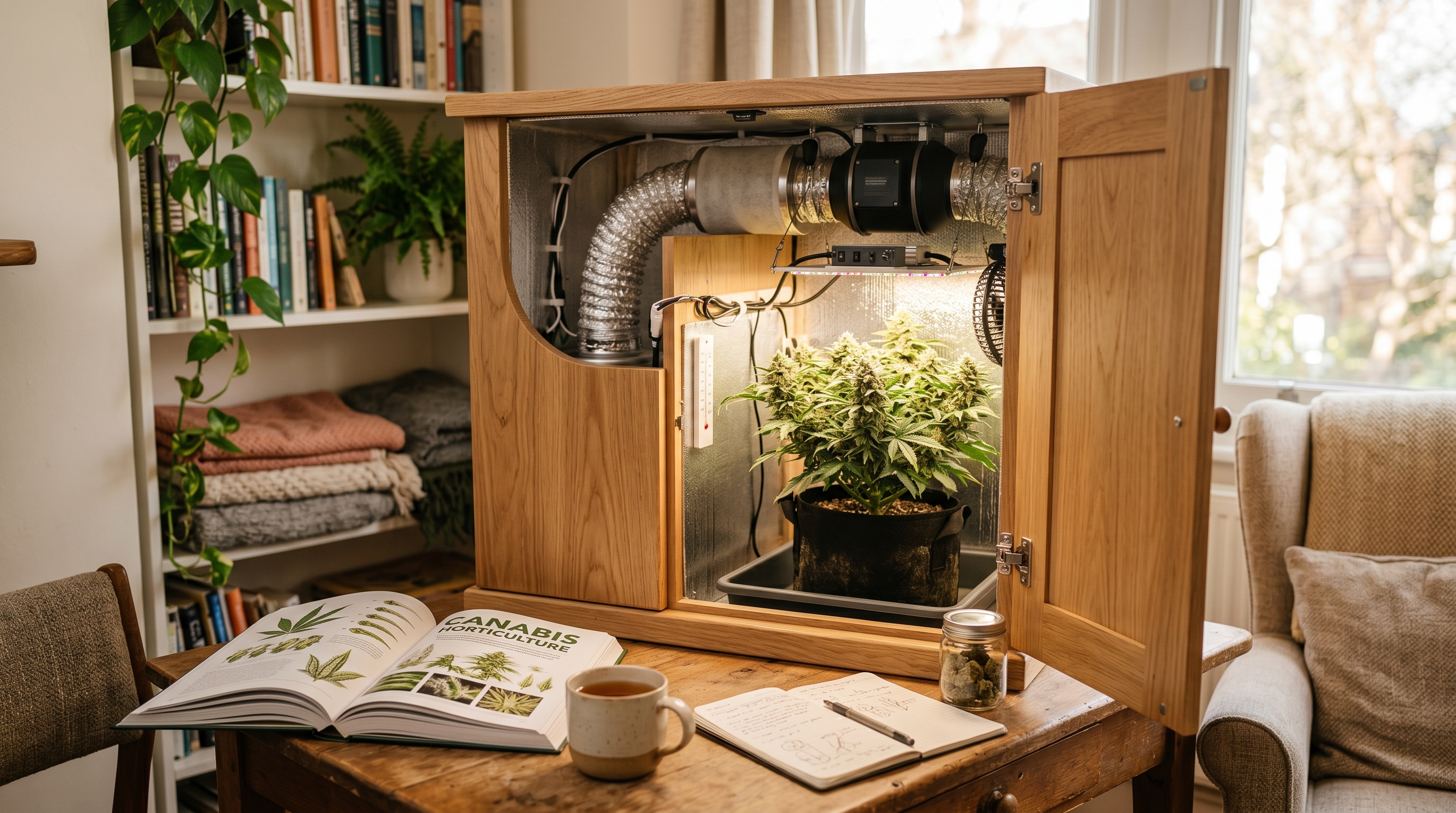
What Counts as a Micro Grow?
There’s no official cutoff, but the working definition is a grow space roughly 60 cm (about 24 inches) or less in its smallest interior dimension, usually holding one to a few small plants. Common micro vessels include:
- A purpose-built grow cabinet — a converted nightstand, wardrobe, or DIY plywood box. The most popular and most controllable option.
- A stealth PC case or “computer tower” grow — extreme micro, often a single trained plant or a clone.
- A small grow tent — the 40×40×80 cm and 60×60×140 cm tents are the entry point. Our full grow tent setup guide covers the larger end; everything here applies in miniature.
- A bar fridge or repurposed cooler — the chassis is ready-made for sealing and insulation.
The core principle is the same regardless of vessel: a micro grow is a complete, self-contained climate. You are responsible for its light, its air exchange, its temperature, its humidity, and its smell. Get those five things right and the plant does the rest.
Step One: Pick Genetics That Stay Small
This is the single most important decision, and it’s where most beginners go wrong. You cannot out-train a plant that genetically wants to be two meters tall. Start with the right seed and the whole project gets easier.
Why Autoflowers Win in Tight Spaces
For micro grows, indica-dominant autoflowers are the default recommendation, and for good reason. Autoflowering genetics carry the cannabis ruderalis autoflowering trait, which means the plant flowers based on age rather than light schedule. Practically, that gives you three advantages:
- They stay short. Many autos finish between 40 and 70 cm, and dedicated micro strains can be held under 40 cm with training.
- They’re fast. Seed to harvest in roughly 8 to 11 weeks, so a mistake costs you weeks, not months.
- They’re forgiving of light leaks. Because they don’t depend on 12/12 darkness to flower, a sliver of light leaking into your cabinet won’t ruin the harvest the way it can with photoperiod plants.
If you want the full picture on the differences, our breakdown of feminized vs autoflower vs regular seeds and the week-by-week autoflower grow guide are the two companion reads.
Compact Strain Profiles to Look For
When shopping genetics, look for words like “dwarf,” “compact,” “micro,” and “stealth,” and check the breeder’s stated indoor height. Indica dominance generally means a shorter, bushier structure with tight internodal spacing — exactly what you want. Heavy indicas tend to fall into the Relax High family, dominated by myrcene, which is also what gives them their classic body-heavy, deep relaxation feel.
If you’d rather grow something you already love to smoke, look at compact phenotypes of familiar names. Sturdy, short-flowering classics like Northern Lights, Granddaddy Purple, Blueberry, and Bubba Kush all have indica-leaning structures that respond well to training. Hybrids such as Wedding Cake, Gelato, and Ice Cream Cake stay manageable when trained early, while frostier picks like White Widow and Gorilla Glue reward the extra airflow a tidy micro canopy provides. For an energizing daytime grow, a trained Jack Herer leans toward the Energy High profile thanks to its terpinolene content.
Step Two: Lighting Without Cooking Your Plants
In a space this small, heat is your number one enemy, and your light is the main heat source. LED is the only sensible choice for micro grows. Old-school HPS and metal halide fixtures throw off enormous heat that a tiny sealed box simply cannot shed — you’ll spend the whole grow fighting temperatures instead of growing weed.
| Space size | Suggested LED draw | Notes |
|---|---|---|
| PC case / ~30 cm cube | 15–40W | Small bar or chip-on-board panels; run them dimmed early |
| 40×40 cm cabinet/tent | 60–100W | The micro-grow sweet spot |
| 60×60 cm tent | 100–150W | Approaching “small grow,” not “micro” |
A few rules that matter more in miniature than they do at scale:
- Use a dimmable LED. During the seedling and early veg stage, run it at 25–50%. Push toward 75–100% only in peak flower. A fixed full-power light at close range will bleach and stress a small plant fast.
- Mind the hang distance. LEDs run cooler than HPS but still need clearance. Hold your hand at canopy height for 30 seconds — if it’s uncomfortable for you, it’s too hot for the plant.
- Light the sides, not just the top. In narrow vertical boxes, supplemental side lighting dramatically improves penetration and lower-bud development.
For the deeper buying decisions — efficacy, spectrum, brand tiers — see our LED grow lights buyer’s guide. The short version: efficient, well-binned diodes mean more light and less waste heat per watt, which is exactly the constraint a micro grow lives and dies by.
Step Three: Training One Plant to Fill the Box
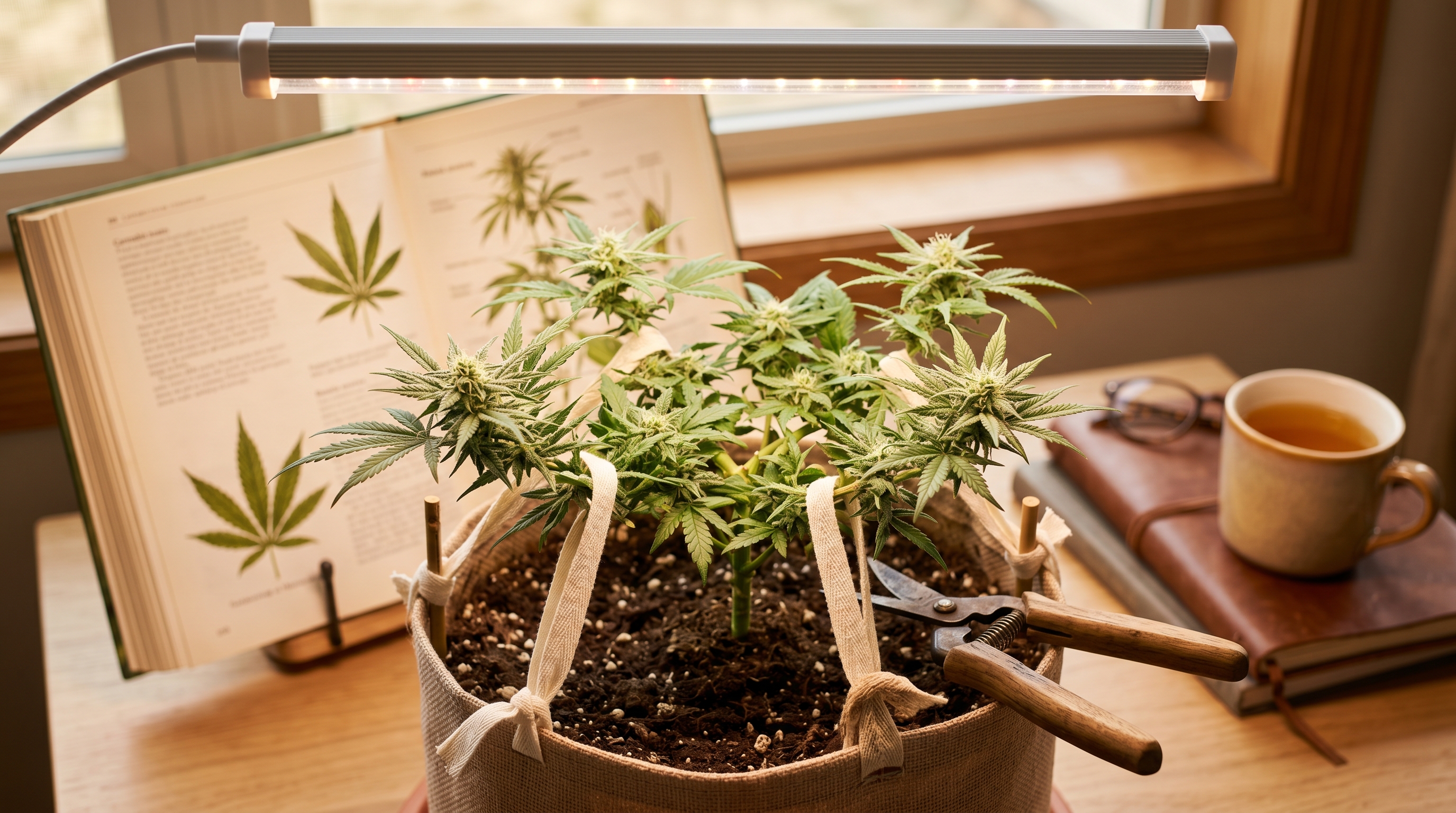
You don’t get more space, so you make the most of the space you have. Training is non-negotiable in a micro grow. The goal is an even, flat canopy that uses every square centimeter of light, with no single cola racing toward the lamp.
Low-Stress Training (LST)
LST is your foundation technique. You gently bend branches outward and tie them down, breaking the plant’s natural “tall central cola” tendency (apical dominance) and encouraging an even spread of bud sites. It’s low-risk, beginner-friendly, and especially well-suited to autoflowers, which don’t recover from heavy damage as readily as photoperiod plants. Start early, around the third or fourth node, and tie a little more every few days. Our step-by-step LST guide walks through the knots and timing.
SCROG (Screen of Green)
For the cleanest micro-grow canopy, add a horizontal screen. SCROG places a net 20–25 cm above the pot; as branches grow through it, you tuck them back under and weave them sideways. The result is a flat, uniform table of bud that can roughly double your yield versus an untrained plant in the same footprint. It’s the highest-payoff technique for a single-plant cabinet. The full method is in our SCROG screen of green guide.
SOG (Sea of Green)
The opposite philosophy: instead of one big trained plant, grow several small ones close together and flower them early so each contributes one main cola. SOG suits clone-heavy setups and pairs beautifully with fast autoflowers, but it requires more pots, more seeds, and more management. In the very smallest boxes, one well-SCROGged plant usually beats a crowded SOG. Read the Sea of Green complete guide to decide which fits your vessel.
Lollipopping
Whichever canopy method you choose, lollipop the plant before or early in flower. Around day 35–40 for autos, strip the bottom 20–30% of growth — the larfy lower branches that never get real light. This sends energy up to the top colas and, crucially in a micro grow, opens up airflow underneath where mold loves to start. Details and timing are in our lollipopping technique guide. For the broader toolkit, the complete plant training guide covers topping and combinations.
Step Four: Air, Heat, and Humidity
A sealed micro box with no air exchange becomes a hot, stale, humidity-trapped death chamber within hours. Ventilation is what makes the whole thing work.
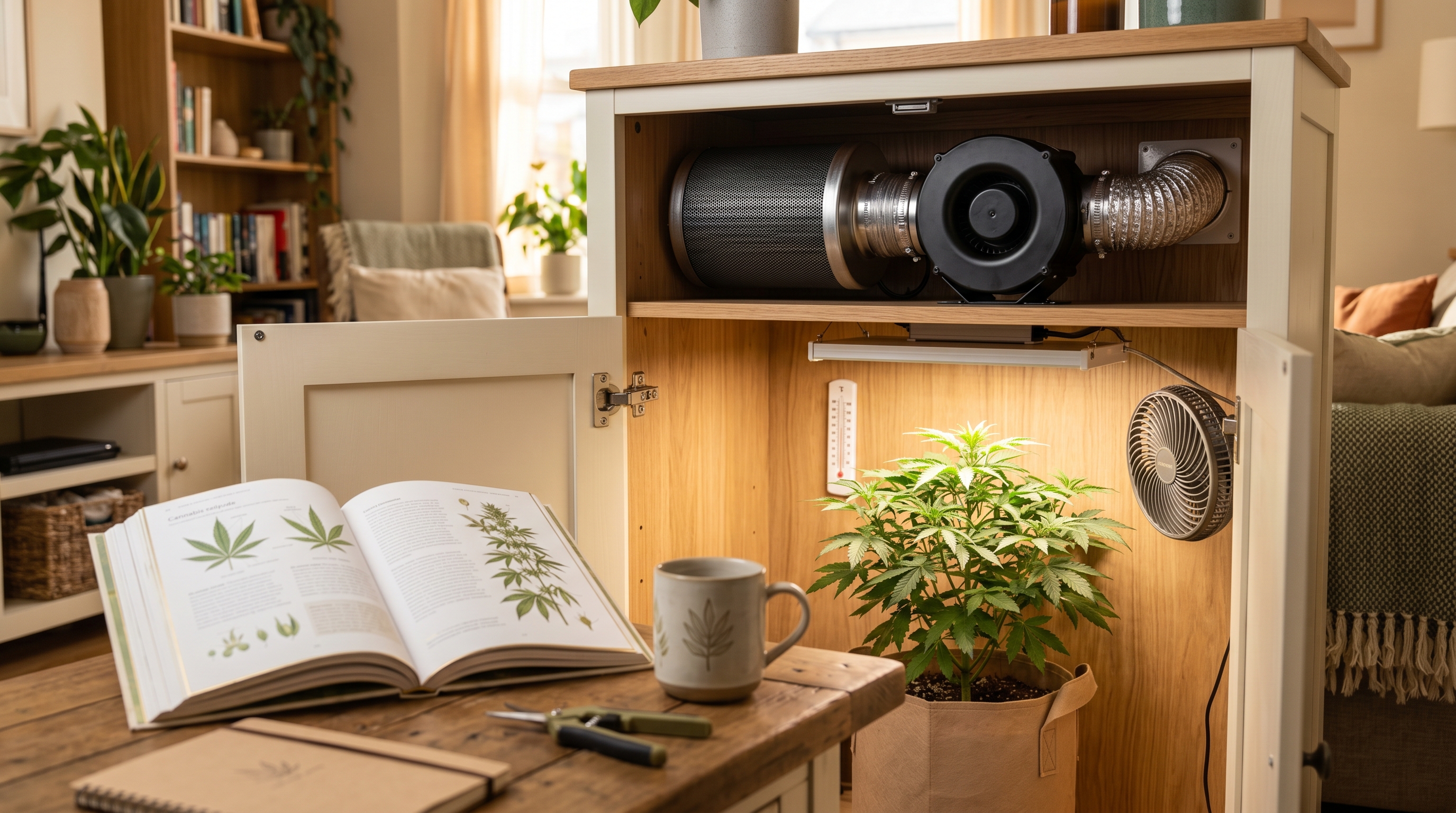
The mechanics scale down but don’t disappear. You need an exhaust fan pulling hot, used air out the top, and passive (or active) intake bringing fresh air in low. A reliable rule: your intake opening should be roughly twice the area of your exhaust opening so the fan isn’t fighting a vacuum. In a tiny cabinet, a small inline or centrifugal blower (even a 24V brushless computer-style blower for PC-case grows) is plenty.
Targets to hold:
- Temperature: 20–28°C (68–82°F) lights-on. The smaller the box, the harder this is, which is exactly why LED matters so much.
- Humidity: higher in veg (~60–70% RH), dropping toward 40–50% in flower to prevent bud rot.
- Air movement: a small clip or USB fan inside keeps the canopy breathing and strengthens stems.
If you want to dial environment in like a pro, our guides on grow room temperature, humidity, and CO2 and VPD (vapour pressure deficit) explain why these numbers interact — VPD is the metric that ties temperature and humidity together into “is the plant actually transpiring well?”
Step Five: Odor Control (The Whole Point of “Stealth”)
Here’s the truth nobody tells beginners: a flowering cannabis plant smells. Even one. Especially the loud, terpene-rich strains worth growing. If discretion is the reason you’re micro-growing, odor control isn’t optional — it’s the feature.
The gold standard is a carbon filter inline with your exhaust fan. Air gets pulled through activated carbon, which adsorbs the aromatic terpene molecules before they hit the room. Size the filter to your fan, mount it on the intake side of the exhaust, and replace the carbon roughly every 12–18 months. In a single-plant PC case, hobbyists sometimes get away with inline carbon “scrubbers” or even tucking a small carbon module in the airflow path — but anything past early flower of a fragrant strain really wants a proper filter.
Layered defenses that help:
- Seal light leaks and gaps — they double as smell leaks.
- Run a small ozone-free air purifier in the room as backup, not as a primary.
- Negative pressure: keep the box pulling slightly inward so air (and odor) exits only through the filter.
Pot Size: The Secret Height Dial
One underrated trick: in a micro grow, your container size partly controls your plant size. Smaller pots restrict the root zone and keep the plant compact; bigger pots let it stretch. For tight cabinets, 2–3 liter pots (or fabric pots) hit the sweet spot of “enough roots for a real yield, small enough to stay short.” Going up to 5L gives bigger plants for taller boxes. With autoflowers, plant directly in the final pot and don’t transplant — they hate the disturbance and don’t have time to recover.
Small-Space Setup Checklist
| Component | Micro-grow recommendation |
|---|---|
| Space | Cabinet, PC case, or 40–60 cm tent; light-tight |
| Genetics | Indica-dominant autoflower, “dwarf”/“compact”/“micro” |
| Container | 2–3L fabric or plastic pot; plant in final pot, no transplant |
| Light | Dimmable LED, 15–100W scaled to box; side lighting if narrow |
| Training | LST from early veg + SCROG screen at 20–25 cm; lollipop in flower |
| Exhaust | Small inline/centrifugal fan; intake ≈ 2× exhaust area |
| Odor | Carbon filter inline with exhaust; seal all gaps |
| Climate | 20–28°C; 60–70% RH veg → 40–50% RH flower; internal fan |
| Timeline | ~8–11 weeks seed to harvest (auto) |
Realistic Yields (Manage Expectations)
Let’s set honest numbers, because micro-growing forums are full of fantasy harvests. In a roughly 30W micro space, a typical realistic yield is 0.25 to 1.6 oz (7–45 g) of dried flower per cycle, depending on strain, training, and skill. A well-managed 40×40 cm cabinet with a tuned 60–100W LED and a SCROGged plant can push toward — and occasionally past — an ounce. Dedicated growers running an optimized cabinet over many cycles have reported well over 9 oz from a single larger trained plant, but that’s the ceiling, not the expectation.
The point of a micro grow usually isn’t to supply a household; it’s to reliably produce a personal stash of flower you actually chose, in a space nobody notices. When it’s time to bring it home, our harvest guide covers reading trichomes and timing the chop — and if anything goes sideways along the way, common growing problems and how to fix them is the troubleshooting reference.
Where High IQ Fits In
Growing your own is the ultimate form of intentional cannabis. You picked the genetics, you controlled the inputs, you know exactly what’s in the jar. But here’s the thing the seed packet never tells you: the same strain can hit you differently each time depending on dose, set, and setting. Once you’ve harvested, the question shifts from “what should I grow?” to “what does this specific batch actually do for me?”
That’s where tracking earns its keep. Log how your homegrown Northern Lights at a given dose affects your sleep versus your daytime Jack Herer, and over a few weeks you’ll see your own pattern — your real Relax High response, your personal sweet spot. The strain you grew matters less than how you respond to its terpene profile. Track what works, and your next grow gets smarter.
Key Takeaways: Professor High’s Bottom Line
Micro-growing isn’t a compromise — it’s a discipline. Pick small genetics, train relentlessly, light with efficient LED, move the air, and scrub the smell, and a cabinet the size of a nightstand will hand you jars of flower you’d be proud to share. Start with one autoflower, learn your box, and scale your skill before you scale your space. Small grow, full payoff.
Sources
- Royal Queen Seeds — The Wonders of Micro-Growing High-Quality Cannabis in Tiny Spaces
- Grow Weed Easy — Building an Ultra Stealthy Grow Cabinet
- ILGM — Micro-Growing: How to Grow Cannabis in Tiny Spaces
- Fast Buds — The Five Shortest Autoflower Strains
- Dutch Passion — Top 5 Strains to Grow in Small Spaces


