ECS Nutrition: How Diet Supports Endocannabinoid Balance
Endocannabinoids are built from the fats you eat. Here is the real science on how omega-3s, black pepper, and exercise shape your body's cannabinoid tone.

Your Cannabinoids Are Made of Food
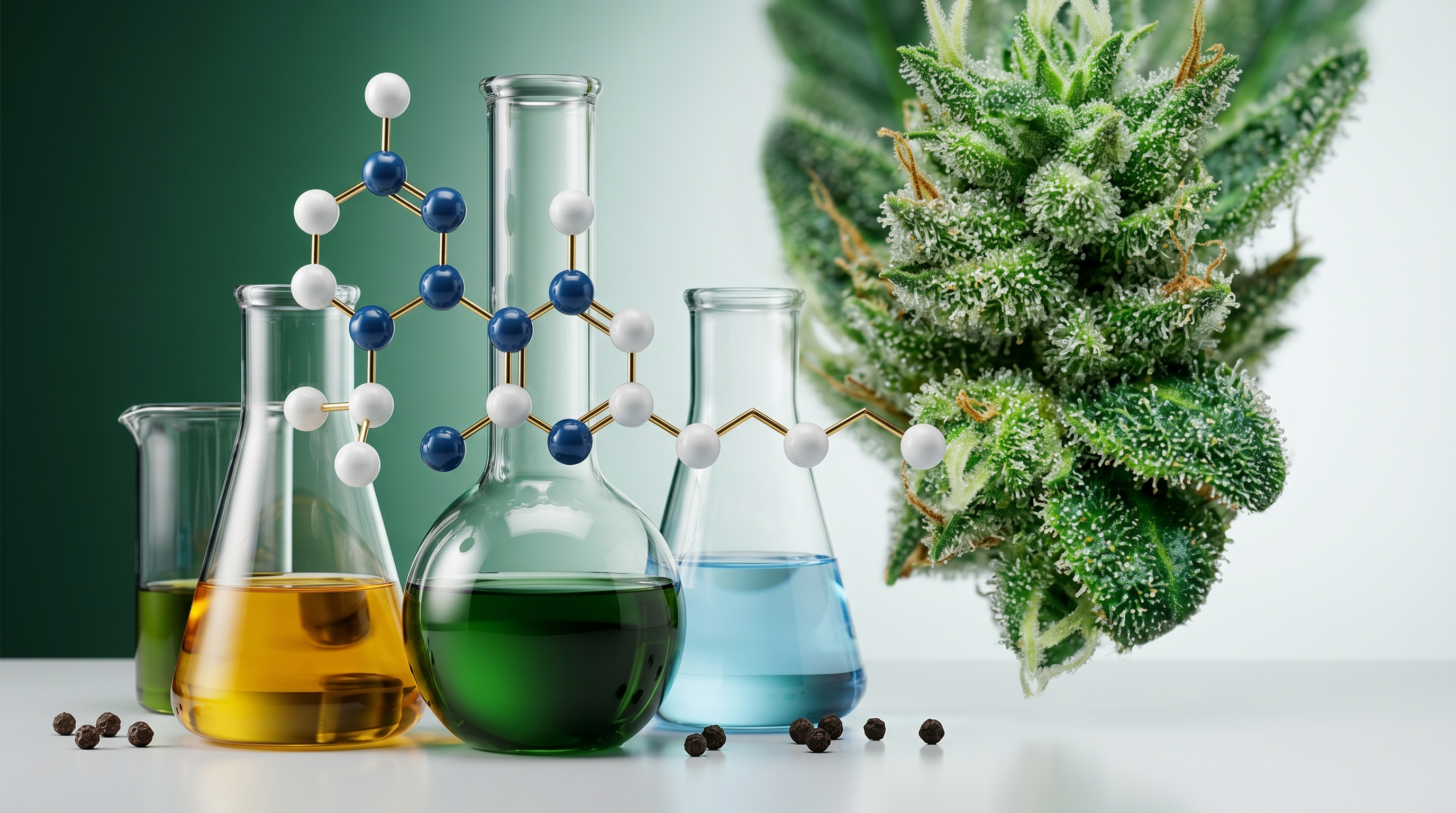
Here is a fact that quietly rewrites how you should think about wellness: the signaling molecules your body uses to regulate mood, appetite, pain, stress, and inflammation are assembled, atom by atom, from the fats on your plate. Your endocannabinoid system (ECS) does not run on some exotic, self-contained fuel. It runs on dietary fatty acids—the same omega-6 and omega-3 molecules you get from cooking oils, nuts, and fish.
So “Can what I eat affect my endocannabinoid balance?” is not really speculative. The answer is yes, and it is baked into the biochemistry. Your two main endocannabinoids—anandamide (AEA) and 2-arachidonoylglycerol (2-AG)—are both built from arachidonic acid. That is an omega-6 polyunsaturated fatty acid (PUFA), and your body sources it almost entirely from diet [Freitas et al., 2018].
Now for the necessary hedge, because this is exactly the kind of topic where the internet loses its mind. Nutritional ECS science is young, mostly preclinical, and largely correlational. Most of the strongest mechanistic data comes from mice, cells in a dish, or short-term human feeding studies. We can say with confidence that diet shapes the raw materials your ECS uses. We cannot yet say “eat X grams of Y and you’ll feel Z.” Anyone selling you that certainty is selling, not teaching. This article is education, not medical advice—nothing here is a treatment plan, and your doctor and a registered dietitian should be in the loop on any real dietary change.
With that guardrail in place, the actual science is genuinely fascinating. Let’s get into it.
The ECS, In One Paragraph
If you are new here, the short version: the endocannabinoid system is a body-wide signaling network. It has receptors (CB1, mostly in the brain and nerves; CB2, mostly on immune cells). It has the endocannabinoids that switch them on (AEA and 2-AG). And it has enzymes that build and break those molecules down—chiefly FAAH, which clears anandamide, and MAGL, which clears 2-AG [Lu & Mackie, 2016]. THC works by mimicking your endocannabinoids well enough to dock into CB1. If you want the full tour, start with our endocannabinoid system guide and the deep-dive on anandamide, your body’s natural THC. The key word for today is tone: the baseline level of endocannabinoid activity humming along in your tissues. Diet is one of the levers that nudges that tone up or down. The concept is explored further in our piece on endocannabinoid tone theory.
Omega-6 vs. Omega-3: The Ratio That Builds Your Endocannabinoids
This is the heart of the matter, so let’s be precise.
Anandamide and 2-AG are both made from arachidonic acid (ARA), which sits at the end of the omega-6 PUFA pathway. Your body makes ARA from linoleic acid (LA)—the dominant fat in soybean, corn, sunflower, and most processed-food oils. More dietary linoleic acid means more arachidonic acid in your cell membranes, which means more substrate available to manufacture AEA and 2-AG.
That relationship has been demonstrated directly. In a controlled mouse study, raising dietary linoleic acid on an otherwise low-fat diet elevated both 2-AG and anandamide in tissue and was associated with greater weight gain—consistent with the ECS’s well-known role in driving appetite and fat storage [Alvheim et al., 2012]. Over the last century, the linoleic acid content of the Western food supply has climbed dramatically, and several researchers have argued this represents a sustained, population-wide upregulation of endocannabinoid tone via diet.
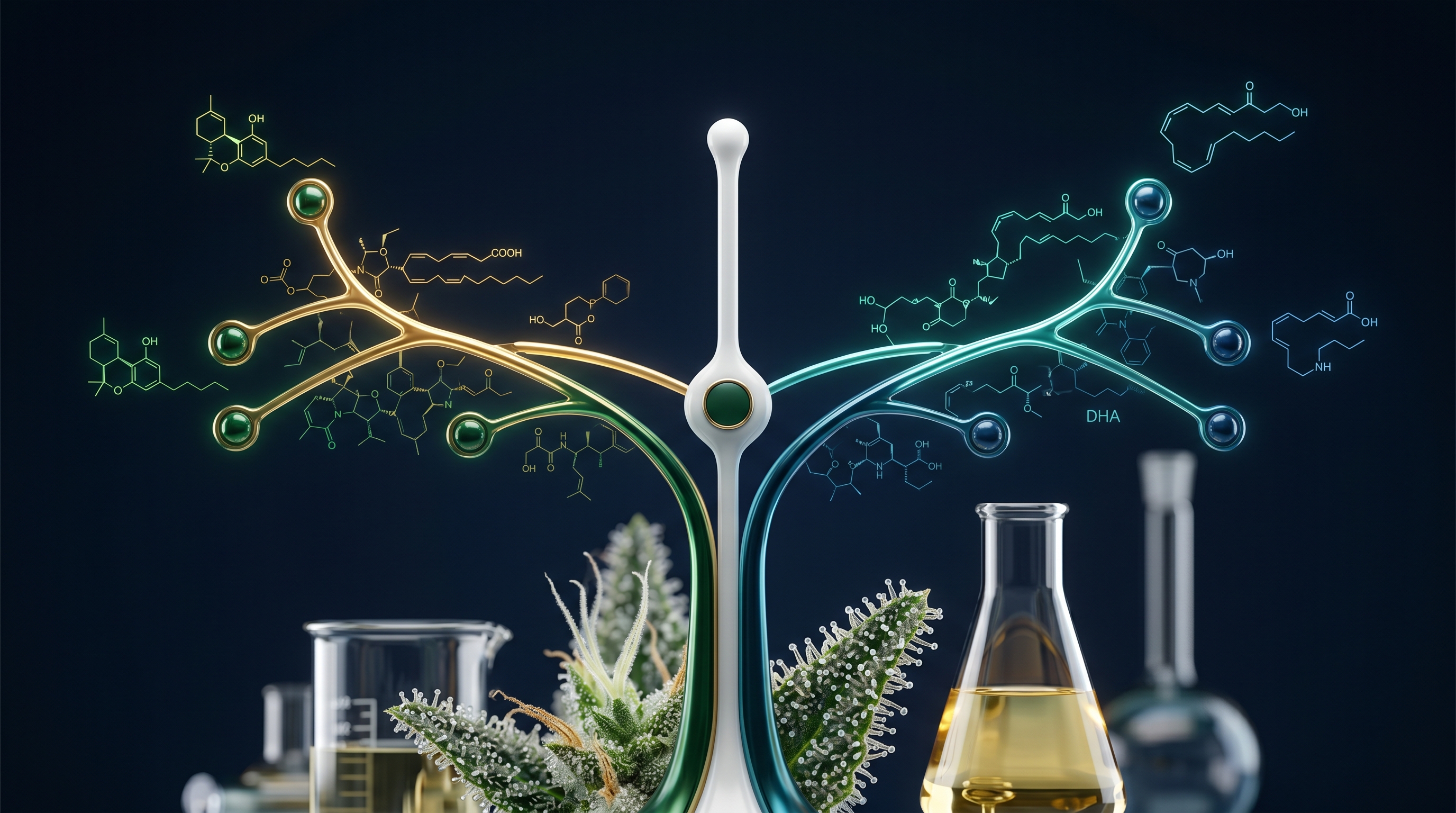
Omega-3 PUFAs—EPA and DHA from fish, and ALA from flax, chia, and walnuts—push in a more complicated direction. They do not simply “lower” your ECS. Instead, long-term omega-3 supplementation tends to reduce AEA and 2-AG while raising a parallel family of omega-3-derived endocannabinoid-like molecules, such as DHA-ethanolamide (synaptamide) and EPA-ethanolamide [Watson et al., 2019]. Because omega-3 and omega-6 fatty acids compete for the same metabolic enzymes, your dietary ratio—not the absolute amount of either—is what reshapes the endocannabinoid signaling profile [Freitas et al., 2018]. A diet drowning in omega-6 and starved of omega-3 builds a different endocannabinoid landscape than a balanced one.
A 2021 review framed it cleanly: dietary PUFA composition is one of the most direct, modifiable inputs into ECS function, with downstream implications for inflammation, metabolism, and neural signaling—while stressing that controlled human dosing data remain thin [Lafourcade-adjacent review summarized in Watson et al., 2019]. The honest takeaway is not “omega-3 good, omega-6 bad.” Both are essential. It is that the balance you eat becomes the balance your ECS works with.
What this looks like on a plate
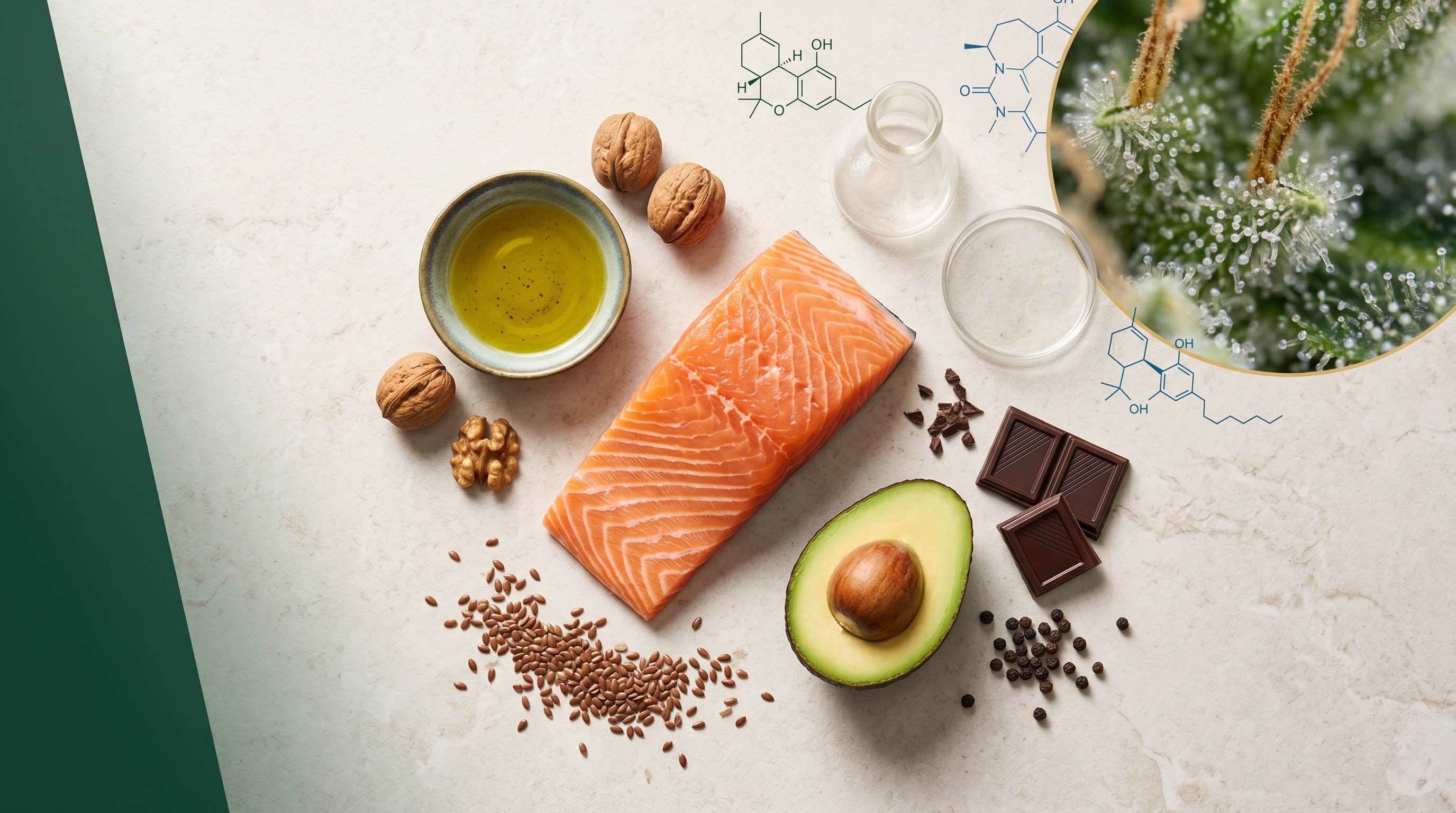
You do not need a supplement regimen to act on this. The practical move is unglamorous: eat more whole-food omega-3 sources (oily fish, flax, chia, walnuts), and lean away from heavily processed oils that load up omega-6 without much else. We covered the food angle in our companion piece, anandamide and the foods that support it. If you’re someone who finds cannabis nudges your appetite hard—see our guide to strains for appetite stimulation—understanding the fatty-acid/ECS link gives you a more complete picture of why hunger signaling is so tightly wired to this system.
Dietary Cannabinoids: Foods That Touch the Same Receptors
Beyond supplying raw materials, a handful of foods contain cannabimimetics—plant compounds that interact with the endocannabinoid machinery directly. The most rigorously documented one lives in your spice rack.
Beta-caryophyllene: the terpene in your pepper grinder
Beta-caryophyllene (BCP) is a terpene with a peppery, woody aroma found in black pepper, cloves, basil, oregano, cinnamon, and hops. It is also abundant in many cannabis cultivars. What makes it remarkable is that, unlike most terpenes, BCP selectively binds and activates the CB2 receptor. In the landmark study, Gertsch and colleagues showed BCP binds CB2 with a Ki of 155 nM and behaves as a functional CB2 agonist; oral BCP reduced inflammation in normal mice but not in mice lacking the CB2 receptor—proof the effect ran through the endocannabinoid system [Gertsch et al., 2008]. They titled the paper, fittingly, “Beta-caryophyllene is a dietary cannabinoid.”
This is why we keep calling it the terpene that acts like a cannabinoid—and why it earns its own write-up in caryophyllene, the terpene that acts like a cannabinoid. Because CB2 lives largely on immune cells, BCP’s activity is tied to inflammation and physical comfort rather than intoxication—it will not get you high. You can read more about why the receptor’s location matters in CB1 vs CB2 receptors. Within our classification framework, caryophyllene-dominant profiles anchor the Relief High family, and you can explore the compound itself on the beta-caryophyllene terpene page.
Cacao: the bliss-molecule preserver
Chocolate’s reputation as a mood food has a real (if modest and debated) mechanistic story. In a 1996 Nature report, di Tomaso and colleagues identified anandamide and two related N-acylethanolamines in cacao [di Tomaso et al., 1996]. The more interesting finding was that the cacao compounds N-oleoylethanolamine and N-linoleoylethanolamine inhibit the breakdown of anandamide—they slow FAAH-like degradation, which could let your own anandamide linger a little longer at its targets. Important caveat: the amounts in a chocolate bar are small, and whether this produces any meaningful effect in humans is genuinely uncertain. It is a beautiful proof-of-concept for “foods can touch the ECS,” not a license to call dessert a wellness protocol.
The rest of the cannabimimetic cupboard
Other foods carry compounds with reported ECS-adjacent activity, though the human evidence is thinner:
- Kaempferol, a flavonoid in kale, broccoli, and tea, has been shown in vitro to inhibit FAAH, the enzyme that degrades anandamide.
- Echinacea contains alkamides structurally similar to anandamide that can engage CB2 receptors—part of why the herb has a traditional anti-inflammatory reputation.
- Cannabis flavonoids and minor terpenes add their own layer; we unpack those in cannabis flavonoids, the anti-inflammatory compounds beyond terpenes and the cannabis terpenes guide.
None of these turn your kitchen into a dispensary. But collectively they make the point that the boundary between “food” and “cannabinoid signaling” is blurrier than most people assume.
Exercise: The Most Reliable ECS Lever You Already Own
If you want a behavior with the strongest evidence for raising endocannabinoid tone, it is not a food at all—it is movement. The famous “runner’s high” was long attributed to endorphins. That story is mostly wrong.
In an elegant 2015 study, Fuss and colleagues showed that the euphoria and reduced anxiety following running in mice depend on cannabinoid receptors, not opioids [Fuss et al., 2015]. The logic is partly anatomical: beta-endorphin is a large molecule that cannot cross the blood-brain barrier, whereas anandamide is lipid-soluble and can travel from blood into the brain, where it can act on CB1 receptors. Blocking cannabinoid receptors abolished the running-induced calm; blocking opioids did not. Human work has reinforced that exercise-induced mood lift and pain tolerance track with rising endocannabinoid levels.
Moderate-intensity aerobic exercise is the sweet spot for bumping endocannabinoids—not sprinting yourself into the ground. We go deeper in the endocannabinoid system during exercise. For people who use cannabis around workouts, this is worth sitting with: you may already be elevating your own anandamide before you ever reach for flower, and stacking the two is its own decision. Strains in the Energetic High family, often rich in terpinolene and ocimene, tend to pair with the energetic and uplifted effects people chase for active days.

The Gut Connection: Microbes, Prebiotics, and ECS Tone
The newest frontier is the gut microbiome, and it ties the whole story together. Your intestinal bacteria help regulate endocannabinoid tone in the gut wall, and—remarkably—the relationship runs both ways.
Research has shown that manipulating gut microbes (via antibiotics, probiotics, or diet) changes the levels of FAAH and MAGL in the colon, which in turn shifts local AEA and 2-AG signaling [Cani et al., 2016]. A standout player is Akkermansia muciniphila, a beneficial mucus-loving bacterium: increased anandamide tends to track with less Akkermansia, and restoring Akkermansia (which prebiotic fibers and polyphenols help feed) is associated with reduced AEA and improved gut-barrier and metabolic health [Cani et al., 2016]. In other words, the fiber and polyphenols you eat feed microbes that feed back into your endocannabinoid signaling.
This is why we treat gut health and ECS health as one conversation—explored fully in cannabis and gut health, the endocannabinoid-microbiome connection. The practical, low-risk move here is the one nutritionists have recommended for decades: eat a diverse, fiber-rich, plant-forward diet. It happens to also be ECS-supportive. For the inflammation side of this picture, see cannabis and inflammation, the complete molecular science.
So… Can You “Eat for a Better High”?
Here is where the strain side of this gets interesting, and where I have to be careful. The popular framing—“eat a mango before you smoke and the myrcene boosts your high”—is mostly folklore with thin evidence. What the real science supports is broader and more useful: your diet shapes the endocannabinoid baseline that cannabis then acts on top of. Two people can consume identical flower and have different experiences partly because their ECS tone—built over weeks and months of eating, moving, and sleeping—is different.
That is the entire premise behind tracking. The terpene profile of myrcene-rich, sedating cultivars in the Relax High family, the limonene brightness of mood-lifting strains, the linalool calm, the humulene in your hops and your flower alike—these interact with a system you are constantly modifying through diet. If you want to see how all those compounds combine rather than act alone, our piece on the entourage effect and the Entourage High family is the natural next read. Strains leaning toward relaxed, happy, or pain-relief effects will land differently on a well-fed, well-rested ECS than on a frazzled, inflamed one.
You cannot control your genetics. You can influence your inputs.
How High IQ Fits In
This is exactly why we built High IQ around tracking rather than prescribing. We are never going to tell you “this strain will make you feel calm,” because the honest science says your endocannabinoid tone—diet included—is part of the equation, and that tone is yours. What the app does is help you log what you consume and how you actually respond, so patterns surface that no generic label could predict. Over time you stop guessing and start seeing your own data: which terpene profiles fit your body, on which kinds of days. Pair that self-knowledge with the ECS-supportive basics—omega-3s, movement, fiber, sleep—and you are working with your biology instead of against it.
Frequently Asked Questions
Does eating omega-3s lower my tolerance or weaken my high? There is no good human evidence for that. Omega-3 intake reshapes the profile of your endocannabinoids over time—it does not flip a switch on cannabis potency. Treat omega-3s as general ECS and cardiovascular support, not a tolerance hack.
Will black pepper or chocolate get me high? No. Beta-caryophyllene in pepper acts on CB2 (immune/anti-inflammatory), not the CB1 receptors responsible for intoxication, and the anandamide-related compounds in cacao are present in tiny amounts. These are interesting mechanisms, not psychoactive doses.
Is there such a thing as “endocannabinoid deficiency” I can eat my way out of? The clinical endocannabinoid deficiency hypothesis is a real, actively researched idea—but it is still a hypothesis. Diet may support healthy ECS function, but “deficiency” is not something you should self-diagnose or self-treat. We cover the theory in clinical endocannabinoid deficiency.
What is the single highest-confidence thing I can do for my ECS? Move your body regularly. The exercise-and-endocannabinoid link is the most robust finding in this entire space.
Key Takeaways
Your endocannabinoid system is not sealed off from your dinner. Here is the short version:
- Anandamide and 2-AG are built from dietary fats. Your omega-6-to-omega-3 ratio shapes the raw materials.
- Beta-caryophyllene in black pepper is a true dietary cannabinoid. It hits CB2, not the receptor that gets you high.
- Cacao carries compounds that slow anandamide breakdown. The amounts are small, so keep expectations modest.
- Exercise has the strongest evidence of all. The runner’s high runs on endocannabinoids.
- Your gut microbes feed back into ECS tone. Fiber and polyphenols help feed the helpful ones.
The safest moves are also the least exotic: eat more omega-3-rich whole foods, lean off heavily processed oils, feed your gut fiber, and move your body.
Just keep the humility. This is emerging, mostly preclinical science. The gap between “diet shapes ECS substrate” and “eat this to feel that” is still being mapped. None of this is medical advice, and it is no substitute for a talk with your doctor. But the core insight is solid: the system cannabis works through is one you already feed, several times a day.
Sources
- Gertsch, J., Leonti, M., Raduner, S., et al. (2008). Beta-caryophyllene is a dietary cannabinoid. Proceedings of the National Academy of Sciences, 105(26), 9099–9104. DOI: 10.1073/pnas.0803601105
- Fuss, J., Steinle, J., Bindila, L., et al. (2015). A runner’s high depends on cannabinoid receptors in mice. Proceedings of the National Academy of Sciences, 112(42), 13105–13108. DOI: 10.1073/pnas.1514996112
- Alvheim, A. R., Malde, M. K., Osei-Hyiaman, D., et al. (2012). Dietary linoleic acid elevates endogenous 2-AG and anandamide and induces obesity. Obesity, 20(10), 1984–1994. DOI: 10.1038/oby.2012.38
- di Tomaso, E., Beltramo, M., & Piomelli, D. (1996). Brain cannabinoids in chocolate. Nature, 382(6593), 677–678. DOI: 10.1038/382677a0
- Freitas, H. R., Isaac, A. R., Malcher-Lopes, R., et al. (2018). Polyunsaturated fatty acids and endocannabinoids in health and disease. Nutritional Neuroscience, 21(10), 695–714. DOI: 10.1080/1028415X.2017.1347373
- Watson, J. E., Kim, J. S., & Das, A. (2019). Emerging class of omega-3 fatty acid endocannabinoids and their derivatives. Prostaglandins & Other Lipid Mediators, 143, 106337. DOI: 10.1016/j.prostaglandins.2019.106337
- Cani, P. D., Plovier, H., Van Hul, M., et al. (2016). Endocannabinoids—at the crossroads between the gut microbiota and host metabolism. Nature Reviews Endocrinology, 12(3), 133–143. DOI: 10.1038/nrendo.2015.211
- Lu, H. C., & Mackie, K. (2016). An introduction to the endogenous cannabinoid system. Biological Psychiatry, 79(7), 516–525. DOI: 10.1016/j.biopsych.2015.07.028
This article is for educational purposes only and is not medical advice. Cannabis affects everyone differently, and dietary changes—especially if you have a health condition or take medication—should be discussed with a qualified healthcare provider.


