Geraniol: The Rose-Scented Terpene with Neuroprotective Potential
Explore geraniol, the floral terpene found in cannabis and roses. Learn what research says about its neuroprotective, anti-inflammatory potential.

A Rose by Any Other Name… Might Be Cannabis
Here’s something that might surprise you: the same molecule responsible for the intoxicating scent of a fresh rose bouquet is also quietly present in certain cannabis strains — and it may be doing far more than just smelling pretty.
That molecule is geraniol, a monoterpene alcohol found in roses, lemongrass, geraniums, and yes, cannabis. While terpenes like myrcene and limonene dominate the conversation, geraniol has been flying under the radar despite a growing body of preclinical research suggesting it may offer neuroprotective, anti-inflammatory, and antioxidant properties.
Why should you care? Because understanding the terpenes in your cannabis isn’t just a nerdy flex — it’s the key to understanding why different strains make you feel different things. The cannabinoids (THC, CBD) get most of the credit, but terpenes like geraniol are increasingly recognized as crucial players in shaping your experience through what scientists call the entourage effect.
In this article, we’ll break down what geraniol is, what the latest research suggests about its neuroprotective potential, and how this knowledge can help you make smarter choices about the cannabis you consume. No PhD required — just curiosity.
What Exactly Is Geraniol?
Geraniol (C₁₀H₁₈O) is a monoterpenoid alcohol — a small, aromatic molecule made by many plants. Think of it as a plant’s built-in perfume that also repels insects. It’s a key ingredient in many natural bug repellents because insects hate it while humans love it. Honeybees even make geraniol in special glands to mark flowers and hive entrances. It’s everywhere in nature.
At a glance:
- Molecular formula: C₁₀H₁₈O
- Classification: Acyclic monoterpenoid alcohol (no ring structure)
- Boiling point: 230°C / 446°F
- Aroma: Sweet, floral, rose-like with citrus hints and a touch of fresh fruit
In cannabis, geraniol is present in small amounts — usually under 0.5% of total terpene content. That’s much less than heavy hitters like myrcene or caryophyllene. But even trace levels shape a strain’s aroma. That hint of roses or fresh berries you sometimes catch in a complex flower? Geraniol is likely doing that.
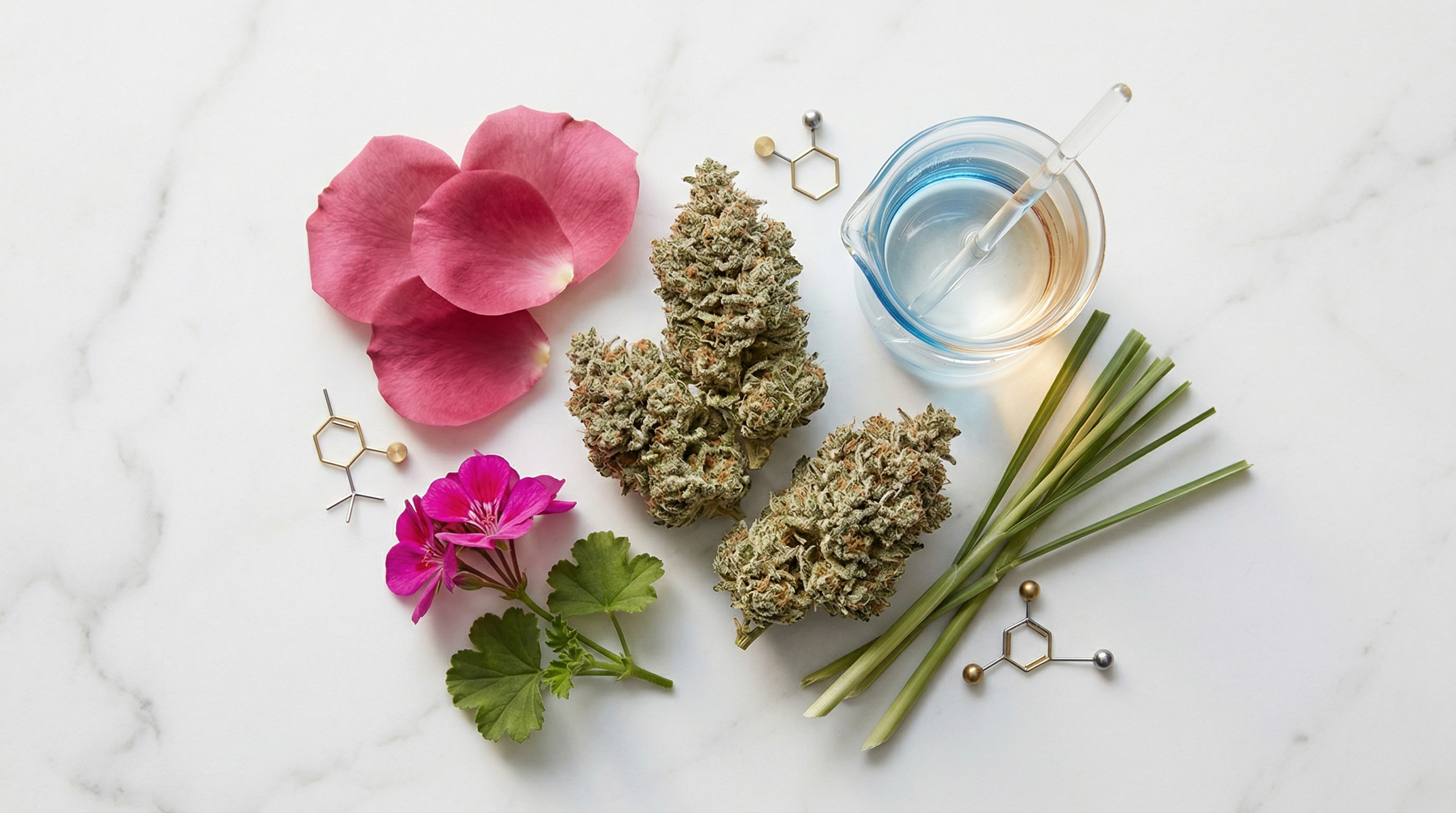
Natural sources of geraniol:
- Roses — one of the richest natural sources; core component of rose absolute
- Palmarosa — a tropical grass where geraniol can exceed 80% of the essential oil
- Geraniums — where it gets its name
- Lemongrass — alongside geranial and citronellal
- Citrus fruits — in the peel, alongside limonene
- Blackberries and blueberries — subtle rose-fruit tones come from geraniol
- Cannabis — trace concentrations in dozens of strains
A 2022 literature review found over 3,068 geraniol-related research papers published between 2010 and 2021. That’s a lot of attention for a “minor” cannabis terpene. Scientists are clearly taking it seriously.
The Neuroprotective Research
This is where geraniol gets genuinely exciting — and where you need to read carefully, because the science is promising but still in early stages.
Memory and Cognitive Aging
A 2022 study published in Neurochemical Research examined geraniol’s effects on d-galactose-induced memory impairment in rats — a well-established model for accelerated aging [Rekha et al., 2022]. The results were striking:
- Geraniol significantly improved memory performance on behavioral tests
- It raised levels of BDNF (brain-derived neurotrophic factor) — the brain’s key growth and repair protein
- It increased acetylcholine levels, the neurotransmitter critical for learning and memory
- It reduced acetylcholinesterase activity, meaning it kept acetylcholine in the synaptic gap longer
Put simply: geraniol helped the brain form and hold memories by boosting the right chemicals. This matters because that same system — acetylcholine signaling — breaks down in Alzheimer’s disease. Most Alzheimer’s drugs try to fix it too.
Alzheimer’s Disease: A Network Pharmacology Analysis
A 2022 study in the European Journal of Medical Research used computer modeling to map geraniol’s potential against Alzheimer’s [Hu et al., 2022]. From nearly 11,000 disease-related targets, researchers found 29 molecular targets that geraniol and Alzheimer’s share.
The five biggest “hub targets” were:
- CHRM3 — a key acetylcholine receptor; showed the strongest geraniol binding in docking tests
- PRKCA and PRKCD — protein kinases involved in neuron survival
- JAK1 and JAK2 — enzymes that control inflammation in the brain
The most affected pathways were cholinergic synapses and neuroactive ligand-receptor interactions — the exact systems that fail in Alzheimer’s. This gives researchers a roadmap for why geraniol might help, not just that it might.
Oxidative Stress and Neuroinflammation
A 2024 study in Aging found that geraniol switches on a key brain defense system: the PI3K/Akt/Nrf2/HO-1 pathway [Zhang et al., 2024]. Here’s what that means in plain terms:
- PI3K/Akt: tells cells to survive and not die off early
- Nrf2: the master switch for your body’s antioxidant defenses
- HO-1: an enzyme that neutralizes harmful pro-oxidant molecules
Brain scans in the study showed better blood flow in mice treated with geraniol. The researchers found it both cut inflammation and boosted antioxidants at the same time — a powerful one-two punch that warrants more research.

Important caveat (read this): Every study cited above used animal models or computational methods — not human clinical trials. The gap between a promising rat study and a proven human treatment is enormous. Think of this research as identifying exciting leads, not established therapies. As with all terpene science, the human clinical data is still catching up.
Anti-Inflammatory Action: The NF-κB Connection
Beyond neuroprotection specifically, geraniol has been studied for broad anti-inflammatory properties that work through a mechanism shared with other well-researched cannabis compounds.
NF-κB is your body’s inflammation master switch. When it’s on, your cells pump out inflammatory signals. When it’s chronically stuck on, you get long-term inflammation linked to arthritis, heart disease, and brain conditions.
Research shows geraniol turns down NF-κB, which reduces inflammatory signals like TNF-α, IL-1β, and IL-6. This puts geraniol in similar territory as caryophyllene (which targets CB2 receptors) and humulene (which also hits NF-κB) — though each works through slightly different pathways.
The 2022 rat study also found geraniol lowered cellular stress markers (IRE1, PERK, GRP78, CHOP). These stress proteins, when out of control, drive the kind of neuronal damage seen in neurodegenerative disease.
Antimicrobial Properties
Geraniol’s pest-repellent qualities translate into broad-spectrum antimicrobial activity in the lab. Research has demonstrated activity against:
- Bacteria: Including Staphylococcus aureus, E. coli, and Candida albicans
- Fungi: Antifungal properties that have attracted interest in agricultural applications
- Parasites: Mosquito and tick repellent activity at concentrations commonly used in natural products
This antimicrobial profile is one reason geraniol is widely used in natural perfumes, cosmetics, and cleaning products — it’s not just pleasant-smelling, it actively inhibits microbial growth.
Skin Absorption and Cosmetic Applications
Here’s a practical angle: geraniol absorbs well through the skin. Your body takes it up easily, which is why it’s used in cosmetics and topical drug research as both an active compound and a delivery helper.
For topical cannabis products, this matters. If a lotion or balm uses geraniol-rich strains, the terpene may help other compounds — like CBD — reach deeper into tissue. That’s the entourage effect applied to skincare, and it’s why terpene profiles matter even in topicals.
Geraniol and the Entourage Effect
Geraniol doesn’t work in isolation when you consume cannabis. It’s part of a complex chemical orchestra where terpenes, cannabinoids, and flavonoids interact synergistically. A 2022 literature review specifically noted geraniol’s synergistic effects with other terpenes, suggesting it may amplify or modify effects that neither compound achieves as effectively alone.
Its potential anti-inflammatory and neuroprotective properties may complement cannabinoids like CBD, which has its own well-studied anti-inflammatory profile. When geraniol co-occurs with linalool (another floral terpene associated with calming effects) and limonene, you get a particularly interesting terpene combination — floral, mood-lifting, and potentially neuroprotective all at once.
High Families and Geraniol
In the High Families system, geraniol-rich strains most often fall within the Uplift High family, where limonene and lighter floral terpenes dominate. The sweet, rosy, bright character of geraniol-forward strains fits naturally with the uplifting, socially energizing effects that define the Uplift family.
Strains with more complex multi-terpene profiles — where geraniol layers alongside heavier terpenes like myrcene or caryophyllene — may lean toward the Entourage High experience: nuanced, full-spectrum, and harder to pin down to a single effect.
Pro tip from Professor High: Instead of choosing strains by indica or sativa labels (which tell you almost nothing about effects), try selecting by terpene profile and High Family. It’s a far more reliable way to predict how a strain will make you feel.
Cannabis Strains with Notable Geraniol
Geraniol rarely tops a strain’s terpene chart, but these varieties are more likely to show meaningful geraniol content in lab testing:
- Amnesia Haze — complex floral-citrus profile with notable geraniol contribution
- Headband — earthy and floral, frequently shows elevated geraniol alongside linalool
- Lavender — the name says it all; floral and calming, geraniol + linalool combo
- Great White Shark — surprising rosy sweetness from geraniol underpinning a complex profile
- 11 Roses — named partly for its geraniol-driven rose character; a standout for floral cannabis enthusiasts
- Agent Orange — the citrus-forward profile has geraniol adding a sweet, fruity dimension
- Black Cherry Soda — sweet berry notes boosted by geraniol’s fruit-adjacent floral character
- OG Kush — geraniol appears as a minor supporting terpene in this classic
Always check the Certificate of Analysis (COA) from your specific batch — terpene profiles vary significantly by cultivator, grow conditions, harvest timing, and cure. A strain name alone doesn’t guarantee geraniol presence.
Key Takeaways
Here’s what matters most:
Geraniol is the underdog of cannabis terpenes. It doesn’t headline the conversation the way myrcene or limonene do. But its scientific profile — neuroprotective potential, anti-inflammatory via NF-κB inhibition, antioxidant through Nrf2 activation, antimicrobial, skin-penetrating — is one of the most intriguing in cannabis terpene research.
The neuroprotection research is genuinely exciting. Multiple independent research groups have documented geraniol’s ability to reduce neuroinflammation, boost BDNF, and protect cognitive function in animal aging models. The Alzheimer’s network pharmacology analysis adds mechanistic depth. This isn’t one lucky study — it’s a converging body of evidence.
But we’re not there yet. All of this research is preclinical. No human clinical trials have confirmed these effects in people. Use this knowledge to appreciate the complexity of your cannabis, not to self-treat neurological conditions.
Your nose can guide you. If your cannabis carries a sweet, floral, slightly rosy scent — especially in strains like Lavender, Amnesia Haze, or 11 Roses — geraniol is likely contributing. That’s the terpene inviting you in.
Track your experience with floral, geraniol-rich strains in High IQ. Your personal data will reveal patterns that no study can predict for you.
Sources
- Hu, Y., et al. (2022). Mechanistic insight of the potential of geraniol against Alzheimer’s disease. European Journal of Medical Research, 27, 116. DOI: 10.1186/s40001-022-00699-8
- Rekha, K.R., et al. (2022). Mechanistic insights into ameliorating effect of geraniol on d-galactose induced memory impairment in rats. Neurochemical Research, 47(6), 1736-1750. DOI: 10.1007/s11064-022-03559-3
- Zhang, Y., et al. (2024). Geraniol attenuates oxidative stress and neuroinflammation-mediated cognitive impairment in D-galactose-induced mouse aging model. Aging, 16(6), 5319-5337. PubMed: 38517361
- Cho, M., So, I., Chun, J.N., & Jeon, J.H. (2016). The antitumor effects of geraniol: Modulation of cancer hallmark pathways. International Journal of Oncology, 48(5), 1772-1782. PMID: 26935693
- Russo, E.B. (2011). Taming THC: potential cannabis synergy and phytocannabinoid-terpenoid entourage effects. British Journal of Pharmacology, 163(7), 1344-1364. PMID: 21749363
- CanaMD. (2025). Geraniol: Marijuana That Smells Like Roses. Retrieved from cannamd.com — reviewing 150+ peer-reviewed studies on geraniol’s bioactive properties.


