

Glassy Eyes From Weed: Not the Same as Red Eyes
Glassy eyes from weed have no clinical definition. Studies measured red eyes, lids and pupils, but never the shine. Here is what the eye evidence shows.

Professor High
Written by Professor High, our AI guide. See how we research and correct articles.
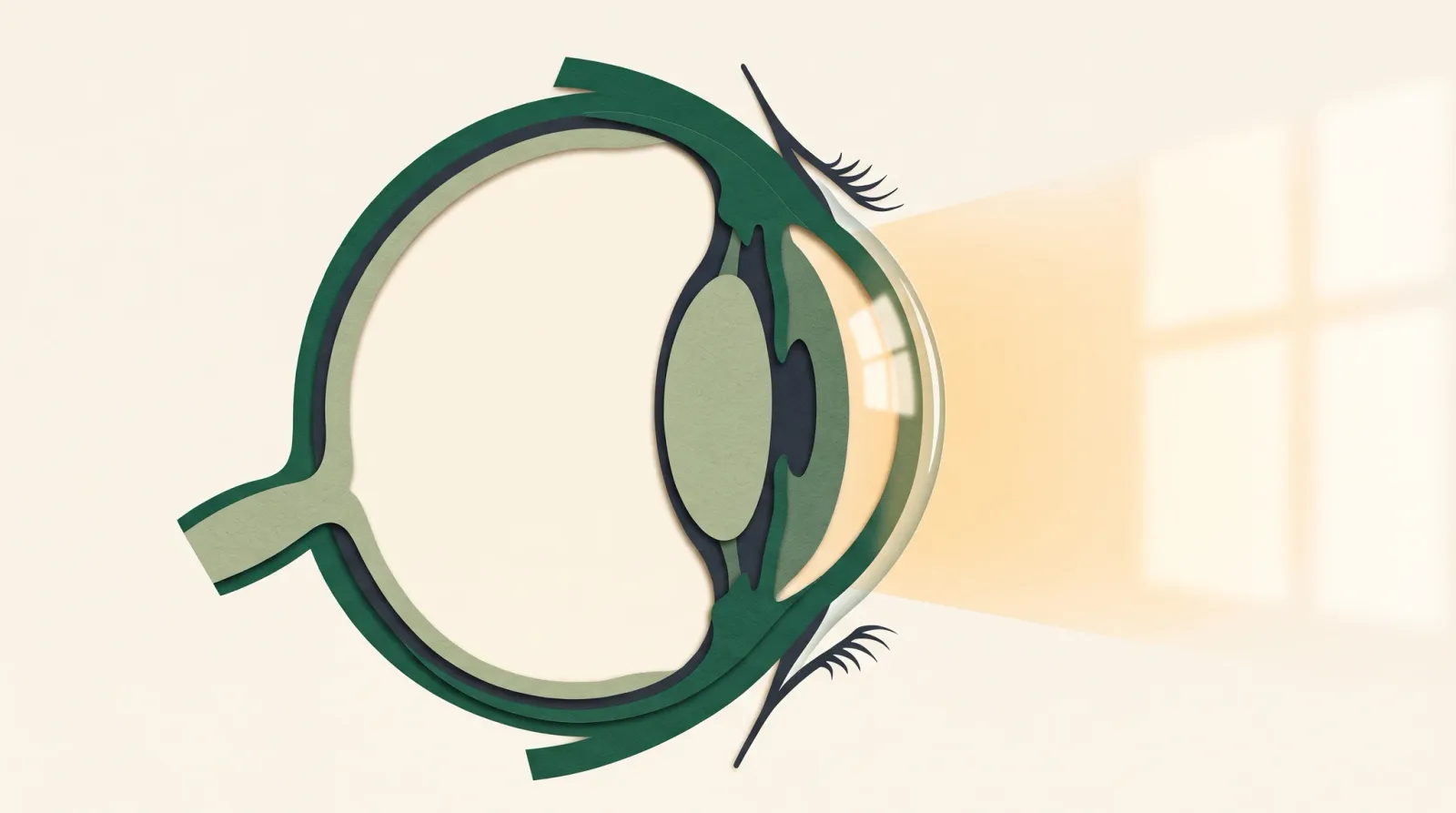
Glassy eyes from weed are a look, not a measured sign: studies of people after cannabis have recorded red eyes, drooping lids and changes in how pupils react to light, but none has measured the shine itself. That gap matters, because the popular explanations for glassy eyes contradict each other, and the most common one runs against the only direct experiment on tears.
Here is the specific to send the next time someone argues about it. In a two-year forensic series of drivers suspected of impairment whose blood tested positive for THC, examiners recorded red eyes in 94% and droopy eyelids in 85.6%. “Glassy” was not on the list. Declues and colleagues, 2018 And the claim that “tear glands get more active” meets an experiment that found the opposite: THC cut tear volume in male mice from 5.0 mm to 2.0 mm on a standard thread test, with no significant change in female mice. Thayer and colleagues, 2020
Red has numbers. Glassy has none. This lesson sorts what was measured, what came back mixed, and what nobody has measured yet.
Evidence checked October 29, 2026.
What does “glassy eyes” actually mean?
There is no clinical definition. No study in our search defined, scored or photographed “glassy” or “glazed” eyes after cannabis. People use the word for eyes that look shiny, wet, unfocused or slow, which may be several different things at once.
The shine part has a physical basis. The front of the eye is covered by a thin tear film, and its outer oily layer gives the cornea “a smooth optical surface” and slows evaporation. Bron and colleagues, 2004 When light hits that smooth surface, you see a bright reflection. A study that wanted to measure “glassy” would have to track that tear surface. None did after cannabis.
The opposite problem is dry eye. The National Eye Institute describes it as eyes that “don’t make enough tears to stay wet,” or tears that “don’t work correctly.” National Eye Institute Its page does not mention cannabis.
How are glassy eyes different from red eyes?
Red eyes are visible blood vessels in the white of the eye. Glassy describes the surface and the gaze. Our red eyes lesson covers why the vessels widen and what helps with comfort, so this table keeps redness to one row.
| Red (bloodshot) eyes | Glassy eyes | |
|---|---|---|
| What you see | Pink or red whites of the eye | A shiny, wet or unfocused look |
| What sits behind it | Widened vessels in the white of the eye | Light reflecting off the tear film; possibly gaze and lid position |
| Measured after cannabis? | Yes, in examiners’ records of suspect drivers | No study measured it |
| Best number | Red eyes in 94% of THC-positive suspect drivers | None |
| Caveat | Suspects stopped for impaired driving, not a random sample; abstract-level evidence with no comparison group stated | Plausible contributors below each have their own limits |
The 94% describes what examiners wrote down for one selected group. It is not a rate for everyone who uses cannabis, and it is not a test’s accuracy.
Does weed make your eyes watery or dry?
Nobody has measured tears in people during a cannabis high. The one direct experiment used mice. Researchers gave THC by injection and tested tearing one hour later. In male mice, tear volume fell from 5.0 mm to 2.0 mm on the thread test. In female mice, the change was not significant. Male tear glands carried roughly four to five times more CB1 receptor than female glands, and the authors concluded that activating CB1 in the tear gland “reduces tearing.” Thayer and colleagues, 2020
That fits a pattern you may know from the cottonmouth lesson, where cannabinoid receptors in salivary glands explain a dry mouth. CB1 is part of the endocannabinoid system. But a mouse result is a mechanism, not a demonstrated effect in human eyes. The same authors suspect THC also acts on a second, unidentified target.
The human evidence is thin. One ophthalmology review found dry eyes reported by 8.7% of medical cannabis users in one cohort, a self-report figure. Bondok and colleagues, 2024 The same review calls dry eye a common side effect, which is stronger than its own figure supports.
Smoke adds a confounder. After one tobacco cigarette, tear break-up time shortened in 45 habitual smokers. Latif and Naroo, 2022 That study was about tobacco, not cannabis. It shows why a smoked-cannabis study could not separate THC from smoke on the tear film.
So “your tear glands work overtime” has no support, and “weed dries your eyes” is a mouse finding plus self-report.
Do you blink less when you’re high?
Nobody has measured it during a high. What exists is a resting trait in long-term users. In one study, 25 chronic users blinked 10.24 times a minute and 25 matched non-users blinked 17.52 times. Users were tested while not intoxicated, and blink rate fell with more years of use. Kowal and colleagues, 2011 A second, independent group of 21 users also blinked less than 20 non-users. Mikulskaya and Martin, 2018
Both are group comparisons, not dose experiments. In the first study, far more users than controls smoked tobacco (21 of 25 against 4 of 25).
Why it could matter for the look: blinking spreads the tear film, and the National Eye Institute notes that blinking less, for example at screens, can lead to dry eye. National Eye Institute Fewer blinks could change how the eye surface looks. That is a reasonable link, not a measured cannabis effect.
Do dilated pupils make your eyes look glassy?
There is no evidence for that, and the pupil studies do not even agree on direction.
- Smaller pupils: marijuana produced “a dose-related constriction of the pupil” at low daylight levels in a 10-person study from 1977. Brown and colleagues, 1977 In a 2025 placebo-controlled trial, intravenous THC shrank pupils from 6.09 mm to 5.45 mm at 60 minutes in 15 volunteers, and the authors wrote that THC “does not cause mydriasis, but rather miosis.” The group difference against the 4 placebo volunteers was not significant. Kleine-Brueggeney and colleagues, 2025
- Larger pupils: 17 people who smoked kif, a cannabis and tobacco mix, had significantly larger pupils in a dark room 30 minutes later. Merzouki and colleagues, 2008 After a large oral dose, pupils were about 0.4 to 0.5 mm larger than after placebo under direct light. Newmeyer and colleagues, 2017
- No consistent change: in the largest study, 126 adults, pupil size in darkness differed between groups by less than 0.2 mm after users inhaled their own cannabis. Brooks-Russell and colleagues, 2025 Our lesson on blurry vision, contrast and halos describes another null pupil result at brighter light levels.
The more repeatable finding is about the light reflex. In the 126-person study, pupils of controls shrank by about 44% when a light came on, against about 36% to 40% for users at the first test. Brooks-Russell and colleagues, 2025 The IV trial also found a smaller light response, and some participants could not tolerate the light stimulus. Kleine-Brueggeney and colleagues, 2025 A third study reported slower pupil responses and less variation in pupil size; it was funded by the eye-tracking device’s maker, and its lead author advises that company. Haider and colleagues, 2024
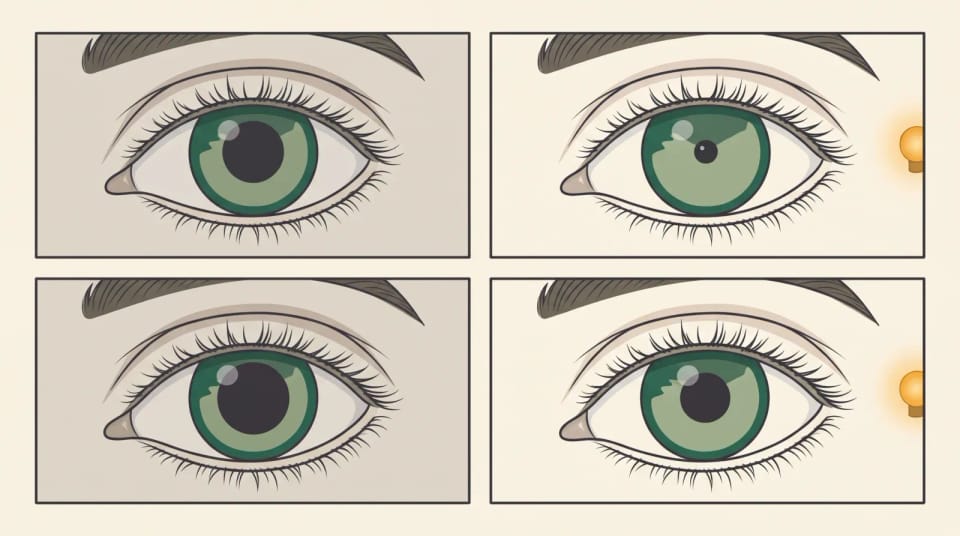
Illustration of the repeated finding: a weaker pupil response to light, not a fixed pupil size. In the studies, top row is the typical response and bottom row the weaker one. Studies disagree on whether resting pupils get larger or smaller.
The US roadside reference profile for cannabis lists pupils as “normal to dilated” and light reaction as “normal to slow.” It lists “bloodshot eyes” among other signs. “Glassy” does not appear. NHTSA Drugs and Human Performance Fact Sheets
What about droopy eyelids and the glazed stare?
Droopy lids are a roadside record and an animal finding, not a controlled human measurement. A review of cannabis and the eyelids found no human study of lid droop; the droop data came from rodents and monkeys, and tremor appeared only in reports on impaired drivers. Nguyen and Wu, 2020
Eyelid tremor, a standard roadside sign, did not hold up in a blinded test. Among 103 people, recent smoking was not associated with tremor (odds ratio 0.75), and the sign showed up in most people who had not just smoked: specificity was 0.18. One author reports funding from roadside-testing companies. Wang and colleagues, 2024
The “stare” has better support. A systematic review of 20 studies found that acute THC consistently reduced the accuracy of quick eye jumps, and fixations lasted longer after 5 mg of oral THC. Smooth tracking of a moving target gave mixed results. Manning and colleagues, 2024 So eyes can move differently during a high. That is not the same as a universal glazed look.
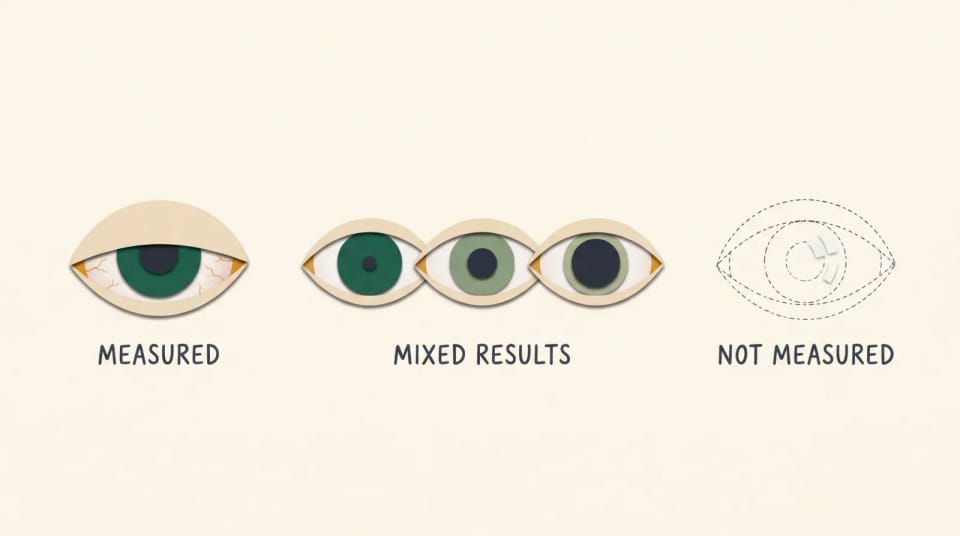
Redness and lid droop appear in examiners’ records, pupil direction conflicts across studies, and no study measured the shine.
Why do some people get red eyes and others glassy eyes?
Nobody knows. No study compared people who get red eyes with people who get glassy eyes after the same product. Dose, route, smoke exposure, tolerance and time since use are all plausible differences, and none has been tested for this question.
Timing is worth knowing when you compare stories. The inhaled and intravenous studies tested eyes 20 to 100 minutes after use, and the oral pupil change appeared at 1.5 and 3.5 hours. For how those windows line up with the high itself, see how long a high lasts and the edible timeline. Our lesson on tolerance and different effects explains why the same product can feel different for two people, though not eye signs specifically.
If you notice that eye effects differ by product, the High IQ app lets you log how each strain worked so you can compare your own notes later.
Can people tell you’re high from your eyes?
Not reliably from one sign. In the 126-person pupil study, the best single eye measure sorted recent users from non-users correctly 64% to 72% of the time, and the authors said that accuracy is far below breathalyzer-grade evidence. Brooks-Russell and colleagues, 2025 Eyelid tremor showed up in most people who had not just smoked. Wang and colleagues, 2024
Eye signs are also not impairment tests. If you are deciding whether to drive, our guide to driving after cannabis covers timing. How your eyes look tells you nothing about whether you are safe to drive.
When should you talk to a clinician?
A shiny look that fades with the high is not the same as an eye symptom. The NHS advises an urgent appointment for changes in vision such as blurred or double vision, flashing lights, pain in one or both eyes, a red and painful eye, or eyes that hurt in bright light. It advises emergency care for sudden loss of sight or sudden severe eye pain. NHS vision loss guidance
Tell the clinician about cannabis use; it helps them read the picture. Our lesson on cannabis and eye health covers eye pressure and what to bring to an eye appointment. For comfort with ordinary redness, see the red eyes lesson.
Sources
- Thayer A, Murataeva N, Delcroix V, Wager-Miller J, Makarenkova HP, Straiker A. “THC Regulates Tearing via Cannabinoid CB1 Receptors.” Investigative Ophthalmology and Visual Science. 2020;61(10):48. DOI: 10.1167/iovs.61.10.48
- Brooks-Russell A, Godbole S, Kosnett MJ, et al. “Pupillary dynamics as a marker of acute cannabis inhalation.” Clinical Toxicology. 2025;63(11):869-877. DOI: 10.1080/15563650.2025.2543066
- Haider MN, Regan D, Hoque M, Ali F, Ilowitz A. “Effects of recent cannabis consumption on eye-tracking and pupillometry.” Frontiers in Neuroscience. 2024;18:1358491. DOI: 10.3389/fnins.2024.1358491
- Kleine-Brueggeney M, Priemer F, Konietschke F, Theiler L, Greif R. “Effects of intravenous d9-THC on pupillary reaction and pupil size: a prospective, placebo-controlled trial in healthy volunteers not regularly consuming cannabis.” BMC Ophthalmology. 2025;25:286. DOI: 10.1186/s12886-025-04107-7
- Wang GS, Kosnett M, Subramanian P, et al. “Accuracy and replicability of identifying eyelid tremor as an indicator of recent cannabis smoking.” Clinical Toxicology. 2024;62(1):10-18. DOI: 10.1080/15563650.2024.2310154
- Declues K, Perez S, Figueroa A. “A Two-Year Study of Δ9 Tetrahydrocannabinol Concentrations in Drivers; Part 2: Physiological Signs on Drug Recognition Expert (DRE) and non-DRE Examinations.” Journal of Forensic Sciences. 2018;63(2):583-587. DOI: 10.1111/1556-4029.13550
- Couper FJ, Logan BK. Drugs and Human Performance Fact Sheets. US Department of Transportation, NHTSA, report DOT HS 809 725. NHTSA PDF
- Kowal MA, Colzato LS, Hommel B. “Decreased spontaneous eye blink rates in chronic cannabis users: evidence for striatal cannabinoid-dopamine interactions.” PLoS One. 2011;6(11):e26662. DOI: 10.1371/journal.pone.0026662
- Mikulskaya E, Martin FH. “Contrast sensitivity and motion discrimination in cannabis users.” Psychopharmacology. 2018;235(8):2459-2469. DOI: 10.1007/s00213-018-4944-2
- Manning B, Downey LA, Narayan A, Hayley AC. “A systematic review of oculomotor deficits associated with acute and chronic cannabis use.” Addiction Biology. 2024;29(1):e13359. DOI: 10.1111/adb.13359
- Nguyen AX, Wu AY. “Association between cannabis and the eyelids: a comprehensive review.” Clinical and Experimental Ophthalmology. 2020;48(2):230-239. DOI: 10.1111/ceo.13687
- Bondok M, Nguyen AX, Lando L, Wu AY. “Adverse ocular impact and emerging therapeutic potential of cannabis and cannabinoids: a narrative review.” Clinical Ophthalmology. 2024;18:3529-3556. DOI: 10.2147/OPTH.S501494
- Brown B, Adams AJ, Haegerstrom-Portnoy G, Jones RT, Flom MC. “Pupil size after use of marijuana and alcohol.” American Journal of Ophthalmology. 1977;83(3):350-354. DOI: 10.1016/0002-9394(77)90732-2
- Merzouki A, Molero Mesa J, Louktibi A, Kadiri M, Urbano GV. “Assessing changes in pupillary size in Rifian smokers of kif (Cannabis sativa L.).” Journal of Forensic and Legal Medicine. 2008;15(5):335-338. DOI: 10.1016/j.jflm.2007.08.001
- Newmeyer MN, Swortwood MJ, Taylor ME, Abulseoud OA, Woodward TH, Huestis MA. “Evaluation of divided attention psychophysical task performance and effects on pupil sizes following smoked, vaporized and oral cannabis administration.” Journal of Applied Toxicology. 2017;37(8):922-932. DOI: 10.1002/jat.3440
- Bron AJ, Tiffany JM, Gouveia SM, Yokoi N, Voon LW. “Functional aspects of the tear film lipid layer.” Experimental Eye Research. 2004;78(3):347-360. DOI: 10.1016/j.exer.2003.09.019
- Latif N, Naroo SA. “Transient effects of smoking on the eye.” Contact Lens and Anterior Eye. 2022;45(5):101595. PMID: 35397995
- National Eye Institute. “Causes of Dry Eye.” Last updated December 6, 2024. NEI page
- NHS. “Vision loss.” Page last reviewed August 28, 2025. NHS page
Key takeaways
- “Glassy” has no clinical definition, and no study measured it after cannabis.
- Red eyes (94%) and droopy lids (85.6%) were recorded in THC-positive suspect drivers, a selected group.
- The only direct tear experiment found less tearing in male mice, not more.
- Lower blink rates appear in chronic users at rest, not in a measured high.
- Pupil size results conflict; a weaker light reflex is the more repeated finding.
- No eye sign is a reliable test for recent use or for impairment.
FAQ
Why are my eyes glassy but not red?
No study explains it. Redness comes from widened vessels, while shine comes from light reflecting off the tear film, so the two can appear separately. Dose, smoke, tolerance and timing may differ between people, but none was tested for this question.
Do edibles make your eyes glassy?
No study measured glassy eyes after edibles. Edibles avoid smoke on the eye surface. One controlled study found pupils about 0.4 to 0.5 mm larger than placebo after a large oral dose, a small change that says nothing about shine.
Do eye drops get rid of glassy eyes?
No study has tested drops for glassy eyes after cannabis. Because the look was never defined or measured, there is no evidence on what removes it. For comfort with redness, the red eyes lesson covers the options, and new pain or vision changes need a clinician.
Can pupil size show if someone is high on weed?
Not reliably. Studies found larger, smaller and unchanged pupils after cannabis, depending on the route, the light and the group. The weaker response to light was more consistent, but even the best eye measure was right only 64% to 72% of the time.



